
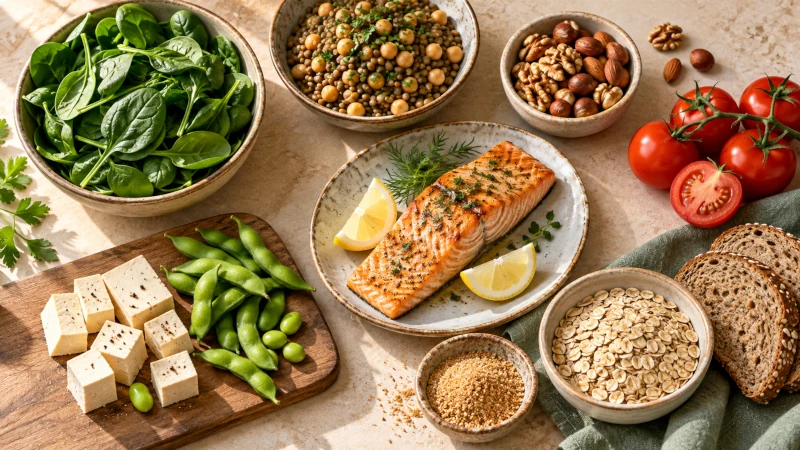
If you’re hoping to get pregnant in the next year, what you and your partner eat is worth a look. No single food works like a fertility drug, but the research points in a steady direction: eating patterns built on vegetables, legumes, seafood, whole grains, and fruit are linked with better fertility in women and better semen quality in men [Gaskins & Chavarro, 2018]. The 7 best foods for reproductive health below are the ones that fit that pattern best, each with an honest read of how strong the evidence is.
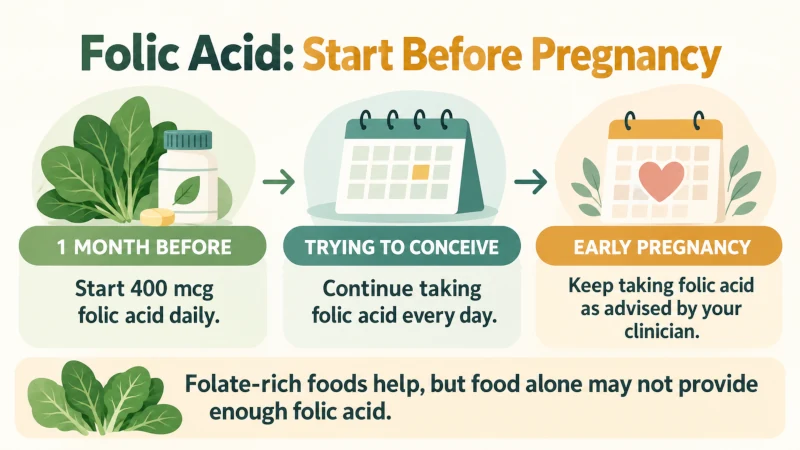
One thing food can’t fully cover. If you could become pregnant, the CDC recommends 400 micrograms of folic acid every day from a supplement, fortified foods, or both, on top of a folate-rich diet, starting at least one month before you try to conceive [CDC, n.d.-a]. Waiting until your first prenatal visit is too late for that protection.
The 7 best foods for reproductive health
1. Spinach and other leafy greens
Leafy greens top the list because of folate, the B vitamin a baby needs in the first weeks of pregnancy, often before you know you’re pregnant. Spinach, mustard greens, and other dark leafy greens are among the natural folate sources NIH lists [NIH ODS, n.d.-a].
Food folate helps, but the CDC says most people find it hard to reach the recommended amount from food alone, which is why it advises folic acid as well [CDC, n.d.-a]. Treat greens as the daily base and the supplement as the insurance.
Greens also bring plant (non-heme) iron. Your body absorbs it less efficiently than iron from meat, and eating it with vitamin C foods such as tomatoes, citrus, or peppers improves absorption [NIH ODS, 2023]. Our guide to spinach’s health benefits has the nutrient numbers and cautions.
Easy win: wilt two big handfuls into eggs, soup, or pasta. Cooked spinach shrinks so much you’ll barely notice it.
2. Lentils, chickpeas, and other legumes
Beans, peas, lentils, and chickpeas cover several needs at once: folate, iron, fiber, and plant protein. NIH lists beans and peas among good folate sources, and lentils, beans, and peas among plant iron sources [NIH ODS, n.d.-a] [NIH ODS, 2023]. Iron needs rise from 18 mg a day to 27 mg in pregnancy [NIH ODS, 2023], so building iron stores beforehand makes sense.
There’s a fertility signal, too. In a Harvard analysis of more than 17,000 women in the Nurses’ Health Study II, those whose habits scored highest on a “fertility diet” got more of their protein from plants than from animal foods, and that pattern went along with a lower risk of infertility caused by ovulation problems [Harvard Gazette, 2007]. This was observational research. It shows an association, not proof that beans did the work.
If you eat little or no meat, pay extra attention to iron: NIH notes vegetarians may need nearly twice the standard amount because plant iron is harder to absorb [NIH ODS, 2023]. Our list of foods high in folate has more options.
3. Low-mercury fish
Fish delivers protein and long-chain omega-3 fats. A review by Harvard researchers Audrey Gaskins and Jorge Chavarro concluded that omega-3s appear to improve female fertility, while cautioning that contaminants in some fish may offset part of that benefit [Gaskins & Chavarro, 2018].
In one study, 500 couples trying to conceive recorded their seafood intake for a year. Among couples who ate seafood more than twice a week, 92% were pregnant by the end of the year, compared with 79% of couples who ate less. They also had sex more often, which did not fully explain the gap [Endocrine Society, 2018]. It’s an observational result, but it’s a good reminder that the male partner’s plate counts too.
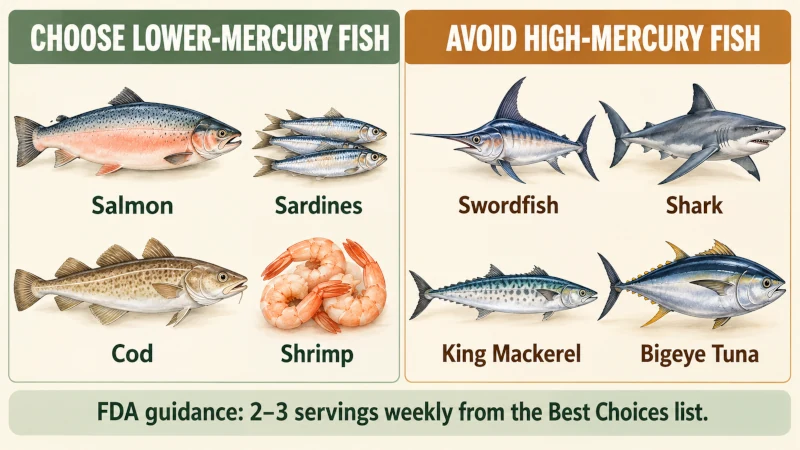
Choose low-mercury fish. For people who are pregnant, breastfeeding, or might become pregnant, the FDA advises 2 to 3 servings a week (about 4 ounces each) from its Best Choices list, which includes salmon, sardines, shrimp, cod, pollock, tilapia, catfish, and canned light tuna [FDA, 2024].
4. Nuts
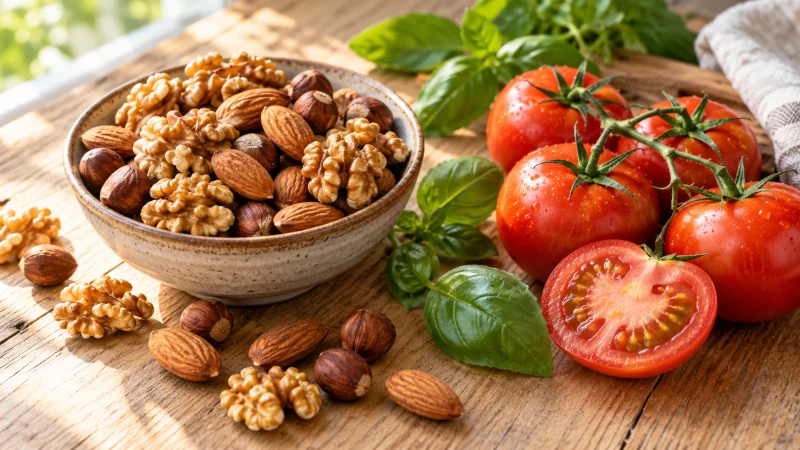
The most direct evidence for nuts concerns sperm. In a Spanish trial, 119 healthy men aged 18 to 35 added 60 grams a day of mixed almonds, hazelnuts, and walnuts to their usual Western-style diet for 14 weeks. Compared with men who ate no nuts, they had higher sperm count, vitality, motility, and morphology, and less sperm DNA fragmentation [ScienceDaily/ESHRE, 2018].
Keep that in proportion. The men were healthy rather than men with fertility problems, the researchers said they couldn’t yet recommend nuts to couples trying to conceive, and a nut industry council funded the study [ScienceDaily/ESHRE, 2018]. Sixty grams is roughly two small handfuls. Almonds and sunflower seeds are also among NIH’s best sources of vitamin E [NIH ODS, n.d.-b], and nuts provide some zinc [NIH ODS, n.d.-c]. See our guide to foods rich in zinc for the strongest sources.
5. Tomatoes
Tomatoes are best known for lycopene, the red carotenoid studied for both sperm and prostate health.
The best-known fertility trial used a supplement, not tomatoes. Sixty healthy young men took 14 mg of lactolycopene or a placebo every day for 12 weeks. The lycopene group ended up with more fast-swimming sperm and more normally shaped sperm, but the trial’s main outcome, motile sperm concentration, did not change significantly [Williams et al., 2020]. Promising, small, and not a treatment.
For the prostate, a meta-analysis of observational studies linked higher dietary lycopene with about a 14% lower risk of prostate cancer, with no clear link to advanced disease [Wang et al., 2015]. That’s a modest association, not prevention. Our guide to the health benefits of tomatoes explains how cooking affects lycopene.
6. Soy foods
Soy has a confusing reputation in reproductive health. The evidence is mixed in places but mostly reassuring.
For women, the Gaskins and Chavarro review found that soy foods and supplements appeared beneficial for women undergoing fertility treatment, and soy was not linked to poorer fertility [Gaskins & Chavarro, 2018].
For men, the usual worry is that soy’s estrogen-like isoflavones disrupt hormones. A 2021 meta-analysis of 41 clinical studies found no significant effect of soy protein or isoflavones on testosterone, free testosterone, estradiol, estrone, or SHBG, whatever the dose or study length [Reed et al., 2021]. One older observational study of 99 men at a fertility clinic did find lower sperm concentrations among the heaviest soy eaters, mostly in men who were overweight; its authors said the clinical meaning was unknown [Chavarro et al., 2008].
A sensible reading: tofu, tempeh, edamame, and soy milk are a reasonable protein swap for both partners. Concentrated isoflavone supplements are a different matter, and NIH says soy in amounts above what’s normally eaten in food may be unsafe in pregnancy [NCCIH, n.d.]. Our soybean guide covers soy’s benefits and myths in more depth.
7. Whole grains and wheat germ
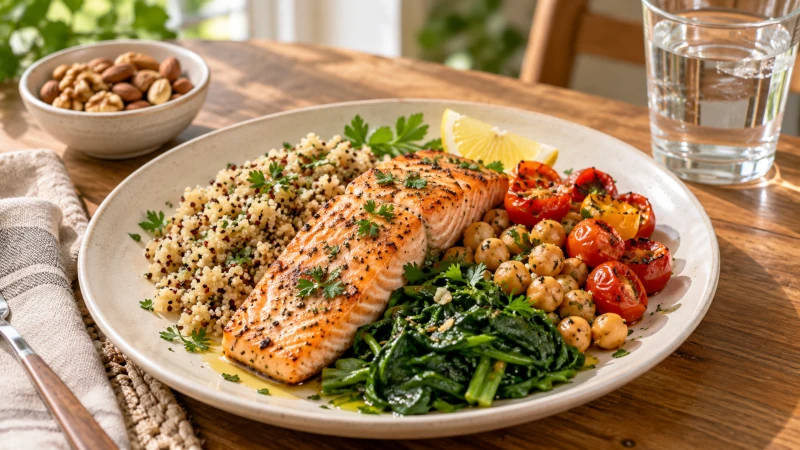
Whole grains appear in nearly every eating pattern linked with better fertility and semen quality [Gaskins & Chavarro, 2018]. They supply some zinc, which men need at 11 mg a day and women at 8 mg, rising to 11 mg in pregnancy [NIH ODS, n.d.-c]. Grains also contain phytates, which reduce zinc absorption, so variety matters [NIH ODS, n.d.-c]. Many enriched breads and cereals add folic acid, too [NIH ODS, n.d.-a].
Wheat germ, the nutrient-dense core of the wheat kernel, has an old reputation as a fertility food because of vitamin E. Wheat germ oil is among NIH’s best vitamin E sources, but vitamin E deficiency is very rare in healthy people [NIH ODS, n.d.-b], and there’s no direct evidence that wheat germ improves ovulation or sperm production. Sprinkle it on oatmeal or yogurt for the nutrients and leave it there.
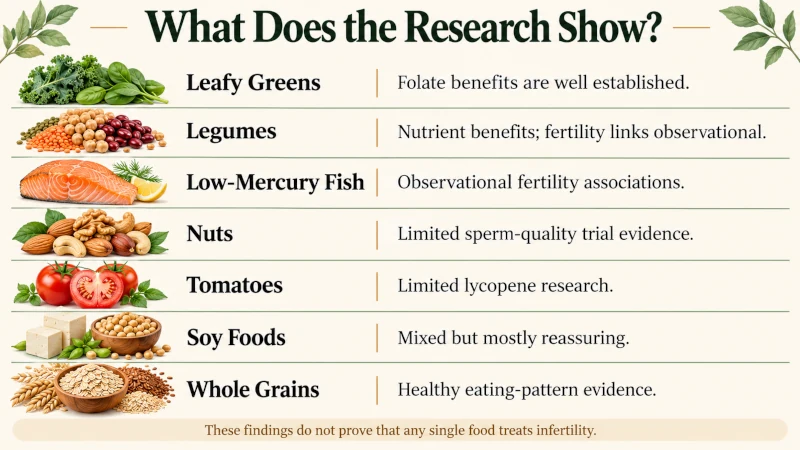
How strong is the evidence for each food?
| Food | Main nutrients | What the evidence shows |
| Leafy greens | Folate, non-heme iron, vitamin K | Strong for folate’s importance in early pregnancy, but folic acid supplements, not food alone, are the recommended route |
| Legumes | Folate, iron, fiber, plant protein | Moderate: nutrient value well established; fertility link is observational |
| Low-mercury fish | Omega-3s, protein | Moderate: consistent observational data; choose low-mercury species |
| Nuts | Vitamin E, zinc, healthy fats | Limited: one trial in healthy men showing better sperm measures; industry-funded |
| Tomatoes | Lycopene, vitamin C | Limited: small supplement trial on sperm; modest observational prostate link |
| Soy foods | Plant protein, isoflavones | Mixed but reassuring: no hormone change in men across 41 studies; one observational sperm-count signal |
| Whole grains & wheat germ | Fiber, zinc, vitamin E | Limited: part of healthy patterns; no direct evidence for wheat germ itself |
Do fertility supplements help?
For folic acid, yes. Anyone who could become pregnant should take 400 mcg a day [CDC, n.d.-a]. If you’ve had a pregnancy affected by a neural tube defect, the CDC advises 4,000 mcg daily, starting a month before trying and continuing through the first three months; do this with your doctor’s guidance [CDC, n.d.-a]. Otherwise, stay at or below 1,000 mcg of folic acid a day, since large amounts can hide a vitamin B12 deficiency [NIH ODS, n.d.-a].
For men, the picture is less encouraging. In the FAZST trial, 2,370 men whose partners were planning fertility treatment took 5 mg of folic acid plus 30 mg of zinc or a placebo for six months. The supplements did not improve semen quality or live birth rates, and the supplement group had slightly more sperm DNA fragmentation and more stomach upset [Schisterman et al., 2020].
Antioxidant blends are a gray area. A 2022 Cochrane review of men with fertility problems found antioxidants may raise pregnancy rates (low-certainty evidence), but the apparent live-birth benefit disappeared when lower-quality studies were set aside, and the authors called the evidence inconclusive [de Ligny et al., 2022]. A 2020 Cochrane review for women rated the evidence low to very low certainty and found limited support for antioxidant supplements [Showell et al., 2020].
If you’re tempted by a high-dose vitamin E product, note that large supplemental doses can raise bleeding risk, especially with blood thinners such as warfarin [NIH ODS, n.d.-b]. Bring any fertility supplement to your doctor or pharmacist before you start it.
Foods and habits to limit when you’re trying to conceive
Most of this list is about food safety. Infections and some nutrients that are harmless to you can affect a pregnancy that may already be underway.
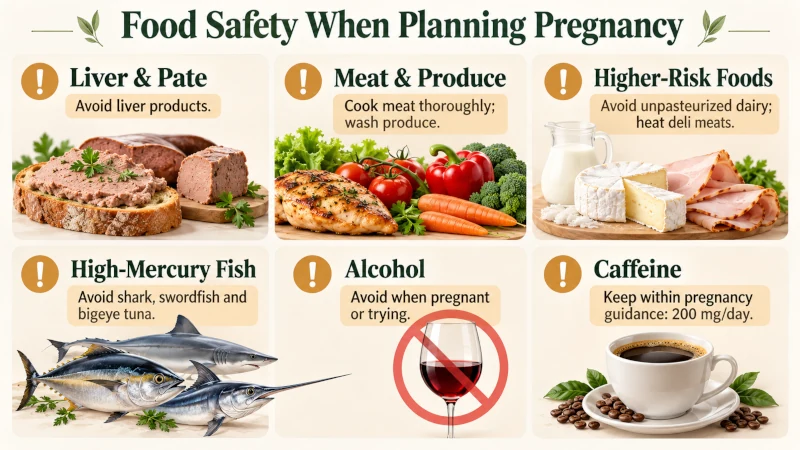
- Liver and liver products, including pâté. They’re very high in vitamin A, which can harm a developing baby [NHS, n.d.].
- Undercooked meat and unwashed produce. Both can carry the parasite behind toxoplasmosis. Cook meat to a safe internal temperature, wash fruits and vegetables, wear gloves when gardening, and change a cat’s litter box daily (or let someone else do it) [CDC, n.d.-b].
- Foods with a higher Listeria risk. Unheated deli meats and hot dogs, raw-milk dairy, queso fresco-type cheeses that haven’t been heated, refrigerated smoked fish, and raw sprouts. Heat deli meats until steaming hot (165°F) [CDC, n.d.-c].
- High-mercury fish: king mackerel, marlin, orange roughy, shark, swordfish, Gulf of Mexico tilefish, and bigeye tuna [FDA, 2024].
- Alcohol. The CDC says there is no known safe amount when you’re pregnant or trying to get pregnant [CDC, n.d.-d].
- Too much caffeine. The NHS advises no more than 200 mg a day in pregnancy, about two cups of instant coffee [NHS, n.d.].
Weight matters as well. A meta-analysis found that women with obesity before pregnancy had higher odds of babies with neural tube defects (about 1.9 times) and spina bifida (about 2.2 times) than women in the recommended weight range [Stothard et al., 2009]. If weight is a concern, a gradual plan made with your doctor or a dietitian is safer than a crash diet just before conceiving. For eating well once you are pregnant, see our list of the best foods for pregnant women.
Who should be careful
- If you take warfarin, keep your intake of spinach and other leafy greens steady from day to day; sudden changes in vitamin K can change how the drug works [NIH ODS, n.d.-d].
- If you’re allergic to soy, nuts, or fish, skip those foods and lean on the others on this list. Soy must be declared on U.S. food labels [NCCIH, n.d.].
- If you take an MAOI antidepressant, ask your pharmacist about tofu, soy sauce, and other soy foods that can contain tyramine, which can raise blood pressure dangerously [NCCIH, n.d.].
- If you use zinc supplements, stay under the adult upper limit of 40 mg a day from all sources; long-term excess can lower copper levels [NIH ODS, n.d.-c].
- If you’re pregnant or breastfeeding, stick with soy foods in normal amounts rather than isoflavone supplements [NCCIH, n.d.].
When to see a doctor
Diet supports fertility; it doesn’t diagnose or treat infertility. The CDC suggests seeing a provider after about a year of trying if you’re under 35, after about six months if you’re 35 or older, and sooner if you’re over 40 [CDC, n.d.-e].
Don’t wait that long if any of these apply [CDC, n.d.-e]:
- Irregular or absent periods, endometriosis, or very painful periods
- A history of pelvic inflammatory disease or known uterine or tubal problems
- More than one miscarriage
- For men: testicular injury, past hernia surgery, past chemotherapy, infertility with a previous partner, or sexual dysfunction
Book a preconception visit, too, if you’ve had a pregnancy affected by a neural tube defect (you’ll likely need the higher folic acid dose), take regular medications, or have a chronic condition such as diabetes or a thyroid disorder. If you might be pregnant and develop severe abdominal pain, heavy bleeding, or dizziness or fainting, get emergency care right away.
| HEALTH DISCLAIMER: This article is for general education and is not medical advice. It is not a substitute for diagnosis, treatment, or guidance from a qualified healthcare professional. The foods described here can be part of a healthy diet, but no food treats infertility or guarantees a pregnancy. If you are trying to conceive, are pregnant or breastfeeding, take prescription medication (especially blood thinners or MAOIs), have a chronic health condition, or are considering any supplement, talk with your doctor, pharmacist, or a registered dietitian first. |
Frequently Asked Questions
Can changing my diet fix infertility?
Usually not on its own. Healthy eating patterns are linked with better fertility in women and better semen quality in men [Gaskins & Chavarro, 2018], but infertility has many causes that need a medical evaluation. See a provider after a year of trying if you’re under 35, or six months if you’re 35 or older [CDC, n.d.-e].
What should men eat to support sperm health?
The same pattern that helps women: vegetables, legumes, fish, whole grains, and fruit [Gaskins & Chavarro, 2018]. Nuts and lycopene have small trials showing better sperm measures [ScienceDaily/ESHRE, 2018] [Williams et al., 2020], but a large trial found that folic acid and zinc supplements did not improve semen quality or live births [Schisterman et al., 2020].
Is soy bad for fertility?
For most people, soy foods appear safe. A meta-analysis of 41 clinical studies found no effect on men’s reproductive hormones [Reed et al., 2021], and soy was not linked to poorer fertility in women [Gaskins & Chavarro, 2018]. Skip concentrated isoflavone supplements during pregnancy [NCCIH, n.d.].
Do I still need folic acid if I eat plenty of leafy greens?
Yes. The CDC recommends 400 mcg of folic acid daily for anyone who could become pregnant, because it’s hard for most people to get enough folate from food alone [CDC, n.d.-a].
How far ahead should I change my diet before trying to conceive?
Start folic acid at least one month before you begin trying [CDC, n.d.-a]. For everything else on this list, sooner is better, and both partners benefit from making the changes together.
References
- Gaskins AJ, Chavarro JE. Diet and fertility: a review. Am J Obstet Gynecol. View source
- Centers for Disease Control and Prevention. Clinical Overview of Folic Acid (Folic Acid: Facts for Clinicians). View source
- NIH Office of Dietary Supplements. Folate: Fact Sheet for Consumers. View source
- NIH Office of Dietary Supplements. Iron: Fact Sheet for Consumers. View source
- NIH Office of Dietary Supplements. Vitamin E: Fact Sheet for Consumers. View source
- NIH Office of Dietary Supplements. Zinc: Fact Sheet for Consumers. View source
- NIH Office of Dietary Supplements. Vitamin K: Fact Sheet for Consumers. View source
- U.S. Food and Drug Administration. Advice about Eating Fish. View source
- Endocrine Society. Seafood-rich diet may help couples get pregnant faster (press release on Gaskins AJ, Sundaram R, Buck Louis GM, Chavarro JE, J Clin Endocrinol Metab, 2018). View source
- European Society of Human Reproduction and Embryology. View source
- Williams EA, Parker M, Robinson A, Pitt S, Pacey AA. A randomized placebo-controlled trial to investigate the effect of lactolycopene on semen quality in healthy males. View source
- Wang Y, Cui R, Xiao Y, Fang J, Xu Q. Effect of carotene and lycopene on the risk of prostate cancer: a systematic review and dose-response meta-analysis of observational studies. View source
- Reed KE, Camargo J, Hamilton-Reeves J, Kurzer M, Messina M. Neither soy nor isoflavone intake affects male reproductive hormones: an expanded and updated meta-analysis of clinical studies. View source
- ScienceDaily. Soy foods may lower sperm counts (July 2008), reporting Chavarro JE, Toth TL, Sadio SM, Hauser R. Hum Reprod. View source
- National Center for Complementary and Integrative Health. Soy: Usefulness and Safety. View source
- Schisterman EF, Sjaarda LA, Clemons T, et al. Effect of folic acid and zinc supplementation in men on semen quality and live birth among couples undergoing infertility treatment: a randomized clinical trial. View source
- de Ligny W, Smits RM, Mackenzie-Proctor R, et al. Antioxidants for male subfertility. View source
- Showell MG, Mackenzie-Proctor R, Jordan V, Hart RJ. Antioxidants for female subfertility. View source
- NHS. Foods to avoid in pregnancy. View source
- Centers for Disease Control and Prevention. About Toxoplasmosis. View source
- Centers for Disease Control and Prevention. Preventing Listeria Infection. View source
- Centers for Disease Control and Prevention. About Alcohol Use During Pregnancy. View source
- Stothard KJ, Tennant PWG, Bell R, Rankin J. Maternal overweight and obesity and the risk of congenital anomalies: a systematic review and meta-analysis. View source
- Centers for Disease Control and Prevention. Infertility FAQs. View source
- Harvard Gazette. Changes in diet and lifestyle may help prevent infertility (Nov 2007), reporting Chavarro JE, Willett WC, et al. Obstet Gynecol. View source


