
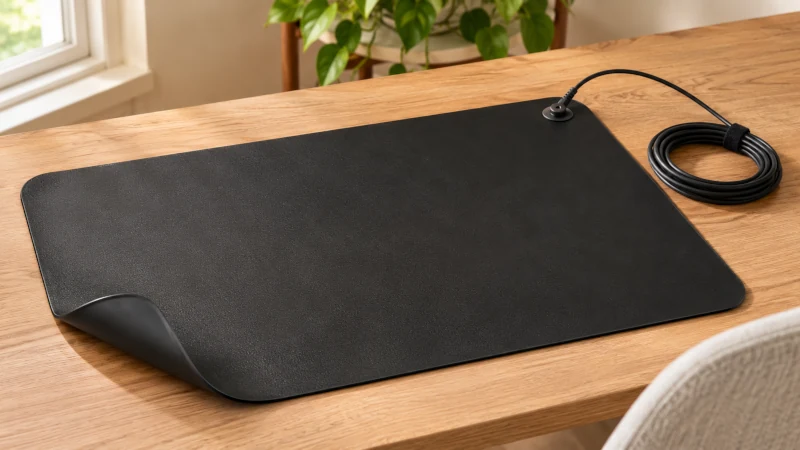
If you’re wondering whether the Hooga grounding mat can help you sleep better or hurt less, the honest answer is that it might help a little, and nobody can promise it will. The Hooga grounding mat is a $30 conductive pad that plugs into the ground port of a wall outlet. Research on grounding (also called earthing) is real but thin: mostly small studies, several of them funded by companies that sell grounding products, with mixed results. The mat looks low-risk if your outlet is wired correctly. Check that, though. Don’t assume it.
What the Hooga grounding mat is
According to Hooga’s product page, the mat measures 24 by 16 inches. It has a carbon-infused vegan leather top and a non-slip rubber base, and it rolls up for storage. A 15-foot cord snaps onto the mat and plugs into the round ground hole of a standard three-prong outlet. The cord has a built-in 100K-ohm resistor. Outside the US, you’ll need a grounded-outlet adapter [Hooga Health, 2026].
A few details worth knowing before you buy: the outlet tester is sold separately, not included. You clean the mat with a damp cloth, with no bleach or harsh cleaners. Hooga lists a one-year warranty and 60-day returns. In mid-November 2026, the single mat was listed at $30 and showing as sold out, so check current price and stock [Hooga Health, 2026].
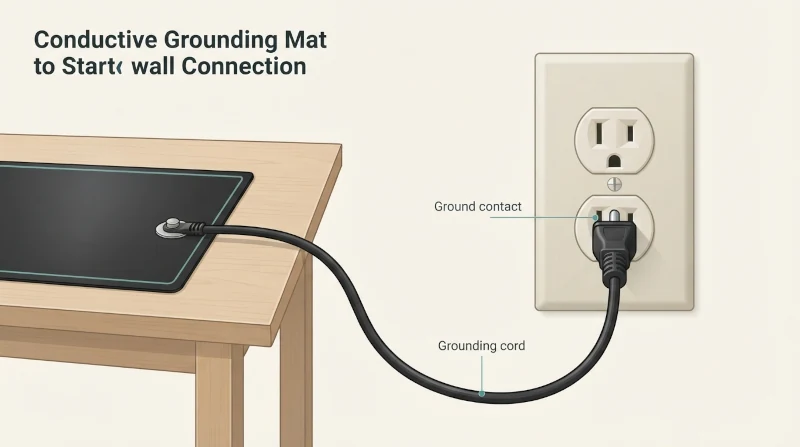
Hooga’s own page also says grounding is not a cure or treatment for any medical condition, and it calls customer-reported results individual and subtle. That is a more careful position than much of the grounding marketing online, and it’s the right frame for everything below.
How grounding is supposed to work
The theory is that the Earth’s surface carries a slight negative electrical charge. Direct skin contact, whether bare feet on grass or a conductive mat wired to your home’s ground, would let your body share that electrical potential. Supporters believe this calms inflammation and the stress response.
That mechanism is still a hypothesis. The most-cited overview, a 2015 paper in the Journal of Inflammation Research, lays out the theory and summarizes early pilot work. Its authors also disclosed owning shares in, or contracting for, a company that sponsors earthing research [Oschman et al., 2015]. That doesn’t make the paper wrong. It does mean the main case for grounding has largely been made by people with a stake in it.
What the research on grounding mats shows
Sleep
The strongest recent trial comes from Kyung Hee University in South Korea. Sixty adults were randomly given either a grounding mat or an identical-looking mat that wasn’t grounded. They were asked to use it six hours a day for 31 days, and 56 were included in the analysis [Park et al., 2025].
The grounded group slept longer, as measured by wrist trackers. On questionnaires for sleep quality, daytime sleepiness, and stress, though, the two groups finished in the same place. Insomnia scores also favored the grounded group, but that group started out with noticeably worse insomnia, which makes the comparison hard to read. The study was funded by mat manufacturers, and one of them supplied the mats.
Sleep researchers at CQUniversity in Australia looked at this trial and concluded that we don’t yet know whether grounding improves sleep. They added that it seems unlikely to make sleep worse [CQUniversity, 2025]. They also describe a 2022 double-blind study from Taiwan in people with Alzheimer’s disease. In that study, 30 minutes on a grounding mat five times a week improved sleep quality but not anxiety or depression.
The older study that many grounding websites cite had 12 people with sleep problems, pain, and stress sleep on a conductive mattress pad for eight weeks. They reported better sleep and lower nighttime cortisol [Ghaly & Teplitz, 2004]. It was a small pilot, and its abstract describes no sham group for comparison, so it can suggest ideas but can’t confirm them.
If sleep is your main problem, the approaches with much stronger evidence are consistent sleep habits and cognitive behavioral therapy for insomnia. Both are covered in our guide to natural remedies for insomnia.
Pain, soreness, and recovery
Two controlled studies stand out. In a 2019 Austrian trial, 22 sport-science students did grueling downhill treadmill running, then slept on grounded or sham-grounded sheets for 10 days. Neither the participants nor the testers knew who had which [Müller et al., 2019]. The grounded group lost less jump height and leg strength, and their creatine kinase (a marker of muscle damage) rose less. Inflammation markers were measured in just four people, and the authors call those results preliminary.
In a 2025 study from Poland, 84 people recovering from lower-back surgery slept one night with either a working grounding electrode or a sham device [Sokal et al., 2025]. Pain scores fell somewhat more in the grounded group, an average drop of 2.5 points versus 1.6, and an inflammation marker in the blood rose less. The authors point to the small sample, the single measurement, and the minor size of the lab changes. They frame grounding as a possible add-on, not a treatment.
Neither study tested the Hooga mat, and neither looked at long-term conditions like arthritis or chronic back pain. If you live with ongoing pain, our guide to chronic pain management covers options with a real track record.
Cortisol, inflammation, and “blood thinning” claims
You’ll see claims that grounding lowers stress hormones, calms inflammation throughout the body, or thins the blood. These rest mostly on small pilot studies and on the 2015 hypothesis paper [Oschman et al., 2015]. A shift in a lab marker over a night or a few weeks is not the same as fewer heart attacks, less arthritis, or better mental health. We found no trials showing grounding changes outcomes like those.
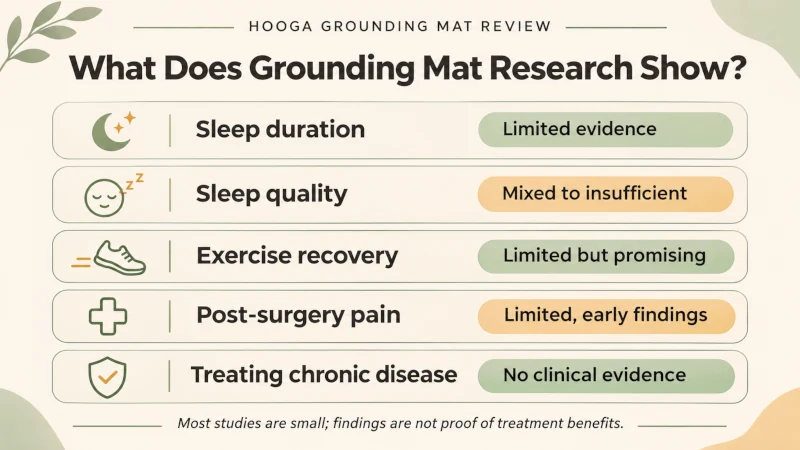
The evidence at a glance
| Claim | Best evidence we found | How strong? |
| Longer sleep | Sham-controlled trial, 56 analyzed, 31 days, industry-funded [Park et al., 2025] | Limited: one positive measure, most others no different |
| Better sleep quality or less insomnia | Same trial (no between-group difference); 12-person pilot [Ghaly & Teplitz, 2004] | Mixed to insufficient |
| Faster recovery after hard exercise | Triple-blind trial, 22 people, 10 days [Müller et al., 2019] | Limited but promising |
| Less pain after surgery | Sham-controlled study, 84 people, one night [Sokal et al., 2025] | Limited, early |
| Lower cortisol or stress | 12-person pilot; no stress difference in the 2025 trial | Insufficient |
| Treating arthritis, autoimmune, or heart disease | Hypothesis paper only [Oschman et al., 2015] | No clinical evidence |
Is the Hooga grounding mat safe?
None of the studies above reported harm, and the CQUniversity researchers found no evidence that grounding products make sleep or exercise recovery worse [CQUniversity, 2025]. The main practical risk is electrical, and it lives in your wall, not in the mat.
Check your outlet properly
A grounding mat connects only to the outlet’s ground contact. In a correctly wired outlet, that contact carries no voltage. But one wiring fault, called a reverse-polarity bootleg ground, connects the ground contact to the live wire. Anything attached to it can then sit at 120 volts, and the common three-light plug-in testers show these outlets as wired correctly [Sokol, 2013]. Hooga’s 100K-ohm resistor limits how much current can flow through the cord. That helps, but it doesn’t replace correct wiring.
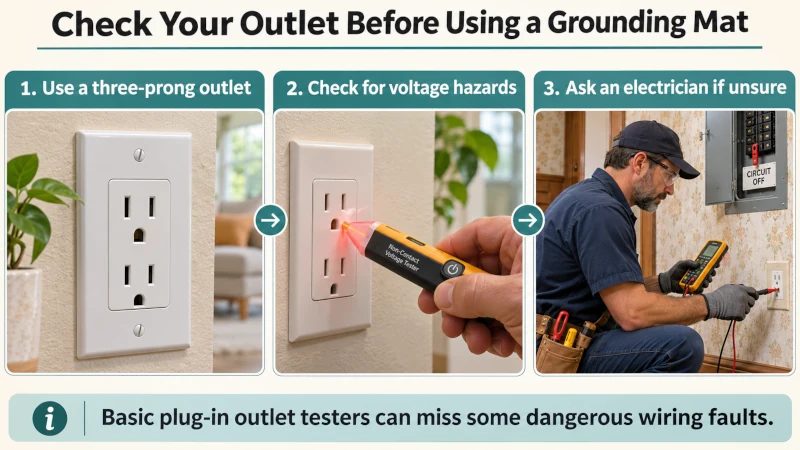
- Use only a three-prong outlet. Never use an adapter or “cheater plug” that drops the ground pin.
- In an older home, or if someone has swapped outlets themselves, ask an electrician to confirm the ground. At minimum, use a non-contact voltage tester near the face of the outlet. It can pick up the bootleg-ground fault that plug-in testers miss [Sokol, 2013].
- Stop using the mat if you feel tingling, warmth, or any shock, and have the outlet checked.
- Keep the cord out of walkways and away from pets that chew.
Who should check with a doctor first
We couldn’t find safety data for the groups below. That gap is the reason to ask first, not proof of a problem:
- People with a pacemaker, implanted defibrillator, nerve stimulator, insulin pump, or other implanted or wearable electronic medical device.
- Anyone who is pregnant or breastfeeding. There are no studies either way.
- Children. Grounding hasn’t been studied in them, and a corded mat shouldn’t be left with young kids.
- Anyone with a sleep disorder, chronic pain condition, or heart condition who is hoping the mat will replace treatment.
Nothing is absorbed, so there are no known drug interactions. Even so, don’t cut back or stop sleep, pain, or blood pressure medication because you’ve started using a grounding mat.
If you try it: realistic expectations
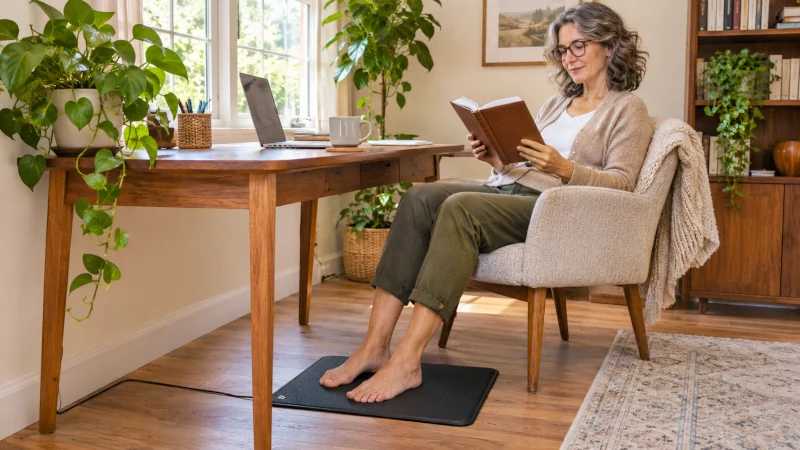
A $30 mat with a 60-day return window is a low-stakes experiment. Use it consistently for a few weeks (study participants used theirs for hours a day) and track something concrete, like how long it takes you to fall asleep or a daily 0–10 pain score, instead of relying on a general impression. Expect small changes or none. If you do feel better, some of that may come from the routine itself: sitting still, slowing down, putting the phone away. That still counts.
There’s also a free version. Time outdoors and natural light can help sleep, body clock, and mood whether or not grounding plays any part [CQUniversity, 2025], and walking barefoot on grass costs nothing. If stress is what keeps you up, meditation apps for calm and better sleep and supplements such as ashwagandha have their own research to weigh. If tiredness is the problem, our guide to boosting your energy levels naturally covers the medical causes worth ruling out.

When to see a professional instead
A grounding mat isn’t the right next step if you have any of the following. CQUniversity’s sleep researchers give the same advice: if sleep problems are ongoing or you suspect a sleep disorder, start with your doctor [CQUniversity, 2025].
- Trouble sleeping most nights for several weeks, loud snoring, gasping or choking at night, or heavy daytime sleepiness.
- Pain that is new, severe, getting worse, or waking you up, or pain that comes with fever, numbness, or weakness.
- Fatigue along with unexplained weight loss, shortness of breath, or persistent low mood.
- Get emergency care right away for chest pain, sudden shortness of breath, signs of a stroke (face drooping, arm weakness, slurred speech), or back pain with new loss of bladder or bowel control or numbness in the groin.
| HEALTH DISCLAIMER: This article is for general information only and is not medical advice. Grounding mats are not approved to diagnose, treat, cure, or prevent any disease. Talk to a qualified healthcare provider before using one if you have an implanted or wearable medical device, are pregnant or breastfeeding, or are managing a medical condition. Don’t start, stop, or change any medication without your prescriber. If you think you’re having a medical emergency, call your local emergency number. |
Frequently Asked Questions
Does the Hooga grounding mat actually work?
No study has tested the Hooga mat specifically. Studies of similar grounding mats and sheets show small, inconsistent effects: longer tracked sleep in one trial, less muscle soreness after hard exercise in another, and a modest drop in pain after surgery in a third [Park et al., 2025] [Müller et al., 2019] [Sokal et al., 2025]. Treat it as a maybe.
How long should I try it before deciding?
There’s no reliable answer. Trials ran from a single night to about a month, with daily use measured in hours. Two to four weeks of consistent use, tracked against a baseline, fits inside Hooga’s 60-day return window.
Can I plug it into any outlet?
Only a properly grounded three-prong outlet. Older homes and DIY-replaced outlets can have hidden wiring faults that standard plug-in testers won’t catch [Sokol, 2013]. If in doubt, have an electrician check it.
Is grounding outside better than using a mat?
They haven’t been compared head to head. Time outdoors has its own benefits for sleep and mood through daylight exposure, whatever grounding does [CQUniversity, 2025].
Can a grounding mat replace my sleep or pain medication?
No. The evidence is far too limited for that. Keep taking prescribed treatment and talk to your doctor before making any changes.
| WHERE TO BUY: The Hooga grounding mat is sold on Hooga Health’s website and through other online retailers. Compare price, shipping (Hooga’s free US shipping starts at $100), and return terms before you buy. Natural Health Message may earn a commission from purchases made through links in this article. Commissions don’t affect our assessment of the evidence. See our advertising disclosure. |
References
- CQUniversity Australia. Miller DJ, Gupta C. What is grounding and could it improve my sleep? View source
- Ghaly M, Teplitz D. The biologic effects of grounding the human body during sleep as measured by cortisol levels and subjective reporting of sleep, pain, and stress. View source
- Hooga Health. Hooga Grounding & Earthing Mat (product page). View source
- Müller E, Pröller P, Ferreira-Briza F, Aglas L, Stöggl T. Effectiveness of grounded sleeping on recovery after intensive eccentric muscle loading. View source
- Oschman JL, Chevalier G, Brown R. The effects of grounding (earthing) on inflammation, the immune response, wound healing, and prevention and treatment of chronic inflammatory and autoimmune diseases. View source
- Park HJ, Lee GR, Kim Y, Kim J, Sohn M, Kim SH, et al. A randomized, double-blind, placebo-controlled study on the improvement of sleep quality with Earthing mat. View source
- Sokal P, Broda M, Zając M, Sokal J. Earthing as a supportive therapy for post-spinal surgery recovery. View source
- Sokol M. Failures in outlet testing exposed. View source


