
A teaspoon of Nordic Naturals Arctic Cod Liver Oil gives you about 1,060 mg of omega-3 fats, including 340 mg of EPA and 510 mg of DHA [iHerb label listing, 2026]. That’s a generous dose, and it’s the real reason to buy it. What surprises most people is what isn’t there: the current U.S. label for the standard liquid doesn’t list vitamin D at all.
So here’s where Nordic Naturals cod liver oil stands. It’s a clean, widely tested way to get EPA and DHA if you rarely eat oily fish, and it reliably lowers triglycerides. It hasn’t been shown to prevent heart attacks in healthy people, sharpen your memory, or fix dry eyes. If you want vitamin D from it, you need the separate Arctic-D version. And if you’re pregnant, UK health officials say to skip cod liver oil entirely [NHS, 2023].
What’s in a Teaspoon of Nordic Naturals Cod Liver Oil
Nordic posts its Supplement Facts panel only as an image, so the numbers below come from the full panel as transcribed by a major retailer, checked against the totals on Nordic’s own product page [iHerb label listing, 2026] [Nordic Naturals, 2026].
| Per 1 teaspoon (about 5 mL) | Amount |
| Total omega-3s (triglyceride form) | 1,060 mg |
| EPA (eicosapentaenoic acid) | 340 mg |
| DHA (docosahexaenoic acid) | 510 mg |
| Other omega-3s | 210 mg (the balance of the total) |
| Calories / total fat | 40 / 4.5 g |
| Vitamin A | Not listed on current label |
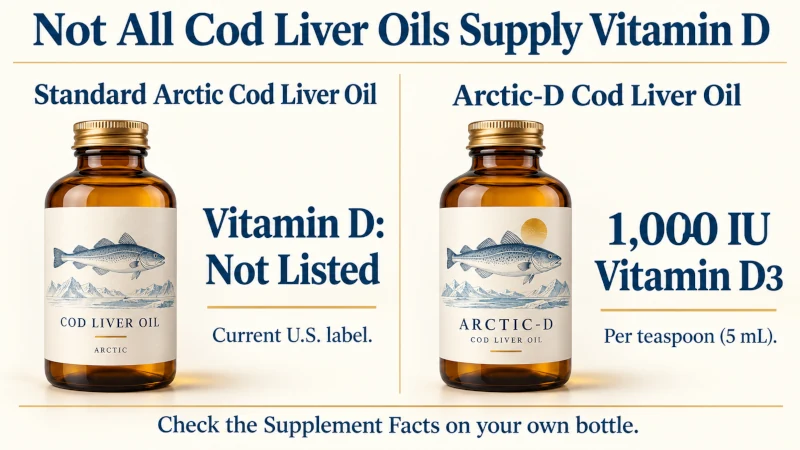
| Vitamin D | Not listed on current label |
| Other ingredients | Purified Arctic cod liver oil, natural flavor, vitamin E (antioxidant), rosemary extract |
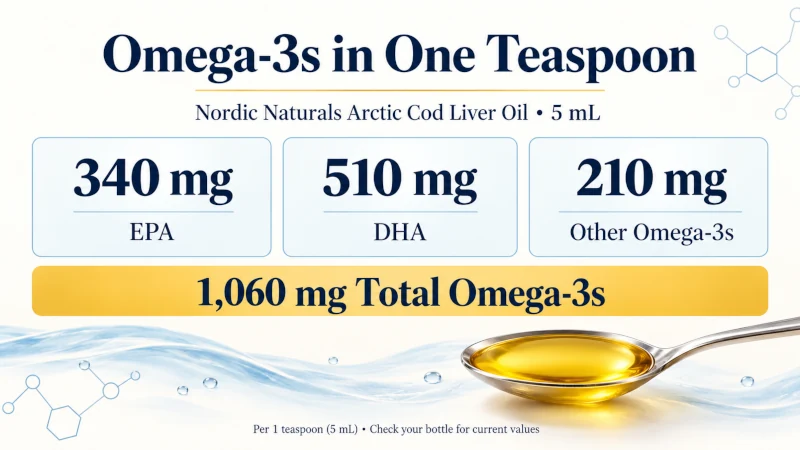
Label as transcribed by iHerb, accessed October 2026. Formulas change; the panel on your bottle is the final word.
To put the omega-3 number in context: a typical 1,000 mg fish oil capsule provides about 180 mg of EPA and 120 mg of DHA [NIH ODS, 2026]. One teaspoon of this oil delivers roughly what three of those capsules would.
The vitamin D surprise
Cod liver oil has a reputation as a vitamin D source, and generic cod liver oil earns it: USDA data put a tablespoon at about 1,360 IU [NIH ODS Vitamin D, 2026]. Nordic’s oil is purified differently. An older version of its label listed vitamin D at 0–20 IU per teaspoon and vitamin A at 425–1,500 IU [Fullscript label listing]. The current panel drops both rows [iHerb label listing, 2026].
For you, that means two things. Don’t count on the standard version for vitamin D. And vitamin A is much less of a worry here than with some other cod liver oils. Even the old top figure, 1,500 IU, works out to about 450 mcg of retinol, around 15% of the adult daily upper limit [NIH ODS Vitamin A, 2025].
If vitamin D is what you’re after, the most practical step is a blood test before you supplement heavily. Our guide to what doctors actually prescribe for low vitamin D walks through the usual approach.
Soft gels and Arctic-D
The soft gels supply 750 mg of total omega-3s per three-capsule serving, a bit less than a teaspoon of the liquid [Nordic Naturals, 2026]. Nordic doesn’t print the EPA/DHA split on its product page, so check the bottle.
Arctic-D Cod Liver Oil is the same base oil with 25 mcg (1,000 IU) of vitamin D3 added per teaspoon [Nordic Naturals, 2026b]. That’s above the adult RDA of 600–800 IU and well under the 4,000 IU upper limit [NIH ODS Vitamin D, 2026]. Just add it to any other vitamin D you take, including from a multivitamin, before you decide it fits.
How It Compares With Regular Fish Oil
Regular fish oil comes from the flesh of oily fish. Cod liver oil comes from the liver, which is why cod liver oils in general carry vitamins A and D [NIH ODS, 2026]. With this particular product, the vitamin difference has mostly been processed away, so in practice it behaves much like a high-quality fish oil in liquid form.
Nordic advertises that its triglyceride-form omega-3s absorb better than the ethyl-ester form used in many cheap capsules. That’s partly true. The NIH notes that triglyceride forms have “somewhat higher” bioavailability, but every form raises blood EPA and DHA [NIH ODS, 2026]. It’s a modest edge, not a different league.
Mercury worries are smaller than people expect. Omega-3 supplements haven’t been found to contain the methylmercury in some fish, because it’s removed during processing [NIH ODS, 2026]. If you’re comparing brands, our review of Carlson cod liver oil covers a product that still lists vitamins A and D on its label.
What the Research Supports
Nordic says this oil supports heart, brain, and immune health, and its website notes that these statements haven’t been evaluated by the FDA [Nordic Naturals, 2026]. None of the trials below tested Nordic’s product. They tested EPA and DHA, mostly from fish oil capsules, which is the closest evidence available.
Triglycerides
This is the strongest case, and it’s solid. A 2020 Cochrane review of 86 randomized trials with 162,796 people found that EPA and DHA lower triglycerides by about 15%, in a dose-dependent way [Abdelhamid et al., 2020]. The prescription products used for very high triglycerides deliver about 4 g a day [NIH ODS, 2026], roughly four teaspoons’ worth of omega-3s, so one teaspoon is a helpful contribution rather than a treatment. If triglycerides are your number to watch, see how to lower triglycerides naturally, ranked by evidence.
Heart attack and stroke prevention
Here the evidence is weaker than the marketing. The VITAL trial gave 25,871 healthy older adults 1 g a day of omega-3s (840 mg of EPA plus DHA, close to one teaspoon of this oil) or a placebo. After a median of 5.3 years, the supplement did not reduce major cardiovascular events or cancer [Manson et al., 2019]. A secondary result showed 28% fewer heart attacks, which is interesting but wasn’t the trial’s main question [NIH ODS, 2026].
The Cochrane review lines up with that. Omega-3s had little or no effect on overall deaths, stroke, or heart rhythm problems, and may slightly lower coronary deaths and events; about 167 people would need to take them to prevent one coronary event [Abdelhamid et al., 2020]. The American Heart Association recommends about 1 g a day of EPA plus DHA for people who already have coronary heart disease, ideally from oily fish, with supplements considered under a doctor’s direction. It doesn’t recommend omega-3 supplements for people without high cardiovascular risk [NIH ODS, 2026].
Brain, memory, and mood
DHA is concentrated in the brain, and diets rich in fish are linked with lower dementia risk in observational studies. Trials of supplements tell a different story: they haven’t improved thinking in healthy older adults or slowed decline in Alzheimer’s disease. People with mild cognitive impairment may see small gains in attention or recall, but that needs confirming. For depression, a Cochrane review found too little evidence to say whether omega-3s help [NIH ODS, 2026].
Joints
Most of the joint research is in rheumatoid arthritis. Trials, many from the 1990s, generally found fish oil helped people cut back on anti-inflammatory painkillers, while effects on pain, swelling, and stiffness were inconsistent [NIH ODS, 2026]. Many of those studies used around 3 g of EPA plus DHA daily, about three to four teaspoons. Our rheumatoid arthritis diet guide puts fish oil alongside the food changes with the best support. We found no strong trial evidence for everyday aches or osteoarthritis.
Eyes
In the largest dry-eye trial, people taking 3,000 mg of EPA plus DHA for a year did no better than those on an olive oil placebo; smaller trials were more positive, so the overall picture is mixed. For age-related macular degeneration, adding EPA and DHA to the AREDS eye-vitamin formula gave no extra benefit [NIH ODS, 2026].
Evidence at a glance
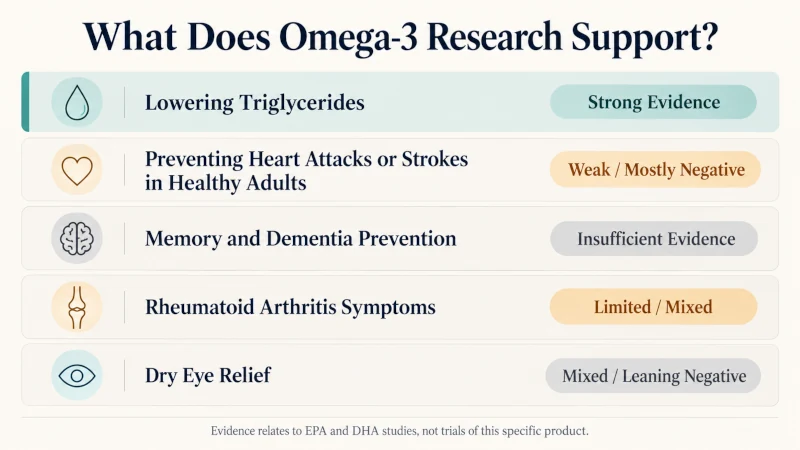
| Claim | What the research shows | Evidence grade |
| Lowers triglycerides | ~15% reduction, dose-dependent (Cochrane) | Strong |
| Prevents heart attack or stroke in healthy adults | VITAL: no reduction in major events; possible fewer heart attacks as a secondary finding | Weak / mostly negative |
| Helps people with existing coronary disease | AHA suggests ~1 g/day EPA+DHA, preferably from fish | Moderate (expert guidance) |
| Protects memory or prevents dementia | No benefit in healthy older adults or Alzheimer’s; possible small effect in MCI | Insufficient |
| Eases rheumatoid arthritis | May reduce painkiller use; symptom effects inconsistent | Limited / mixed |
| Relieves dry eye | Largest trial: no better than placebo | Mixed, leaning negative |
| Supplies vitamin D (standard version) | Not listed on current label; older label 0–20 IU | Not supported |
| Supplies vitamin D (Arctic-D) | 1,000 IU per teaspoon on the label | Established (label content) |
How to Take It

Nordic’s directions are one teaspoon of liquid or three soft gels a day, with food [Nordic Naturals, 2026]. For most adults, that’s a reasonable place to stop. There’s no official daily target for EPA and DHA specifically, so more isn’t automatically better [NIH ODS, 2026].
- Take it with a meal. It’s what the label says, and it tends to cut down on fishy burps and heartburn.
- Refrigerate after opening and finish within three months [Nordic Naturals, 2026]. If the oil smells sharp or rancid rather than mildly lemony or fishy, replace it.
- Know the ceiling. The FDA considers up to 5 g a day of EPA plus DHA from supplements safe, and says labels shouldn’t recommend more than 2 g a day [NIH ODS, 2026]. Going above that is a conversation for your doctor.
- Higher doses carry a heart-rhythm caveat. Two large trials found that 4 g a day slightly raised the risk of atrial fibrillation in people with, or at high risk of, heart disease [NIH ODS, 2026].
If you dislike the taste straight from the spoon, the flavored versions (lemon, orange, strawberry) help, and you can stir it into a smoothie or yogurt.
Side Effects and Drug Interactions
Side effects from omega-3 supplements are usually mild: an unpleasant taste, bad breath, heartburn, nausea, stomach upset, diarrhea, headache, and fishy-smelling sweat [NIH ODS, 2026]. Taking the oil with food and keeping it cold solves most of these.
Tell your doctor or pharmacist before you start if you take any of the following. Nordic’s own label asks you to check with your physician if you take medications, including blood thinners, or have a known medical condition [iHerb label listing, 2026].
| Medicine | What can happen | Source |
| Warfarin and other anticoagulants | Fish oil might raise INR, but most research at 3–6 g/day found no significant change. The evidence is mixed; prescription omega-3 labels still advise periodic INR checks. | [NIH ODS, 2026] |
| Antiplatelet drugs (aspirin, clopidogrel) | High doses of fish oil have antiplatelet effects, weaker than aspirin’s. | [NIH ODS, 2026] |
| Arctic-D + thiazide diuretics | Vitamin D with thiazides may push blood calcium too high, especially in older adults or people with kidney problems. | [NIH ODS Vitamin D, 2026] |
| Arctic-D + certain statins | High vitamin D intake might reduce the potency of atorvastatin, lovastatin, and simvastatin. 1,000 IU is a modest dose. | [NIH ODS Vitamin D, 2026] |
| Orlistat (Alli, Xenical) | Reduces absorption of fat-soluble vitamins, including A and D. | [NIH ODS Vitamin D, 2026] |
Who Should Skip It or Check First
Pregnancy and breastfeeding
Official advice differs here, so you should see both positions. The UK’s NHS tells pregnant women not to take cod liver oil or any supplement containing vitamin A (retinol), because too much vitamin A could harm the baby [NHS, 2023]. U.S. guidance from the NIH draws the line at a number instead: people who are or might be pregnant, and those breastfeeding, shouldn’t take more than 3,000 mcg (10,000 IU) of vitamin A a day from supplements [NIH ODS Vitamin A, 2025].
Omega-3s themselves matter in pregnancy. U.S. agencies recommend 8–12 ounces a week of lower-mercury seafood, and omega-3 supplements have been shown to reduce the risk of preterm birth [NIH ODS, 2026]. The simplest route is to talk with your prenatal provider about a plain fish oil or algae-based DHA, which don’t come with a cod liver oil label at all. Our page on vitamin A and safe intake explains why the form of vitamin A matters.
Children
Children have much lower vitamin A limits than adults: 600 mcg a day for ages 1–3 and 900 mcg for ages 4–8 [NIH ODS Vitamin A, 2025]. Don’t give a child the adult oil at adult doses, and check with your pediatrician first, especially if your child already takes a multivitamin.
Everyone else on the list
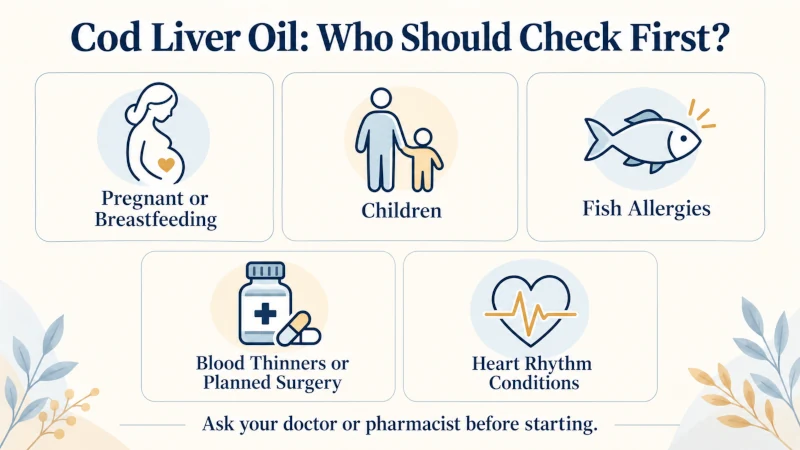
- People with a fish allergy — the product is made from cod [Nordic Naturals, 2026]. An older label also warned people allergic to iodine to check first [Fullscript label listing].
- Anyone taking blood thinners or antiplatelet drugs, or with surgery scheduled.
- People with atrial fibrillation or a history of heart rhythm problems, particularly if considering higher doses.
- Anyone already taking vitamin D, vitamin A, or a multivitamin who is considering Arctic-D.
Quality Claims: What’s Checked and What Isn’t
Nordic says its oil is made only from wild Arctic cod sustainably sourced in Norway, that every product is third-party tested for purity and freshness, that Certificates of Analysis are available for any product, and that its fish oils are Friend of the Sea certified [Nordic Naturals, 2026]. Those are the manufacturer’s claims. We didn’t independently review its test results.
Keep in mind how supplements are regulated in the U.S. Manufacturers are responsible for making sure their products are safe and properly labeled before they go on sale; the FDA can act against a problem product after it reaches the market [FDA, 2024]. Published Certificates of Analysis are a reasonable thing to ask for from any brand.
When to Call a Doctor
Check with your doctor before starting if you have heart disease, take any regular medication, are pregnant or breastfeeding, or want to take more than the label dose. Stop the oil and get medical care if you notice:
- Signs of an allergic reaction such as hives or swelling of the lips, face, or throat. Call 911 for any trouble breathing.
- Unusual bleeding or bruising, including black stools or blood in your urine, especially if you take a blood thinner.
- A racing, fluttering, or irregular heartbeat.
- Possible vitamin D excess (Arctic-D or stacked supplements): nausea, vomiting, muscle weakness, confusion, excessive thirst, frequent urination, or kidney stones [NIH ODS Vitamin D, 2026].
| HEALTH DISCLAIMER: This article is for general education and isn’t a substitute for advice, diagnosis, or treatment from a qualified healthcare professional. Nordic Naturals Cod Liver Oil is a dietary supplement; it isn’t intended to diagnose, treat, cure, or prevent any disease. Talk with your doctor or pharmacist before starting it if you’re pregnant, breastfeeding, giving it to a child, managing a health condition, or taking prescription medication. If you think you’re having a medical emergency, call 911. |
Frequently Asked Questions
Does Nordic Naturals cod liver oil have vitamin D?
The standard Arctic Cod Liver Oil doesn’t list vitamin D on its current U.S. label, and an older label gave 0–20 IU per teaspoon [iHerb label listing, 2026] [Fullscript label listing]. Arctic-D adds 1,000 IU of vitamin D3 per teaspoon [Nordic Naturals, 2026b].
How much Nordic Naturals cod liver oil should I take a day?
The label directs one teaspoon of liquid or three soft gels daily, with food [Nordic Naturals, 2026]. Talk to your doctor before taking more, especially if you use a blood thinner.
Is it better than regular fish oil?
Not meaningfully. It’s a high-dose, triglyceride-form omega-3 oil with an advantage in absorption the NIH describes as modest [NIH ODS, 2026]. Choose based on dose, taste, and price.
Is cod liver oil safe during pregnancy?
The NHS advises against cod liver oil in pregnancy [NHS, 2023]; U.S. guidance focuses on keeping supplemental vitamin A under 3,000 mcg a day [NIH ODS Vitamin A, 2025]. Ask your prenatal provider about plain fish oil or algae-based DHA instead.
Does it need to be refrigerated?
Yes, after opening. Nordic says to refrigerate the liquid and use it within three months [Nordic Naturals, 2026].
References
- Abdelhamid AS, Brown TJ, Brainard JS, et al. Omega-3 fatty acids for the primary and secondary prevention of cardiovascular disease. View source
- FDA. Dietary Supplements. View source
- Fullscript. Nordic Naturals Arctic Cod Liver Oil 8 fl oz View source
- iHerb. Nordic Naturals, Arctic Cod Liver Oil, Orange, 16 fl oz View source
- Manson JE, Cook NR, Lee IM, et al.; VITAL Research Group. Marine n-3 fatty acids and prevention of cardiovascular disease and cancer. View source
- National Health Service (NHS). Vitamins, supplements and nutrition in pregnancy. View source
- NIH Office of Dietary Supplements. Omega-3 Fatty Acids: Fact Sheet for Health Professionals. View source
- NIH Office of Dietary Supplements. Vitamin A and Carotenoids: Fact Sheet for Health Professionals. View source
- NIH Office of Dietary Supplements. Vitamin D: Fact Sheet for Health Professionals. View source
- Nordic Naturals. Arctic Cod Liver Oil View source
- Nordic Naturals. Arctic-D Cod Liver Oil. View source


