
If you were told you have pink eye and it isn’t acting like pink eye, trust that feeling. Several eye problems are commonly misdiagnosed as pink eye, and a few of them can damage your sight within days. Maybe it hurts more than it itches. Maybe light makes you squint, or your vision stays blurry after you blink. Most red eyes really are conjunctivitis, but not all of them.
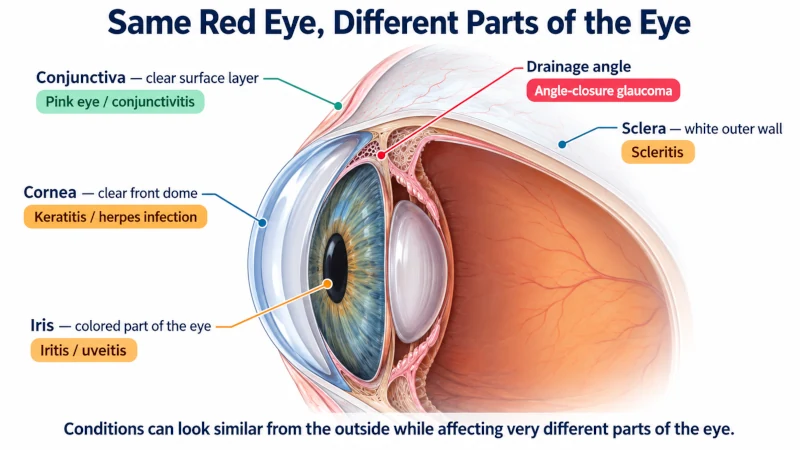
On the mild end, the usual mix-ups are allergies, dry eye, and inflamed eyelids (blepharitis). On the serious end: iritis, keratitis (including herpes infections of the cornea), shingles near the eye, scleritis, and acute angle-closure glaucoma. One more falls in between. Chlamydial conjunctivitis is a type of pink eye, but it’s often mistaken for the viral kind and goes untreated for weeks.
If you remember one thing, make it this. An Australian audit of more than 1,000 people referred to hospital eye emergency services concluded that a red eye with pain, light sensitivity, or blurred vision almost always signals something more serious than conjunctivitis [Medical Journal of Australia audit, 2008].
What is commonly misdiagnosed as pink eye? Why it is easy to get wrong
Pink eye is diagnosed by pattern: redness, discharge, a gritty feeling. Plenty of other eye problems share that pattern. The tools that tell them apart, such as a slit-lamp microscope, fluorescein dye, and an eye-pressure check, usually aren’t available in a primary care office or urgent care clinic. The authors of that Australian study pointed to exactly this gap [Medical Journal of Australia audit, 2008].
Their numbers are sobering. Among 1,062 patients who saw a family doctor, emergency doctor, or optometrist before reaching a hospital eye service, the first diagnosis matched the eye specialists’ diagnosis for about 36% of patients sent by family doctors, 42% sent by emergency doctors, and 48% sent by optometrists. Keep the context in mind. These were people who needed referral, often because things weren’t straightforward, and the data come from Australia in 2006. The study doesn’t tell us how often a routine pink eye diagnosis is wrong. It does show where mistakes cluster.
US data point to a related problem: treating first and diagnosing later. In a study of 340,372 people in a national insurance database who were newly diagnosed with acute conjunctivitis, 58% filled a prescription for antibiotic eye drops. About 1 in 5 of those filled an antibiotic-steroid combination, which the authors described as contraindicated for acute conjunctivitis. People first diagnosed at urgent care had roughly three times the odds of filling an antibiotic compared with people diagnosed by an ophthalmologist [Shekhawat et al., Ophthalmology, 2017]. That study measured prescriptions, not diagnostic accuracy, but it shows how often a red eye gets a reflexive drop.
Most of the time, a wrong label costs you little. Viral pink eye clears up whatever you call it. The harm comes when the label delays the right treatment, or when a steroid-containing drop lands on an infection it can make worse.
Serious conditions that get mistaken for pink eye
Iritis (anterior uveitis)
Iritis is inflammation of the iris, the colored part of the eye. It happens inside the eye, not on its surface. In the Australian audit it stood out: fewer than a third of the 59 patients with iritis were diagnosed correctly at first, and 11 were treated for conjunctivitis with antibiotic drops. Several of the study’s worst outcomes, including permanent vision loss and severe pain after a week or more of delay, were iritis cases [Medical Journal of Australia audit, 2008].
The clues differ from pink eye. Expect a deep, constant ache that can spread to the brow or temple, light sensitivity, blurred vision, and a pupil that’s smaller than the other one and reacts sluggishly to light [American Family Physician review on red eye, 2010]. There’s usually little or no discharge.
Uveitis often starts suddenly with blurry vision, floaters, eye pain, redness, and light sensitivity. It can cause vision loss if it isn’t treated, which is why the National Eye Institute advises seeing an eye doctor right away. It’s often linked to conditions such as ankylosing spondylitis, rheumatoid arthritis, sarcoidosis, and ulcerative colitis [National Eye Institute on uveitis, n.d.]. If you have one of those conditions and develop a painful red eye, say so.
Keratitis and contact lens infections
Keratitis is inflammation of the cornea, the clear dome over the front of the eye. Its symptoms overlap heavily with pink eye: redness, pain, tearing or discharge, blurred or reduced vision, light sensitivity, and a feeling that something is stuck in your eye. Mayo Clinic warns that delays in diagnosing and treating keratitis can lead to serious complications, including blindness [Mayo Clinic on keratitis, 2024].
Contact lenses change the math. Wearing them, and especially sleeping in them, raises the risk of keratitis. Corticosteroid eye drops can also raise the risk of infectious keratitis or make an existing one worse [Mayo Clinic on keratitis, 2024]. CDC guidance for doctors says contact lens wearers with bacterial conjunctivitis are at higher risk of bacterial keratitis and should remove their lenses and be seen promptly by an ophthalmologist [CDC clinical overview of pink eye, 2024].
If you wear contacts and have a red, painful eye, take the lenses out and get an eye exam the same day.
Herpes simplex eye infection
The virus behind cold sores can infect the cornea. CDC lists its symptoms as eye pain, redness, blurred vision, light sensitivity, and watery discharge, a list that reads almost exactly like viral pink eye. It’s often a flare-up of an earlier infection, it can come back, and it’s a major cause of blindness worldwide [CDC on herpes simplex keratitis, 2025].
Here’s why the diagnosis matters so much. A treatment guideline accepted by the American Academy of Ophthalmology states that steroid drops should be avoided in the initial treatment of herpes infection of the corneal surface, and that steroid use can set the stage for severe herpes keratitis. The same guideline notes that herpes eye infections in children are commonly misdiagnosed [AAO herpes simplex keratitis guideline, 2014]. Think back to the 1 in 5 antibiotic users in the US study who filled an antibiotic-steroid drop. That’s the combination you don’t want on an undiagnosed herpes infection.
Tell your doctor if you get cold sores, have had a herpes eye infection before, or have a weakened immune system. Herpes keratitis is usually diagnosed with a careful eye exam, often including a dye that highlights damage on the cornea.
Shingles near the eye
Shingles on the forehead, scalp, or tip of the nose can spread to the eye, a condition called herpes zoster ophthalmicus. Pain and tingling usually come first, followed by a blistering rash on one side of the face and a red eye. It can involve the cornea and cause uveitis [American Family Physician review on red eye, 2010].
In the Australian audit, two patients with shingles of the eye were first labeled with a simple “red eye” and given antibiotic drops. Their antiviral treatment was delayed, and one had permanent vision loss [Medical Journal of Australia audit, 2008]. A red eye plus a new rash on the same side of the face needs to be seen the same day.
Scleritis
Scleritis is inflammation of the tough white wall of the eye. Its pain gives it away: severe and boring, spreading around the eye, worse when you move the eye, and often intense at night or on waking. It’s frequently tied to systemic diseases such as rheumatoid arthritis [American Family Physician review on red eye, 2010].
Its milder cousin, episcleritis, causes a patch of redness with little or no pain and usually settles on its own within about three weeks [American Family Physician review on red eye, 2010]. Eye pain that wakes you up is not a pink eye symptom.
Acute angle-closure glaucoma
This one is rare compared with everything else here, and it moves fast. Fluid inside the eye can’t drain, so pressure rises suddenly. The National Eye Institute calls it a medical emergency: go to a doctor or emergency room immediately if you suddenly have intense eye pain, nausea, a red eye, and blurry vision. Untreated, it can cause blindness in just a few days [National Eye Institute on types of glaucoma, 2021]. Other signs include halos around lights and a pupil that stays enlarged and reacts poorly to light [American Family Physician review on red eye, 2010].
People with narrow drainage angles shouldn’t use decongestant “redness relief” drops, because these can trigger an attack [American Academy of Ophthalmology on redness-relieving drops, 2018]. If you’ve been told you have narrow angles, read drop labels carefully.
Everyday look-alikes that still matter
Allergic conjunctivitis
Allergic conjunctivitis is technically a type of pink eye, but it isn’t contagious and antibiotics won’t help it. Itching is the most obvious feature. It usually affects both eyes, produces watery or stringy discharge, and often comes with hay fever [American Family Physician review on red eye, 2010]. Getting away from the trigger, such as pollen or pet dander, helps most, and allergy medicines or antihistamine eye drops can ease symptoms [CDC guidance on treating pink eye, 2024].
Dry eye and blepharitis
Dry eye gets mistaken for pink eye because it can make your eyes water. When the eye surface is irritated, it floods itself with reflex tears. Typical features include redness in both eyes, a gritty or foreign-body feeling, mild pain, and bouts of excessive watering [American Family Physician review on red eye, 2010]. Our guide to dry eye causes and safe relief covers home care in detail.
Blepharitis is inflammation along the eyelid margins. Your eyes feel red and irritated, worst when you wake up, and the lids are itchy and crusted. It’s managed with lid hygiene and warm compresses, often for the long term, rather than a short course of drops [American Family Physician review on red eye, 2010].
Chlamydial conjunctivitis
Here the diagnosis of pink eye is right, but the type is wrong. Chlamydia, a sexually transmitted infection, can infect the eye, and it looks a lot like viral pink eye.
A 2026 UK study of 267 lab-confirmed cases at a London eye hospital found that 64% were initially misdiagnosed, most often as viral (adenoviral) conjunctivitis. The median time to the correct diagnosis was 14 days. Most patients had symptoms in one eye only (88%), and the median age was 26 [Milligan et al., BMJ Open Ophthalmology, 2026]. This was a single specialist center, so the exact rate may differ elsewhere.
Chlamydial eye infection should be suspected in sexually active people whose “pink eye” doesn’t respond to standard treatment. It needs oral antibiotics, and sexual partners need treatment too [American Family Physician review on red eye, 2010]. A related infection, gonorrhea, causes a sudden, heavy, pus-filled discharge with pain and blurred vision. It can damage the cornea quickly and needs prompt specialist care [American Family Physician review on red eye, 2010].
For a wider list that includes broken blood vessels, styes, and eyelid infections, see our guide to what can be mistaken for pink eye.
How the look-alikes compare
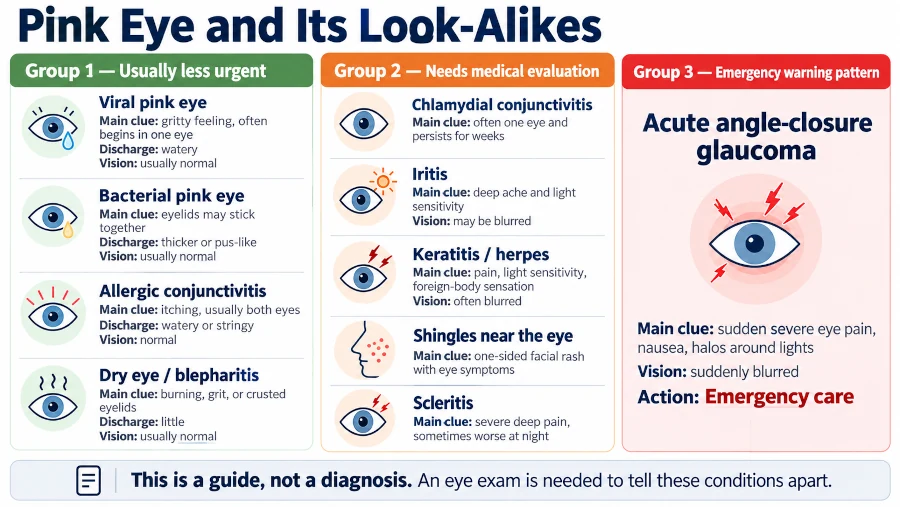
This table is a rough guide, not a diagnostic tool. Only an eye exam can reliably tell these apart.
| Condition | Main clue | Discharge | Vision | How soon to be seen |
| Viral pink eye | Gritty; often one eye first, then the other within a day or two | Watery | Normal | Routine, unless red flags |
| Bacterial pink eye | Lids stuck together on waking | Thick, pus-like | Normal | Routine; same day if you wear contacts |
| Allergic conjunctivitis | Itching in both eyes | Watery or stringy | Normal | Routine |
| Dry eye or blepharitis | Grit and burning; crusted lids, worse in the morning | Little; crusting | Usually normal | Routine |
| Chlamydial conjunctivitis | Usually one eye; lingers for weeks | Mucus or pus | Usually normal | Within a few days if not improving |
| Iritis | Deep ache, light sensitivity, small pupil | Little or none | Blurred | Same day |
| Keratitis or herpes | Pain, something-in-the-eye feeling, light sensitivity | Watery or pus | Often blurred | Same day |
| Shingles near the eye | Tingling, then a blistering rash on one side of the face | Varies | May blur | Same day |
| Scleritis | Severe, boring pain; worse moving the eye or at night | Watery | Sometimes reduced | Same day |
| Acute angle-closure glaucoma | Sudden severe pain, nausea, halos around lights | None | Suddenly blurred | Emergency: ER or 911 |
Sources: adapted from the American Family Physician review on red eye, 2010, CDC guidance on treating pink eye, 2024, and the National Eye Institute on types of glaucoma, 2021.
Told it’s pink eye, but it isn’t getting better?
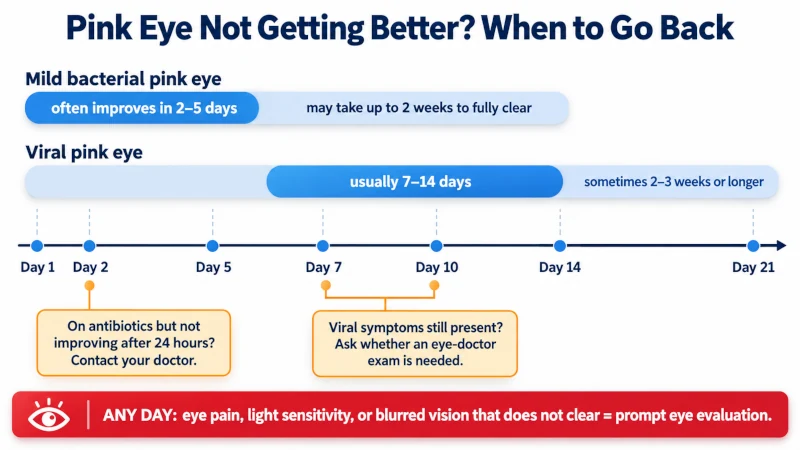
Slow improvement alone isn’t cause for alarm. Viral pink eye usually clears in 7 to 14 days but can take 2 to 3 weeks or longer. Mild bacterial pink eye often clears in 2 to 5 days without treatment, though it can take 2 weeks to go away completely [CDC guidance on treating pink eye, 2024].
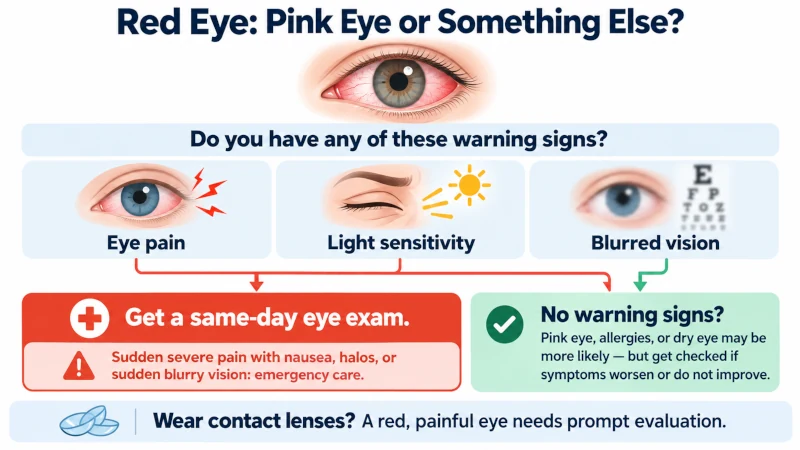
Getting worse is different. CDC advises seeing a health care provider for pink eye with eye pain, light sensitivity, blurred vision that doesn’t improve when discharge is wiped away, intense redness, symptoms that worsen or don’t improve, bacterial pink eye that hasn’t improved after 24 hours on antibiotics, or a weakened immune system [CDC guidance on treating pink eye, 2024]. Guidance for family doctors recommends referral to an ophthalmologist when viral pink eye hasn’t resolved after 7 to 10 days [American Family Physician review on red eye, 2010].
If you’re not improving, ask for an exam with an eye doctor (optometrist or ophthalmologist). They have the slit lamp and dyes needed to look at the cornea and inside the front of the eye, and many offer same-day urgent visits.
It also helps to know what antibiotics can and can’t do. A 2023 Cochrane review of 21 trials with 8,805 people with bacterial conjunctivitis found that about 55% of those on placebo got better by days 4 to 9, compared with about 68% of those on antibiotic drops. That’s a real but modest benefit [Cochrane review, 2023]. Antibiotics won’t improve viral pink eye at all [CDC guidance on treating pink eye, 2024]. So if an antibiotic “didn’t work,” the answer may be a different diagnosis rather than a stronger drop.
Questions worth asking your doctor
- Could this be something other than conjunctivitis, such as iritis, keratitis, or a herpes infection?
- Does this drop contain a steroid? If so, has herpes been ruled out with an eye exam?
- What should I watch for, and when should I come back?
- I wear contacts. Should I see an eye doctor today?
- If one eye has lingered for weeks and you’re sexually active: should I be tested for chlamydia?
What not to put in your eye
- Leftover prescription drops, especially anything with a steroid. Steroid drops for any red eye should be used only under an ophthalmologist’s direct supervision [American Family Physician review on red eye, 2010].
- Redness-relief drops on an eye nobody has examined. When decongestant drops wear off, redness can come back worse, and the American Academy of Ophthalmology advises against using them for more than 72 hours. A red eye can also signal something like uveitis or glaucoma that needs a diagnosis, not a cosmetic fix [American Academy of Ophthalmology on redness-relieving drops, 2018].
- Contact lenses, until your eye doctor says it’s OK. If you didn’t see a doctor, wait until your symptoms are gone [CDC guidance on treating pink eye, 2024].
- Homemade washes or anything not made for eyes. Cold compresses and artificial tears are reasonable comfort measures while you wait to be seen [CDC guidance on treating pink eye, 2024].
When to get help right away
Get seen the same day by an eye doctor, or at urgent care or an ER if you can’t get an eye appointment, if you have a red eye with any of these:
- Eye pain beyond mild irritation, pain when you move the eye, or pain that wakes you up
- Light sensitivity
- Blurred vision that doesn’t clear when you blink or wipe away discharge
- A pupil that looks different from the other one
- Any red, painful eye while wearing contact lenses
- Heavy pus that returns quickly after you wipe it away
- A blistering rash on your forehead, scalp, or nose on the same side
- A recent eye injury or eye surgery
- A weakened immune system
Call 911 or go to the ER for sudden, severe eye pain with nausea or vomiting, halos around lights, or suddenly blurry vision. These are signs of acute angle-closure glaucoma [National Eye Institute on types of glaucoma, 2021]. Chemical splashes and eye injuries also need emergency care [American Family Physician review on red eye, 2010].
Newborns with any signs of pink eye should see a doctor right away [CDC guidance on treating pink eye, 2024].
Health Disclaimer: This article is for general education and is not a substitute for professional medical advice, diagnosis, or treatment. Conditions that look alike from the outside can differ greatly in how serious they are, and only an in-person eye examination can reliably tell them apart. Don’t use this page to diagnose yourself or to put off care. If you have eye pain, vision changes, light sensitivity, or symptoms while wearing contact lenses, contact a doctor promptly. Don’t start, stop, or change any eye drop or medication based on what you read here. See our full medical advice disclaimer.
Frequently asked questions
Which conditions are most often mistaken for pink eye?
Everyday mix-ups include allergies, dry eye, and blepharitis. In studies of misdiagnosis, the serious conditions that turn up most are iritis, keratitis (including herpes infections), and shingles near the eye [Medical Journal of Australia audit, 2008]. Chlamydial conjunctivitis is frequently mistaken for viral pink eye [Milligan et al., BMJ Open Ophthalmology, 2026].
Can a doctor tell pink eye from something worse just by looking?
Often, but not always. Iritis and acute glaucoma generally can’t be diagnosed without a slit-lamp microscope and a way to measure eye pressure, equipment most primary care offices don’t have [Medical Journal of Australia audit, 2008]. If you have pain, light sensitivity, or blurred vision, ask for an eye doctor’s exam.
There’s no simple office test that separates viral from bacterial pink eye, so many doctors prescribe antibiotics to cover the possibility [American Family Physician review on red eye, 2010]. For bacterial cases the benefit is modest [Cochrane review, 2023], and for viral cases there’s none [CDC guidance on treating pink eye, 2024].
Are steroid eye drops safe for pink eye?
They should be used only under an ophthalmologist’s supervision [American Family Physician review on red eye, 2010]. Steroid drops can worsen a herpes infection of the cornea [AAO herpes simplex keratitis guideline, 2014] and can raise the risk of infectious keratitis [Mayo Clinic on keratitis, 2024].
Can pink eye start in just one eye?
Yes. Viral pink eye often starts in one eye and spreads to the other within a day or two [American Family Physician review on red eye, 2010]. Still, a single red eye with pain deserves more suspicion than two mildly red eyes, because serious conditions like iritis more often affect one eye [Medical Journal of Australia audit, 2008].
References
- Centers for Disease Control and Prevention. “How to Treat Pink Eye.” CDC, View source
- Centers for Disease Control and Prevention. “Clinical Overview of Pink Eye (Conjunctivitis).” CDC, View source
- Centers for Disease Control and Prevention. “What Causes HSV (Herpes Simplex Virus) Keratitis.” CDC, View source
- Mayo Clinic Staff. “Keratitis: Symptoms and Causes.” Mayo Clinic, View source
- National Eye Institute. “Uveitis.” National Institutes of Health, n.d. View source
- National Eye Institute. “Types of Glaucoma.” National Institutes of Health, View source
- Boyd K (reviewed by McKinney JK). “Redness-Relieving Eye Drops.” American Academy of Ophthalmology, View source
- White ML, Chodosh J. “Herpes Simplex Virus Keratitis: A Treatment Guideline.” American Academy of Ophthalmology / Ocular Microbiology and Immunology Group, 2014. View source
- Cronau H, Kankanala RR, Mauger T. “Diagnosis and Management of Red Eye in Primary Care.” American Family Physician. 2010;81(2):137-144. View source
- Statham MO, Sharma A, Pane AR. “Misdiagnosis of acute eye diseases by primary health care providers: incidence and implications.” Medical Journal of Australia. 2008;189(7):402-404. DOI: 10.5694/j.1326-5377.2008.tb02091.x. View source
- Shekhawat NS, Shtein RM, Blachley TS, Stein JD. “Antibiotic Prescription Fills for Acute Conjunctivitis among Enrollees in a Large United States Managed Care Network.” Ophthalmology. 2017;124(8):1099-1107. DOI: 10.1016/j.ophtha.2017.04.034. PMID: 28624168. PMCID: PMC9482449. View source
- Chen Y-Y, Liu SH, Nurmatov U, van Schayck OCP, Kuo IC. “Antibiotics versus placebo for acute bacterial conjunctivitis.” Cochrane Database of Systematic Reviews. 2023;3:CD001211. DOI: 10.1002/14651858.CD001211.pub4. PMID: 36912752. View source
- Milligan AL, Abdulhussein D, Neo YN, et al. “Diagnostic delays and sexual health integration in Chlamydia trachomatis conjunctivitis: an 11-year retrospective study at a UK tertiary ophthalmic centre.” BMJ Open Ophthalmology. 2026;11(3):e002843. DOI: 10.1136/bmjophth-2026-002843. PMID: 42419863. Status: View source


