A Bitot’s spot is a foamy, white or grey patch on the white of the eye, and it almost always means the body is short on vitamin A. The spot itself doesn’t hurt and won’t harm your sight on its own. What it signals is the real issue: vitamin A is running low, and the same shortage can, if ignored, go on to damage the cornea and threaten vision.
So Bitot’s spots are less a surface problem to treat and more a warning worth acting on. The encouraging part is that the underlying cause is usually easy to identify and — especially in children — treatable. That’s also why a Bitot’s spot should send you to a clinician rather than a home remedy: getting vitamin A checked and corrected is what actually protects your eyes. [AAO]
What a Bitot’s spot actually is
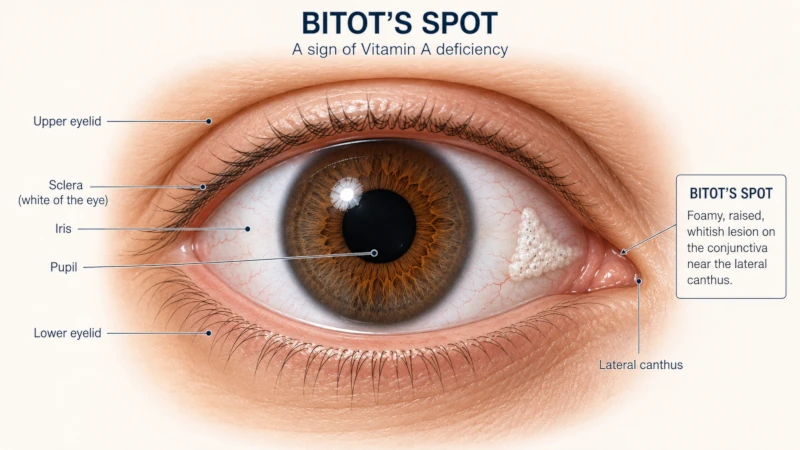
Bitot’s spots are dry, foamy, roughly triangular patches that sit on the bulbar conjunctiva — the clear membrane over the white of the eye — usually on the temporal side, toward the ear rather than the nose. [AAO] Up close they look frothy or cheesy, like a smear of dried soap film, and they often appear in both eyes. They’re made of keratin: skin-like protein and dead surface cells that pile up when the conjunctiva can no longer stay smooth and moist. [AJM] The French physician Pierre Bitot first described them in 1863, which is where the name comes from. [AAO]
They’re painless, which is part of why they’re easy to overlook. Doctors treat them as a fairly specific sign of vitamin A deficiency. In the World Health Organization’s staging of vitamin-A-related eye disease — called xerophthalmia — Bitot’s spots are stage X1B. [AAO] That staging matters, because it tells you how far things have gone and how urgently they need attention.
What causes Bitot’s spots
The root cause is nearly always too little usable vitamin A. [StatPearls] That happens in a few different ways:
- Not enough in the diet. Too few vitamin A foods — liver, eggs, dairy, fish, and the orange, yellow, and dark-green produce that supplies beta-carotene. This is the dominant cause worldwide, especially where diets are limited. [WHO]
- Trouble absorbing it. Vitamin A is fat-soluble, so anything that interferes with fat absorption can starve the body of it even when the diet looks fine — celiac disease, inflammatory bowel disease, cystic fibrosis, chronic pancreatic disease, cholestatic liver disease, and some weight-loss surgeries. [StatPearls]
- Liver problems and heavy alcohol use. The liver stores and processes vitamin A, and chronic liver disease or long-term heavy drinking interferes with both. [StatPearls]
- Very restrictive eating. Severely limited diets — from food insecurity, eating disorders, or self-imposed restriction — can push intake low enough to matter, and there are documented cases even in wealthy countries.
So while vitamin A deficiency is overwhelmingly a problem of poverty and food access, it isn’t only that. Worldwide it remains the leading preventable cause of childhood blindness: the WHO estimates that 250,000 to 500,000 vitamin-A-deficient children go blind each year, and about half die within a year of losing their sight. [WHO]
The other signs that travel with Bitot’s spots
A Bitot’s spot rarely shows up alone. The earliest and most common symptom of vitamin A deficiency is night blindness — trouble seeing in dim light, or taking a long time to adjust when the lights go down. [Cleveland Clinic] Eyes may also feel dry, gritty, or rough, because the same deficiency thins the eye’s protective surface and weakens tear quality. [Cleveland Clinic]
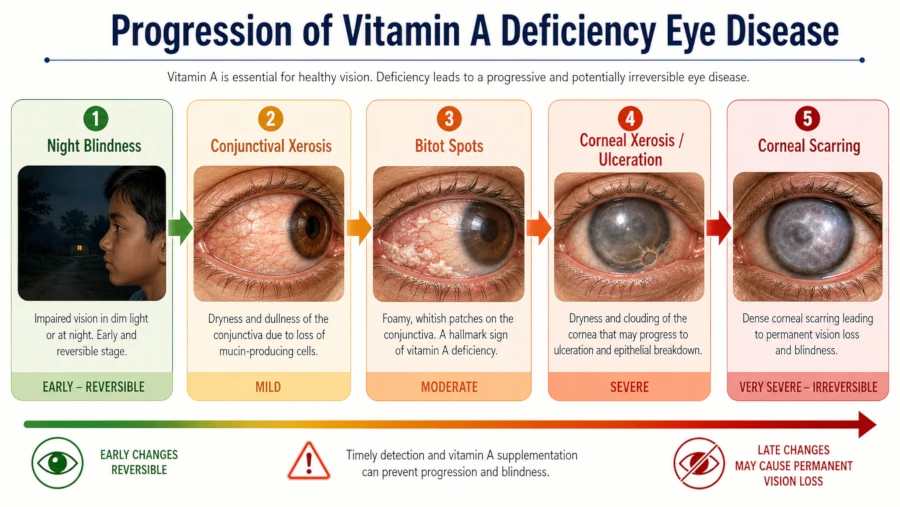
Vitamin A deficiency follows a recognized progression, and Bitot’s spots sit in its early-to-middle part. The WHO classification lays it out: [AAO]
| Stage | Sign | What it means |
| XN | Night blindness | Earliest sign — trouble seeing in dim light |
| X1A | Conjunctival xerosis | The white of the eye loses its moist, glossy look |
| X1B | Bitot’s spots | Foamy keratin patches — the focus of this article |
| X2 | Corneal xerosis | The cornea itself begins to dry and cloud |
| X3A / X3B | Corneal ulceration / keratomalacia | The cornea softens and breaks down — a sight-threatening emergency |
| XS | Corneal scarring | Permanent scarring left by earlier damage |
The point of the table isn’t to alarm you — it’s to show that Bitot’s spots are a stage you want to catch, early enough that the cornea hasn’t been touched. Once the cornea is involved, vision loss can move quickly and become permanent. [StatPearls]
Are Bitot’s spots dangerous? When to get help
On their own, Bitot’s spots won’t blind you and don’t hurt. The danger is in what they predict. Treat them as a prompt to see a doctor — ideally an eye specialist or your primary care clinician — to confirm the diagnosis and check vitamin A status. This isn’t something to diagnose or treat yourself from a photo.
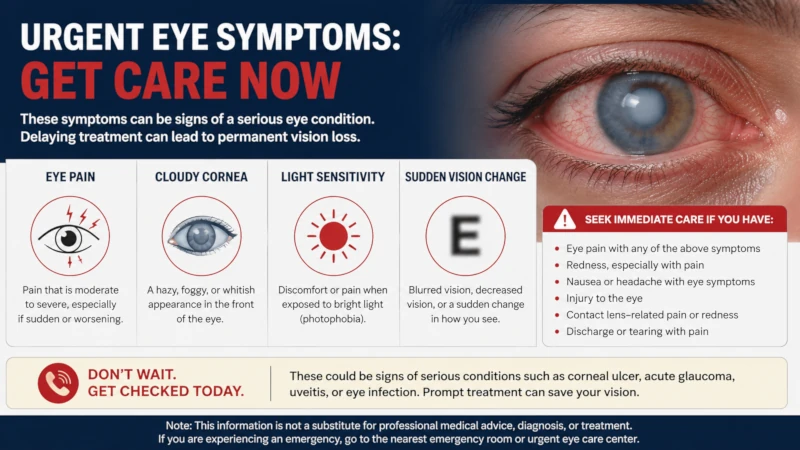
| Seek urgent eye care if any of these appear Some symptoms suggest the cornea — the clear front of the eye — may already be affected, and these need same-day or emergency attention: • Eye pain • Sudden or worsening blurry vision • A hazy or cloudy-looking cornea • New sensitivity to light • Fast-changing vision in a child who is unwell or malnourished In a severely malnourished child or one recovering from measles, vitamin A deficiency can damage the cornea within days, so any eye change is urgent. |
How Bitot’s spots are treated
Treatment targets the deficiency, not the spot. [AAO] In practice that means three things.
Restoring vitamin A — under medical guidance
For a diagnosed deficiency, clinicians use specific vitamin A doses based on age and severity. The WHO has standard treatment schedules, and in children these are deliberately high, short-course doses given and monitored by a health professional. [WHO] This is worth underlining: the treatment doses for genuine deficiency are far above everyday supplement levels, and a clinician chooses them precisely because too much vitamin A is also harmful (more on that below). It is not a do-it-yourself situation.
Fixing the underlying reason
If malabsorption, liver disease, alcohol use, or a very limited diet is driving the deficiency, that has to be addressed too — otherwise the problem returns. [StatPearls]
Rebuilding the everyday diet
Alongside treatment, working vitamin A–rich foods back into regular meals helps hold levels steady over the long run.
What to expect: in young children, Bitot’s spots often clear within weeks once vitamin A is restored, and night blindness can improve within days. [AAO] In adults, the spot itself sometimes persists even after blood levels return to normal — the keratin patch has become a fixed change in the surface, and a few documented cases have needed minor surgery to remove it for comfort or appearance. [Case report] That doesn’t mean treatment failed; the aim is to correct the deficiency and protect the cornea, which it does whether or not the visible patch fully fades.
One clear “don’t.” Skip the eye home remedies. Putting aloe vera — or any other home preparation — on or in the eye isn’t supported by evidence and can introduce irritation or infection to an already vulnerable surface. The thing that treats a Bitot’s spot is correcting vitamin A, not anything applied to the eye’s surface.
Vitamin A in food — the practical part
There are two kinds of vitamin A in the diet, and the difference matters for both treatment and safety. [NIH ODS]
Preformed vitamin A (retinol) comes from animal foods and is used by the body directly: liver (by far the richest source), eggs, dairy, and oily fish. Cod liver oil is also very high in it. [NIH ODS]
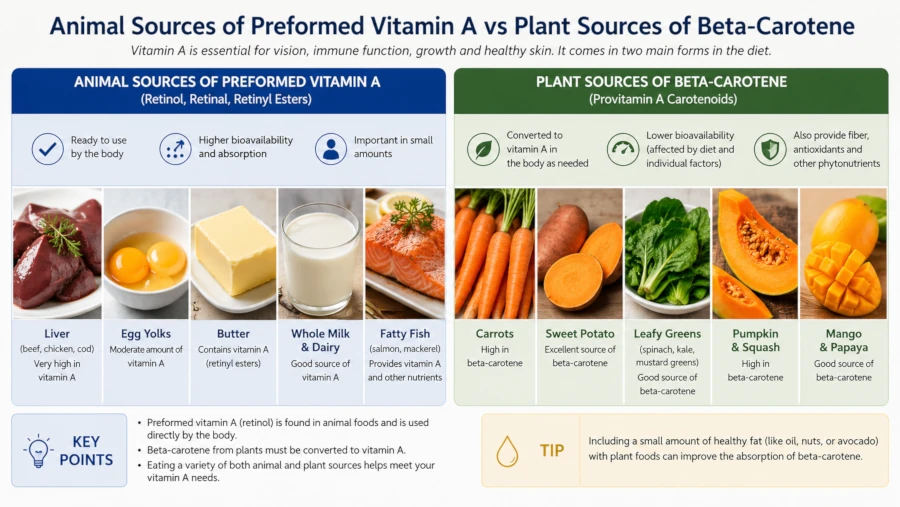
Provitamin A carotenoids — mainly beta-carotene — come from plants, and the body converts them into vitamin A as needed: sweet potato, carrots, pumpkin, spinach, kale and other dark greens, plus mango and red peppers. [NIH ODS]
| Food | Type of vitamin A | Notes |
| Beef liver | Preformed (very high) | A small portion far exceeds a day’s needs; avoid in pregnancy |
| Eggs, dairy | Preformed | Everyday, reliable sources |
| Oily fish, cod liver oil | Preformed | Cod liver oil is concentrated — watch the dose |
| Sweet potato, carrots, pumpkin | Beta-carotene | Body converts as needed; safe in pregnancy |
| Spinach, kale, dark greens | Beta-carotene | Absorbed better with a little fat |
| Mango, red pepper | Beta-carotene | Easy everyday additions |
A useful quirk: because the body converts beta-carotene only as it needs to, you can’t really overdose on vitamin A from carrots and spinach. Preformed vitamin A from animal foods and supplements is a different story — which brings us to safety.
Supplements and safety — what to know before you take vitamin A
Supplements have a real place here: for a diagnosed deficiency, for malabsorption conditions, or where a clinician recommends them. But vitamin A is fat-soluble, so the body stores the excess rather than flushing it out. More is genuinely not better, and high doses carry real risks. [NIH ODS] [StatPearls]
Realistic expectations. Correcting a true deficiency can restore night vision and halt the slide toward corneal damage. It won’t “detox” the eye or sharpen vision that’s already normal, and for someone who isn’t deficient, extra vitamin A offers no benefit — only added risk.
Too much vitamin A is harmful.
- Acute toxicity from a single very large dose can cause severe headache, blurred vision, nausea, dizziness, and poor coordination. [NIH ODS]
- Chronic toxicity from taking too much over time can damage the liver and bones and raise pressure around the brain, with bone and joint pain, dry skin, hair loss, and headaches. [StatPearls]
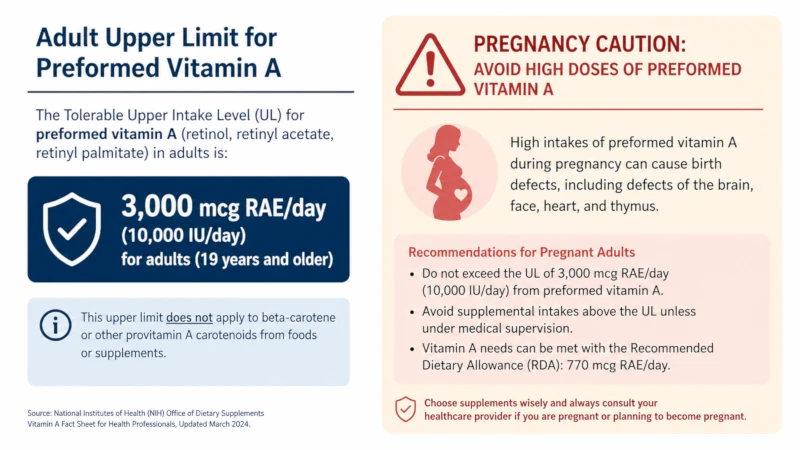
- The adult upper limit for preformed vitamin A is 3,000 mcg RAE (about 10,000 IU) per day from food and supplements combined. Beta-carotene from food isn’t counted toward it. [NIH ODS]
Pregnancy is a special case. High-dose preformed vitamin A (retinol) is teratogenic — it can cause birth defects. Pregnant women, and women who might become pregnant, are advised not to exceed 3,000 mcg RAE (10,000 IU) a day of preformed vitamin A, and to avoid liver and high-dose cod liver oil. [NIH ODS] One large study estimated that among women taking more than 10,000 IU a day of preformed vitamin A in supplements, roughly 1 baby in 57 had a malformation linked to it. [NEJM 1995] Beta-carotene is not known to cause this, so in pregnancy, plant sources are the safer way to meet vitamin A needs. [NIH ODS]
Beta-carotene supplements and smokers. High-dose beta-carotene supplements have been linked to a higher risk of lung cancer in people who smoke or have heavy asbestos exposure, so smokers should avoid them — though beta-carotene from food is fine. [NIH ODS]
Medication interactions. Orlistat (a weight-loss medication) reduces absorption of fat-soluble vitamins, including A. Prescription retinoids such as isotretinoin and acitretin are vitamin A relatives, and combining them with vitamin A supplements can stack toxicity. [NIH ODS] If you take these, check with your prescriber before adding vitamin A.
Who should be especially careful: people who are pregnant or may become pregnant, smokers (for beta-carotene supplements), people with liver disease, and anyone on retinoid medication. For everyone, a diagnosed deficiency is the reason to supplement — and the dose should come from a clinician, not a label. Vitamin A also supports immune function, but that’s not a reason to megadose; the risks above still apply.
Preventing Bitot’s spots
For an individual, prevention is mostly a diet with enough vitamin A from the foods above — a mix of plant carotenoids and, if you eat them, animal sources. [NIH ODS] People with conditions that impair absorption should have their vitamin A status checked periodically, since they can become deficient on a normal-looking diet.
At the population level, vitamin A deficiency is tackled with public-health tools: high-dose vitamin A supplementation for young children in high-risk areas, food fortification, and support for breastfeeding, which protects infants. These programs have measurably reduced childhood blindness and deaths where they run. [WHO]
| Health Disclaimer This article is for general education and is not medical advice or a substitute for it. Bitot’s spots and vitamin A deficiency need to be diagnosed and treated by a qualified health professional, and vitamin A dosing in particular should be set by a clinician because too much can be harmful. Do not start, stop, or change a supplement — especially during pregnancy — based on this page alone. If you have eye pain, vision changes, or a cloudy cornea, seek urgent eye care. Always consult a licensed healthcare provider about your own situation. |
Frequently Asked Questions
Can Bitot’s spots go away on their own?
Not without correcting the vitamin A shortage behind them. In children, they often clear within weeks once vitamin A is restored. In adults, the visible patch sometimes persists even after blood levels return to normal — but the deficiency still needs treating to protect vision. [AAO]
Are Bitot’s spots always caused by vitamin A deficiency?
Almost always — they’re considered a fairly specific sign of it. Rarely, an old residual spot lingers in someone whose levels have since normalized. Either way, a Bitot’s spot is a reason to have vitamin A status checked. [AJM]
Can I treat a Bitot’s spot at home with diet alone?
A mild dietary shortfall may improve with a better diet, but don’t self-diagnose or self-dose. A clinician should confirm the deficiency and decide whether you need treatment-level vitamin A, which is far higher than everyday supplements and needs monitoring. Never put a home remedy on the eye itself.
Are Bitot’s spots contagious?
No. They’re a sign of a nutritional deficiency, not an infection, and can’t be passed to anyone.
Do adults get Bitot’s spots, or just children?
Both. They’re most common in young children where vitamin A deficiency is widespread, but adults develop them too — especially with malabsorption conditions, liver disease, heavy alcohol use, or very restricted diets. [StatPearls]
How soon should I see a doctor?
Soon, even though the spot doesn’t hurt. And seek urgent eye care for eye pain, a cloudy cornea, light sensitivity, or fast-changing vision, which can signal the cornea is involved. [AAO]
References
- American Academy of Ophthalmology. “Management of Bitot’s Spots,” EyeNet Magazine. View source
- World Health Organization. “Vitamin A deficiency,” Nutrition Landscape Information System. View source
- NIH Office of Dietary Supplements. “Vitamin A and Carotenoids — Health Professional Fact Sheet.” View source
- Feroze KB, Kaufman EJ. “Xerophthalmia.” StatPearls, NCBI Bookshelf. View source
- Cleveland Clinic. “Xerophthalmia.” (Medically reviewed.) View source
- StatPearls. “Vitamin A Toxicity.” NCBI Bookshelf. View source
- Rothman KJ, et al. “Teratogenicity of High Vitamin A Intake.” N Engl J Med. 1995;333:1369–1373. View source
- Fukuoka H, Yokoi N, Sotozono C. “Immunohistochemistry in an Adult Case of Bitot’s Spots Caused by Vitamin A Deficiency.” Diagnostics. 2023;13(24):3676. View source
- American Journal of Medicine. “Bitot Spots: A Pathognomonic Sign of Vitamin A Deficiency.” View source
