
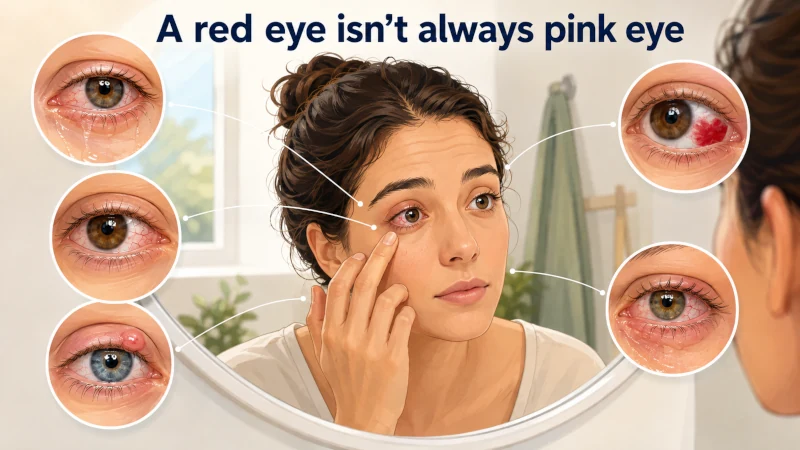
A red, watery, crusted-over eye gets the same guess from almost everyone: pink eye. That guess is wrong a great deal of the time. Quite a lot can be mistaken for pink eye — seasonal allergy, dry eye, a clogged eyelid gland, a scratched cornea — and a few of the look-alikes will cost you vision if you spend a week waiting for “the pink eye” to run its course.
The reassuring part: most red eyes are minor and settle on their own. The part worth five minutes of your attention: a small number of them are not, and they announce themselves with three specific signs.
Three questions that sort out most red eyes
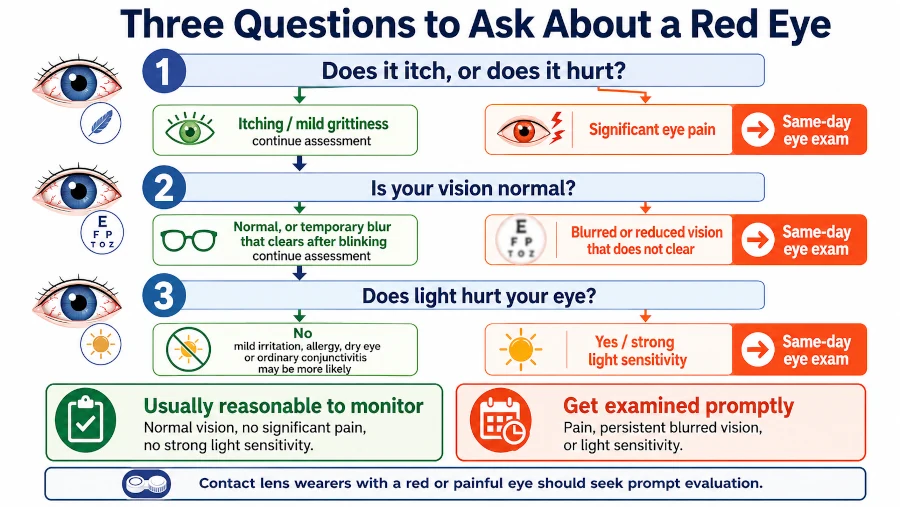
Does it itch, or does it hurt? Itching is the signature of allergy — the American College of Allergy, Asthma and Immunology calls it the hallmark symptom [ACAAI]. Grittiness, like sand or an eyelash you cannot find, points toward dry eye or eyelid inflammation. Real pain — the kind that makes you wince — belongs to the cornea, the iris or the sclera, not to the conjunctiva.
Is your vision the same as it was yesterday? Conjunctivitis leaves vision alone. Discharge can smear it, but a blink clears the smear. Blurring that does not blink away is a reason to be examined [Cronau, 2010].
Does light bother you? Light sensitivity points inward, toward the cornea and iris, and away from ordinary pink eye [CDC, 2024].
Two more clues help: how many eyes, and what is coming out. Viral pink eye usually starts in one eye and moves to the other within days, with watery discharge. Bacterial pink eye makes thick pus that glues the lashes shut overnight. Allergy hits both eyes at once and itches [CDC, 2024].
Pink eye and its look-alikes at a glance
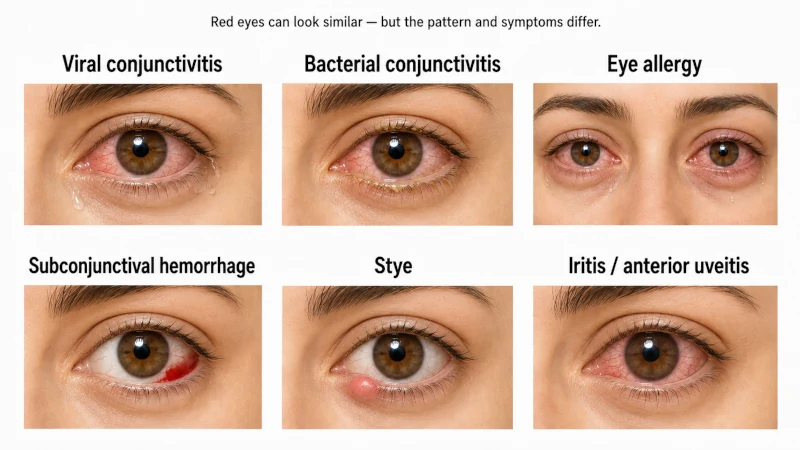
| Condition | How it feels | Discharge | Vision affected? | How fast to be seen |
| Viral conjunctivitis | Gritty, burning; often one eye first | Watery | No | Routine unless red flags |
| Bacterial conjunctivitis | Sore, sticky lids on waking | Thick pus | No | Routine; sooner if severe |
| Allergic conjunctivitis | Intense itching, both eyes | Clear, watery | No | Routine |
| Dry eye disease | Scratchy, burning; may water | Little or stringy | Blurring that blinks clear | Routine |
| Blepharitis | Crusted, greasy lids; worse mornings | Crusting at lash line | No | Routine |
| Stye / chalazion | Tender lump (stye); painless lump (chalazion) | None | No | 48 hours if no improvement |
| Subconjunctival hemorrhage | Usually painless; looks dramatic | None | No | Routine; sooner if recurrent |
| Keratitis | Pain, foreign-body feeling, light sensitivity | Tearing or discharge | Yes, often | Same day |
| Iritis (anterior uveitis) | Deep ache into brow; light sensitivity | None | Yes | Same day |
| Scleritis | Severe boring pain, worse on eye movement | None | Sometimes | Same day |
| Acute angle-closure glaucoma | Severe pain, nausea, halos around lights | None | Yes, suddenly | Emergency |
Sources: CDC symptoms of pink eye (2024); Cronau et al., American Family Physician (2010); NEI; Mayo Clinic. Full citations in References.
What can be mistaken for pink eye: 11 conditions
1. Allergic conjunctivitis
Technically this is conjunctivitis. Practically it is the single most common thing people call pink eye when they do not have the contagious kind, and treating it as an infection wastes weeks.
Itching is the tell, usually alongside redness, burning and clear watery discharge [ACAAI]. Both eyes are typically involved, and it often travels with a stuffy nose, sneezing or an itchy throat [CDC, 2024]. It is not contagious, and nobody needs to stay home.
Getting away from the trigger helps most. Beyond that: cool compresses, preservative-free artificial tears to rinse allergen off the surface, and antihistamine or mast-cell-stabilizer eye drops. ACAAI lists both over-the-counter and prescription options and notes that durable control usually needs prescription treatment rather than the drugstore shelf [ACAAI]. Antibiotic drops do nothing here.
2. Dry eye disease
Dry eye is the great impostor because it can look wet. When the tear film breaks down, the eye floods in response — so “my eyes water constantly” is a common dry eye complaint, not an argument against the diagnosis. Mayo Clinic lists watery eyes explicitly as “the body’s response to the irritation of dry eyes” [Mayo Clinic].
The rest of the picture: a scratchy feeling as though something is in your eye, stinging or burning, redness, light sensitivity, and blurring that clears when you blink [NEI, 2025]. Wind, dry air and long screen sessions all make it worse.
Risk rises after age 50, in women, in contact lens wearers, in people low on vitamin A or omega-3 fatty acids, and with autoimmune conditions such as Sjögren syndrome and lupus [NEI, 2025]. Common medications dry eyes out too — antihistamines, antidepressants, some blood pressure drugs [Mayo Clinic], which is worth raising with whoever prescribed them rather than stopping anything on your own.
Artificial tears are the first-line treatment for mild dry eye and need no prescription [NEI, 2025]. If drops several times a day are not holding it, that is a conversation with an eye doctor rather than a stronger product off the shelf. Our guide to dry tear ducts and safe relief covers the day-to-day management in more detail.
3. Blepharitis
Blepharitis is inflammation at the base of the eyelashes, and it produces a chronically red, irritated eye that gets blamed on infection over and over again.
It is usually worst in the morning. Mayo Clinic describes eyelids that appear greasy, crusted eyelashes, a gritty or burning sensation, watery eyes, and waking with the lids stuck together [Mayo Clinic]. Two things drive it: overgrowth of bacteria that normally live on the lid, or clogged oil glands at the lash line.
The part people do not enjoy hearing is that “blepharitis can’t be cured, but daily care and treatments can usually control the symptoms” [Mayo Clinic]. It is a maintenance condition — warm compresses and lid hygiene most days, indefinitely — not a course of drops. It is also not contagious. Left alone, it feeds other problems: styes, chalazia, dry eye and chronic conjunctival irritation [Mayo Clinic].
4. Styes and chalazia
A stye, or hordeolum, is a bacterial infection of a gland at the lid margin — a tender, well-defined lump right at the lash line [Carlisle, 2015]. It is localized, and the rest of the eye may be perfectly quiet.
Warm compresses do most of the work: a warm washcloth held on the closed lid for five to ten minutes several times a day, with gentle massage [Mayo Clinic]. Do not squeeze it.
A chalazion is the quieter relative — a blocked oil gland in the middle of the lid, lasting more than two weeks and, importantly, not painful [Carlisle, 2015]. That absence of pain is a genuinely useful distinguishing feature.
Contact a clinician if a stye has not started improving after 48 hours, or if redness and swelling spread across the whole eyelid or into the cheek [Mayo Clinic]. Spreading is the sign that matters, for reasons covered in the cellulitis section below. Our article on the differences between hordeolum and chalazion goes further into treatment.
5. Subconjunctival hemorrhage
The most alarming thing on this list to look at, and the least dangerous. A small blood vessel under the conjunctiva breaks and lays down a flat red patch across the white of the eye, sometimes a bright and frankly startling one.
It usually does not hurt. AAO notes that people often discover it in the mirror rather than by feeling it, with at most “a very mild irritation of the eye” [AAO, 2023]. Coughing, sneezing, straining, vigorous rubbing or minor trauma are the usual causes; less often it relates to diabetes, high blood pressure or blood-thinning medication.
It clears on its own over a few days to a few weeks depending on the size of the patch, with no treatment needed beyond artificial tears if the eye feels scratchy [AAO, 2023]. Repeated episodes are worth mentioning to your doctor, since they can point to a blood pressure or clotting issue.
6. A foreign body, a scratch, or a chemical splash
A speck of grit, a stray eyelash, a metal fragment or a splash of household cleaner produces a red, streaming, painful eye very quickly. The history usually gives it away if you think back a few hours.
The distinguishing feature is a persistent sense that something is in the eye — often localized to one spot, often worse on blinking, and almost always one-sided. Corneal involvement changes the urgency: AAFP lists corneal involvement, traumatic eye injury and copious purulent discharge among the findings that warrant prompt ophthalmology referral [Cronau, 2010].
A chemical splash is not a wait-and-see situation. Irrigate immediately with clean water for several minutes and get medical help while you are doing it.
7. Keratitis
Keratitis is inflammation of the cornea, the clear dome over the iris, and it is the look-alike that most often ends badly when it gets mistaken for pink eye.
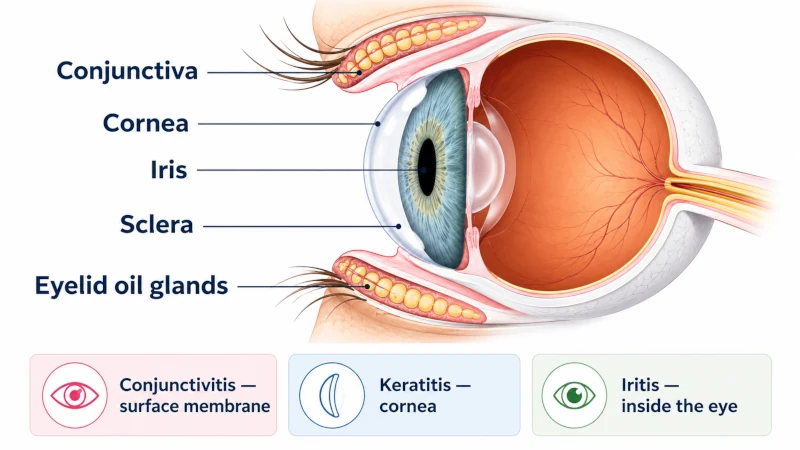
The symptoms overlap heavily with conjunctivitis: redness, pain, tearing or discharge, blurred or reduced vision, light sensitivity and a foreign-body sensation [Mayo Clinic]. What differs is the risk. Untreated keratitis can scar the cornea, progress to a corneal ulcer and cause permanent vision loss [Mayo Clinic].
Contact lenses are the dominant risk factor in otherwise healthy people. CDC states that germs “are more likely to invade the eyes when contact lenses are worn for too long or are not cared for correctly” [CDC, 2025].
Mayo Clinic’s guidance here is unusually direct: “If you notice any of the symptoms of keratitis, make an appointment to see an eye specialist right away. Delays in diagnosis and treatment of keratitis can lead to serious complications, including blindness” [Mayo Clinic].
One subtype deserves a specific mention. Herpes simplex virus keratitis presents with eye pain, redness, blurred vision, light sensitivity and watery discharge, tends to recur in people who have had it before, and is a significant infectious cause of blindness worldwide [CDC, 2025]. It needs antiviral treatment. Steroid drops given for a presumed case of pink eye can make it considerably worse, which is the practical reason never to reuse leftover prescription drops on a new red eye.
8. Iritis (anterior uveitis)
Iritis is inflammation inside the eye, at the iris. From the outside it can pass for a red, sore, light-sensitive eye. Underneath, something quite different is happening.
AAFP describes the pattern that separates it from conjunctivitis: diminished vision, a constricted and poorly reactive pupil, and pain that radiates into the brow or temple [Cronau, 2010]. Conjunctivitis leaves vision and pupil reactions normal.
Symptoms usually arrive suddenly — blurry vision, floaters, eye pain, redness, light sensitivity [NEI, 2024]. The National Eye Institute is blunt about the stakes: “Uveitis can cause vision loss if it isn’t treated — so it’s important to see your eye doctor right away if you have symptoms” [NEI, 2024]. AAO adds that uveitis “can damage vital eye tissue, leading to permanent vision loss” [AAO, 2022].
It is often linked to a systemic condition — lupus, rheumatoid arthritis, sarcoidosis, ankylosing spondylitis, multiple sclerosis, inflammatory bowel disease — or to infections including shingles, syphilis and toxoplasmosis [NEI, 2024]. Treatment is corticosteroid drops and dilating drops, prescribed and monitored by an ophthalmologist [AAO, 2022]. This is not a condition to manage at home.
9. Episcleritis and scleritis
Both inflame the tissue layers over the white of the eye, and both get called pink eye. They behave very differently from one another.
Episcleritis is typically a sectoral patch of redness, mild and frequently self-limiting. Scleritis is the serious one. AAFP describes severe boring pain radiating to the periorbital area, pain on eye movement, and diffuse redness with swelling of the sclera [Cronau, 2010]. Pain that wakes you at night, or pain when you move the eye, does not belong to conjunctivitis. Scleritis is often associated with autoimmune disease and needs specialist care.
10. Acute angle-closure glaucoma
Rare compared with everything else on this list, and the reason a painful red eye is never something to sit on for a week.
Pressure inside the eye climbs quickly when the iris blocks fluid drainage. NEI puts it plainly: “Angle-closure glaucoma, also called narrow-angle or acute glaucoma, is a medical emergency. Go to the doctor or emergency room immediately if you suddenly have” intense eye pain, nausea, a red eye or blurry vision [NEI, 2021]. AAFP adds halos around lights and a dilated, poorly reactive pupil to the picture [Cronau, 2010].
Untreated, it can cause blindness within days [NEI, 2021]. Severe eye pain with nausea and vomiting is an emergency department visit, not a next-week appointment.
11. Preseptal and orbital cellulitis
When the eyelid itself is swollen, red and warm, the question is which side of the orbital septum the infection sits on, and that distinction decides everything.
Preseptal cellulitis sits in front of the septum, in the lid tissues. The classic findings are full eye movements and no vision changes, and it can often be managed as an outpatient with oral antibiotics [Carlisle, 2015].
Orbital cellulitis sits behind it, usually spreading from a sinus infection, and it is a hospital problem. The red flags AAFP lists are limited or painful eye movements, vision changes, double vision, proptosis — the eye pushed forward — and fever with an ill-appearing patient, particularly in children [Carlisle, 2015]. Any of those calls for urgent imaging and ophthalmology the same day.
What about COVID-19 pink eye?
Conjunctivitis can accompany COVID-19, but it is an uncommon feature rather than a typical one, and the evidence is messier than the 2020 headlines suggested.
A 2021 meta-analysis pooling 20 studies and 3,383 patients with laboratory-confirmed COVID-19 estimated conjunctivitis in roughly 1% of cases [Al-Namaeh, 2021]. Treat that as an approximation rather than a firm number: heterogeneity across the included studies was very high (I² = 97%), meaning the individual studies disagreed substantially, and other reviews have reported higher rates in hospitalized groups. This is limited, mixed evidence, not a settled figure.
The practical version is straightforward. A red eye alongside fever, cough, sore throat or loss of smell is worth a COVID test. Viral conjunctivitis from any respiratory virus spreads easily, and adenovirus remains a far more common cause than SARS-CoV-2. Wash your hands, do not share towels, and leave the contact lenses out. There is no eye-specific treatment; care is directed at the underlying illness.
If you wear contact lenses, the rules change
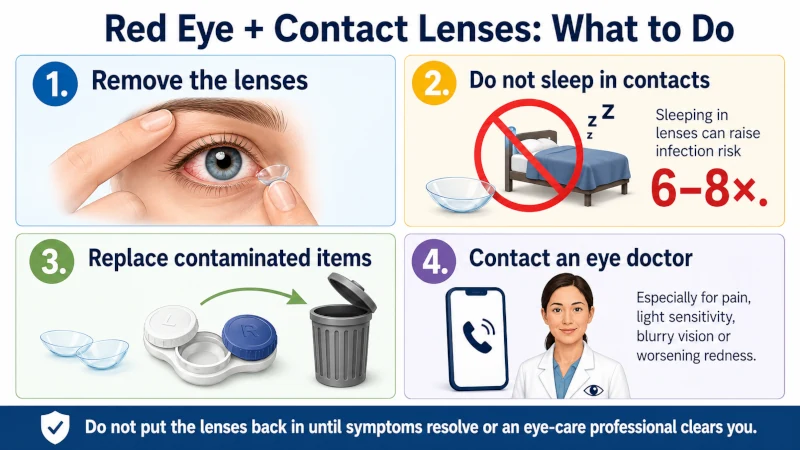
Contact lens wearers do not get the same wait-and-see advice as everyone else. This is the most important safety point on the page.
CDC’s clinical guidance is explicit: “Contact lens wearers with bacterial conjunctivitis are at higher risk of bacterial keratitis. They should be asked to remove their contact lenses; treated with topical antibiotics; and promptly evaluated by an ophthalmologist” [CDC, 2024].
Take the lenses out and call an eye doctor if you have irritated red eyes, worsening pain even after removing the lenses, light sensitivity, sudden blurry vision, or excessive tearing or discharge [CDC, 2025].
Sleeping in lenses carries a specific, quantified risk. A CDC report in MMWR found that sleeping in lenses — “whether inadvertently, occasionally, or as part of a prescribed wearing schedule” — increases the risk of contact lens-related eye infection six- to eightfold, and that roughly a third of wearers report doing it [Cope, 2018].
If pink eye symptoms do develop, stop wearing lenses until symptoms have gone or your doctor clears you, discard disposable lenses and the case used while you were symptomatic, and disinfect reusable lenses according to your provider’s instructions [CDC, 2024].
Children, newborns, and school
Newborns are the exception to every reassuring sentence on this page. CDC advises that newborns with symptoms of pink eye should be seen by a doctor right away, because conjunctivitis in the first weeks of life can be serious [CDC, 2024].
For older children, most infectious conjunctivitis is viral and self-limited [CDC, 2024]. CDC advises staying home when conjunctivitis comes with systemic signs of illness, particularly where close contact cannot be avoided [CDC, 2024]. Many schools apply stricter exclusion rules than the medical evidence supports — check your school’s policy, but do not assume a course of antibiotic drops is medically necessary to get back in the classroom.
Any child with eye pain, a change in vision, swelling spreading across the lid or into the cheek, or fever with an ill appearance should be seen the same day [Carlisle, 2015].
What the wrong guess actually costs
Antibiotics that were never going to work. Michigan Medicine reported on an analysis of 340,372 people diagnosed with acute conjunctivitis across 14 years: 58% filled a prescription for antibiotic eye drops, and about 20% of those filled a combination antibiotic-steroid drop that can worsen some eye infections [Michigan Medicine, 2017]. Prescribing tracked more closely with the type of clinician seen than with medical need. CDC is clear that antibiotics will not improve viral pink eye [CDC, 2024].
Waiting, when waiting is the risk. Iritis, keratitis, scleritis and angle-closure glaucoma all produce a red eye. All can damage sight. All respond far better to early treatment.
Masking the problem with the wrong drop. Redness-relieving decongestant drops constrict blood vessels and make an eye look better without treating anything. AAO warns that when the drops wear off “your eyes can become more red than before” — rebound redness that can worsen with repeated use — and that a red eye can occasionally signal something like uveitis or glaucoma that needs a diagnosis rather than cosmetic correction [AAO, 2018]. Whitening an undiagnosed red eye is a poor trade.
Red flags: be examined the same day
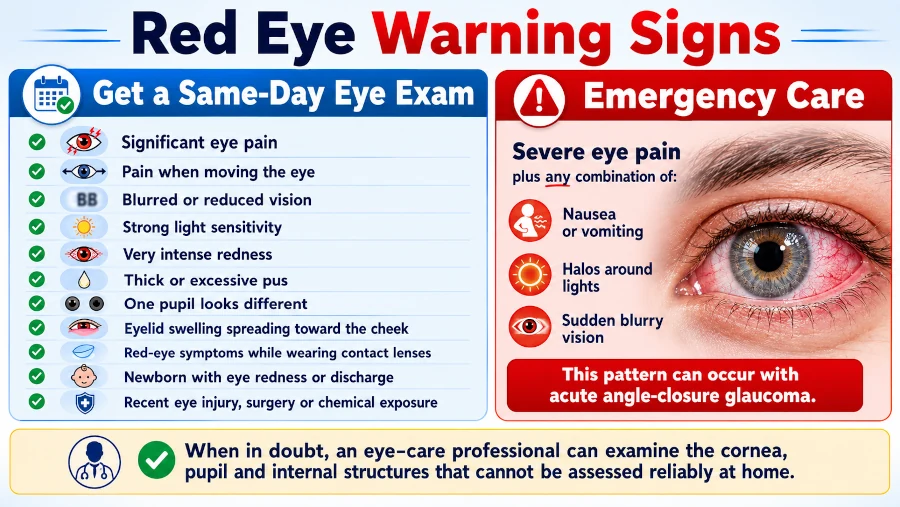
Any one of these is enough to justify an appointment today rather than a wait-and-see week [CDC, 2024] [Cronau, 2010]:
- Eye pain that is more than mild irritation, especially pain on moving the eye
- Blurred vision or vision loss that does not clear when you blink
- Sensitivity to light
- Intense redness of the eye
- Thick, copious pus
- A pupil that looks different from the other side, or reacts poorly to light
- Redness or swelling spreading across the whole eyelid or into the cheek
- Any symptoms at all in a contact lens wearer
- A newborn with eye redness or discharge
- Recent eye surgery, eye injury, or a chemical splash
- A history of herpes eye infection, or a weakened immune system
Go to an emergency department for severe eye pain with nausea, vomiting, halos around lights and sudden blurred vision — the pattern of acute angle-closure glaucoma [NEI, 2021].
Safe self-care while you sort it out
For a red eye with none of the red flags above, normal vision, and no contact lenses involved, a few things are reasonable while you work out what you are dealing with.
Cool compresses suit allergy and general irritation; warm compresses suit eyelid problems — styes, chalazia, blepharitis. Preservative-free artificial tears several times a day are safe for nearly everyone. Wash your hands often with soap and water for at least 20 seconds, use a fresh cotton ball or washcloth for each wipe of discharge, wash pillowcases, sheets and towels in hot water, and share none of them — or your makeup, or your eye drop bottles [CDC, 2024]. Throw out eye makeup used while you were symptomatic.
Expect it to take a while. Viral conjunctivitis typically runs five to seven days, though some cases stretch to three or four weeks; bacterial conjunctivitis usually settles in around ten days [Cleveland Clinic, 2026]. A 2023 Cochrane review of antibiotics versus placebo for acute bacterial conjunctivitis — 21 trials, 8,805 participants — found that roughly 55% of people given placebo resolved on their own by days four to nine, with antibiotics producing a modest improvement in clinical resolution at moderate certainty of evidence [Chen, 2023]. Antibiotics help some people; most bacterial conjunctivitis clears without them.
Three things not to do: do not use leftover prescription drops, particularly anything containing a steroid; do not use redness-relieving whitening drops on an eye nobody has examined; and do not put anything in your eye that was not manufactured for eyes. Home preparations involving boric acid, herbal infusions, tea bags or diluted anything carry a real contamination risk on an already-inflamed eye surface, and the evidence supporting them is weak to absent.
| Health Disclaimer: This article is for general education and is not a substitute for professional medical advice, diagnosis or treatment. Eye conditions that look alike from the outside can differ enormously in seriousness, and only an in-person examination by an optometrist or ophthalmologist — using tools such as a slit lamp and fluorescein staining — can reliably tell them apart. Do not use this page to diagnose yourself or to delay care. If you have eye pain, changes in vision, light sensitivity, or symptoms while wearing contact lenses, contact a qualified healthcare professional promptly. Never start, stop or change any medication based on what you read here. See our full medical advice disclaimer for more. |
Frequently Asked Questions
How can I tell allergic pink eye from an infection at home?
Itching in both eyes at once, with clear watery discharge and often a stuffy nose or sneezing, points to allergy [ACAAI] [CDC, 2024]. Thick pus that sticks the lashes together points to bacteria; a watery eye that started on one side and spread points to a virus. None of this is definitive, and any pain, light sensitivity or blurred vision moves the question out of the home-assessment category entirely.
Can dry eye really cause watery, red eyes?
Yes, and this catches people out constantly. Mayo Clinic lists watery eyes among dry eye symptoms as “the body’s response to the irritation of dry eyes” [Mayo Clinic]. A watering eye is not evidence against dry eye disease.
Do I need antibiotic eye drops for pink eye?
Usually not. Most acute infectious conjunctivitis in adults is viral and self-limited, and antibiotics do not improve viral pink eye [CDC, 2024] [CDC, 2024]. Even in bacterial cases, roughly 55% of placebo-treated participants in a 2023 Cochrane review resolved on their own within four to nine days [Chen, 2023]. Contact lens wearers are the notable exception and should be evaluated promptly [CDC, 2024].
What is the most serious condition that gets mistaken for pink eye?
Acute angle-closure glaucoma is the fastest-moving — NEI calls it a medical emergency and notes it can cause blindness within days if untreated [NEI, 2021]. Keratitis and iritis are more common and also sight-threatening if left. All three cause a red eye that a casual glance can mistake for conjunctivitis.
How long should I wait before seeing someone?
If you have any of the red flags listed above, do not wait at all. Without them, a red eye that is not improving after a few days, or is getting worse, warrants a visit [Cleveland Clinic, 2026]. Contact lens wearers should not wait even that long.
Is a red patch on the white of my eye dangerous?
A flat, painless red patch is usually a subconjunctival hemorrhage, which resolves without treatment over days to weeks [AAO, 2023]. Redness accompanied by pain, light sensitivity or a change in vision is a different matter and needs examining.
References
- Al-Namaeh M. COVID-19 and conjunctivitis: a meta-analysis. Therapeutic Advances in Ophthalmology. 2021;13. DOI 10.1177/25158414211003368. PMID 34192224. View source
- American Academy of Ophthalmology. Conjunctivitis: What Is Pink Eye? Boyd K. 2016. View source
- American Academy of Ophthalmology. What Is Uveitis? Reviewed by J. Kevin McKinney, MD. Dec 8, 2022. View source
- American Academy of Ophthalmology. What Is a Subconjunctival Hemorrhage? Reviewed by J. Kevin McKinney, MD. May 1, 2023. View source
- American Academy of Ophthalmology. Redness-Relieving Eye Drops. Boyd K; reviewed by J. Kevin McKinney, MD. Aug 31, 2018. View source
- American College of Allergy, Asthma & Immunology. Eye Allergies. View source
- Carlisle RT, DiGiovanni J. Differential Diagnosis of the Swollen Red Eyelid. American Family Physician. 2015;92(2):106-112. View source
- Centers for Disease Control and Prevention. About Pink Eye. Updated Apr 15, 2024. View source
- Centers for Disease Control and Prevention. Symptoms of Pink Eye. Updated Apr 15, 2024. View source
- Centers for Disease Control and Prevention. How to Treat Pink Eye. Updated Apr 15, 2024. View source
- Centers for Disease Control and Prevention. How to Prevent Pink Eye. Updated Apr 15, 2024. View source
- Centers for Disease Control and Prevention. Clinical Overview of Pink Eye (Conjunctivitis). Updated Apr 15, 2024. View source
- Centers for Disease Control and Prevention. What Causes Contact Lens-related Eye Infections. Updated May 27, 2025. View source
- Centers for Disease Control and Prevention. What Causes HSV (Herpes Simplex Virus) Keratitis. Updated May 27, 2025. View source
- Chen Y-Y, Liu ASH, Nurmatov U, van Schayck OCP, Kuo IC. Antibiotics versus placebo for acute bacterial conjunctivitis. Cochrane Database of Systematic Reviews. 2023;CD001211.pub4. DOI 10.1002/14651858.CD001211.pub4. View source
- Cleveland Clinic. Pink Eye (Conjunctivitis): What It Is, Types & Treatment. Last reviewed Jul 8, 2026. View source
- Cope JR, Konne NM, Jacobs DS, et al. Corneal Infections Associated with Sleeping in Contact Lenses — Six Cases, United States, 2016-2018. MMWR. 2018;67(32):877-881. View source
- Cronau H, Kankanala RR, Mauger T. Diagnosis and Management of Red Eye in Primary Care. American Family Physician. 2010;81(2):137-144. View source
- Mayo Clinic. Blepharitis — Symptoms & causes. View source
- Mayo Clinic. Dry eyes — Symptoms & causes. View source
- Mayo Clinic. Keratitis — Symptoms & causes. View source
- Mayo Clinic. Sty (stye) — Symptoms & causes. View source
- Michigan Medicine. Nearly 60% of Pinkeye Patients Receive Antibiotic Eye Drops, But They’re Seldom Necessary. Jun 27, 2017. View source
- National Eye Institute. Dry Eye. Updated Aug 6, 2025. View source
- National Eye Institute. Uveitis. Updated Dec 4, 2024. View source
- National Eye Institute. Types of Glaucoma. Updated Sep 10, 2021. View source
