
Most pink eye gets better on its own, and the home care that genuinely helps is simple: cool compresses, preservative-free artificial tears, clean hands, and a break from contact lenses. Those are the natural remedies for conjunctivitis that public-health agencies actually recommend [CDC pink eye treatment guidance, 2024]. What doesn’t help — and can make things worse — is putting homemade liquids into an already inflamed eye. Below you’ll find what to do, what to skip, how long to expect it to last, and the signs that mean you need a doctor today rather than another day of waiting.

One exception up front: if a baby in the first weeks of life has red, puffy or draining eyes, skip the home care entirely and get them seen right away [CDC guidance on pink eye in newborns, 2024].
First, which kind of pink eye is it?
Conjunctivitis means inflammation of the conjunctiva, the thin, clear membrane that covers the white of the eye and lines the inside of the eyelids. The three common causes are viruses, bacteria and allergies, with chemicals, contact lenses and bits of debris in the eye behind a smaller share [CDC overview of pink eye, 2024]. Viral pink eye is the most common type [American Academy of Ophthalmology, 2016].
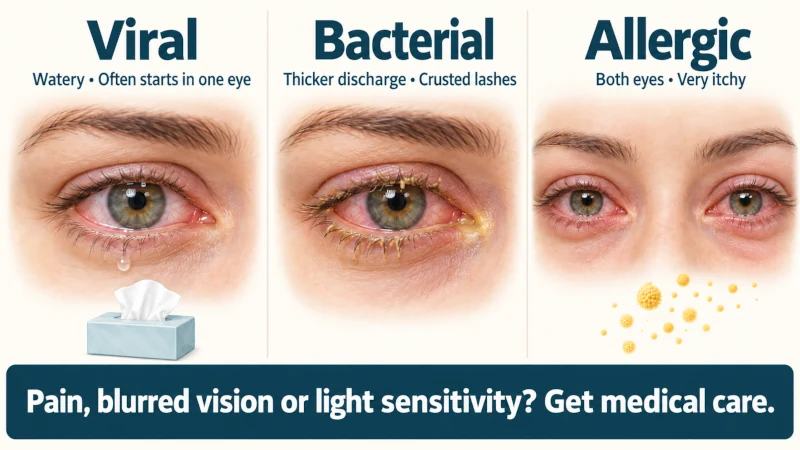
The type matters because it decides whether you’re contagious and which home measures fit. You can’t be certain from the mirror, but these patterns are a reasonable starting guess:
| Type | Typical signs | Contagious? |
| Viral | Watery discharge; often comes with a cold, flu or other respiratory infection; usually starts in one eye and spreads to the other within days [CDC guidance on pink eye symptoms, 2024] | Yes, very |
| Bacterial | Thick pus that can glue the eyelids shut; sometimes comes with an ear infection [CDC guidance on pink eye symptoms, 2024] | Yes, very |
| Allergic | Intense itching in both eyes at once, with sneezing or an itchy nose [CDC guidance on pink eye symptoms, 2024] | No |
| Irritant (smoke, chemicals, pool water) | Watery eyes and mucus discharge [CDC guidance on pink eye symptoms, 2024] | No |
Viral and bacterial pink eye spread easily from person to person [CDC overview of pink eye, 2024]. Allergic conjunctivitis isn’t contagious at all [American Academy of Ophthalmology, 2016]. If your “pink eye” hurts, blurs your vision or makes light painful, it may not be conjunctivitis — our guide to what can be mistaken for pink eye walks through the look-alikes that need a same-day exam. How to tell eye allergies from pink eye.
Natural remedies for conjunctivitis that are safe to try
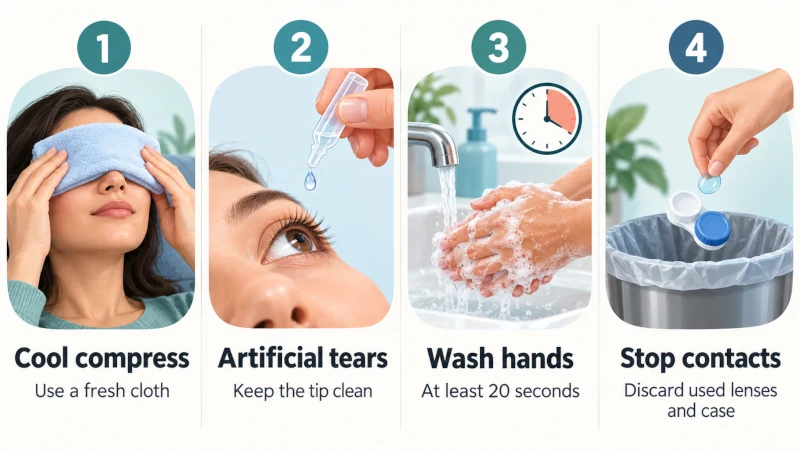
None of these cures the infection. Viral pink eye has to run its course, and most bacterial cases clear on their own. What these measures do is make you more comfortable and keep you from passing it on.
Cool compresses
Soak a clean washcloth in cool water, wring it out, and hold it over your closed eyes for a few minutes. CDC recommends cold compresses to calm the inflammation [CDC pink eye treatment guidance, 2024], and they are especially soothing for itchy, allergic eyes. Use a fresh cloth each time, and a separate one for each eye if only one is infected, so you don’t carry germs across.
Preservative-free artificial tears
Lubricating eye drops rinse the surface of the eye and ease the gritty, dry feeling [CDC pink eye treatment guidance, 2024]. They’re safe to use often, which is also why the allergy specialists at ACAAI list them as a first step for itchy eyes [ACAAI on eye allergy]. Single-use vials are the easiest way to keep drops clean. Don’t let the tip touch your eye, and never share a bottle — CDC lists eye drops among the personal items that spread pink eye [CDC pink eye prevention guidance, 2024].
Gentle cleaning of discharge
Crust that glues your lashes together overnight is common with bacterial pink eye. Wipe it away with a clean, damp cloth or cotton pad, working from the inner corner outward, then throw the pad away or put the cloth straight in the wash. Wash your hands before and after.
A break from contact lenses and eye makeup
Stop wearing contacts until your symptoms are gone or an eye doctor clears you. Throw away disposable lenses and the case you used while your eyes were infected [CDC pink eye prevention guidance, 2024]. This isn’t only about reinfection: contact lens wearers with bacterial pink eye are at higher risk of bacterial keratitis, an infection of the cornea that can threaten vision, and CDC advises they be evaluated promptly [CDC clinical overview of conjunctivitis, 2024]. Treat eye makeup the same way: stop using it, and replace anything that touched your eyes while you were sick.
Hygiene that stops the spread
This is the part of home care that protects everyone else in the house. CDC’s list is short and practical [CDC pink eye prevention guidance, 2024]:
- Wash your hands with soap and water for at least 20 seconds, especially after touching your eyes. Use an alcohol-based sanitizer with at least 60% alcohol if you can’t get to a sink.
- Wash pillowcases, sheets, washcloths and towels often in hot water and detergent.
- Don’t share pillows, towels, washcloths, eye drops, makeup or makeup brushes.
- Stay out of swimming pools until it clears.
For allergic pink eye: get away from the trigger
If both eyes itch and you’re also sneezing, the most effective natural remedy is avoidance. ACAAI suggests keeping windows closed and using air conditioning during high-pollen days, wearing sunglasses outside, using dust-mite-proof bedding covers, and keeping indoor humidity between 30% and 50% to limit mold [ACAAI on eye allergy]. Pair that with cool compresses and artificial tears.
Be careful with “get the red out” decongestant drops. ACAAI advises using them for no more than two or three days, because longer use causes rebound redness [ACAAI on eye allergy]. If over-the-counter options aren’t enough, an allergist or eye doctor can prescribe antihistamine or mast-cell-stabilizer drops that work far better.
How long pink eye lasts — and whether you need antibiotics
CDC’s estimates [CDC pink eye treatment guidance, 2024]:
- Viral: usually clears in 7 to 14 days, though some cases take two to three weeks or longer.
- Bacterial: often clears in 2 to 5 days without treatment, and can take up to two weeks.
Antibiotics won’t help viral pink eye, since they don’t work against viruses [CDC pink eye treatment guidance, 2024]. Most acute infectious conjunctivitis in adults is viral and self-limited [CDC clinical overview of conjunctivitis, 2024].
For bacterial pink eye, antibiotic drops do help — modestly. A 2023 Cochrane review of 21 trials with 8,805 participants found that about 55% of people given a placebo had recovered by days four to nine, compared with about 68% of those given antibiotics. The authors rated that evidence as moderate certainty and stressed that most cases are self-limited [Liu et al., Cochrane review findings, American Journal of Ophthalmology, 2023]. In other words, waiting a few days is reasonable for mild cases in otherwise healthy adults, but antibiotics can shorten things, and some people — contact lens wearers, anyone with a weakened immune system, newborns — shouldn’t wait.
Home remedies to skip
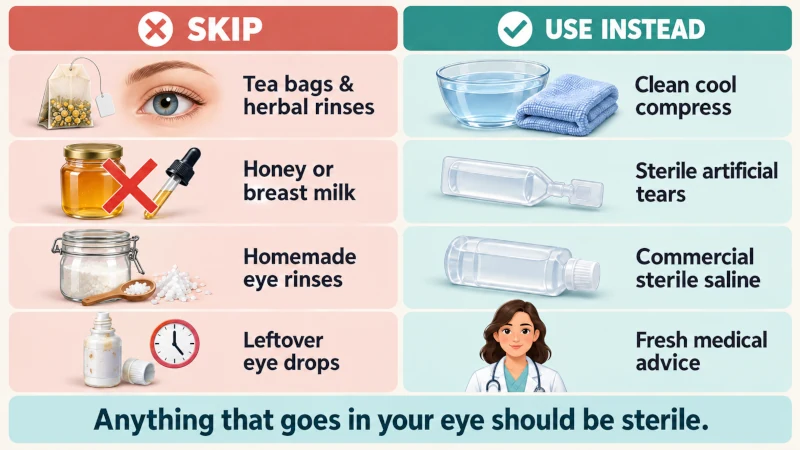
The common thread here is sterility. Anything you put in your eye bypasses some of the body’s natural defenses, which is why the FDA requires eye products to be sterile; contaminated eye products have caused infections, partial vision loss and blindness [FDA consumer guidance on eye drops]. A kitchen-made rinse, even one you boiled, isn’t made under those conditions.
| Remedy you’ll see recommended | The problem | What to do instead |
| Chamomile tea bags or chamomile rinses | Not sterile. NCCIH notes chamomile may irritate the eyes, and people allergic to ragweed, daisies, marigolds or chrysanthemums are more likely to react [NCCIH on chamomile, 2024]. | A clean washcloth soaked in cool water |
| Herbal washes (eyebright, fennel, chickweed, raspberry leaf, catnip, slippery elm, aloe) | Traditional use only; homemade infusions aren’t sterile eye products [FDA consumer guidance on eye drops] | Preservative-free artificial tears |
| Witch hazel pads on the eyes | Witch hazel product labels say to avoid the eyes — see our witch hazel safety guide | Cool compresses |
| Honey or breast milk drops | Not sterile; the FDA lists honey among ingredients with no legally marketed eye-drop formulation [FDA consumer guidance on eye drops] | Artificial tears; a doctor if it’s getting worse |
| Homemade salt-water or charcoal eye drops | Not sterile, and the salt concentration is easy to get wrong [FDA consumer guidance on eye drops] | Commercial sterile saline or artificial tears |
| Boric acid poultices or washes | Not a treatment for conjunctivitis in any CDC guidance; homemade preparations aren’t sterile | Leave it out |
| Leftover prescription eye drops | May not fit the cause this time, and an opened bottle can become contaminated [FDA consumer guidance on eye drops] | A fresh assessment from a doctor |
If you’re drawn to plant-based care for your eyes in general, our evidence review of herbs for eye health covers what has real research behind it — and it, too, draws the line at homemade eye drops.
Do vitamins or supplements help?
Not for an active case of pink eye. Vitamin A does matter for the eye surface: it helps keep the conjunctiva and cornea healthy, and a true deficiency causes dryness of the eye (xerophthalmia), with night blindness as the first sign [NIH Office of Dietary Supplements vitamin A fact sheet, 2025]. That deficiency is rare in the United States, and it shows up as its own set of signs, such as the foamy patches described in our guide to Bitot’s spots — not as ordinary pink eye.
Taking extra vitamin A won’t speed up recovery from a viral or bacterial infection, and high doses carry real risks:
- The upper limit for adults is 3,000 mcg a day of preformed vitamin A (retinol) from food and supplements combined.
- Doses above that in pregnancy can cause birth defects. Beta-carotene isn’t known to do this.
- High-dose beta-carotene supplements have raised lung cancer risk in current and former smokers.
All three points come from the NIH Office of Dietary Supplements, 2025. If you want more vitamin A, get it from food — our list of the best sources of vitamin A is a good start — and ask your doctor or pharmacist before starting any supplement, especially if you’re pregnant, smoke, or take prescription retinoids.
High-dose vitamin C, zinc and quercetin often show up on natural-remedy lists for pink eye. None of them appears in the treatment or allergy guidance from CDC or ACAAI, and they shouldn’t replace the steps above.
Newborns are the exception
Pink eye in a newborn is never a home-remedy situation. It can come from a blocked tear duct or from irritation caused by the preventive drops given at birth, but it can also be an infection passed from mother to baby during delivery — even when the mother had no symptoms [CDC guidance on pink eye in newborns, 2024].
Chlamydial eye infection usually shows up 5 to 12 days after birth and can spread to the lungs. Gonococcal eye infection appears within the first two to five days and can lead to corneal ulcers and blindness if it isn’t treated. That is why most states require antibiotic eye drops or ointment within a few hours of birth [CDC guidance on pink eye in newborns, 2024].
If your baby has eye drainage, puffy eyelids or redness, call your pediatrician right away or go to urgent care. Don’t try compresses, rinses or heat and wait to see.
When to see a doctor
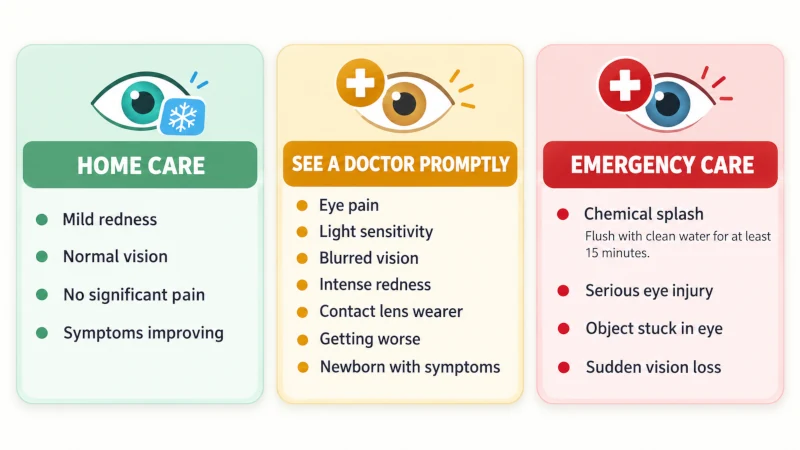
See a doctor — your primary care office, an eye doctor, or urgent care — if you have any of these [CDC pink eye treatment guidance, 2024]:
- Eye pain or sensitivity to light
- Blurred vision that doesn’t improve when you wipe away discharge
- Intense redness
- Symptoms that get worse, or don’t improve
- Bacterial pink eye that isn’t better after 24 hours on antibiotics
- A weakened immune system
- A newborn with any pink eye symptoms
Also get prompt care if you wear contact lenses and develop pink eye [CDC clinical overview of conjunctivitis, 2024].
Go to the ER or call 911 for a chemical splash, a serious eye injury, or something stuck in the eye. For chemicals, flush the eye with a gentle stream of cool tap water right away for at least 15 minutes, then get help. If an object is embedded, leave it in place, don’t rub the eye, and get emergency care [MedlinePlus on eye emergencies, 2025].
| Health Disclaimer: This article is for general education and isn’t a substitute for medical advice, diagnosis or treatment. Several eye conditions look like pink eye from the outside but need very different care, and only an in-person exam can tell them apart. Don’t put homemade preparations in your eyes, and don’t use this page to delay care for eye pain, light sensitivity, blurred vision, a contact lens–related infection, or any eye symptoms in a newborn. If you’re pregnant or breastfeeding, take prescription medicines, or are considering a supplement, talk to your doctor or pharmacist first. For a chemical splash, a serious eye injury, or sudden vision loss, call 911 or go to the ER. |
Frequently Asked Questions
What is the fastest natural way to get rid of pink eye?
There isn’t a natural remedy that clears the infection faster. Viral pink eye runs its course over one to two weeks, and bacterial pink eye often clears in a few days on its own [CDC pink eye treatment guidance, 2024]. Cool compresses and artificial tears make you more comfortable in the meantime. If it’s bacterial and you want it gone sooner, antibiotic drops from a doctor modestly speed recovery.
Are chamomile tea bags good for pink eye?
They’re better skipped. A tea bag isn’t sterile, chamomile can irritate the eyes, and people allergic to ragweed, daisies, marigolds or chrysanthemums are more likely to react to it [NCCIH on chamomile, 2024]. A plain, clean, cool washcloth gives you the same soothing effect without those risks.
Can I put breast milk or honey in my baby’s or my own eye?
No. Neither is sterile, and the FDA lists honey among ingredients with no legally marketed eye-drop formulation [FDA consumer guidance on eye drops]. For a baby in the first weeks of life, any eye redness or discharge needs a doctor, not a home remedy.
How long is pink eye contagious?
Viral and bacterial pink eye are very contagious while symptoms are present [CDC overview of pink eye, 2024]. Careful handwashing, not sharing towels or makeup, and washing linens in hot water all cut the spread [CDC pink eye prevention guidance, 2024]. CDC advises children not attend school if they can’t avoid close contact with others, and schools often set their own return rules [CDC clinical overview of conjunctivitis, 2024].
Is it OK to use leftover eye drops from a previous infection?
Don’t. Old prescription drops may not match the cause this time, and an opened bottle can become contaminated [FDA consumer guidance on eye drops]. Start with fresh artificial tears and let a doctor decide on anything stronger.
References
- American Academy of Ophthalmology. Boyd K. “Conjunctivitis: What Is Pink Eye?” View source
- American College of Allergy, Asthma & Immunology. “Eye Allergy.” View source
- Centers for Disease Control and Prevention. “About Pink Eye.” View source
- Centers for Disease Control and Prevention. “How to Treat Pink Eye.” View source
- Centers for Disease Control and Prevention. “How to Prevent Pink Eye.” View source
- Centers for Disease Control and Prevention. “Clinical Overview of Pink Eye (Conjunctivitis).” View source
- Centers for Disease Control and Prevention. “Symptoms of Pink Eye.” View source
- Centers for Disease Control and Prevention. “Pink Eye in Newborns.” View source
- Liu SH, Chen YY, Nurmatov U, van Schayck OCP, Kuo IC. “Antibiotics Versus Placebo for Acute Bacterial Conjunctivitis: Findings From a Cochrane Systematic Review.” American Journal of Ophthalmology, 2023. PMC10799969. View source
- MedlinePlus Medical Encyclopedia (U.S. National Library of Medicine). “Eye Emergencies.” View source
- National Center for Complementary and Integrative Health. “Chamomile.” View source
- NIH Office of Dietary Supplements. “Vitamin A and Carotenoids — Fact Sheet for Health Professionals.” View source
- U.S. Food and Drug Administration. “What You Should Know about Eye Drops.” View source


