
If you’re searching for sea wormwood plant benefits, the honest starting point is this: the plant’s one well-documented use is as a vermifuge — a remedy meant to expel intestinal worms — because its flower heads contain a compound called santonin. That use is real, and it has centuries of history behind it. But it comes with a serious catch. Santonin is toxic, it was abandoned by mainstream medicine decades ago, and far safer, more reliable deworming drugs have replaced it [Molecules, 2020].
So if you came here hoping for a natural home remedy, the practical answer is that sea wormwood is better understood as a piece of medical history than as something to take today. The sections below explain what the plant is, what santonin actually did, why it fell out of use, and what doctors now use instead.
What sea wormwood is
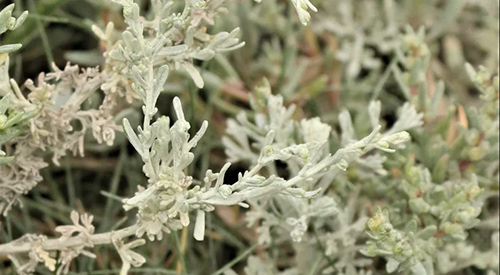
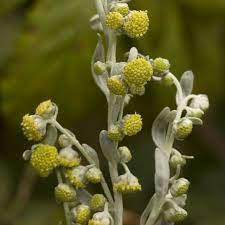
Sea wormwood (Artemisia maritima) is a small, aromatic shrub in the daisy family (Asteraceae, also called Compositae). It grows along coasts and on salty soils across Europe and well into Asia, reaching roughly 30–60 cm tall, with fine greyish hairs and small, dull-yellow flower heads. It’s a close relative of common wormwood (Artemisia absinthium), the bitter herb best known from absinthe, and of wormseed. The part used in traditional medicine is the unopened flower head, which is where the active compound concentrates.
Historically the plant sat among the herbs traditionally used against intestinal parasites. The U.S. Department of Agriculture’s ethnobotanical database lists Artemisia maritima with two activities worth putting side by side: “ascaricide” (kills roundworms) and “fatality” [USDA PhytoChem]. Both come from the same chemistry.
The one benefit with a real basis: santonin as a dewormer
The flower heads contain santonin, a sesquiterpene lactone that acts on parasitic worms. Through the 1800s and into the mid-1900s, purified santonin was a standard treatment for roundworm (Ascaris lumbricoides) infection. It was almost always given with a laxative or purgative: the santonin stunned or killed the worm, and the purgative then flushed it out [Molecules, 2020].
Two limits matter. First, santonin worked against roundworm and some related worms but not against tapeworm. Second, “it worked” is not the same as “it was safe.” The dose that cleared worms sat uncomfortably close to the dose that caused harm.
Why sea wormwood is no longer used
Santonin is poisonous in amounts not far above the old therapeutic dose, and it leaves the body slowly, so it can build up with repeated dosing and act as a cumulative poison. Peer-reviewed analyses put the toxic threshold at roughly 60 mg in children and 200 mg in adults [Molecules, 2020].
The most famous warning sign is xanthopsia — objects take on a yellow tint, sometimes with violet shading of dark areas — which in serious cases progressed to temporary or lasting vision loss. Larger or repeated overdoses caused nausea and vomiting, headache, dizziness, tremor, and convulsions, and fatal poisonings were recorded, including in children [Molecules, 2020]. Because of this, santonin was withdrawn and is no longer registered as a medicine in most countries [NIH/PMC, 2017].
This is the part of the old folk instructions that deserves a hard stop. Traditional texts describe grinding dried flower heads and giving grams of the raw plant to children over several mornings. A homemade preparation gives you no way to know how much santonin you are actually delivering, and grams of flower head can carry far more than the milligram-level amounts where harm begins. There is no safe way to do this at home, and the risk falls hardest on the children these recipes were aimed at.
What actually treats intestinal worms now
Roundworm and the other common soil-transmitted worms are now treated with medicines that are both safer and more effective than anything in the wormwood family. The U.S. Centers for Disease Control and Prevention lists albendazole (400 mg once), mebendazole (100 mg twice daily for three days, or 500 mg once), and ivermectin as standard options, with the same dosing for adults and children and a course that usually lasts one to three days [CDC, 2024].
How well do they work? A Cochrane review pooling 30 trials found single-dose albendazole, mebendazole, and ivermectin all produced high cure rates against Ascaris with no serious side effects reported [Cochrane, 2019]; individual trials commonly report cure rates above 95% for roundworm [Cochrane, 2019]. These drugs are considered safe enough that the World Health Organization donates them for mass treatment of school-age children in regions where worms are common [WHO, 2023].
| Santonin from sea wormwood | Modern deworming drugs | |
| Current status | Obsolete; withdrawn from medical use over toxicity | First-line, WHO-recommended worldwide |
| Effect on roundworm (Ascaris) | Stuns or kills the worm; needed a laxative to clear it | Single dose clears the infection in most people |
| Effect on tapeworm | None | Specific drugs available for tapeworm |
| Typical course | Repeated morning doses plus a purgative | One to three days |
| Main safety problem | Cumulative poison; visual disturbance, seizures, death reported | Generally well tolerated; mild, short-lived side effects |
How sea wormwood’s santonin compares with the medicines doctors use today.
Other traditional claims, and how strong the evidence is
Beyond deworming, sea wormwood appears in old herbals as a bitter digestive tonic and a remedy for low-grade fevers. Those uses are plausible in the loose sense that bitter Artemisia herbs can stimulate appetite and digestion, but the evidence specific to Artemisia maritima in people is thin. Most modern research on the genus looks at the chemistry of the plants or at effects in test tubes and animals, not at controlled trials in humans. Treat any “digestive” or “fever” benefit as traditional use rather than proven medicine.
You’ll also see sea wormwood mentioned alongside other santonin- or oil-bearing relatives such as Mexican wormwood (Artemisia mexicana) and the muscle-paralysing fern remedy male fern. They share the same basic problem: the active chemistry that expels worms is also what makes the plant risky in uncontrolled doses.
Safety, cautions, and who should avoid it
The straightforward guidance is that no one should use sea wormwood or santonin as a home dewormer. The caution is sharpest for these groups:
- Children. Historical poisonings, including deaths, occurred at low doses in kids, and children were the main target of these old recipes.
- Pregnant or breastfeeding people. Wormwood-family plants contain compounds (including thujone in some species) that can stimulate the uterus; safety has not been established. If treatment is needed, a clinician can choose a medicine suited to pregnancy.
- Anyone with eye, liver, or neurological conditions. Santonin’s known harms target vision and the nervous system.
- People taking other medication. Interactions for homemade Artemisia preparations are unpredictable because the dose itself is unknown.
Red flags: when worms need urgent care
A confirmed worm infection is usually treated easily, but certain symptoms point to complications and need prompt medical attention rather than any home remedy [CDC DPDx, 2019]:
- Severe abdominal pain, a swollen belly, or vomiting — especially vomiting up a worm — which can signal the intestine being blocked by a mass of worms.
- No stool or gas alongside that pain, another sign of obstruction.
- Yellowing of the skin or eyes, or intense right-upper-abdomen pain, which can mean a worm has moved into the bile duct.
- Fever with cough or breathing trouble during early infection, when larvae pass through the lungs.
Diagnosis is simple and worth doing properly: a clinician checks a stool sample for eggs, and an expelled worm can be identified directly [Mayo Clinic, 2024]. That confirmation matters, because the right drug depends on which worm you have.
Realistic expectations
If your interest in sea wormwood is historical or botanical, it’s a genuinely interesting plant — a coastal herb that gave nineteenth-century medicine one of its first real deworming drugs. If your interest is practical, set expectations honestly: there is no version of this plant that is a safe, modern home treatment, and a single prescribed tablet will do the job better and more safely than anything you could prepare yourself.
| Health disclaimer This article is for general education and is not medical advice. Sea wormwood and santonin are described here for historical and informational purposes only; nothing in this article is a recommendation to use them. Do not attempt to treat intestinal worms — your own or a child’s — with sea wormwood or any homemade preparation. If you think you or your child has a parasitic infection, see a doctor, who can confirm the diagnosis and prescribe a safe, proven treatment. Always talk to a qualified healthcare professional before using any herb or supplement, especially if you are pregnant, breastfeeding, taking medication, or managing a health condition. |
Frequently asked questions
Is sea wormwood safe to take for parasites?
No. Its active compound, santonin, is toxic at amounts close to the doses once used to treat worms, and homemade preparations give no reliable way to control the dose [Molecules, 2020]. Safe, proven prescription medicines have replaced it.
What is santonin, and why was it banned?
Santonin is the worm-expelling chemical in sea wormwood and a few related plants. It worked against roundworm but caused yellow vision, seizures, and in some cases death, and it builds up in the body, so it was withdrawn and is no longer a registered medicine in most countries [NIH/PMC, 2017].
Does sea wormwood work against tapeworm?
No. Santonin acted on roundworm and some related worms but had no useful effect on tapeworm, which needs different, specific treatment [CDC, 2024].
What should I use instead to treat intestinal worms?
See a healthcare provider. For roundworm, the usual options are a single dose of albendazole or ivermectin, or mebendazole over one to three days, with cure rates above 95% and few side effects [Cochrane, 2019].
Is sea wormwood the same as the wormwood in absinthe?
No, but they’re relatives. Absinthe uses common wormwood (Artemisia absinthium), which is known for thujone rather than santonin. Sea wormwood (Artemisia maritima) is a separate coastal species.
References
- World Health Organization. Soil-transmitted helminth infections (fact sheet). 2023. → View source
- Centers for Disease Control and Prevention. Clinical Care of Soil-transmitted Helminths. 2024. → View source
- Centers for Disease Control and Prevention, DPDx. Ascariasis. 2019. → View source
- Mayo Clinic. Ascariasis — Diagnosis & treatment. 2024. → View source
- Cochrane Infectious Diseases Group. Comparing the effect of medications for treating Ascaris infection (CD010599). 2019. → View source
- Pharmacological Evaluation of Artemisia cina Crude CO₂ Subcritical Extract after the Removal of Santonin. Molecules. 2020. → View source
- Quantification of santonin in eight species of Artemisia from Kazakhstan (HPLC-UV). NIH/PMC. 2017. → View source
- U.S. Department of Agriculture. Ethnobotanical Plant: Artemisia maritima. Dr. Duke’s Phytochemical and Ethnobotanical Databases. → View source
