
Gotu kola (Centella asiatica) has a short list of uses with real human research behind them and a much longer list that rests on tradition, cell cultures and rodents. The best-supported gotu kola benefits are for sluggish leg-vein circulation and, applied to the skin, wound healing. The memory and anxiety claims you see on supplement labels are weaker than they look. Gotu kola is usually well tolerated, but it has been tied to rare cases of liver injury, so it is not a no-risk herb.
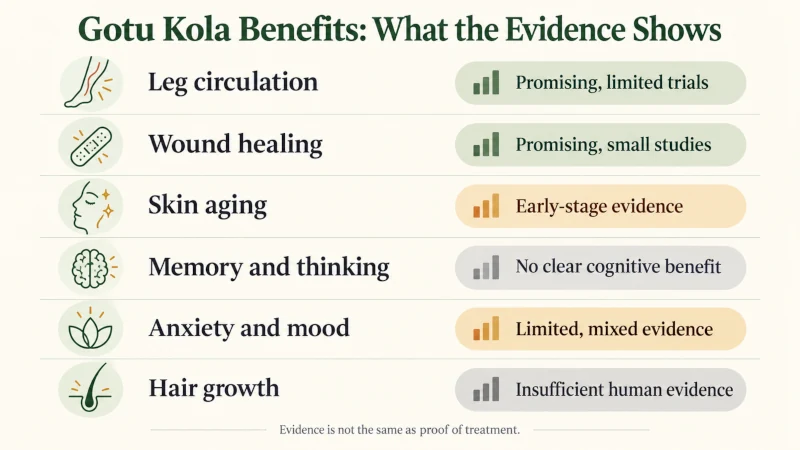
Here is how the main claims stack up before we go through each one.
| Claimed benefit | Best evidence we found | Our read |
| Leg circulation, swelling, varicose veins | Several small human trials of standardized extracts | Promising — the strongest case, still limited |
| Wound healing (topical or oral) | Systematic review of 4 human trials | Promising but small |
| Stretch marks | Cochrane review of topical creams | Not supported |
| Wrinkles and collagen | Lab and cosmetic studies | Early-stage |
| Memory and thinking | Meta-analysis of 11 trials | Not supported so far |
| Anxiety and mood | A few small human studies | Limited, mixed |
| Hair growth | No human trials found | Insufficient |
What is gotu kola?
Gotu kola is a low, creeping perennial in the carrot and parsley family (Apiaceae). It has small fan-shaped leaves, grows in damp, swampy ground across South and Southeast Asia and other tropical regions, and has been used in Ayurveda and traditional Chinese medicine for a very long time — in India it is also called mandukparni or Indian pennywort [Gohil et al., 2010].
Despite the name, it has nothing to do with the kola nut. Gotu kola contains no caffeine and is not a stimulant [Gohil et al., 2010]. The compounds researchers care about are triterpenes — chiefly asiaticoside, madecassoside, asiatic acid and madecassic acid [Gohil et al., 2010]. How much of them a product contains varies a lot depending on where the plant was grown [MSK, 2022], which is one reason study results don’t always translate to the bottle on a store shelf.
Gotu kola benefits, ranked by the evidence
1. Leg circulation and varicose veins
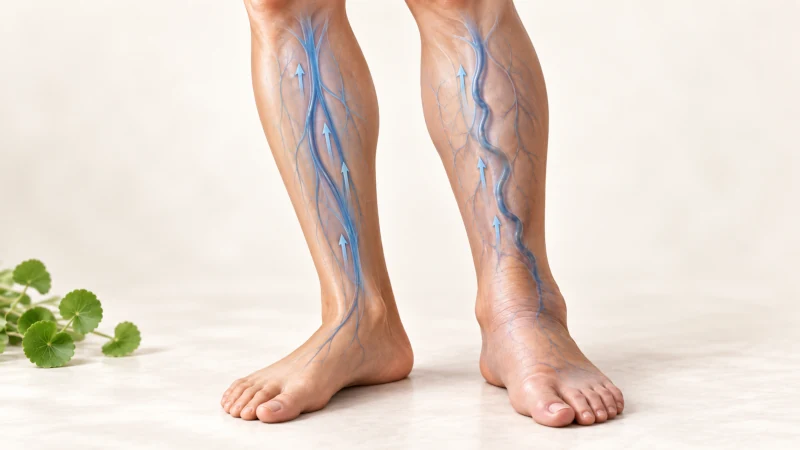
This is gotu kola’s strongest use. Memorial Sloan Kettering’s herb database describes several trials in which standardized extracts reduced lower-leg swelling or venous pressure compared with placebo in people with chronic venous insufficiency — the condition where leg veins struggle to push blood back toward the heart [MSK, 2022]. In one trial described in a 2010 review, 94 people with venous insufficiency took 60 mg or 120 mg a day of a titrated extract, or placebo, for two months; the extract groups did better on leg heaviness and swelling measures [Gohil et al., 2010].
Keep it in proportion. These trials are small, mostly decades old, and used specific standardized extracts rather than tea or loose powder. MSK’s overall verdict is that the evidence is not yet strong enough to support gotu kola for any condition [MSK, 2022]. If your legs ache, swell or show bulging veins, get them checked first — our guide to what varicose veins are and how they’re treated covers the options that do have solid evidence, like compression and movement. Swelling in only one leg, especially with pain, warmth or redness, can mean a blood clot and needs same-day care.
2. Wound healing and scars
Gotu kola has been used on wounds for centuries, and lab work offers a plausible reason: in cell and animal studies, its triterpenes increase collagen production and new blood-vessel growth at the wound site [Gohil et al., 2010]. In people, a 2022 systematic review found only four clinical trials. They suggested gotu kola may help wounds close and look better, but the trials measured different things, so the results couldn’t be pooled, and some carried an unclear risk of bias [Arribas-López et al., 2022].
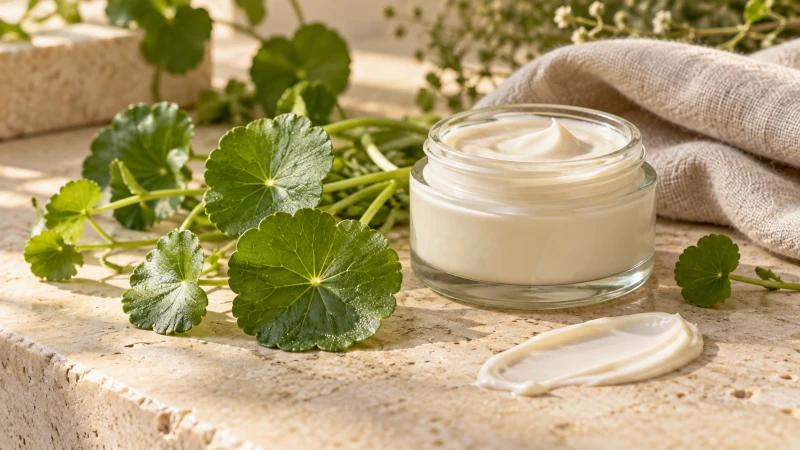
Europe’s medicines regulator has published an EU herbal monograph for gotu kola in the area of skin disorders and minor wounds [EMA, 2022]. That is a reasonable signal for small, clean, everyday skin injuries. It is not a reason to put gotu kola on a deep, infected or slow-healing wound — those need medical care, especially if you have diabetes.
3. Skin aging, collagen and stretch marks
Gotu kola is the “cica” in a lot of soothing creams. The anti-wrinkle story mostly comes from fibroblast cultures showing more collagen after exposure to its triterpenes [Gohil et al., 2010]. That is a long way from proof that a cream changes your skin.
Stretch marks are where the marketing gets ahead of the data. A Cochrane review of creams for preventing stretch marks in pregnancy found no high-quality evidence that any topical preparation works; pooled results for active creams versus placebo or nothing were not statistically significant [Brennan et al., Cochrane]. Some older products in those trials combined gotu kola with other ingredients such as vitamin E, so even a positive single study can’t be credited to gotu kola alone.
4. Memory and thinking
Gotu kola is sold hard as a “brain herb,” and the animal research is genuinely interesting. The human picture is flatter. A 2017 meta-analysis pooled 11 randomized trials and found no significant improvement over placebo in any area of cognition. It did find a modest increase in alertness and a short-term drop in anger scores, and none of the trials reported side effects [Puttarak et al., 2017]. The authors concluded there is not strong evidence for gotu kola as a cognitive enhancer and called for better trials with standardized doses [Puttarak et al., 2017].
If memory is your worry, start with what is known to help. Our article on memory changes in older adults explains which changes are normal, which ones deserve a doctor’s visit, and why sleep, exercise and blood pressure control beat any supplement.
5. Anxiety, mood and stress
There are hints, not answers. A small double-blind study in healthy volunteers found gotu kola blunted the acoustic startle response, which researchers use as a rough proxy for anxiety [Gohil et al., 2010]. MSK notes one small study in generalized anxiety disorder [MSK, 2022]. Claims that gotu kola treats depression come from mouse experiments [Gohil et al., 2010]. Gotu kola is often grouped with adaptogens, but the human evidence for that label is thin; our evidence guide to adaptogenic herbs covers the better-studied options.
Ongoing anxiety or low mood is worth treating properly. Common mental health conditions respond well to therapy and, when needed, medication — and gotu kola can add to the drowsiness some of those medicines cause (more on that below).
6. Hair growth
Gotu kola shows up in many shampoos and scalp oils, but we found no human trials showing it helps hair grow or stops hair loss. Treat those claims as unproven. Sudden or patchy hair loss is worth a visit to a doctor or dermatologist, since thyroid problems, iron deficiency and some medications are common causes.
How to take gotu kola
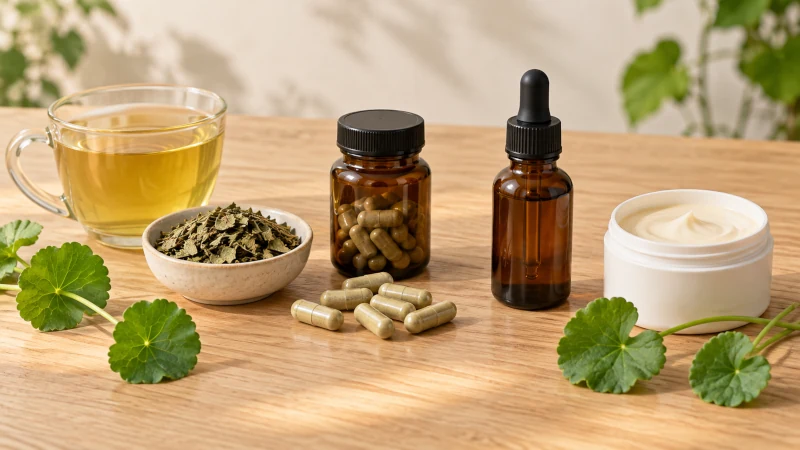
Gotu kola comes as dried leaf for tea, capsules or tablets of powdered herb or extract, liquid tinctures, and creams or ointments. Standardized extracts — labeled with a set percentage of triterpenes — are what most clinical trials used, so they are the closest match to the research. Tea and whole-leaf powder are traditional but vary much more in strength.
Amounts used in research
There is no officially established dose. The table below lists amounts that appear in studies or standard references, so you can compare a product label against them. It is not a prescription.
| Form | Amount reported | Context |
| Titrated extract (venous trials) | 60–120 mg per day, for about 2 months | Venous insufficiency trial described by [Gohil et al., 2010] |
| Triterpene fraction (venous trials) | 30 mg or 60 mg twice daily | Venous hypertension trial described by [Gohil et al., 2010] |
| Extract (cognition trial) | 250, 500 or 750 mg per day, for 2 months | Small trial in healthy older adults described by [Gohil et al., 2010]; pooled evidence did not show a cognitive benefit [Puttarak et al., 2017] |
| Dried leaf tea | 1–2 teaspoons dried leaf in about 150 ml boiling water, steeped 10–15 minutes | Traditional preparation reported in [Gohil et al., 2010] |
Some herbal references suggest not taking gotu kola continuously for more than about six weeks without a break [Gohil et al., 2010]. That advice comes from tradition rather than trials, but given the liver reports below, taking it for a defined period rather than indefinitely is sensible. Buy from a brand that uses third-party testing, since supplement contents are not checked by the FDA before sale.
Gotu kola side effects and safety
Common side effects
Most people who take gotu kola notice nothing. When side effects happen, the usual ones are an upset stomach, nausea, headache, dizziness and drowsiness, mostly at higher doses [Gohil et al., 2010]. On the skin, creams can cause a rash or contact dermatitis in a small number of people [MSK, 2022]. Patch-test a new product on your inner arm for a day before using it widely.
Rare liver injury
This is the side effect to take seriously. The U.S. National Institutes of Health’s LiverTox database rates gotu kola as a probable rare cause of clinically apparent liver injury. The reported cases — mainly three women described in 2005 and one later case — developed hepatitis with jaundice about 3 to 8 weeks after starting the product, and recovered within one to two months of stopping. In one case the injury came back when the person took it again [LiverTox, 2024]. Whether the herb itself or contaminants in those products were responsible was not settled [LiverTox, 2024].
Liver injury is rare, and in the few prospective human studies liver enzymes did not rise [LiverTox, 2024]. But it is the reason people with liver disease should avoid gotu kola, and the reason anyone taking it should know the warning signs listed below.
Medication interactions
In lab tests, gotu kola blocks several liver enzymes (CYP1A2, 2C9, 2C19, 2D6 and 3A4) that clear many common drugs; whether that matters in people hasn’t been worked out [MSK, 2022]. MSK’s patient guidance is more cautious than its clinical summary and advises against combining gotu kola with drugs processed by these enzymes [MSK, 2022]. Because that covers a very wide range of prescriptions, the practical step is to ask your pharmacist before combining gotu kola with any regular medication.
Two more combinations deserve care. Gotu kola can cause drowsiness, so it may add to the effect of sleep aids, anti-anxiety medicines, opioids, some antihistamines and alcohol [Gohil et al., 2010]. Older reviews also raise a theoretical effect on blood sugar and cholesterol medicines [Gohil et al., 2010]; that one is not well documented, but it is worth mentioning to your doctor if you take them.
Who should skip gotu kola
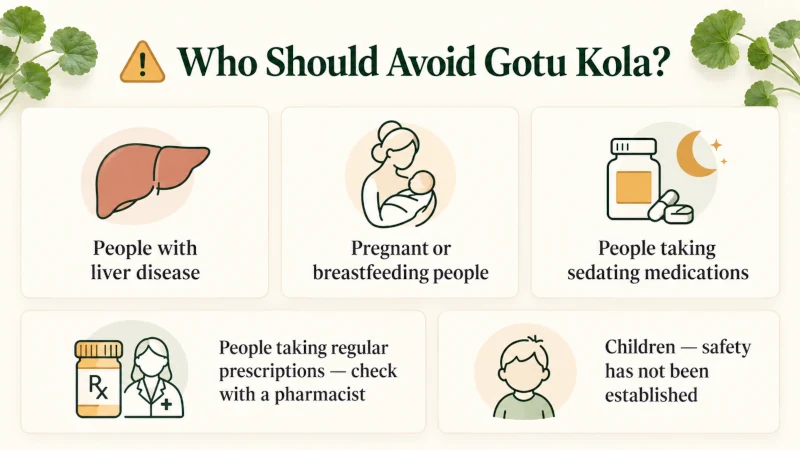
- People with liver disease or a history of drug- or herb-related liver injury [LiverTox, 2024].
- Pregnant or breastfeeding women. There is little safety information, and an old animal study raised concerns about fertility and pregnancy [Gohil et al., 2010].
- Anyone taking sedatives or other medicines that cause drowsiness, unless a clinician has okayed it [Gohil et al., 2010].
- People on regular prescriptions cleared by the liver, until a pharmacist has checked for interactions [MSK, 2022].
- Children, since dosing and safety have not been studied, and MSK lists a liver-injury report in a child [MSK, 2022].
Stop and call a doctor if…
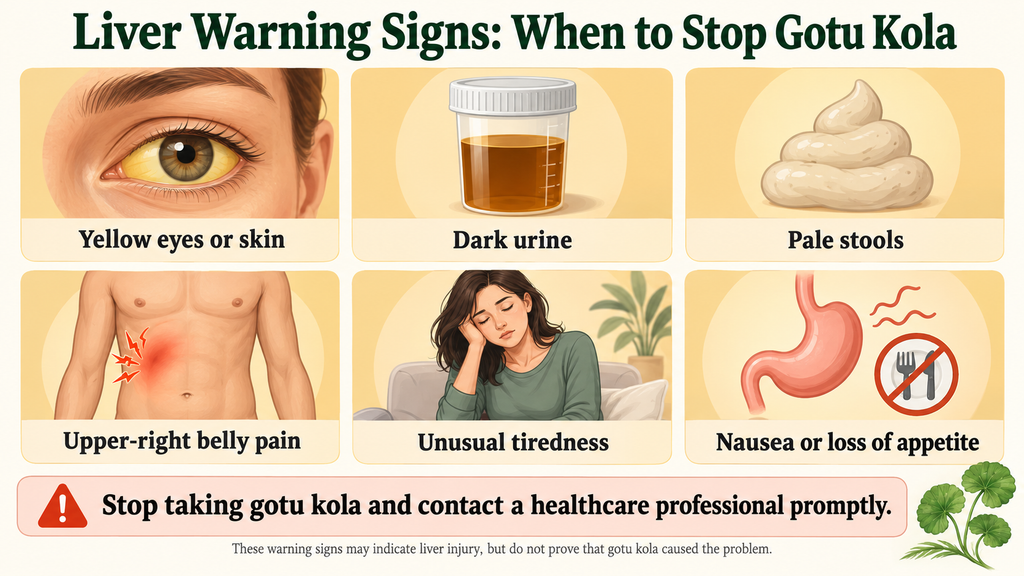
Stop taking gotu kola and contact a healthcare professional promptly if you notice yellowing skin or eyes, dark urine, pale stools, pain in the upper right abdomen, unusual tiredness, or loss of appetite with nausea — these can signal liver injury [LiverTox, 2024]. Get urgent care for hives with swelling of the face or lips or any trouble breathing. Don’t restart gotu kola after a suspected liver reaction [LiverTox, 2024].
| HEALTH DISCLAIMER: This article is for general education and is not medical advice. It doesn’t replace a diagnosis or treatment plan from a qualified healthcare professional. Talk with your doctor or pharmacist before taking gotu kola if you take prescription medicines, have a liver condition, are pregnant or breastfeeding, or are giving it to a child. Herbal supplements are not reviewed for safety or effectiveness by the FDA before they are sold, and product strength can vary. If you have symptoms of a medical emergency, call 911 or your local emergency number. Read our full medical advice disclaimer. |
Frequently Asked Questions
Is gotu kola the same as kola nut?
No. They are unrelated plants. Kola nut contains caffeine; gotu kola does not and is not a stimulant [Gohil et al., 2010].
How long does gotu kola take to work?
In the venous trials, benefits on leg swelling were measured after about four to eight weeks of a standardized extract [Gohil et al., 2010]. There is no reliable timeline for memory or mood, because the pooled trials did not show a clear effect [Puttarak et al., 2017].
Can I take gotu kola every day?
Many people do for short periods without problems. Because of the rare liver reports, it’s sensible to use it for a defined stretch — some references suggest no more than about six weeks before a break [Gohil et al., 2010] — and to stop at any sign of liver trouble [LiverTox, 2024].
Does gotu kola help with brain fog or ADHD?
There is no good evidence for either. A meta-analysis of 11 trials found no meaningful cognitive benefit, though alertness scores rose modestly [Puttarak et al., 2017]. If focus problems are new or affecting work or school, a doctor can look for causes such as sleep problems, thyroid issues or depression.
Is gotu kola cream (cica) safe for sensitive skin?
Usually, but a small number of people develop a rash or contact dermatitis [MSK, 2022]. Patch-test first and skip it on broken, infected or weeping skin unless a clinician recommends it.
References
- Puttarak P, Dilokthornsakul P, Saokaew S, et al. Effects of Centella asiatica (L.) Urb. on cognitive function and mood related outcomes: a systematic review and meta-analysis. View source
- Arribas-López E, Zand N, Ojo O, Snowden MJ, Kochhar T. A systematic review of the effect of Centella asiatica on wound healing. International Journal of Environmental Research and Public Health. View source
- Memorial Sloan Kettering Cancer Center. About Herbs: Gotu kola. View source
- National Institute of Diabetes and Digestive and Kidney Diseases. LiverTox: Centella asiatica. View source
- Gohil KJ, Patel JA, Gajjar AK. Pharmacological review on Centella asiatica: a potential herbal cure-all. Indian Journal of Pharmaceutical Sciences. View source
- Brennan M, Young G, Devane D. Topical preparations for preventing stretch marks in pregnancy. View source
- European Medicines Agency. Centellae asiaticae herba — herbal medicinal product. View source


