
Fo-ti, sold in Chinese medicine as he shou wu, has a centuries-old reputation for turning gray hair dark again and keeping people young. Here is the honest version of fo-ti benefits: almost all of the supporting research comes from test tubes and lab animals, and no well-controlled human trial has shown that it darkens hair, slows aging, or sharpens memory [Drugs.com, 2026].
What is well documented in people is liver injury. The NIH’s LiverTox database gives fo-ti its highest likelihood rating, meaning it is a well-established cause of clinically apparent liver damage [LiverTox, 2020]. Most people who take it won’t be harmed. But you deserve both halves of the story before you buy a bottle.
| Fo-ti at a glance What it is: the root of Polygonum multiflorum, also sold as he shou wu, Shou Wu Pian, and Shen Min.Best-known use: graying and thinning hair. Evidence in people: none from controlled trials.Other claims (aging, memory, cholesterol, blood sugar, cancer): lab and animal findings only.Main safety concern: liver injury, rated a well-established risk by the NIH’s LiverTox.Avoid it if you have liver disease, are pregnant or breastfeeding, or are buying it for a child. |
What fo-ti is
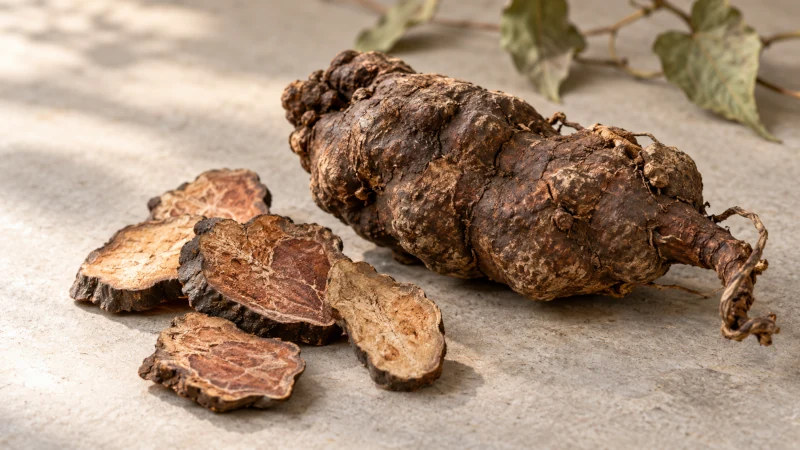
Fo-ti is the root of Polygonum multiflorum (also classified as Fallopia multiflora), a climbing vine in the buckwheat family native to central and southern China [Drugs.com, 2026]. “Fo-ti” is mostly a Western market name. On labels you may also see he shou wu, ho shou wu, Shou Wu Pian, Shen Min, fleeceflower root, or Chinese knotweed. They all refer to the same plant [LiverTox, 2020].
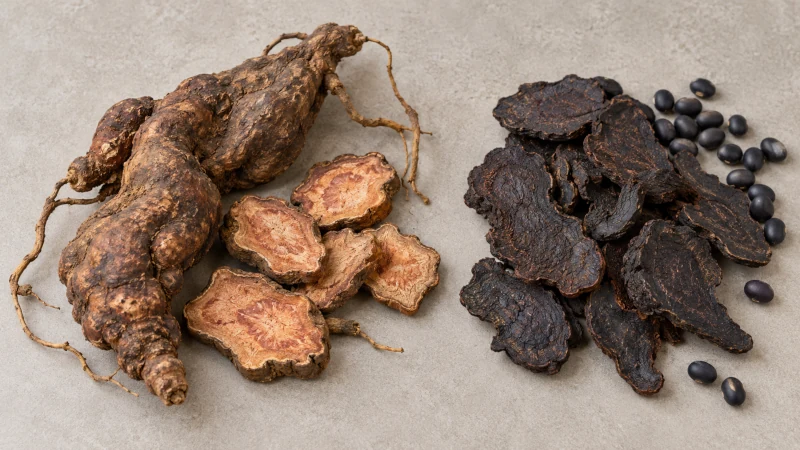
The root is used two ways. Raw root is traditionally a laxative. Processed root, which is steamed or boiled (classically with black soybeans), is the form used as a tonic for hair and aging [Liu et al., 2018; LiverTox, 2020]. Both are sold in the United States [Drugs.com, 2026], and researchers say there is still no reliable way to confirm how well a processed product was actually prepared [Liu et al., 2018].
More than 100 compounds have been identified in the root [Lin et al., 2015]. Two groups get most of the attention. Stilbene glycosides, especially one called TSG (tetrahydroxystilbene glucoside), drive most of the lab research on possible benefits [Pharmazie review, 2021]. Anthraquinones such as emodin, physcion, and chrysophanol account for the laxative effect and are the leading suspects in liver toxicity [LiverTox, 2020].
Fo-ti benefits: what the research actually shows
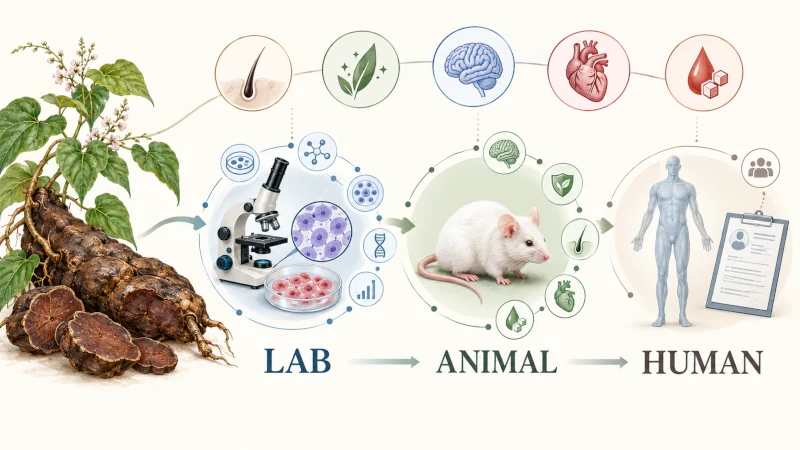
The table below grades each popular claim. “Lab” means cells or chemical assays; “animal” usually means mice or rats. Neither tells you what a capsule does in a human body.
| Claimed benefit | What has been studied | Evidence in people |
| Darker or thicker hair | Mouse studies; lab cultures of hair-follicle cells | None from controlled trials |
| Anti-aging, antioxidant | Chemical antioxidant assays; cell and animal studies | None |
| Memory and dementia | Cell and rat studies; one Chinese study of a multi-herb formula with unclear methods | Very limited, low quality |
| Cholesterol and heart | Mouse and cell studies | None |
| Blood sugar | Lab and rat studies | None |
| Cancer | Cell and limited animal studies | None |
| Estrogen-like effects | One test-tube assay (2003) | None |
| Constipation | Traditional use of raw root; anthraquinones are known laxatives | Traditional use; plausible mechanism |
Sources: [Drugs.com, 2026; LiverTox, 2020; Oerter Klein et al., 2003]
Hair: the reason most people buy it
Hair is where the lab work is most interesting. Fo-ti applied to the skin of mice stimulated hair-follicle cells. Compounds isolated from the root made dermal papilla cells multiply faster than minoxidil did in a lab dish. And in cultured human hair follicles, an extract lengthened the growth phase and blocked some effects of androgens [Drugs.com, 2026].
None of that has been tested in a proper human trial. There is no controlled study showing fo-ti reverses gray hair or regrows hair in people. Meanwhile, hair loss comes up again and again in the liver-injury case reports. One of the best-documented involves a 5-year-old girl whose parents gave her Shou Wu Pian for hair loss; she developed jaundice, recovered, and became jaundiced again within a month of restarting it [LiverTox, 2020].

If thinning hair is your real concern, a few herbs have actual human trial data behind them, including rosemary oil and pumpkin seed oil. Our guide to herbs for hair loss that have been tested in people compares them.
Aging and antioxidants
Fo-ti extracts show strong antioxidant activity in lab assays, and TSG has protected cells and tissues across a range of animal experiments [Drugs.com, 2026; Pharmazie review, 2021]. Antioxidant activity in a test tube says little about what happens after you swallow a capsule, and no study has measured aging outcomes in people. The longevity reputation is traditional.
Memory and brain health
In cell and rat studies, TSG reduced markers of brain inflammation, protected neurons from toxins, and improved learning in rats injected with amyloid-beta. But another lab study found a fo-ti extract was toxic to cultured mouse neurons. The only human data is a Chinese study of 209 people with Alzheimer’s disease given a compound formula containing fo-ti, and reviewers describe its methods as unclear [Drugs.com, 2026].
For steps that do have evidence behind them, such as treating blood pressure, checking hearing, and staying active, see our guide to memory health in seniors.
Cholesterol, blood sugar, and the heart
Fo-ti compounds lowered triglycerides and cholesterol in mice and cell cultures, and a rat study linked a fo-ti polysaccharide to better insulin sensitivity. TSG also slowed platelet clumping in lab tests [Drugs.com, 2026]. None of this has been confirmed in people.
If you are working on cholesterol or blood sugar levels, stick with approaches that have been tested, and tell your doctor about any herb you add. Effects seen in animals could, in theory, add to the effects of your medication.
Other traditional uses
Traditional Chinese medicine also uses fo-ti as a liver and kidney tonic and for weak bones, insomnia, and sexual complaints including erectile dysfunction and infertility [LiverTox, 2020; Drugs.com, 2026]. None of these uses has been proven in controlled trials [LiverTox, 2020]. The one with a clear mechanism is constipation: anthraquinones are laxatives, and the raw root is used for exactly that [LiverTox, 2020].
The liver risk: why fo-ti deserves caution
LiverTox, the NIH’s clinical reference on drug- and supplement-induced liver injury, gives fo-ti a likelihood score of A, its top category. In China, fo-ti is reported to be the most common cause of herb-related liver injury [LiverTox, 2020].
A 2015 systematic review pulled together 450 published cases from 76 articles. Symptoms usually appeared about a month after people started taking it. Of the 450, 441 recovered or improved after stopping, two needed liver transplants, and seven died [Lei et al., 2015]. LiverTox estimates that up to 10% of clinically apparent cases end in death or urgent transplant [LiverTox, 2020]. The two figures differ because they count different groups of patients, but both describe a real, if uncommon, risk of serious harm.
This is not only an issue in Asia. Case reports come from Europe and the United States, often involving products bought for hair loss [LiverTox, 2020]. Regulators in the United Kingdom, Canada, Australia, and China have all acted on the risk, and Australia required products to carry the warning “Polygonum multiflorum may harm the liver in some people” [Kang et al., 2022].
What fo-ti liver injury looks like
It usually resembles acute viral hepatitis: fatigue, nausea, and pain under the right ribs, followed by dark urine and yellowing skin or eyes. Onset ranges from a few days to about six months after starting [LiverTox, 2020]. In a Beijing hospital series of 29 patients, 76% were women and 79% were jaundiced when they came in [Wang et al., 2019].
The reaction is idiosyncratic. It doesn’t happen to most users, and a low dose doesn’t guarantee safety. In Chinese studies, a gene variant called HLA-B*35:01 turned up in 70% to 88% of patients compared with about 5% of controls, which points to an immune reaction [LiverTox, 2020]. That helps researchers, but it doesn’t give consumers a practical way to screen themselves.
Two groups fare worse. People who already have chronic liver disease had a 9% mortality rate in one large Chinese study, compared with 1% in those without it [LiverTox, 2020]. And people who restart fo-ti after recovering often get injured again, faster the second time [LiverTox, 2020].
Is processed fo-ti safer?
Probably safer, but not safe. Processing lowered toxicity in mouse studies, and processed products are generally considered lower risk than raw root [Drugs.com, 2026; Liu et al., 2018]. Yet the 450-case review included processed root and many patent medicines alongside raw root [Lei et al., 2015]. In one well-documented case, the tablets that caused the injury contained mostly stilbene glycoside and only trace amounts of the anthraquinones usually blamed [LiverTox, 2020]. Researchers still don’t know exactly which compounds cause the damage [Liu et al., 2018].
If the goal is liver support, fo-ti is a poor choice. Milk thistle and artichoke leaf have more human data and fewer red flags; our guide to herbs for the gallbladder and liver covers them.
Other side effects and cautions
- Digestive upset. Abdominal pain, diarrhea, nausea, and vomiting are the common side effects [LiverTox, 2020]. Raw or poorly processed root is more likely to cause diarrhea [Drugs.com, 2026].
- Possible estrogen-like activity. A 2003 lab assay found surprisingly high estrogen activity in fo-ti extracts, about 1/300th the strength of estradiol per microgram [Oerter Klein et al., 2003]. That was a test-tube result, and nobody knows what it means in people. If you have a hormone-sensitive condition such as breast, uterine, or ovarian cancer, endometriosis, or fibroids, it’s sensible to avoid fo-ti. For menopause symptoms, black cohosh has at least been through human trials.
- Pregnancy and breastfeeding. Avoid it. Emodin, one of fo-ti’s anthraquinones, caused embryo toxicity in mouse studies, and drug references advise avoiding fo-ti during both pregnancy and breastfeeding [Drugs.com, 2026].
- Kidneys and nerves. Animal and lab research suggests fo-ti may also be toxic to the kidneys and nerves [Drugs.com, 2026].
- Drug interactions. None are well documented in people [Drugs.com, 2026]. Two theoretical concerns: TSG slowed platelet clumping in the lab, so take care if you use blood thinners or antiplatelet drugs, and animal findings on blood sugar are a reason to check with your doctor if you take diabetes medication.
Who should not take fo-ti
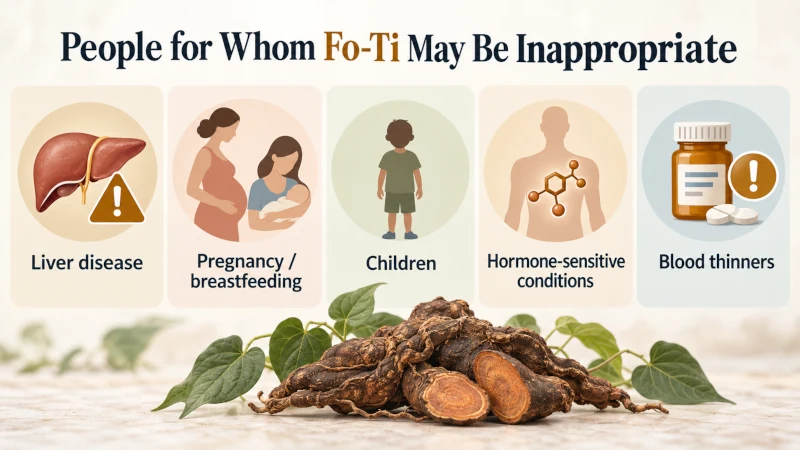
- Anyone with liver disease or abnormal liver tests. Drug references list liver disease as a contraindication [Drugs.com, 2026].
- Anyone who has had a liver reaction to fo-ti or a fo-ti blend before [LiverTox, 2020].
- People who are pregnant, trying to conceive, or breastfeeding [Drugs.com, 2026].
- Children. Pediatric liver injury cases, including the 5-year-old described above, are on record [LiverTox, 2020].
- People with hormone-sensitive cancers or conditions (a precaution based on lab data) [Oerter Klein et al., 2003].
- People on blood thinners, or taking several medicines that doctors have flagged for liver effects. Regular heavy drinking is another reason to skip it.
If you still want to try fo-ti
There is no evidence-based dose. Clinical studies haven’t established one [Drugs.com, 2026], and the drop-and-capsule charts that circulate online trace back to traditional herbals rather than trials. If you decide to use it anyway, these steps lower the odds of a bad outcome:
- Talk to your doctor first, and ask whether a baseline liver blood test (ALT and AST) makes sense for you.
- Pick a single-ingredient product that states whether the root is processed, and look for third-party testing such as a USP or NSF seal. Testing confirms what is in the bottle; it doesn’t prove the herb is safe.
- Stay at or below the label amount and keep the course short.
- Stop at the first sign of trouble listed below, and don’t restart after any liver problem.
- Tell every clinician you see that you take it. In the case of the 5-year-old, her family didn’t mention the herb at first and didn’t suspect it [LiverTox, 2020].
When to get medical help
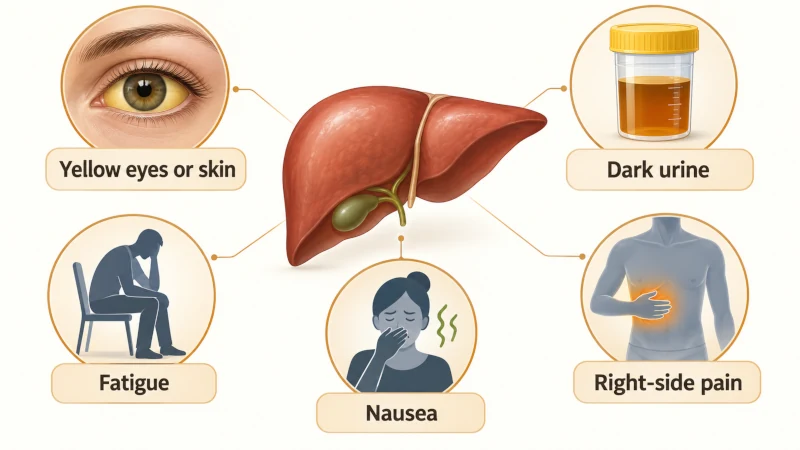
Stop taking fo-ti and call your doctor promptly if you notice unusual tiredness, loss of appetite, nausea, pain under your right ribs, dark urine, pale stools, or itching.
Get urgent care the same day if your skin or the whites of your eyes turn yellow, you are vomiting and can’t keep fluids down, or you notice confusion, unusual drowsiness, or easy bruising or bleeding. Bring the bottle with you so doctors can see exactly what you took.
| Health Disclaimer: This article is for general education and is not medical advice. Fo-ti (he shou wu) has been linked to liver injury that can be serious, and it may not be appropriate if you have liver disease, are pregnant or breastfeeding, have a hormone-sensitive condition, take prescription medicines, or are considering it for a child. Talk with a doctor or pharmacist before starting any herbal product, and don’t delay or replace medical care because of anything you read here. If you develop yellow skin or eyes, dark urine, or unusual fatigue while taking fo-ti, stop and seek medical attention. |
Frequently Asked Questions
Does fo-ti really turn gray hair black?
There is no controlled human trial showing it does. The supporting research is from mice and lab cultures of hair-follicle cells [Drugs.com, 2026]. The claim rests on tradition, and hair loss comes up repeatedly as the reason people in the liver-injury case reports were taking it [LiverTox, 2020].
Is processed or “prepared” fo-ti safe?
It appears less toxic than raw root in animal studies [Drugs.com, 2026; Liu et al., 2018], but processed products still show up in liver-injury reports [Lei et al., 2015]. Treat processed fo-ti as lower risk, not no risk.
How soon can liver damage show up?
Anywhere from a few days to about six months after starting, most often around one month [LiverTox, 2020; Lei et al., 2015]. Early signs include fatigue, nausea, and dark urine; yellow skin or eyes means you should get seen urgently.
Is fo-ti the same as he shou wu?
Yes. Fo-ti, he shou wu, ho shou wu, Shou Wu Pian, and Shen Min all refer to the root of Polygonum multiflorum or products made from it [LiverTox, 2020].
Can I take fo-ti with medications or other supplements?
No interactions are well documented in people [Drugs.com, 2026], but that mostly reflects a lack of study. Because of lab effects on platelets and animal effects on blood sugar, check with a doctor or pharmacist first, and avoid stacking it with other products that can stress the liver.
References
- National Institute of Diabetes and Digestive and Kidney Diseases. Polygonum Multiflorum. In: LiverTox: Clinical and Research Information on Drug-Induced Liver Injury. Bethesda (MD); updated August 18, 2020. PMID 31644102. View source
- Drugs.com. Fo-ti (Natural Products, professional monograph). Medically reviewed; last updated September 3, 2026. View source
- Lei X, Chen J, Ren J, et al. Liver damage associated with Polygonum multiflorum Thunb.: a systematic review of case reports and case series. Evid Based Complement Alternat Med. 2015;2015:459749. doi:10.1155/2015/459749. View source
- Wang Y, Wang L, Saxena R, et al. Clinicopathological features of He Shou Wu-induced liver injury: this ancient anti-aging therapy is not liver-friendly. Liver Int. 2019;39(2):389–400. PMID 30066422. View source
- Oerter Klein K, Janfaza M, Wong JA, Chang RJ. Estrogen bioactivity in fo-ti and other herbs used for their estrogen-like effects as determined by a recombinant cell bioassay. J Clin Endocrinol Metab. 2003;88(9):4077–4079. doi:10.1210/jc.2003-030349. PMID 12970265. View source
- Liu Y, Wang Q, Yang J, et al. Polygonum multiflorum Thunb.: a review on chemical analysis, processing mechanism, quality evaluation, and hepatotoxicity. Front Pharmacol. 2018;9:364. doi:10.3389/fphar.2018.00364. View source
- Lin L, Ni B, Lin H, et al. Traditional usages, botany, phytochemistry, pharmacology and toxicology of Polygonum multiflorum Thunb.: a review. J Ethnopharmacol. 2015;159:158–183. PMID 25449462. View source
- Kang L, Li D, Jiang X, et al. Hepatotoxicity of the major anthraquinones derived from Polygoni Multiflori Radix based on bile acid homeostasis. Front Pharmacol. 2022;13:878817. doi:10.3389/fphar.2022.878817. View source
- Stilbene glucoside: recent advances in pharmacology, bioinformatics investigation, toxicity and future opportunities. Pharmazie. 2021. doi:10.1691/ph.2021.1393. PMID 34412733. View source


