
If you’re looking at ashwagandha and L-theanine as a two-part “calm stack,” here’s the honest headline: each one has real, if modest, evidence for taking the edge off stress — but the specific pairing has never been tested head-to-head against either ingredient on its own.
So the popular claim that ashwagandha and L-theanine act in “synergy” is a reasonable idea, not a proven fact. Both are generally well tolerated by healthy adults over a few months, yet ashwagandha in particular carries cautions the marketing rarely mentions, including a rare but real risk of liver injury and a firm “avoid” during pregnancy. This guide sorts what the research supports from what it doesn’t — and what that means if you’re deciding whether to try them.
The short answer
- Ashwagandha has its best evidence for lowering perceived stress and cortisol, with a smaller-but-real benefit for sleep. The anxiety evidence is genuinely mixed, and effects build over 6–8 weeks rather than in a single dose. [NCCIH, 2023] [NIH ODS, 2023]
- L-theanine, an amino acid from green tea, may ease stress and support a relaxed-but-alert state in small human trials, usually at 200–400 mg. The claim that it “raises GABA, serotonin, and dopamine” comes mostly from animal research. [Williams et al., 2020] [Hidese et al., 2019]
- Together, no published trial has tested the exact duo, so any “synergy” is inferred from how they work separately. Expect modest, individual-level effects rather than a multiplier. [ClinicalTrials.gov, NCT06889584]
- On safety, the pair is fine for many healthy adults short-term, but it is not for pregnancy or breastfeeding, thyroid, autoimmune, or hormone-sensitive conditions, or use alongside several medications without medical advice. Stop ashwagandha and get care for any sign of liver trouble. [LiverTox, 2024]
Ashwagandha: what the research actually shows
Ashwagandha (Withania somnifera) is a shrub whose root has been used for centuries in Ayurvedic medicine, and is sold today mostly as a standardized root extract marketed as an “adaptogen” — a loosely defined term for substances said to help the body handle stress. For a deeper look at the herb on its own, see our guide to what the evidence supports for ashwagandha.
Stress is the best-supported use. Several small randomized, placebo-controlled trials and pooled analyses report that ashwagandha root extract can modestly lower self-reported stress and cortisol, the hormone that climbs during sustained strain, and the NIH Office of Dietary Supplements notes it appeared more effective at 500–600 mg a day than at lower doses over 6 to 8 weeks. [NIH ODS, 2023] A 2022 meta-analysis pooling about 12 trials in roughly 1,000 adults found significant average reductions in both stress and anxiety — but it rated the certainty of that evidence as low, with the trials varying widely in their results. [Akhgarjand et al., 2022] In other words, the direction is encouraging and consistent, but the effect you personally get could be meaningful, small, or nil.
Anxiety is where the picture splits. Some trials show ashwagandha easing anxiety symptoms, yet NCCIH — reviewing the same body of work — says the evidence on anxiety is unclear because studies used different measures, populations, and extracts. [NCCIH, 2023] It may help some people; it is not a substitute for treatment of an anxiety disorder.
Sleep
A 2021 systematic review pooled five randomized trials with 400 adults and found a small but statistically significant improvement in sleep versus placebo (standardized mean difference −0.59), with a clearer effect in people diagnosed with insomnia at doses of 600 mg a day or more for at least eight weeks. [Cheah et al., 2021] The plain reading: ashwagandha is not a sleeping pill, but when stress is what’s wrecking your sleep, it may help you settle a little faster. If sleep is your main concern, it’s worth comparing against other natural sleep supplements.
L-theanine: the calm-without-drowsiness amino acid
L-theanine is an amino acid found mainly in green tea. A cup of tea supplies only a modest amount (roughly 8–30 mg), while supplement studies typically use around 200 mg. [Hidese et al., 2019] It crosses into the brain within an hour or so, and because its structure resembles the neurotransmitter glutamate, researchers think it acts on glutamate signaling — which is the leading hypothesis for its calming reputation.
A 2020 systematic review of nine randomized trials concluded that 200–400 mg a day may help reduce stress and anxiety in people under stressful conditions, while calling for larger, longer studies. [Williams et al., 2020] A four-week trial in 30 healthy adults found that 200 mg a day improved self-rated stress, trait anxiety, and sleep during the L-theanine period; when measured strictly against placebo, the clearest advantages showed up on sleep, with stress and mood trending in the right direction. [Hidese et al., 2019] That study was small and funded by an L-theanine manufacturer, which is worth keeping in mind.
One correction worth making: you’ll often read that L-theanine “boosts GABA, serotonin, and dopamine.” Those effects come mostly from animal studies and small brain-wave experiments. They’re a plausible mechanism, not a settled human fact — the honest summary is a real but modest calming effect in short trials, with the biology still being worked out.
Do they actually work better together?
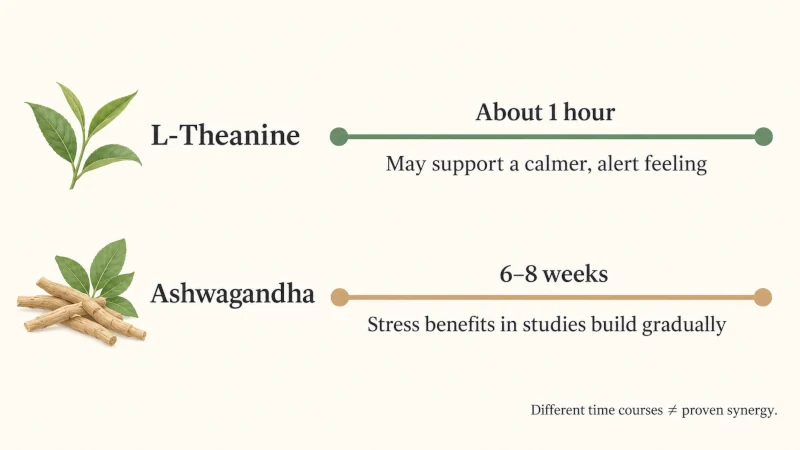
The pitch for stacking them is intuitive: L-theanine may act within an hour, ashwagandha over weeks, and they work through different routes — so, the reasoning goes, one covers acute moments while the other lowers your baseline. That’s a sensible rationale, and it’s why ingredient suppliers describe the combination as “synergistic.”
But a rationale isn’t a result. No published randomized trial has compared the ashwagandha–L-theanine combination against ashwagandha alone or L-theanine alone in people, so there is no direct evidence that the pair outperforms either ingredient by itself. The one registered trial testing a stack that includes both also contains rhodiola, magnesium threonate, and apigenin — so even when it reports, it won’t isolate what the two-ingredient pair does. [ClinicalTrials.gov, NCT06889584]
Practical takeaway: if each ingredient suits you, taking them together is reasonable and low-risk for most healthy adults, but set expectations at “modest help from two things that each do a little,” not a proven multiplier.
How the two are actually used: doses, forms, and timing
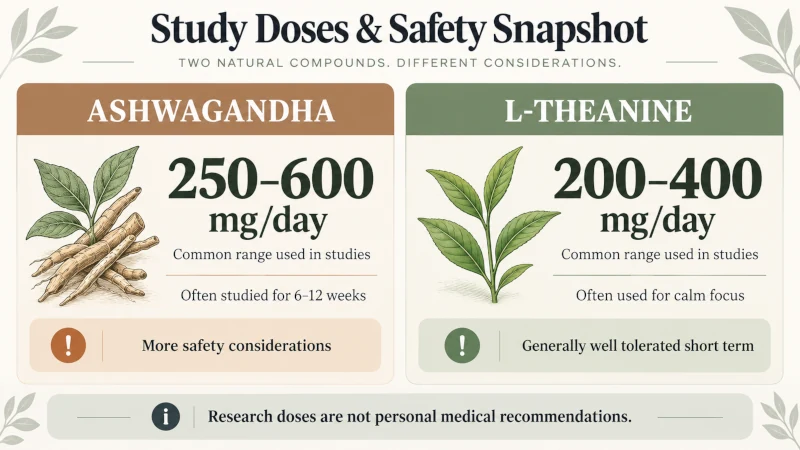
The figures below reflect what researchers used, not a personal prescription. There is no officially recommended dose for either supplement, and the right choice depends on your health and medications — which is a conversation to have with a clinician or pharmacist.
- Ashwagandha: clinical trials commonly used about 250–600 mg a day of a standardized root extract for 6 to 12 weeks; 500–600 mg worked better for stress, and sleep benefits mostly showed up at 600 mg or more for at least eight weeks. [NIH ODS, 2023] [Cheah et al., 2021]
- L-theanine: 200 mg a day is the most common trial dose, with some studies using up to 400 mg. [Williams et al., 2020]
- Forms: capsules and tablets are what most studies used; powders and teas work too; gummies are convenient but often carry lower or less clearly labeled doses plus added sugar.
- Timing: L-theanine acts acutely, so it’s often taken when calm focus is wanted; ashwagandha builds over weeks, so consistency matters more than timing.
Because supplements aren’t reviewed by the FDA before sale, it helps to choose products carrying a third-party testing seal such as NSF or USP. [NCCIH, 2023]
Evidence at a glance
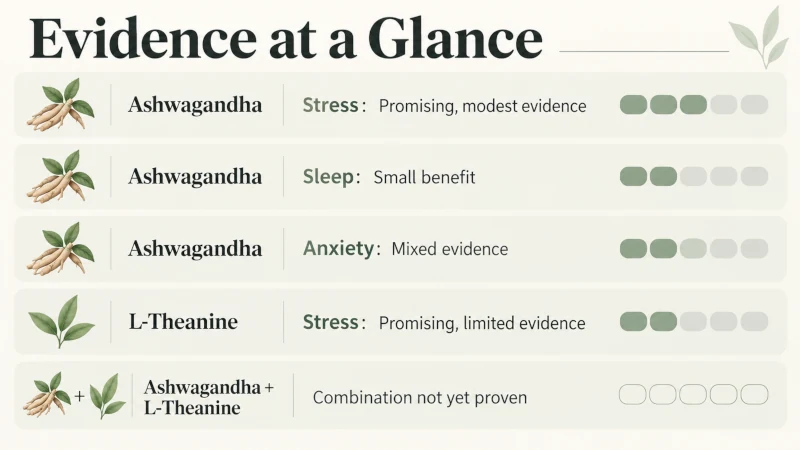
| Use | What the evidence shows | Honest grade |
| Ashwagandha – stress | Several small RCTs and meta-analyses report lower perceived stress and cortisol over 6–8 weeks; 500–600 mg/day worked better than lower doses in some trials. | Promising but modest. Trials are small and graded low-certainty. |
| Ashwagandha – sleep | A meta-analysis of five RCTs (400 adults) found a small but real improvement, strongest in people with insomnia at 600 mg/day or more for 8+ weeks. | Real but small. Not a sedative. |
| Ashwagandha – anxiety | Some trials show benefit, but studies used different measures and extracts; NCCIH calls the anxiety evidence unclear. | Genuinely mixed. |
| L-theanine – stress | Small human trials at 200–400 mg/day suggest reduced stress and a calm-but-alert state; effects are modest and trials are small. | Promising, limited (small studies). |
| L-theanine – brain chemistry | The idea that it raises GABA, serotonin, and dopamine comes mostly from animal and small brain-wave studies. | Mechanistic / mostly preclinical. |
| The two together | No published trial has tested the exact two-ingredient combination against either alone. One multi-ingredient trial is underway. | Not yet demonstrated. “Synergy” is inferred, not proven. |
Safety, side effects, and interactions
For most healthy adults, both supplements appear well tolerated for up to about three months; longer-term safety is not well established. [NIH ODS, 2023] The important cautions sit mostly on the ashwagandha side.
Ashwagandha
Common side effects are usually mild: upset stomach, loose stools, nausea, and drowsiness. [NIH ODS, 2023] Two issues deserve more attention. First, liver injury: the NIH LiverTox database lists ashwagandha as a likely, though uncommon, cause of clinically apparent liver injury, typically appearing 2 to 12 weeks after starting, often with jaundice and itching. Most cases resolve after stopping, but rare fatal cases have occurred, mainly in people with pre-existing liver disease — so it should be avoided if you have cirrhosis or advanced chronic liver disease. [LiverTox, 2024] Second, thyroid effects: ashwagandha can raise thyroid hormone levels, which is a problem if you have a thyroid condition or take thyroid medication. [NCCIH, 2023]
NCCIH lists possible interactions with medications for diabetes and high blood pressure, immunosuppressants, sedatives, anti-seizure drugs, and thyroid hormone medications. [NCCIH, 2023] If you take any prescription regularly, clear ashwagandha with a pharmacist first.
L-theanine
L-theanine has a lighter safety profile: it’s generally well tolerated, and trials have reported no serious adverse events. [Hidese et al., 2019] Because it can be mildly calming, it’s sensible to be cautious about combining it with sedatives or with blood-pressure-lowering medication, and safety data in pregnancy and breastfeeding are thin — so the same “ask first” rule applies.
Who should avoid this combination (or check with a clinician first)
- Anyone pregnant, breastfeeding, or trying to conceive. Health authorities advise avoiding ashwagandha in pregnancy and not using it while breastfeeding; our deeper look at ashwagandha and breastfeeding explains why the data gap itself is the problem. [NCCIH, 2023]
- People with a thyroid condition or who take thyroid medication such as levothyroxine.
- People with an autoimmune condition (for example lupus, rheumatoid arthritis, or multiple sclerosis), because ashwagandha may affect immune activity.
- People with a hormone-sensitive condition such as prostate cancer, which NCCIH flags because ashwagandha may raise testosterone. [NCCIH, 2023]
- People with liver disease, a history of liver problems, or heavy alcohol use.
- Anyone scheduled for surgery within about two weeks (possible effects on sedation and blood sugar), and anyone under 18, since safety hasn’t been established in children and teens.
Red flags: when to stop and seek care
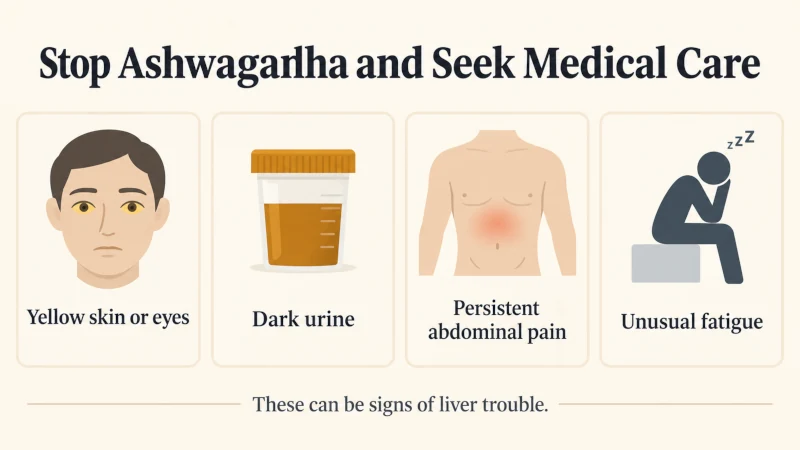
Stop ashwagandha and seek medical attention promptly if you notice signs of liver trouble — yellowing of the skin or eyes, dark urine, persistent abdominal pain, or unusual fatigue. And know when a supplement isn’t the right tool: if stress, anxiety, or insomnia is disrupting your work, relationships, or daily life, or if you’re having thoughts of harming yourself, that’s a reason to reach out to a healthcare professional rather than self-experiment. Neither supplement is a treatment for a diagnosed mental health condition. In the U.S., you can call or text 988 (Suicide & Crisis Lifeline) any time. For broader context on how this class of herbs is studied, see our guide to adaptogenic herbs for stress and anxiety.
| Health disclaimer: This article is for general education only. It is not medical advice and does not replace guidance from a qualified healthcare professional. Ashwagandha and L-theanine are dietary supplements, not approved treatments for any condition, and supplements are not reviewed by the FDA for safety or effectiveness before sale. Talk to your doctor, pharmacist, or another licensed clinician before starting either one — especially if you are pregnant, breastfeeding, or trying to conceive; take prescription medication; or have a thyroid, liver, autoimmune, or hormone-sensitive condition. Stop use and seek medical care promptly if you develop yellowing of the skin or eyes, dark urine, persistent abdominal pain, or unusual fatigue. |
Frequently Asked Questions
Can I take ashwagandha and L-theanine together?
For most healthy adults, taking them together is low-risk and reasonable, since they act through different routes and timescales. Just remember that no trial has proven the combination beats either one alone, and the ashwagandha cautions above still apply. Clear it with a clinician if you’re pregnant or breastfeeding, take medication, or have a thyroid, liver, autoimmune, or hormone-sensitive condition.
How long until they work?
L-theanine may produce a mild calm within an hour or so. Ashwagandha works gradually — most studies that found a benefit ran for at least 6 to 8 weeks — so give it a couple of months of consistent use before judging it.
Will they make me drowsy?
L-theanine is known for relaxation without strong sedation. Ashwagandha can cause drowsiness in some people, which is one reason to be careful about combining it with sedatives, sleep medication, or alcohol.
Is the combination safe during pregnancy or breastfeeding?
No. Health authorities advise avoiding ashwagandha in pregnancy and while breastfeeding, and safety data for L-theanine in these periods are thin. If you’re pregnant, nursing, or trying to conceive, don’t take either without first speaking to your provider.
Can I just drink green tea instead of an L-theanine supplement?
Green tea contains L-theanine, but only a small amount per cup compared with the 200 mg used in most studies — and it also contains caffeine, which works against the goal of winding down. Tea is a pleasant source, but it won’t match a supplement dose.
References
- National Center for Complementary and Integrative Health (NCCIH). Ashwagandha: Usefulness and Safety. 2023. View source
- National Institutes of Health, Office of Dietary Supplements. Ashwagandha: Is It Helpful for Stress, Anxiety, or Sleep? Consumer Fact Sheet. Updated December 2023. View source
- LiverTox: Clinical and Research Information on Drug-Induced Liver Injury. Ashwagandha. National Institute of Diabetes and Digestive and Kidney Diseases; updated December 3, 2024. View source
- Cheah KL, Norhayati MN, Husniati Yaacob L, Abdul Rahman R. Effect of Withania somnifera (ashwagandha) extract on sleep: a systematic review and meta-analysis. PLoS One. 2021;16(9):e0257843. View source
- Hidese S, Ogawa S, Ota M, et al. Effects of L-theanine administration on stress-related symptoms and cognitive functions in healthy adults: a randomized controlled trial. Nutrients. 2019;11(10):2362. View source
- Akhgarjand C, et al. Does ashwagandha supplementation have a beneficial effect on the management of anxiety and stress? A systematic review and meta-analysis of RCTs. Phytother Res. 2022;36(11):4115–4124. (PMID 36017529) View source
- Williams JL, et al. The effects of green tea amino acid L-theanine consumption on the ability to manage stress and anxiety levels: a systematic review. Plant Foods Hum Nutr. 2020. (PMID 31758301) View source
- ClinicalTrials.gov. Supplement Combination on Stress and Sleep (Ashwagandha, Rhodiola, magnesium threonate, L-theanine, apigenin). NCT06889584. Recruiting as of 2025; no results posted. View source


