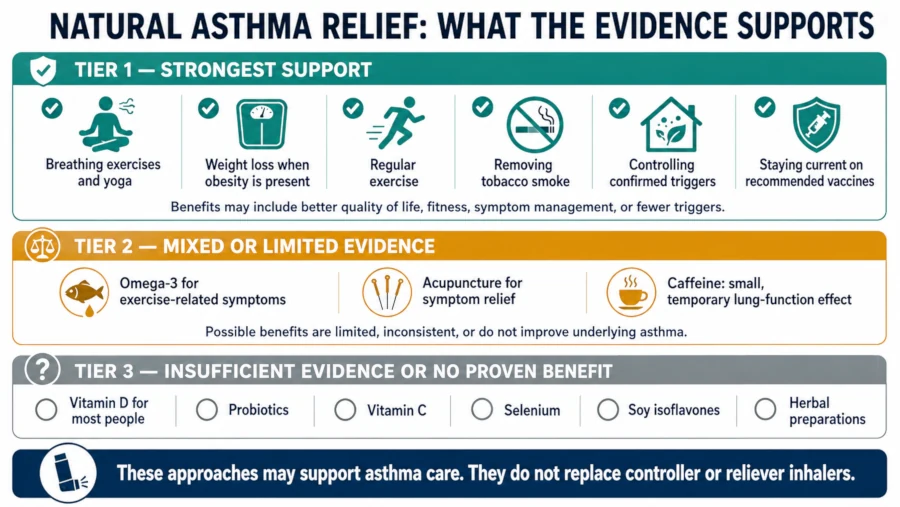
Here is the honest answer: a handful of natural approaches to asthma genuinely help, and not one of them replaces your inhaler. That isn’t a legal hedge. It is the finding that keeps turning up in the trials, and it is the difference between natural asthma relief that improves your life and the kind that sends people to the emergency room.
Asthma is not a rare problem to get wrong. About 27.8 million people in the United States had asthma in 2023 — 8.4% of the population — and 42% of them had at least one attack that year [CDC asthma surveillance data, 2023]. Among children with asthma, nearly half had an attack.
So let’s sort the options by how much evidence is actually behind them.
What natural asthma relief can realistically do
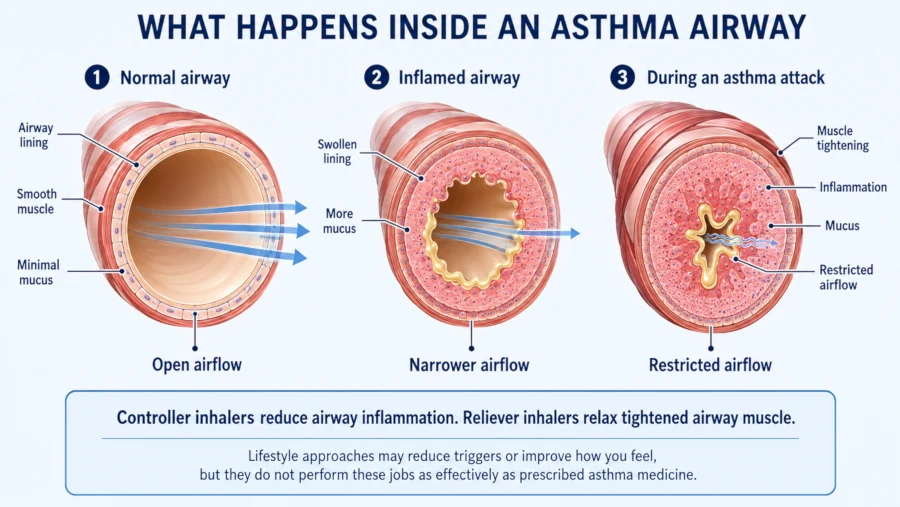
Asthma has two moving parts. Your airways are chronically inflamed, and the muscle wrapped around them tightens when something provokes it. Controller inhalers work on the inflammation. Reliever inhalers relax the muscle. Nothing sold in a grocery store or supplement aisle does either job nearly as well.
What natural approaches can do is reduce how often your airways get provoked, and improve how you feel while living with the condition. In trials, that shows up as better quality-of-life scores and less breathlessness — real benefits, just not the same benefit as treating the disease.
The NIH’s National Center for Complementary and Integrative Health draws the line plainly: do not substitute complementary approaches for treatments your provider prescribed, and if you take asthma medicine, talk with your provider before starting a dietary supplement, because some supplements and medicines interact in harmful ways [NCCIH, 2022].
The approaches with the strongest evidence
Breathing exercises and yoga
This is the best-supported non-drug option, and it costs nothing.
A Cochrane review pooled 22 randomized trials covering 2,880 adults with mild to moderate asthma. Breathing exercises improved asthma-related quality of life at three months (mean difference 0.42 on the Asthma Quality of Life Questionnaire, 95% CI 0.17 to 0.68; moderate-certainty evidence), reduced hyperventilation symptoms at four to six months, and improved percent-predicted FEV1 by about 6.9 points. Asthma symptom scores themselves did not clearly change [Cochrane review of breathing exercises for adults with asthma, 2020].
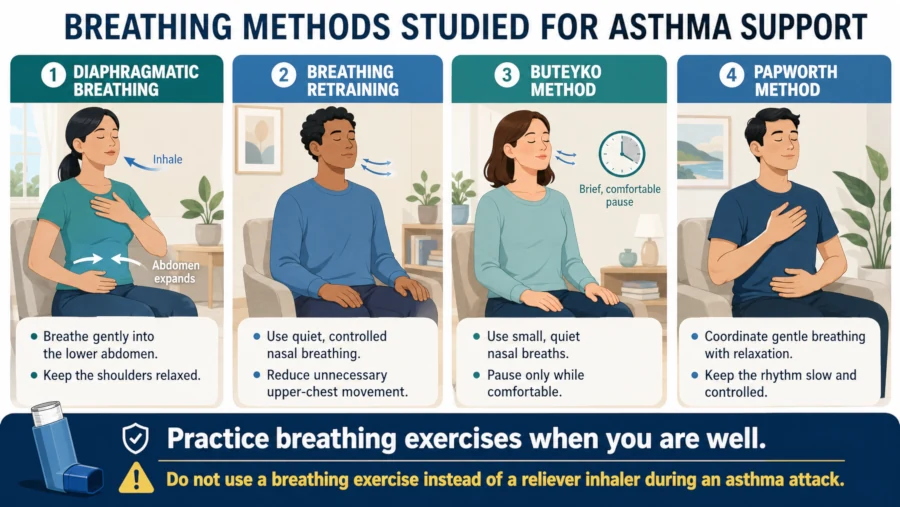
Read that pattern carefully, because it is the pattern for almost everything in this article: people breathed with less effort and felt better, while the underlying disease stayed where it was. Fourteen of the 22 trials used yoga; the rest used breathing retraining, the Buteyko method, the Papworth method, or deep diaphragmatic breathing.
No harmful effects have been reported in studies of breathing techniques in people with asthma, and a separate review found yoga probably produces small improvements in quality of life and symptoms [NCCIH, 2022]. In children, the evidence is thinner — a 2019 review of 10 studies in 466 children could not reach clear conclusions.
Practical version: ask your doctor for a referral to breathing retraining, usually with a respiratory therapist or physical therapist, rather than piecing it together from videos. And practice when you are well. A breathing exercise is not something to attempt in place of a reliever inhaler during an attack.
Losing weight, if you’re carrying extra
If you have both asthma and obesity, weight loss has some of the most convincing evidence of any lifestyle change here.
A 2025 systematic review and meta-analysis of six randomized trials in 522 adults with obesity and asthma found that weight reduction over 12 to 24 weeks improved Asthma Control Questionnaire scores by −0.75 (95% CI −0.91 to −0.59), improved quality of life, and raised FEV1 by an average of 4.65 percentage points (95% CI 2.96 to 6.33) [Journal of Allergy and Clinical Immunology: In Practice, 2025]. An earlier review of four pediatric and six adult randomized trials reported improvements in asthma-related quality of life in the same direction, though the studies varied too much to pool [Okoniewski et al., Annals of the American Thoracic Society, 2019].
Worth noting: the heterogeneity in that second review was real, and lung-function gains have been inconsistent across studies. But the direction of effect has held up. If weight is a factor for you, this is a conversation to have with your doctor or a registered dietitian rather than a solo project.
Regular exercise
A lot of people with asthma quietly back away from exercise — sometimes because they were told to — and get deconditioned, which makes breathlessness worse. A Cochrane review of physical training in asthma found it improved cardiopulmonary fitness, was well tolerated, and did not worsen lung function. Its conclusion was that people with stable asthma should be encouraged to exercise regularly without fear of setting off symptoms [Cochrane review of physical training for asthma, 2013].
If exercise reliably triggers your symptoms, treat that as information: it usually means your asthma is not well controlled, not that you should stop moving. Raise it at your next appointment. Many people are prescribed a reliever inhaler to use before activity.
Getting smoke out of your air
CDC lists respiratory infections, allergy particles, chemical irritants, and air pollution among the triggers that set off asthma attacks [CDC, 2024]. Tobacco smoke sits squarely in the irritant category, and unlike pollen or weather it is one you can remove completely.
There is no supplement, tea, or breathing technique that offsets a daily smoke exposure. If quitting is on your list, the step-by-step quit-smoking plan on this site walks through the evidence-based options, including the free 1-800-QUIT-NOW coaching line. The same applies to secondhand smoke in the house or car, which is worth addressing whether or not you are the one smoking.
Trigger control — but only your triggers
This is where the most well-meaning effort gets wasted, so it is worth being specific.
The NHLBI’s 2020 asthma guideline update recommends a multicomponent, allergen-specific mitigation strategy for people who have symptoms or confirmed sensitization to an indoor allergen and are actually exposed to it. It recommends against allergen mitigation as routine asthma management in people with no symptoms or sensitization to that allergen. Impermeable pillow and mattress covers get a conditional recommendation only as part of a broader plan — explicitly not as a single-component intervention [NHLBI 2020 Focused Updates to the Asthma Management Guidelines].
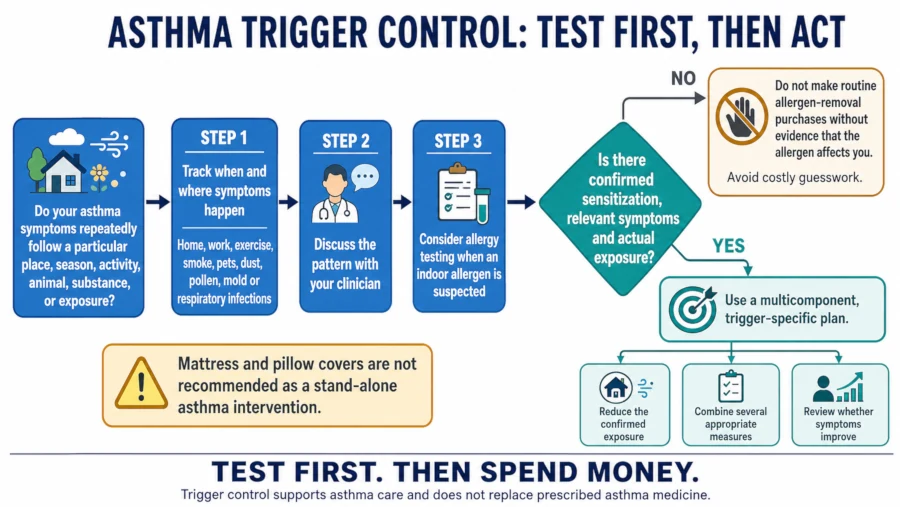
In plain terms: find out what you actually react to before you tear out the carpet or rehome the cat. Allergy testing turns guesswork into a plan, and if a trigger does check out, a bundle of measures works better than any single purchase. Our guide to identifying and reducing allergy triggers covers the testing options and what avoidance realistically achieves.
Staying current on vaccines
Flu is a well-documented asthma trigger, and CDC notes that people with asthma face higher risk of serious flu complications even when their asthma is mild or well controlled by medication. Flu shots have a long-established safety record in this group. The nasal spray vaccine is a different matter — CDC advises that people with asthma should generally not receive it, and children aged 2 to 4 with asthma or recent wheezing should not get it at all. CDC also recommends staying up to date on pneumococcal vaccination [CDC, Flu and People with Asthma, 2024].
One more detail from the same source, worth knowing before flu season: people with asthma should not use the antiviral zanamivir (Relenza), because it may cause wheezing.
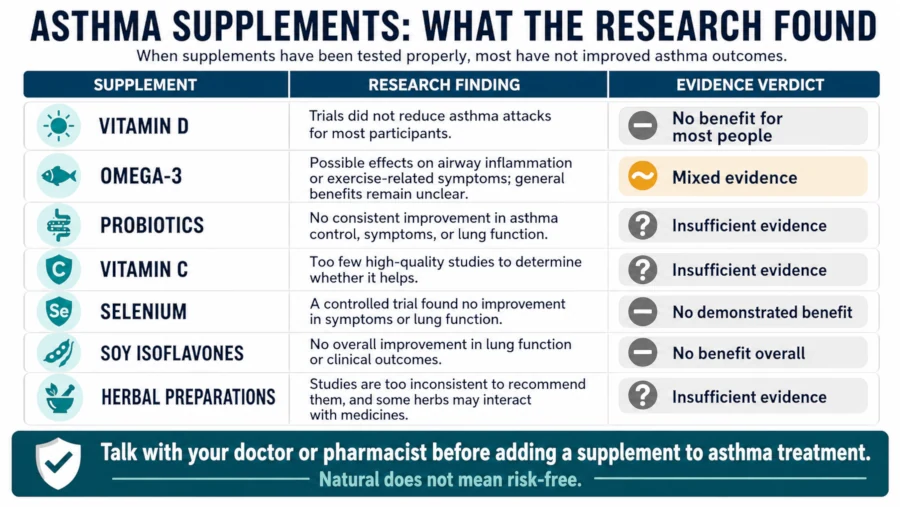
Supplements: what the research actually found
This is the section most “natural remedies” pages skip, because the answers are unflattering. Every figure below comes from NIH’s evidence review [NCCIH, 2022], with the vitamin D numbers cross-checked against the Cochrane review it summarizes.
| Supplement | What the studies found | Evidence verdict |
| Vitamin D | A 2023 review of 20 trials — 15 in children (1,155 participants) and 5 in adults (1,070) — found supplementation did not reduce the proportion of people having one or more asthma attacks. Few participants had severe asthma or genuinely low blood vitamin D. | Good evidence of no benefit for most people. A possible effect in severe asthma or true deficiency cannot yet be ruled out. |
| Omega-3 (fish oil) | A 2021 review of 16 studies (464 participants) found lower exhaled nitric oxide, a marker of airway inflammation, and four studies reported less lung-function decline after exercise in people with exercise-triggered symptoms. Effects on general lung function and symptoms were inconclusive. | Mixed. Possibly worth discussing if exercise is your main trigger; not a general treatment. |
| Probiotics | A 2020 review of 19 studies (5,157 participants) giving probiotics in pregnancy or infancy found no significant effect on whether children developed asthma. A 2018 review of 11 studies (910 children with asthma) found fewer episodes but no improvement in asthma control, symptoms, or lung function; study quality was low. | Insufficient. Neither confirmed nor ruled out. |
| Vitamin C | A 2013 review of 11 studies (419 people) concluded there were not enough high-quality studies to say either way. | Insufficient. |
| Selenium | A high-quality 2007 UK trial gave 197 adults with asthma selenium or placebo for six months and found no benefit for symptoms or lung function — notable because UK dietary selenium intake is lower than in the US. | Good evidence of no benefit. |
| Soy isoflavones | A trial in 386 adults and adolescents with poorly controlled asthma found no improvement in lung function or clinical outcomes overall. A later analysis found fewer severe attacks in a subgroup with specific genotypes. | No benefit overall; the subgroup finding is exploratory. |
| Herbal preparations | A 2010 review of 26 studies of various herbal products found insufficient evidence to recommend any of them. A 2019 review of 18 studies (2,080 participants) of East Asian traditional medicines could not reach conclusions either. | Insufficient — and some herbs interact with asthma medicines. |
| Acupuncture | A 2019 review of 9 studies (777 participants) comparing usual treatment plus acupuncture against usual treatment alone found improved symptoms but no improvement in lung function. | Limited. Symptom-level only; generally safe with sterile technique. |
A pattern is visible once you line them up. Where a supplement has been tested properly and at scale — vitamin D, selenium, soy — the answer has come back negative. Where the answer still looks open, it is usually because the studies are small or low quality, not because a benefit has been demonstrated.
Coffee, steam, and other kitchen remedies
Caffeine is chemically related to theophylline, an older asthma drug, and it does something measurable. A Cochrane review of seven crossover trials in 75 adults with mild to moderate asthma found caffeine — even at doses under 5 mg/kg — improved lung function for up to four hours, translating to roughly a 5% average difference in FEV1 [Cochrane review of caffeine for asthma, 2010].
Two things follow from that, and the second one is the genuinely useful one.
- Coffee is not a rescue inhaler. A 5% shift over a couple of hours is nowhere near what a reliever does in minutes, and treating an attack with a latte wastes time you may not have.
- If you have a lung function test scheduled, skip caffeine for at least four hours beforehand. Otherwise your spirometry may look better than your lungs actually are, and your treatment could be adjusted downward on the strength of a false reading.
Steam is the other perennial. A warm drink or a shower can feel soothing when your chest is tight, and there is no harm in either. But there is no good evidence that steam relieves asthma, and leaning over a pan of boiling water is a real scald hazard, particularly with children in the house. If tightness is bad enough that you are reaching for a steam bowl, reach for your reliever instead.
What to skip
The FDA has warned consumers not to rely on over-the-counter asthma products labeled as homeopathic. These have not been evaluated by the FDA for safety or effectiveness, and they are widely sold in stores and online. You can spot them by the word “homeopathic” on the label and by active ingredients listed as dilutions such as 6X or 30C [NCCIH, 2022].
Also worth skipping: any product marketed as a natural alternative to a controller inhaler, and any herb taken for asthma without telling your doctor. Some herbs and essential oils can provoke bronchospasm in sensitive people, which is precisely the opposite of the goal. If you want to explore botanicals anyway, do it with your prescriber’s knowledge — our overview of herbs used for respiratory health and their safety caveats lays out which plants carry real risks, including liver toxicity and blood-pressure effects.
And a note on diet, since it comes up constantly. Beyond weight management, no specific food has been shown to treat asthma. Eating well is worth doing on its own merits, and if you want ideas there is a companion piece on foods and asthma on this site — but treat it as general nutrition reading, not as a substitute for your treatment plan.
Safety, interactions, and who should be extra careful
“Natural” does not mean inert. The specific cautions below come from NIH’s review of the evidence.
- Anyone taking asthma medicine. Check with your doctor or pharmacist before adding any supplement. Some supplements and medicines interact in harmful ways.
- Pregnancy and breastfeeding. Safety data for most supplements in pregnancy is thin. This is not the time to experiment, and it is definitely not the time to stop a prescribed controller inhaler on your own. Talk to your OB or doctor first.
- Children. The evidence for breathing exercises in children is not strong enough to draw conclusions, and dosing for any supplement should be set by a pediatrician, not scaled down from an adult label.
- People who are seriously ill or immunocompromised. The risk of harm from probiotics is greater in this group.
- People on warfarin or other anticoagulants. Omega-3 supplements may interact with warfarin (Coumadin).
- People with hemochromatosis, or being treated for cancer or high cholesterol. Talk to a doctor before taking vitamin C supplements.
- Anyone considering yoga. Sprains and strains are the most common injuries; serious ones are rare. Older adults, people who are pregnant, and people with other health conditions may need to modify poses — tell the instructor.
Common side effects worth knowing: omega-3 supplements can cause an unpleasant aftertaste, bad breath, digestive symptoms, headache and body odor. Too much vitamin C causes diarrhea, nausea and stomach cramps. Excess vitamin D can cause nausea, vomiting, muscle weakness, confusion, pain, appetite loss and dehydration. Excess selenium can cause nausea, rashes, discolored teeth, and hair or nail loss, and extremely high intakes can cause heart attacks and kidney failure.
When natural asthma relief isn’t enough
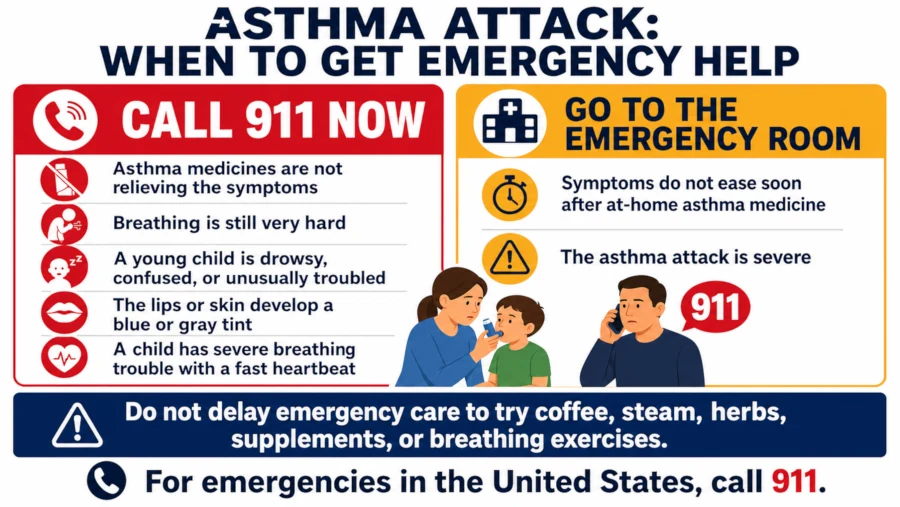
No home approach substitutes for emergency care. NHLBI’s guidance is direct [NHLBI, Asthma Attack, 2024]:
Call 911 if:
- Your medicines are not relieving your symptoms during an attack, or breathing is still very hard
- A young child seems drowsy, confused or troubled, has a blue tint to the skin and lips, or has a fast heartbeat
Go to the emergency room if:
- Your symptoms do not ease soon after your at-home medicines, or the attack is severe
Get medical care right away — even between attacks — if you have symptoms and any of these apply:
- You were hospitalized for asthma in the past year, or have had a life-threatening attack
- You recently needed corticosteroids taken by mouth
- You have not been using an inhaled corticosteroid
- You go through more than one reliever (short-acting beta2-agonist) canister a month
- You have a mental health condition, or an alcohol or drug use disorder
- You are not closely following your asthma action plan
- You have a food allergy
That fourth point deserves emphasis, because it is the most common quiet warning sign: needing your reliever inhaler often means the underlying inflammation is not controlled, and no amount of breathing practice fixes that. If you do not have a written asthma action plan, that is the single most useful thing to leave your next appointment with. NHLBI publishes a free asthma action plan template you can fill out together.
| Health Disclaimer: This article is for general education and information only. It is not a substitute for diagnosis, treatment, or advice from a doctor who knows your medical history. Asthma is a condition that can become life-threatening, and nothing here should be used in place of prescribed controller or reliever medication. If you are pregnant or breastfeeding, taking any prescription medicine, managing another health condition, or making decisions for a child, talk with your doctor, pharmacist, or a registered dietitian before starting a supplement or changing your routine. If your medicines are not relieving an asthma attack, or breathing is still very hard, call 911. |
Frequently Asked Questions
Can asthma be cured naturally?
No. Asthma is a chronic inflammatory condition, and no diet, supplement, herb, or breathing practice has been shown to cure it. Symptoms can quiet down for long stretches, especially in children, but that is not the same as a cure — and any page promising one is selling something.
Does drinking coffee help during an asthma attack?
Not enough to matter. Caffeine improves lung function modestly for up to four hours, on the order of a 5% difference in FEV1 [Cochrane, 2010]. During an attack you need your reliever inhaler, not a beverage. The one place this finding is useful: avoid caffeine for at least four hours before a lung function test.
Should I buy dust-mite mattress and pillow covers?
Only if dust mites are a confirmed trigger for you, and only alongside other measures. The 2020 NHLBI guideline recommends impermeable covers as part of a multicomponent allergen-specific plan, not as a standalone fix, and advises against allergen mitigation as routine management for people who are not sensitized to that allergen [NHLBI, 2020]. Allergy testing first, purchases second.
Will taking vitamin D reduce my asthma attacks?
For most people, no. A 2023 review of 20 trials found no reduction in the proportion of people having asthma attacks needing steroid treatment [Cochrane, 2023]. Few participants had severe asthma or genuinely low vitamin D levels, so a benefit in those specific groups has not been ruled out. If you think you may be deficient, that is a blood test and a conversation with your doctor, not a reason to start supplementing on your own.
Is it safe to exercise if I have asthma?
For most people with stable asthma, yes — and it is encouraged. Cochrane reviewers concluded that physical training improves cardiopulmonary fitness, is well tolerated, and does not worsen lung function [Cochrane, 2013]. If activity reliably triggers symptoms, that is a sign to review your treatment, not to stop exercising.
Can breathing exercises replace my inhaler?
No. Breathing exercises improved quality of life and hyperventilation symptoms in trials while asthma symptom scores stayed largely unchanged. They work as an addition to treatment, and stopping a controller inhaler because you feel better is how people end up in the emergency room.
References
- Centers for Disease Control and Prevention. “Most Recent Asthma Data.” Asthma Data, CDC. Updated June 25, 2026. View source
- Centers for Disease Control and Prevention. “Flu and People with Asthma.” Influenza (Flu), CDC. Reviewed September 5, 2024. View source
- National Center for Complementary and Integrative Health. “Asthma and Complementary Health Approaches: What You Need To Know.” NIH/NCCIH. Last updated March 2022. View source
- Santino TA, Chaves GSS, Freitas DA, Fregonezi GAF, Mendonça KMPP. “Breathing exercises for adults with asthma.” Cochrane Database of Systematic Reviews, 2020, Issue 3. Art. No.: CD001277. DOI: 10.1002/14651858.CD001277.pub4. View source
- Williamson A, Martineau AR, Sheikh A, Jolliffe D, Griffiths CJ. “Vitamin D for the management of asthma.” Cochrane Database of Systematic Reviews, 2023, Issue 2. Art. No.: CD011511. DOI: 10.1002/14651858.CD011511.pub3. View source
- Welsh EJ, Bara A, Barley E, Cates CJ. “Caffeine for asthma.” Cochrane Database of Systematic Reviews, 2010, Issue 1. Art. No.: CD001112. DOI: 10.1002/14651858.CD001112.pub2. PMID 20091514. View source
- Carson KV, Chandratilleke MG, Picot J, et al. “Physical training for asthma.” Cochrane Database of Systematic Reviews, CD001116 (2013 update). Abstract record, NCBI Bookshelf (DARE). View source
- “Effect of Weight Loss on Asthma in Obese Adult Patients With Asthma: A Systematic Review and Meta-Analysis.” The Journal of Allergy and Clinical Immunology: In Practice, 2025. View source
- Okoniewski W, Lu KD, Forno E. “Weight Loss for Children and Adults with Obesity and Asthma. A Systematic Review of Randomized Controlled Trials.” Annals of the American Thoracic Society. 2019;16(5):613–625. PMID 30605347. View source
- National Heart, Lung, and Blood Institute. “Asthma — Asthma Attack.” NHLBI, NIH. Last updated April 17, 2024. View source
- National Heart, Lung, and Blood Institute. “2020 Focused Updates to the Asthma Management Guidelines: At-a-Glance Guide.” NIH Publication No. 20-HL-8142. View source
- National Heart, Lung, and Blood Institute. “Asthma Action Plan.” NHLBI, NIH (2020, aligned to the 2020 Focused Updates). View source
