
This spring salad is mostly vegetables — boiled green beans, peas and potatoes folded through raw tomato, onion, carrot and garlic, then dressed with a little olive oil, parsley and oregano. That simplicity is the point. Most of what makes it good for you isn’t a single “superfood”; it’s that a plateful of plants, dressed with olive oil instead of a heavy sauce, is the kind of eating that decades of research link to a healthier heart and a steadier appetite.
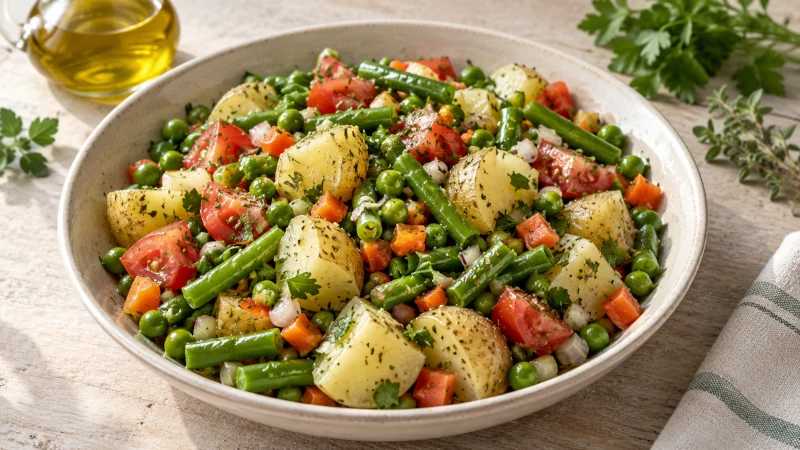
Below is the full recipe, the nutrition, and an honest look at this spring salad recipe and its health benefits — including the two ingredients, potatoes and peas, that come with a caveat if you’re watching your blood sugar.
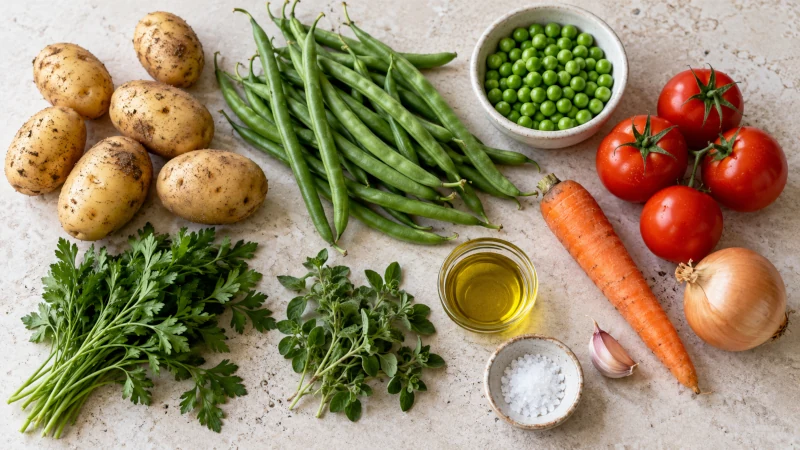
Spring salad ingredients (serves 4)
Boiled
- 1 lb (about 450 g) potatoes, skin on
- 14 oz (400 g) green beans, trimmed
- 150 g (about 1 cup) peas
Raw
- 1 lb (about 450 g) tomatoes
- 1 onion
- 1 carrot
- 1 garlic clove
To dress
- Fresh parsley and oregano
- 3 tablespoons olive oil
- Sea salt, to taste
How to make it
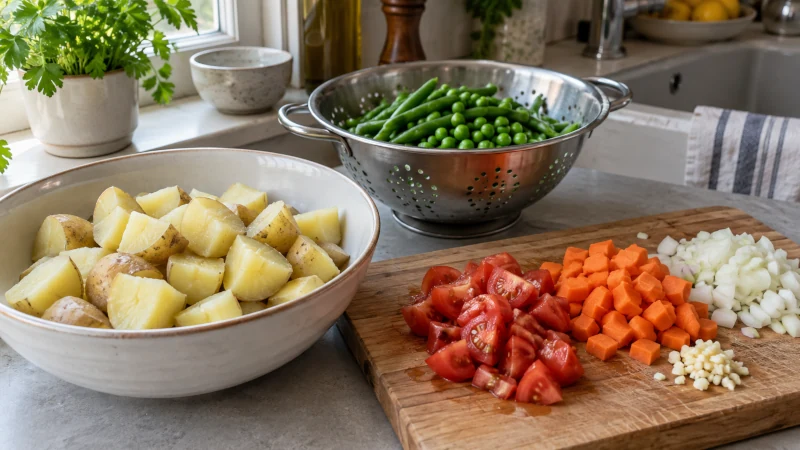
- Peel and finely chop the onion, carrot and garlic.
- Wash and chop the tomatoes.
- Trim the green beans, pull off any strings, wash and chop.
- Boil the potatoes with the skin on until just tender, then drain and let them cool. Cut into chunks. (Cooling them matters — see the note below.)
- In a separate pot, boil the peas and green beans until tender-crisp; drain.
- Combine everything in a bowl and dress with parsley, oregano, olive oil and a little salt.
- Serve cold.
Prep 15 min · Cook 30 min · Serves 4
Practical note: this is an easy salad to eat if chewing is difficult, since the boiled potatoes, beans and peas are soft — one reason it suits older family members or anyone recovering from dental work.
Nutrition per serving (approximate)
| Per serving (of 4) | Base recipe* | With 3 tbsp olive oil |
| Energy | 195 kcal | ~285 kcal |
| Total fat | 0.7 g | ~11 g |
| Saturated fat | 0.1 g | ~1.5 g |
| Protein | 8 g | 8 g |
| Carbohydrate | 33 g | 33 g |
| Fiber | 9 g | 9 g |
| Sodium | ~40 mg (pre-salt) | ~40 mg (pre-salt) |
*Base figures are the source cookbook’s estimate and appear to exclude the olive oil in the dressing. Three tablespoons of olive oil add roughly 360 kcal and about 40 g of fat across the whole salad — about 90 kcal and 10 g of fat per serving — almost all of it heart-healthy monounsaturated fat (Harvard T.H. Chan School of Public Health, 2025). Salt is added to taste, so the sodium figure rises with however much you use.
The fiber is the standout number: at roughly 9 grams a serving, one bowl covers a good share of the 25–35 grams most adults should aim for and rarely reach (Harvard T.H. Chan School of Public Health, 2022).
The real health benefits of this spring salad recipe
No salad “cures” anything. What a bowl like this does is stack several small, well-supported advantages into one meal.
It’s built the way a heart-protective plate is built
The strongest evidence here isn’t about green beans or tomatoes specifically — it’s about the pattern. In a pooled analysis of nearly 470,000 people, each extra daily serving of fruit and vegetables was associated with about a 4% lower risk of dying from cardiovascular disease (Harvard T.H. Chan School of Public Health, 2025).
People who averaged eight or more servings a day were roughly 30% less likely to have had a heart attack or stroke than those eating fewer than 1.5 (Harvard T.H. Chan School of Public Health, 2025). One salad won’t get you there, but it’s a genuine step in that direction — and swapping a creamy dressing for olive oil keeps the benefit intact rather than burying it under saturated fat.
The fiber does real work
Beans, peas and potatoes eaten with the skin push this bowl to about 9 grams of fiber a serving. Soluble fiber — the kind in beans and peas — forms a gel in the gut that can blunt the rise in blood sugar after a meal and modestly lower LDL (“bad”) cholesterol; insoluble fiber keeps things moving (Harvard T.H. Chan School of Public Health, 2022). Most people fall short of the recommended 25–35 grams a day, so a fiber-dense side like this is an easy way to close the gap. Increase fiber gradually and drink water alongside it if you’re not used to it, or it can cause bloating.
Green beans and peas, and blood sugar
Green beans are a non-starchy vegetable: low in carbohydrate, high in water and fiber, with little effect on blood sugar, which is why they sit comfortably in diabetes-friendly eating. You’ll sometimes read that green beans have a “specific anti-diabetic effect.” That’s overstated — the honest version is that they’re a low-impact vegetable, not a treatment. Our guide to diabetic-friendly foods that help control blood sugar places them in the “eat freely” group alongside other non-starchy vegetables. Peas are a little different: they’re a starchy legume, so they count toward the carbohydrate in your meal — but their fiber and protein still make them a slow, steady source rather than a spike.
Potatoes: the honest caveat
This is the ingredient to be clear-eyed about. Potatoes are nutritious, but they’re starchy and relatively high on the glycemic index, and leading nutrition guidance doesn’t count them as a vegetable at all (Harvard T.H. Chan School of Public Health, 2025). If you have diabetes or are watching your weight, that doesn’t mean skip them — it means portion them and prepare them well. Two things in this recipe already help: leaving the skin on adds fiber, and boiling then cooling the potatoes lets some of the starch turn into resistant starch, which behaves more like fiber and is gentler on blood sugar (Harvard T.H. Chan School of Public Health, 2022).
Eating them as part of a mixed plate — with the beans, tomato and olive oil rather than alone — softens the glucose response further. For the fuller picture, see our diabetic-friendly foods guide.
Tomatoes, olive oil and antioxidants
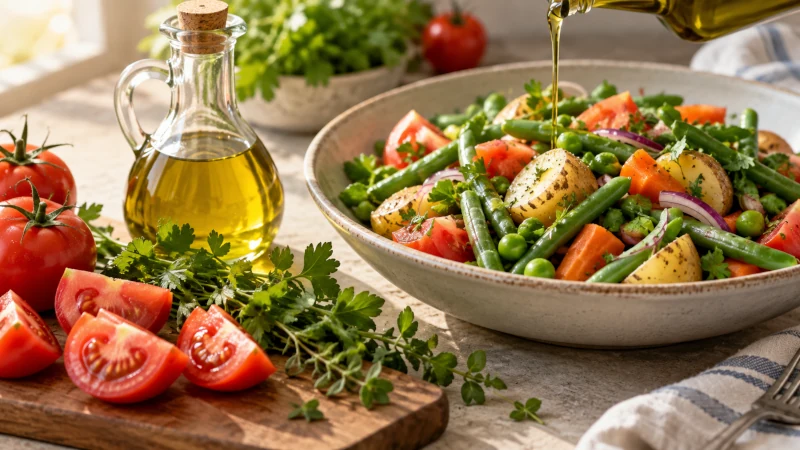
Raw tomato brings vitamin C and lycopene, the pigment behind its red colour; diets rich in tomato products have been linked — though not conclusively — to a lower risk of prostate cancer (Harvard T.H. Chan School of Public Health, 2025). The olive oil isn’t just flavour: it’s about 72% monounsaturated fat, the type that improves cholesterol levels when it replaces saturated fat like butter (Harvard T.H. Chan School of Public Health, 2025). Dressing vegetables with a little olive oil also helps your body absorb their fat-soluble nutrients. It’s still calorie-dense, so “a little” is the operative phrase.
What about “alkalizing” and “detox”?
Older versions of recipes like this often claim the ingredients “alkalize the blood” and help “eliminate uric acid and waste.” It’s worth being straight about this: your body tightly controls its own blood pH, and food doesn’t meaningfully change it — the popular “alkaline” framing isn’t supported by the science (WebMD, 2025).
The good news is you don’t need it to be true. A produce-heavy, olive-oil-dressed salad is worth eating for the well-established reasons above, not for a pH effect it doesn’t have. On the related uric-acid point: vegetables — even higher-purine ones like peas — don’t meaningfully raise gout risk, so a bowl like this is fine for most people managing gout (see our guide to foods that trigger gout).
Who should be a little careful
Most people can eat this freely. A few situations are worth a mention:
- If you have diabetes: enjoy the beans, tomato, onion and carrot freely, but count the potatoes and peas as your carbohydrate for the meal and keep the portion sensible. Cooling the potatoes and keeping the skin on both help.
- If you’re watching blood pressure or sodium: go easy on the added salt — the salad is naturally very low in sodium until you add it.
- If you get gout: this salad is generally fine; vegetables aren’t meaningful triggers. Alcohol, sugary drinks and organ meats matter far more.
- If you have kidney disease: tomatoes and potatoes are relatively high in potassium, so if you’ve been told to limit potassium, check portions with your care team.
- Reflux or IBS: raw onion and garlic trigger symptoms in some people; soften or reduce them if that’s you.
None of this is medical advice for your specific situation. If you have diabetes, kidney disease, or are pregnant or breastfeeding and want to know how a dish like this fits your plan, a doctor or registered dietitian can tailor it to you.
Make it a full meal
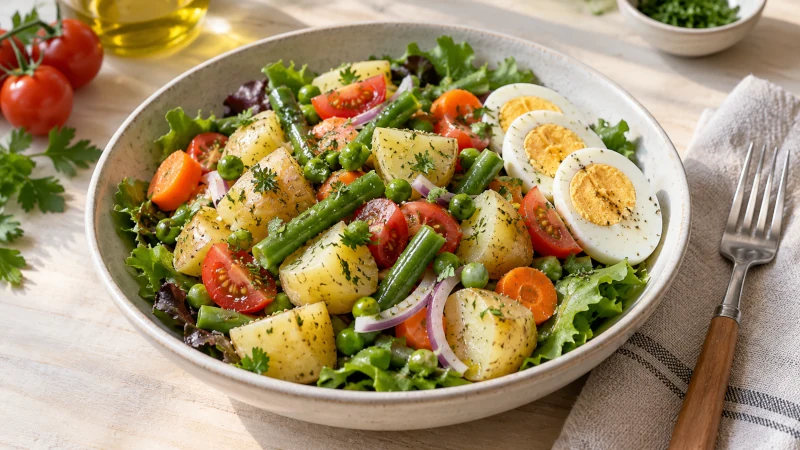
As written, this is a side or a light lunch. To turn it into a main, add a protein — chickpeas or white beans, a boiled egg, canned tuna or leftover chicken — and a handful of leafy greens for more nutrients per bite. If you like this style of simple, vegetable-forward cooking, our Mexican salad and rice and vegetables recipes work the same way.
| Health Disclaimer: This article is for general information and education only. It is not medical or dietary advice, and it is not a substitute for guidance from a qualified professional. If you have diabetes, kidney disease, high blood pressure, a food allergy, or are pregnant or breastfeeding, talk to your doctor or a registered dietitian before making changes to how you eat. Never disregard professional advice because of something you read here. |
Frequently Asked Questions
Is this spring salad good for weight loss?
It can help as part of a calorie-aware diet: it’s high in fiber and water, which are filling, and naturally low in calories before the oil. The olive oil and potatoes are the calorie-dense parts, so mind the portions. Adding produce only helps with weight if it replaces something more calorie-dense, not if it’s piled on top (Harvard T.H. Chan School of Public Health, 2025).
Can people with diabetes eat it?
Yes, with attention to the potatoes and peas, which are the carbohydrate sources. The green beans, tomato, onion and carrot have little effect on blood sugar. Keeping the potato skin on and cooling the potatoes before eating both soften the glucose response. Our diabetic-friendly foods guide has more detail.
Is it better warm or cold?
Cold, and not only for taste. Cooling the boiled potatoes increases resistant starch, which is gentler on blood sugar than hot, freshly cooked potato (Harvard T.H. Chan School of Public Health, 2022).
How much fiber is in it?
Roughly 9 grams a serving by the source’s estimate — a meaningful share of the 25–35 grams adults should aim for daily.
Does it really “detox” or “alkalize” the body?
No. Your kidneys and lungs regulate your blood’s pH; diet doesn’t change it in any lasting way (WebMD, 2025). Eat it because it’s a genuinely healthy bowl, not for a detox effect.
Can I make it ahead?
Yes. It keeps a day or two refrigerated and the flavours settle. Dress it just before serving if you want the vegetables to stay crisp.
References
- Harvard T.H. Chan School of Public Health, The Nutrition Source. Vegetables and Fruits. Updated 2025. View source
- Harvard T.H. Chan School of Public Health, The Nutrition Source. Fiber. Last reviewed April 2022. View source
- Harvard T.H. Chan School of Public Health, The Nutrition Source. Types of Fat. Updated 2025. View source
- WebMD. Alkaline Diet: Foods High in Alkaline. Medically reviewed February 12, 2025. View source
- Pamplona-Roger GD. Encyclopedia of Foods and Their Healing Power, Vol. 3. Editorial Safeliz, 2005, p. 312. (Original recipe and per-serving nutrition estimate.)


