
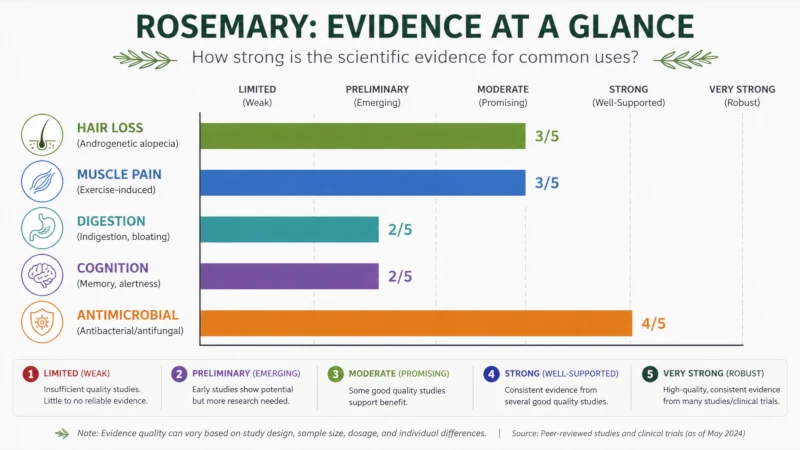
Rosemary earns its reputation in three separate places, and the evidence is uneven across all three. Rubbed into the scalp, it has one reasonably designed human trial behind it for pattern hair loss. Massaged into a stiff shoulder or sipped as a tea after a heavy meal, it holds a formal traditional-use approval in Europe — which certifies long, safe use rather than proven effect. And the popular claim that smelling rosemary sharpens your thinking rests on small studies that don’t agree with each other.
That is the honest map of the benefits of rosemary. What follows is what sits underneath each claim, the doses regulators actually approve, and the handful of situations where this very ordinary kitchen herb can cause real trouble.
What rosemary actually is
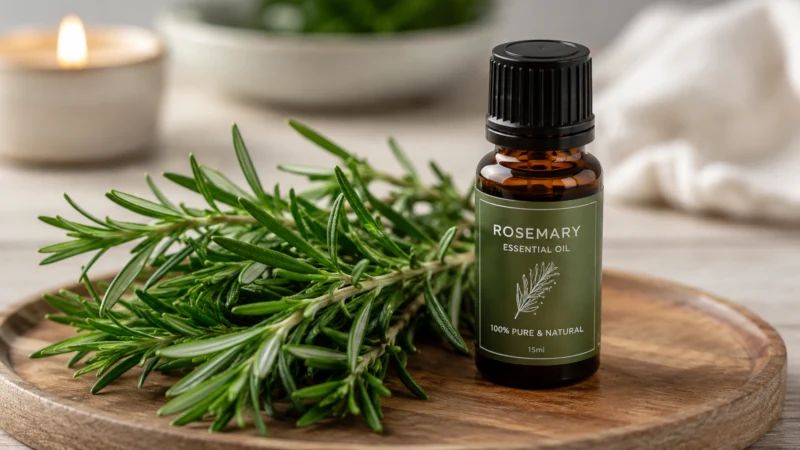
Rosemary is an evergreen shrub in the mint family, native to the Mediterranean. Botanists reclassified it, so you will now see it written as Salvia rosmarinus. The older name Rosmarinus officinalis still appears on most product labels and in most research papers, and it refers to the same plant (Baptista et al., Plants, 2024).
Its activity comes from two different chemical groups, and confusing them is where most bad rosemary advice starts. The leaf carries water-soluble phenolics — rosmarinic acid, carnosic acid, carnosol, and various flavonoids — which is what you get in tea (Baptista et al., Plants, 2024). The steam-distilled essential oil carries volatile terpenes instead, chiefly 1,8-cineole, camphor, and α-pinene (Bin Rubaian et al., Clinical, Cosmetic and Investigational Dermatology, 2024). Tea and essential oil are not interchangeable, and the safety rules for each are different.
Rosemary oil and hair loss: the strongest single piece of evidence
This is the one benefit of rosemary with a head-to-head human trial behind it. In a six-month randomised comparison, 100 men aged 18 to 49 with androgenetic alopecia were assigned to either topical rosemary oil or minoxidil 2%. At three months neither group had changed. By six months both groups showed a significant increase in hair count, with no significant difference between them. Scalp itching was significantly more common in the minoxidil group (Panahi et al., Skinmed, 2015; summarised in Bin Rubaian et al., 2024).
That result is genuinely interesting. It is also one study, and it deserves to be read with its limits attached:
- It was single-blind, not double-blind, and enrolled only men in a single centre.
- The comparator was minoxidil 2%, not the 5% strength most people now use.
- Both groups needed a full six months before anything measurable happened. Three months showed nothing.
- No placebo arm means we cannot separate the oil’s effect from the effect of massaging a scalp twice a day for half a year.
The proposed mechanism is plausible rather than proven. Rosemary leaf extract inhibits 5α-reductase — the enzyme that converts testosterone into DHT — in laboratory and mouse work, with 12-methoxycarnosic acid identified as the most active constituent. Those are animal and in vitro findings, not human ones (Bin Rubaian et al., 2024).
A realistic expectation: if you have genuine pattern hair loss, rosemary oil may slow it and modestly improve density over six months or more, with less itching than minoxidil. It is not a regrowth cure, and it has not been tested against the treatments a dermatologist would actually reach for first. If your hair is coming out in discrete round patches rather than thinning diffusely, that is a different condition — see our guide to stopping alopecia areata from spreading and get a diagnosis before you treat anything.
How to apply it without irritating your scalp
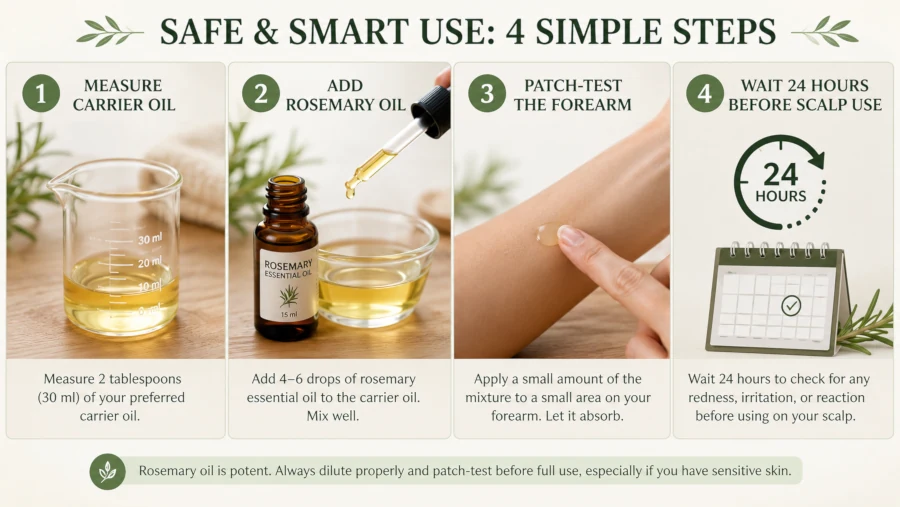
Never put undiluted essential oil on skin. Dilute it in a carrier oil such as jojoba, coconut or sweet almond, patch-test on your inner forearm and wait a day, then massage the diluted oil into the scalp and leave it for the length of time the product directs. Consistency over months matters more than concentration.
A separate note for anyone thinking of using it on facial hair: DHT drives beard growth even as it works against scalp hair, so a DHT-lowering oil is a different proposition on the face. We cover that tension in rosemary oil for beard growth.
Sore muscles and stiff joints: approved on tradition, not on trials
Europe’s Committee on Herbal Medicinal Products approves rosemary oil as a traditional herbal medicine applied to the skin for minor muscular and joint pain and minor peripheral circulatory problems. The approved preparation is a semi-solid form — cream, gel or ointment — containing 6 to 10% rosemary oil, applied two or three times daily by adults (EMA/HMPC monograph on Rosmarinus officinalis L., aetheroleum, 2024).
It is worth being precise about what that approval means. “Traditional use” registration is granted on the basis of at least three decades of documented safe use, expressly because the clinical trial evidence is not sufficient for a stronger claim. It tells you the preparation is unlikely to hurt you at that dose. It does not tell you it outperforms a placebo rub.
The same monograph sets a stopping rule that matters: if your symptoms have not settled after four weeks, stop self-treating and see a clinician (EMA/HMPC, 2024).
Rosemary leaf works as a bath additive under the same traditional indication — around 50 g as a decoction added to the water, at 35–38 °C for 10 to 20 minutes (EMA/HMPC monograph on Rosmarinus officinalis L., folium, 2024). If you have high blood pressure, take a full hot bath cautiously.
Benefits of Rosemary tea for digestion
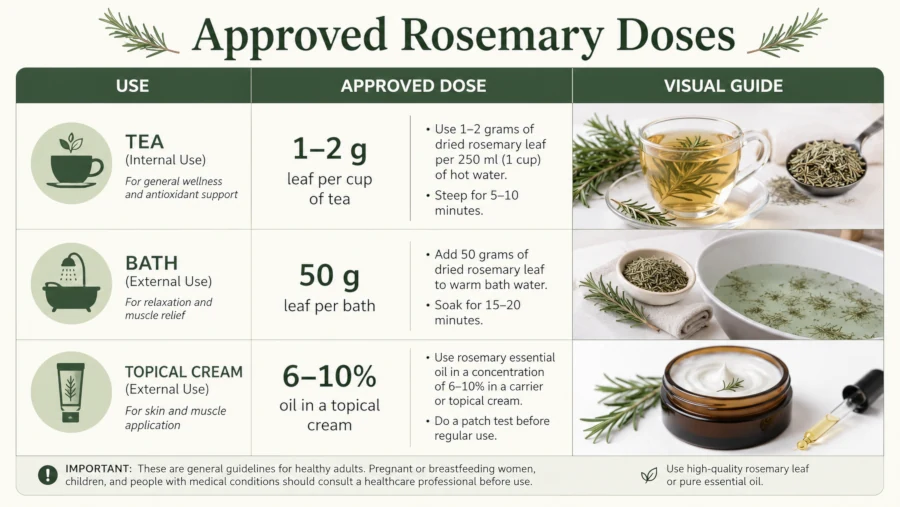
The other traditional indication for rosemary leaf is symptomatic relief of dyspepsia and mild cramping in the gut. The approved preparation is straightforward: 1 to 2 g of dried leaf steeped in 150–250 ml of boiling water, two or three times a day, up to a daily total of 2 to 6 g. It is not recommended for children under 12, and if symptoms last more than two weeks you should see someone (EMA/HMPC monograph on rosemary leaf, 2024).
There is one important exclusion. Rosemary stimulates bile flow, so oral use is cautioned in people with gallstones, bile duct obstruction, cholangitis, liver disease, or any biliary condition under medical supervision (EMA/HMPC, 2024). If you have had gallbladder trouble, rosemary tea is not a casual choice.
Does smelling rosemary help you think?
This is where the internet has run considerably ahead of the science. The most-cited study exposed 20 healthy volunteers to diffused rosemary aroma, tested them on arithmetic and visual processing tasks, then measured blood levels of 1,8-cineole. Higher blood concentrations correlated with better speed and accuracy (Moss & Oliver, Therapeutic Advances in Psychopharmacology, 2012).
Read that carefully. Twenty people, no control group, and a correlation between an absorbed compound and performance — not a demonstration that rosemary made anyone smarter. The same paper found the mood relationship weaker and, in one measure, running the opposite way.
Other work points the other direction. A controlled study of rosemary aroma, lavender aroma and a placebo pill found no effect of any of them on sustained attention, alertness or heart rate, though all three raised participants’ expectations of improvement (Babulka et al., Flavour and Fragrance Journal, 2017). Taken together, the evidence here is genuinely mixed and preliminary. Enjoy the smell; don’t reorganise your study routine around it.
Antioxidant and antimicrobial activity: real, but mostly in a dish
Rosemary is a strong antioxidant in laboratory conditions. Carnosol and rosmaridiphenol perform comparably to or better than the synthetic food preservatives BHA and BHT, which is precisely why rosemary extract is used commercially to stop fats going rancid. Extracts also show activity against several Candida species and dermatophytes in vitro (Bin Rubaian et al., 2024).
None of that has been shown to translate into treating an infection or a disease in a person. Antioxidant activity in a test tube is a chemical property, not a health outcome, and it should not be read as evidence that rosemary prevents anything.
What rosemary does not do
Some of the oldest claims attached to this herb do not survive contact with current evidence, and a few of them are unsafe.
- It does not cure rheumatism, arthritis, or any other chronic inflammatory disease.
- It does not restore youth, reverse ageing, or treat depression. Those stories are folklore, and they are charming folklore, but they are not medicine.
- It should not be swallowed as an essential oil. When European regulators reviewed rosemary oil in 2024, oral and bath preparations were removed; the only approved route is now semi-solid preparations applied to the skin (EMA/HMPC, 2024). Counting drops of essence into water is not a supported practice.
- It does not treat kidney stones or renal colic. Trying to flush a stone with a diuretic herb instead of getting imaging is how a treatable obstruction becomes an emergency.
Side effects, interactions, and who should avoid rosemary
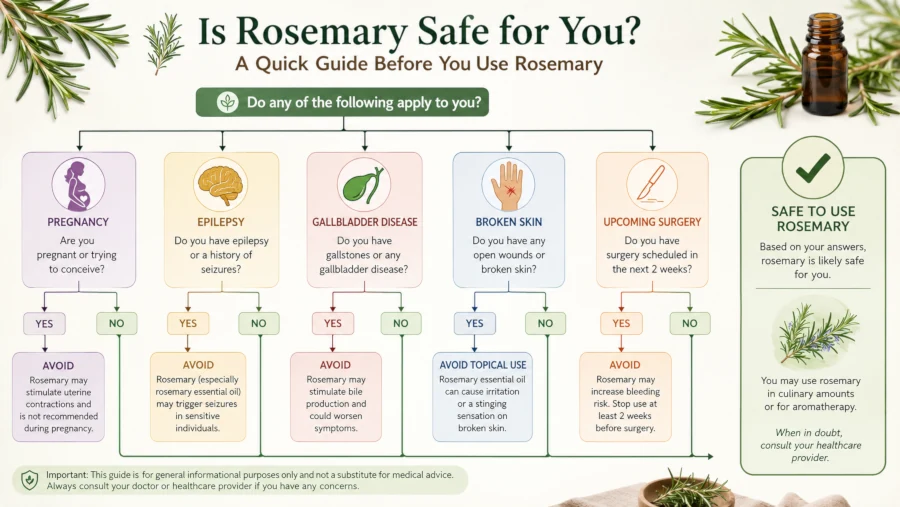
Side effects
Culinary amounts are unremarkable. For medicinal preparations, the recognised adverse reactions are hypersensitivity: contact dermatitis for both leaf and oil, and allergic asthma reported with the oil. Frequency is not known for either (EMA/HMPC, 2024). Undiluted essential oil on skin is a common and avoidable cause of irritation.
The camphor problem
Rosemary oil contains camphor, and camphor-containing essential oils are recognised as proconvulsant. Rosemary appears on the standard list of epileptogenic essential oils alongside eucalyptus, sage, thuja and turpentine (Mathew et al., JACEP Open, 2020). The three cases described in that particular series involved eucalyptus and camphor rather than rosemary specifically, so treat this as a recognised class risk rather than a rosemary-specific one. Either way, if you have epilepsy or any seizure history, do not use concentrated rosemary oil without asking your neurologist first — and never ingest it.
Medication interactions
Here the sources genuinely disagree, and it is worth naming that rather than picking the more dramatic side. The European monographs for both rosemary leaf and rosemary oil state that no interactions have been reported at traditional doses (EMA/HMPC, 2024).
Cancer-centre guidance takes a more conservative line on concentrated herbal preparations generally, advising patients to stop herbal remedies and supplements a week before surgery, chemotherapy or radiotherapy because of bleeding and treatment-interference risk, while noting that ordinary culinary use of spices and teas is fine (Memorial Sloan Kettering, Herbal Remedies and Cancer Treatment). Both can be true: the food-level exposure and the concentrated-extract exposure are different things.
The practical translation: rosemary on your potatoes needs no clearance. A concentrated rosemary supplement, if you take blood thinners, are due for surgery, or are on cancer treatment, is a conversation with your pharmacist.
Pregnancy and breastfeeding
Safety in pregnancy and lactation has not been established for either rosemary leaf or rosemary oil, and in the absence of adequate data, medicinal use during pregnancy and breastfeeding is not recommended. No fertility data exist, and reproductive-toxicity testing has not been carried out (EMA/HMPC, 2024). Rosemary as a cooking herb is a different matter and is not what this caution is about.
Who should skip it
| If this applies to you | What to do |
| Known allergy to rosemary or other mint-family plants | Avoid entirely. |
| Broken, irritated, or inflamed skin | Do not apply. Contraindicated for topical use. |
| Pregnant or breastfeeding | Avoid medicinal doses. Culinary use is not the concern here. |
| Children under 12 | Rosemary leaf (tea or bath) is not recommended. |
| Under 18 | Rosemary oil preparations are not recommended — safety not established. |
| Epilepsy or any seizure history | Avoid concentrated essential oil. Never ingest it. |
| Gallstones, bile duct obstruction, cholangitis, or liver disease | Avoid oral rosemary preparations. |
| High blood pressure | Use full hot rosemary baths cautiously. |
| Surgery, chemotherapy or radiotherapy coming up | Stop concentrated herbal supplements roughly a week beforehand and tell your team. |
Two more universal rules for the oil: keep it away from the eyes, and do not apply it near mucous membranes.
When to stop and see a professional
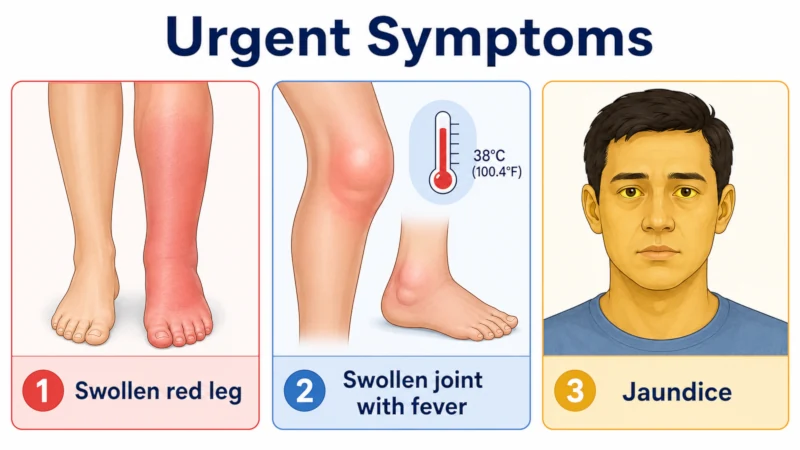
Rosemary is a comfort measure. These signs mean the problem is not one a comfort measure should be handling:
- Joint pain with swelling, redness, or fever — get it examined rather than rubbing anything on it.
- Sudden swelling of one or both legs, particularly with redness and heat; skin inflammation, ulceration or hardening beneath the skin; or a sudden sharp pain in the leg at rest. Any of these needs same-day medical assessment.
- Known cardiac or renal insufficiency alongside circulatory symptoms.
- Digestive symptoms lasting more than two weeks, or muscle and joint symptoms lasting more than four weeks, despite treatment.
- Any symptom that worsens while you are using rosemary.
These thresholds come straight from the European monographs (EMA/HMPC, rosemary leaf and rosemary oil, 2024), and they exist because the symptoms on that list overlap with deep vein thrombosis, cellulitis, septic arthritis and biliary obstruction.
Hair loss deserves a diagnosis too. Thyroid disease, iron deficiency, and telogen effluvium after illness or stress all cause shedding, and none of them responds to scalp oil. Our overview of herbs for hair loss walks through the main causes. For rosemary applied to eczema-prone or already-inflamed skin, take a look at the safer options in our guide to herbs for eczema first — broken skin is an explicit contraindication.
| Health disclaimer: This article is for education and general information. It is not medical advice and it is not a substitute for diagnosis or treatment from a qualified healthcare professional. Talk to your doctor, pharmacist, or another qualified clinician before using rosemary medicinally — particularly if you are pregnant or breastfeeding, taking prescription medication, living with epilepsy, gallbladder or liver disease, or preparing for surgery or cancer treatment. If a symptom is severe, sudden, or getting worse, seek medical care rather than treating it at home. |
Frequently Asked Questions
Is rosemary oil as good as minoxidil for hair loss?
In one six-month randomised trial of 100 men, hair counts rose similarly in both groups, and rosemary caused significantly less scalp itching. That is a single single-blind study using minoxidil 2%, not the 5% strength most people use, and it had no placebo arm. “Comparable in one trial” is accurate; “just as good as minoxidil” is not.
How much rosemary tea can I safely drink?
The traditional-use dose approved in Europe is 1–2 g of dried leaf per cup, two or three times daily, up to 6 g a day. Stop after two weeks if your digestive symptoms haven’t settled, and skip it entirely if you have gallstones or another biliary condition.
Can I swallow rosemary essential oil?
No. Oral preparations were removed when European regulators reviewed rosemary oil in 2024, leaving only semi-solid preparations for the skin. The oil is concentrated, contains camphor, and swallowing it carries a seizure risk that the herb in food does not.
Is rosemary safe during pregnancy?
As a cooking herb, it isn’t the concern. As a medicine — tea, supplements, essential oil, or rosemary baths — safety during pregnancy and breastfeeding has not been established, and regulators advise against medicinal use for that reason.
Does rosemary really improve memory?
The evidence is thin and inconsistent. One small study of 20 people found better task performance at higher blood levels of an absorbed rosemary compound; a controlled study of rosemary aroma found no effect on attention or alertness beyond raised expectations. There is not yet enough here to call it a memory aid.
Can rosemary oil irritate the skin?
Yes — contact dermatitis is the recognised adverse reaction, and allergic asthma has been reported with the oil. Dilute it in a carrier oil, patch-test before first use, avoid broken or irritated skin, and keep it away from your eyes.
References
- Baptista A, Menicucci F, Brunetti C, et al. Unlocking the Hidden Potential of Rosemary (Salvia rosmarinus Spenn.): New Insights into Phenolics, Terpenes, and Antioxidants of Mediterranean Cultivars. Plants. 2024;13(23):3395. View source
- Bin Rubaian NF, Alzamami HFA, Amir BA. An Overview of Commonly Used Natural Alternatives for the Treatment of Androgenetic Alopecia, with Special Emphasis on Rosemary Oil. Clinical, Cosmetic and Investigational Dermatology. Dove Medical Press. 2024;17:2495–2503. View source
- Panahi Y, Taghizadeh M, Marzony ET, Sahebkar A. Rosemary oil vs minoxidil 2% for the treatment of androgenetic alopecia: a randomized comparative trial. Skinmed. 2015;13(1):15–21. PMID 25842469. View source
- European Medicines Agency, Committee on Herbal Medicinal Products. European Union herbal monograph on Rosmarinus officinalis L., aetheroleum. EMA/HMPC/513893/2021, Revision 1, 29 May 2024. View source
- European Medicines Agency, Committee on Herbal Medicinal Products. European Union herbal monograph on Rosmarinus officinalis L., folium. EMA/HMPC/513940/2021, Revision 1, 29 May 2024. View source
- Moss M, Oliver L. Plasma 1,8-cineole correlates with cognitive performance following exposure to rosemary essential oil aroma. Therapeutic Advances in Psychopharmacology. 2012;2(3):103–113. PMID 23983963; PMCID PMC3736918. View source
- Babulka P, Berkes T, Szemerszky R, Köteles F. No effects of rosemary and lavender essential oil and a placebo pill on sustained attention, alertness, and heart rate. Flavour and Fragrance Journal. 2017;32(4):305–311. View source
- Mathew T, John SK, Kamath V, et al. Essential oil–related status epilepticus: A small case series study. Journal of the American College of Emergency Physicians Open. 2020;1(5):918–921. PMID 33145540. View source
- Memorial Sloan Kettering Cancer Center. Herbal Remedies and Cancer Treatment. Patient education library. View source
