
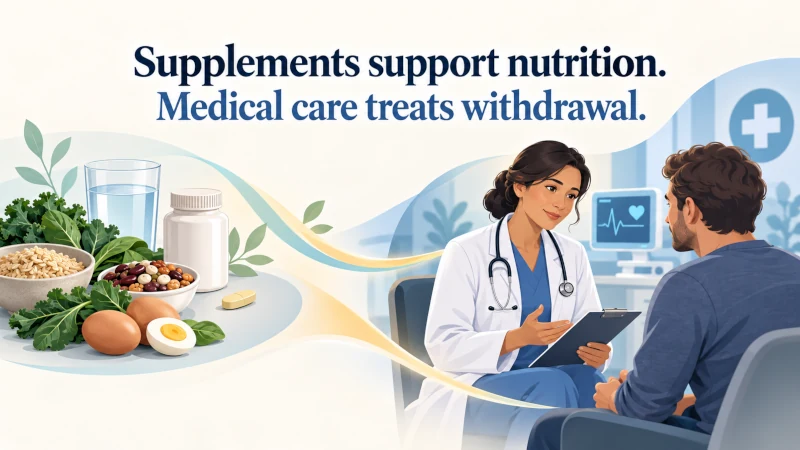
Most supplements for alcohol withdrawal do not treat withdrawal. One of them — thiamine, vitamin B1 — matters enormously, and it matters for a reason that has nothing to do with easing tremors or calming nerves. The rest range from plausible-but-unproven to actively risky for someone whose liver is already under strain.
That is the honest version, and it is worth saying plainly, because alcohol withdrawal is the one form of substance withdrawal that can kill you. The NIAAA puts it bluntly: withdrawal can be life-threatening when someone who drinks heavily stops suddenly rather than tapering or stopping with medical support [NIAAA, 2025]. Up to half of people with alcohol use disorder have some withdrawal symptoms when they stop, and a smaller group needs medical monitoring to get through it safely. In the U.S., alcohol withdrawal accounts for about 260,000 emergency department visits and 850 deaths a year [NIAAA, 2025].
So the first question isn’t which supplement to buy. It’s whether you should be doing this alone at all.
Before anything else: is this safe to do at home?
Call a doctor before you stop — not after symptoms start. A clinician can estimate your risk in a short conversation and, if needed, prescribe medication that makes withdrawal both safer and more bearable. Benzodiazepines are the first-line treatment for acute withdrawal and have the deepest evidence base behind them [NIAAA, 2025]. The professional guideline U.S. clinicians work from — ASAM’s alcohol withdrawal management guideline — is built around assessment, monitoring and medication, not nutrition [ASAM, 2020]. No vitamin, mineral, amino acid or herb substitutes for that.
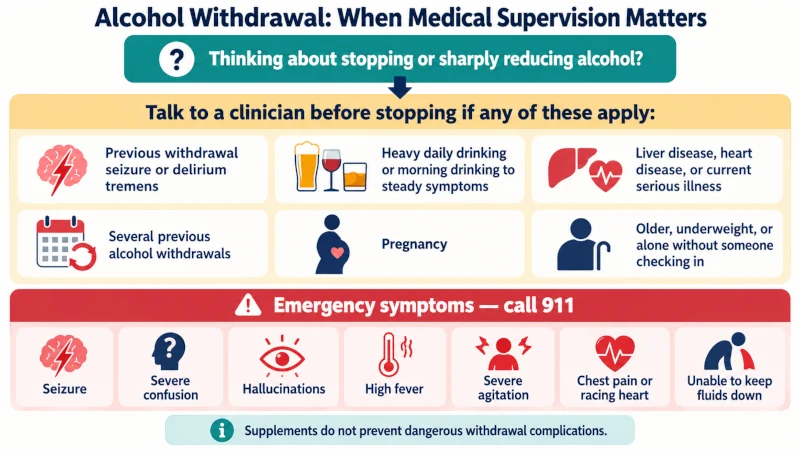
You need medical supervision, not a supplement plan, if any of these apply:
- You have ever had a withdrawal seizure or delirium tremens
- You drink daily and heavily, or drink in the morning to steady yourself
- You have liver disease, heart disease, or an infection right now
- You have been through withdrawal several times before — each episode tends to be worse than the last
- You are pregnant
- You are older, underweight, or living alone with no one to check on you
| Call 911 / go to an emergency department for: A seizure · confusion or not knowing where you are · seeing, hearing or feeling things that aren’t there · a high fever · severe agitation · chest pain or a racing heart · vomiting that makes it impossible to keep fluids down. Confusion, unsteady walking and abnormal eye movements occurring together are a particular emergency: that triad suggests Wernicke’s encephalopathy, which is treatable with prompt thiamine and, untreated, is fatal in up to 20% of cases [Day, 2013]. |
If you want a fuller picture of the timeline and symptoms, our guide to alcohol withdrawal symptoms and management covers it in more detail.
Supplements for alcohol withdrawal: What can they realistically do
Here is the useful frame. Heavy drinking causes nutritional deficiencies — through poor diet, poor absorption, liver damage, and the metabolic cost of processing alcohol itself. Correcting those deficiencies is genuinely worth doing. It supports repair, and in one case it prevents a specific, devastating brain injury.
What supplements do not do is treat the withdrawal syndrome. The tremor, the racing heart, the sleeplessness, the seizure risk — those come from a nervous system that adapted to alcohol and is now over-firing without it. That is a pharmacological problem, and it has a pharmacological solution.
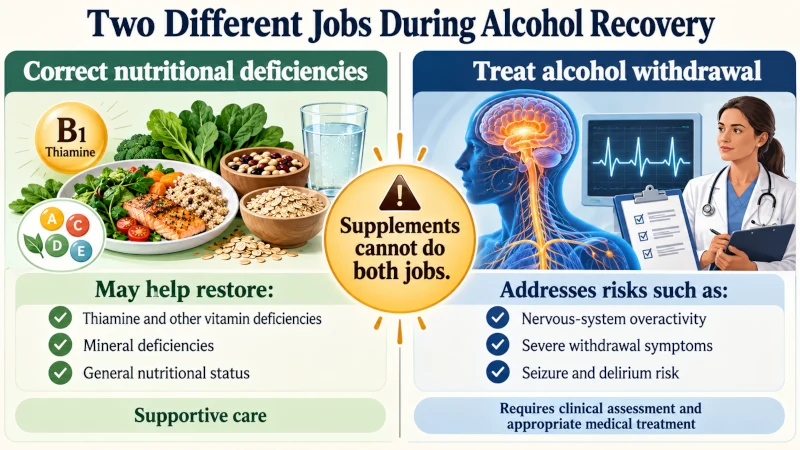
Keep those two jobs separate and the rest of this article makes sense.
Thiamine (vitamin B1): the one that genuinely matters
Between 30% and 80% of people who drink heavily show clinical or biochemical signs of thiamine deficiency [Day, 2013]. The body stores very little of it, so deficiency can develop within two to three weeks of inadequate intake. And thiamine deficiency in this context doesn’t just cause vague fatigue — it causes Wernicke-Korsakoff syndrome, a brain disorder that can begin abruptly with confusion, loss of coordination and eye-movement problems, and that leaves many survivors with permanent memory damage.
Treating and preventing it with thiamine has been standard practice for more than 50 years, and clinical guidelines worldwide recommend it. That is the strong part.
Here is the honest part. When Cochrane reviewers went looking for randomised trials to establish the right dose, route and duration, they found two — 177 participants between them, one unpublished and too small to analyse. Their conclusion: the evidence from randomised trials is insufficient to guide clinicians on dose, frequency, route or duration [Day, 2013]. Current recommendations rest on case reports, basic science and clinical experience rather than trial data.
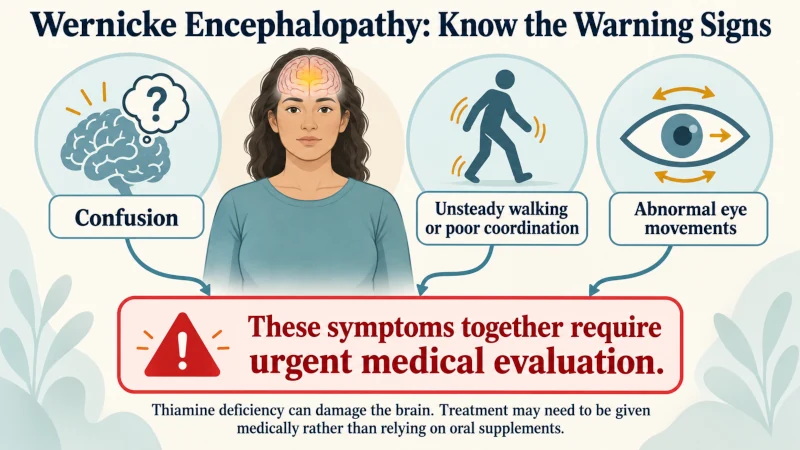
What that means for you, practically: thiamine is worth taking, and it is worth asking a clinician about rather than guessing. People at high risk — anyone going through withdrawal, anyone with alcohol-related liver disease, anyone malnourished or vomiting — are often given thiamine by injection first, because oral absorption is unreliable in exactly the situation where it is needed most. Do not assume a drugstore B-complex has solved this.
The other B vitamins, folate, and multivitamins
Folate, B6 and B12 deficiencies are common in heavy drinkers, and correcting them is part of standard nutritional care. A general-purpose multivitamin or B-complex is reasonable, low-risk and inexpensive.
What the evidence does not support is the claim that these vitamins ease withdrawal symptoms. You will read that niacin stabilises mood and reduces anxiety during withdrawal, or that B6 and B12 “enhance mental clarity.” Those claims are not backed by trials in people going through alcohol withdrawal. Correcting a deficiency you actually have helps your body function normally. It is not a treatment for anxiety, tremor or insomnia.
One caution worth naming: high-dose niacin can cause flushing and, at sustained high doses, liver injury — a bad trade for someone whose liver is already recovering from alcohol.
Minerals: magnesium, potassium, zinc
Magnesium: plausible, popular, and unproven
Magnesium is the supplement most often recommended for withdrawal, and the reasoning sounds right. Low magnesium is common in heavy drinkers, magnesium calms nerve excitability, and withdrawal is a state of nerve over-excitement. Many hospital protocols include it.
The trials don’t settle it. A Cochrane review pooled four randomised trials covering 317 hospitalised adults. Only one measured seizures, delirium tremens or withdrawal severity at all. The single outcome that could be pooled — handgrip strength — showed no benefit. The authors concluded there is insufficient evidence to determine whether magnesium is beneficial or harmful for treating or preventing alcohol withdrawal [Sarai, 2013].
That is not the same as “magnesium doesn’t work.” It means nobody has run the study that would tell us. If your magnesium is low, correcting it is sensible — and food is the safest route, as our guide to magnesium-rich foods lays out. If you supplement, the ceiling for adults is 350 mg a day from supplements unless a doctor says otherwise, and anyone with reduced kidney function should not take magnesium supplements without supervision.
Potassium and electrolytes: this is not a DIY job
Withdrawal, vomiting and poor eating can throw potassium, sodium and other electrolytes out of balance. That is real. But potassium is the one mineral on this list where guessing can hurt you: too much is as dangerous as too little, and the symptoms of both include an irregular heartbeat.
Electrolyte correction belongs to a clinician with a blood test result in front of them. If you are unwell enough to be worried about your electrolytes, you are unwell enough to be seen.
Zinc and vitamin D
Both are commonly low in people who drink heavily. Neither has been shown in trials to ease withdrawal. Correct a documented deficiency; don’t expect it to change how the week goes.
Herbs and amino acids marketed for alcohol withdrawal
This is where the marketing outruns the evidence most sharply, so it’s worth going one by one.
Kudzu
Kudzu is the most interesting of the group, and also the most misunderstood. Researchers at McLean Hospital have run a series of small trials showing that kudzu extract reduces how much heavy drinkers drink. In one, 20 men received either a single dose of kudzu extract or placebo before a 90-minute drinking session; the kudzu group went from about 3.0 beers at baseline to 1.9, while the placebo group rose from 2.7 to 3.4 [Penetar, 2015]. Earlier work from the same lab, using a week of dosing before a laboratory drinking session, found the same direction of effect [Lukas, 2005].
Two things to notice. First, these are studies of drinking behaviour in heavy drinkers who were not seeking treatment — not studies of withdrawal symptoms. Kudzu has not been shown to reduce tremor, anxiety or seizure risk during withdrawal. Second, the picture isn’t uniform. A pilot trial in 38 veterans with chronic alcoholism concluded that kudzu root was no better than placebo at reducing alcohol craving or promoting sobriety [Shebek, 2000]. Calling kudzu a proven anti-craving supplement overstates a small, promising, unfinished body of work — and the positive studies measure how much someone drinks, not how safely they stop.
N-acetylcysteine (NAC)
NAC is widely sold for cravings and liver support during recovery. A 2026 systematic review and meta-analysis pooled seven randomised, double-blind, placebo-controlled trials covering 566 participants. For alcohol use disorder, NAC showed no significant effect on craving (SMD −0.40, 95% CI −1.05 to 0.25), no significant effect on heavy drinking days, and no significant effect on ALT, AST or GGT — the liver enzymes it is most often sold to improve. It did significantly increase gastrointestinal side effects compared with placebo (RR 1.40, 95% CI 1.07 to 1.84) [Ahmed, 2026].
The authors’ own conclusion is that NAC shouldn’t be considered a first-line or standalone treatment. It is relatively safe; it just hasn’t been shown to work for this.
Milk thistle
Milk thistle’s reputation for liver protection is older than the evidence for it. A Cochrane review of randomised trials in alcoholic and viral liver disease found that liver-related mortality looked lower with milk thistle across all trials (RR 0.50, 95% CI 0.29 to 0.88) — but the effect disappeared once the analysis was restricted to high-quality trials (RR 0.57, 95% CI 0.28 to 1.19). The reviewers concluded that their results question the benefit and highlight the lack of high-quality evidence [Rambaldi, 2007]. Milk thistle appears well tolerated, with no significant increase in adverse events. It is not a reason to feel protected while still drinking.
L-glutamine
L-glutamine is sold for cravings and sleep on the strength of a mechanism — blood sugar stability, GABA precursor chemistry — rather than results. There is no good human trial evidence that it reduces alcohol cravings or improves sleep during withdrawal. The mechanism may be real; the clinical effect is unmeasured.
Ashwagandha and other adaptogens
This one needs a warning rather than a verdict. Ashwagandha has reasonable evidence for stress and sleep in healthy adults, and it has never been studied for alcohol withdrawal. More importantly, NCCIH notes documented cases linking liver injury to ashwagandha supplements [NCCIH, 2023]. Reported cases typically appear two to twelve weeks after starting, often with jaundice.
For someone whose liver is already dealing with years of alcohol, that risk profile is the wrong shape. Our ashwagandha and anxiety guide goes into the liver question in depth, and its advice applies squarely here: avoid it if you have liver disease or a history of heavy drinking.
The evidence at a glance
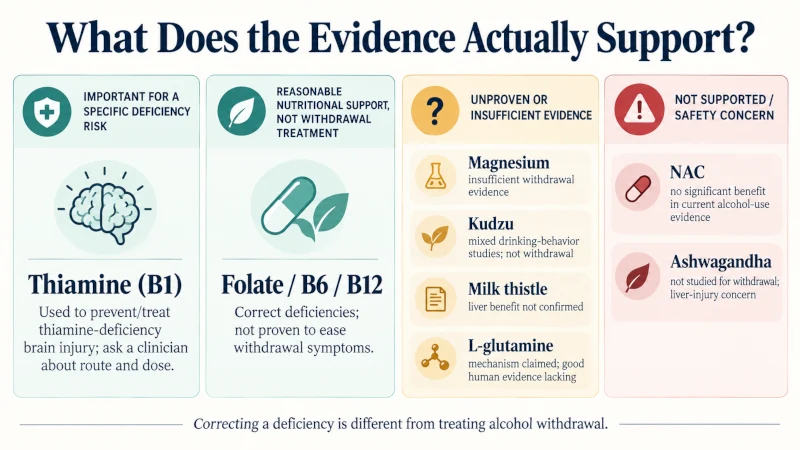
| Supplement | What it’s sold for | What the evidence actually shows | Verdict |
| Thiamine (B1) | Nerve and brain protection | Standard of care for 50+ years to prevent Wernicke-Korsakoff; trial evidence too thin to set dose or route [Day, 2013] | Important — ask a clinician |
| Folate, B6, B12 | Mood, energy, anemia | Deficiencies common; correcting them is routine care. No trial support for easing withdrawal symptoms | Reasonable as basic nutrition |
| Magnesium | Tremor, sleep, seizures | 4 trials, 317 people: insufficient evidence of benefit or harm [Sarai, 2013] | Unproven |
| Potassium / electrolytes | Rebalancing | Real clinical need — but requires blood testing | Clinician only |
| Zinc, vitamin D | Immunity, mood | Often low in heavy drinkers; no withdrawal trials | Correct deficiency only |
| Kudzu | Cravings | Reduced drinking in small lab studies [Penetar, 2015]; a 38-person pilot found no craving or sobriety benefit [Shebek, 2000]; never tested for withdrawal | Early and mixed |
| NAC | Cravings, liver | 7 RCTs, 566 people: no effect on craving, drinking or liver enzymes; more GI side effects [Ahmed, 2026] | Not supported |
| Milk thistle | Liver repair | Benefit not confirmed in high-quality trials [Rambaldi, 2007] | Not confirmed |
| L-glutamine | Cravings, sleep | Mechanism only; no good human trials in withdrawal | Insufficient evidence |
| Ashwagandha | Stress, anxiety | Not studied for withdrawal; linked to liver injury [NCCIH, 2023] | Avoid in this context |
Side effects, interactions, and who should avoid these
Supplements are not regulated like drugs. The FDA does not approve them for safety or effectiveness before sale, and manufacturers are responsible for their own claims [NCCIH, 2023]. Two consequences follow: what’s in the bottle may not match the label, and “natural” tells you nothing about whether something is safe for you.
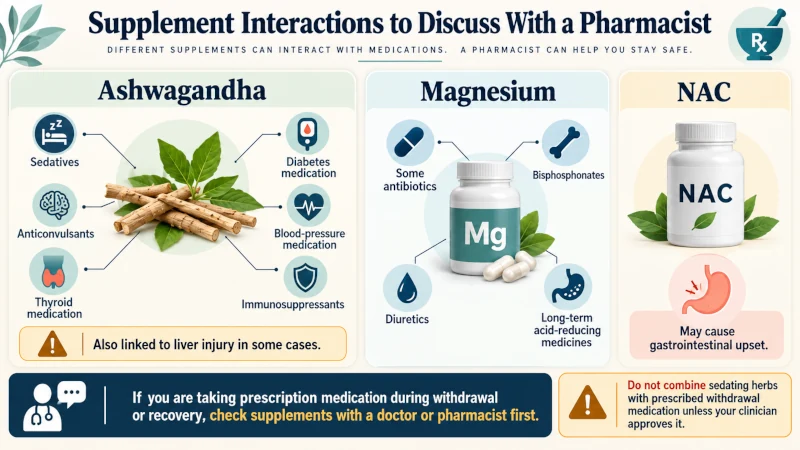
Common side effects. NAC causes more gastrointestinal upset than placebo. Magnesium supplements commonly cause diarrhea, nausea and cramping, and very high doses can cause low blood pressure, confusion and irregular heartbeat. Ashwagandha can cause stomach upset, loose stools and drowsiness.
Interactions to raise with a pharmacist. Ashwagandha may interact with sedatives, anticonvulsants, thyroid medication, diabetes drugs, blood pressure drugs and immunosuppressants [NCCIH, 2023] — a list that overlaps heavily with what people are prescribed during and after withdrawal. Magnesium interferes with the absorption of bisphosphonates and some antibiotics, and interacts with diuretics and long-term acid reducers. If you are prescribed a benzodiazepine for withdrawal, do not add sedating herbs to it without asking.
Pregnancy and breastfeeding. Withdrawal in pregnancy is a specialist situation and should always be managed medically. Ashwagandha should be avoided in pregnancy and not used while breastfeeding [NCCIH, 2023]. Herbal products in general lack safety data in pregnancy; prenatal vitamins and clinician-directed thiamine are a different matter.
Who should avoid the herbal options entirely. Anyone with liver disease or a history of liver problems; anyone with a thyroid or autoimmune condition (for ashwagandha); anyone with reduced kidney function (for magnesium); anyone awaiting surgery; and anyone taking prescription medication who hasn’t cleared it with a prescriber.
When to talk to a professional. Before stopping, not after. Also: if symptoms are worsening rather than easing after 48 hours, if you can’t sleep at all for more than a night or two, if your mood drops sharply, or if you find yourself drinking to stop the symptoms — which is itself a sign that this needs medical help rather than a supplement shelf.
What actually helps alongside medical care
Once safety is handled, the unglamorous things earn their place.
Eat regularly, even when appetite is gone — small, frequent meals with protein and complex carbohydrates steady blood sugar better than willpower does. Drink fluids, but don’t overdo plain water if you’ve been vomiting; you’re losing electrolytes as well as volume, and oral rehydration solutions handle both. Protect sleep as far as you can, accepting that it will be poor for a while and that this is expected rather than a sign something has gone wrong.
Tell someone. Withdrawal managed alone is worse and more dangerous than withdrawal managed with a person who can check on you and notice if you become confused.
And keep the horizon in view: detox is not treatment. NIAAA makes the point directly — a few days of detox is the beginning, and care for alcohol use disorder is measured in months and sometimes years [NIAAA, 2025]. Medications such as naltrexone and acamprosate, behavioural therapy and mutual-support groups are where the durable outcomes come from. SAMHSA’s National Helpline is free, confidential and open 24/7 in English and Spanish at 1-800-662-HELP (4357) [SAMHSA, 2026].
| Health Disclaimer: This article is for general education and is not medical advice, diagnosis or treatment. Alcohol withdrawal can be life-threatening. Do not stop drinking abruptly without speaking to a qualified healthcare professional, particularly if you drink heavily or daily, have had a withdrawal seizure or delirium tremens before, are pregnant, or have liver, heart or kidney disease. Supplements can interact with medications and are not regulated like prescription drugs. Talk to a doctor or pharmacist before starting any supplement. Call 911 for seizures, confusion, hallucinations, high fever, chest pain or severe agitation. In the U.S., call or text 988 if you are in crisis. |
Frequently Asked Questions
What is the single most important supplement during alcohol withdrawal?
Thiamine (vitamin B1) — and not because it eases symptoms. It prevents Wernicke-Korsakoff syndrome, a brain injury caused by thiamine deficiency that can cause permanent memory loss and is fatal in up to 20% of untreated cases [Day, 2013]. Because oral absorption is unreliable in people who are vomiting or malnourished, clinicians often give it by injection. Ask rather than self-dose.
Can supplements replace medical detox?
No. Benzodiazepines are the first-line treatment for acute alcohol withdrawal and have the strongest evidence behind them [NIAAA, 2025]. No supplement has been shown to prevent withdrawal seizures or delirium tremens. Supplements address nutritional deficiencies, which is a different job.
Does magnesium help with alcohol withdrawal tremors?
The honest answer is that nobody knows. A Cochrane review of four trials in 317 hospitalised adults found insufficient evidence to say whether magnesium helps or harms in withdrawal [Sarai, 2013]. Low magnesium is common in heavy drinkers and worth correcting, but don’t count on it for tremor relief.
Is NAC worth taking for alcohol cravings or liver support?
Current evidence says no. A 2026 meta-analysis of seven randomised placebo-controlled trials in 566 people found no significant effect on alcohol craving, heavy drinking days or liver enzymes, and more gastrointestinal side effects than placebo [Ahmed, 2026]. It appears safe, but “safe” and “effective” aren’t the same claim.
Are herbal supplements safe if my liver is already damaged from drinking?
Be cautious. Ashwagandha is linked to clinically apparent liver injury and should be avoided if you have liver disease [NCCIH, 2023]. Supplements aren’t verified for content before sale, so a bottle may contain more, less, or something other than what the label says. If you have any liver involvement, clear every supplement with a doctor first.
How long do alcohol withdrawal symptoms last?
The usual clinical pattern is that symptoms start within hours of the last drink, are worst over the first few days, and settle over roughly a week — though this varies a great deal between people. What matters more than the average timeline is that serious complications, including seizures and delirium tremens, can appear during that window, which is why a small proportion of people need medical monitoring rather than self-management [NIAAA, 2025]. Sleep problems and low mood often outlast the physical symptoms by weeks.
References
- National Institute on Alcohol Abuse and Alcoholism (NIAAA). Alcohol Use Disorder: From Risk to Diagnosis to Recovery. Core Resource on Alcohol. Last revised 8 May 2025. View source
- Day E, Bentham PW, Callaghan R, Kuruvilla T, George S. Thiamine for prevention and treatment of Wernicke-Korsakoff Syndrome in people who abuse alcohol. Cochrane Database of Systematic Reviews. 2013;(7):CD004033. DOI: 10.1002/14651858.CD004033.pub3. PMID: 23818100. View source
- Sarai M, Tejani AM, Chan AHW, Kuo IF, Li J. Magnesium for alcohol withdrawal. Cochrane Database of Systematic Reviews. 2013;(6):CD008358. DOI: 10.1002/14651858.CD008358.pub2. View source
- Ahmed MAE, Amin M, Abdalla YE, et al. N-acetylcysteine for patients with alcohol use disorder, post-traumatic stress disorder, and their co-occurrence: a systematic review of placebo-controlled randomized trials. BMC Psychiatry. 2026;26:384. DOI: 10.1186/s12888-026-08124-8. View source
- Rambaldi A, Jacobs BP, Gluud C. Milk thistle for alcoholic and/or hepatitis B or C virus liver diseases. Cochrane Database of Systematic Reviews. 2007;(4):CD003620. DOI: 10.1002/14651858.CD003620.pub3. View source
- National Center for Complementary and Integrative Health (NCCIH). Ashwagandha: Usefulness and Safety. Last updated March 2023. View source
- Penetar DM, Toto LH, Lee DY, Lukas SE. A single dose of kudzu extract reduces alcohol consumption in a binge drinking paradigm. Drug and Alcohol Dependence. 2015;153:194–200. DOI: 10.1016/j.drugalcdep.2015.05.025. PMID: 26048637. View source
- Lukas SE, Penetar D, Berko J, Vicens L, Palmer C, Mallya G, Macklin EA, Lee DY. An extract of the Chinese herbal root kudzu reduces alcohol drinking by heavy drinkers in a naturalistic setting. Alcoholism: Clinical and Experimental Research. 2005;29(5):756–762. PMID: 15897719. View source
- Shebek J, Rindone JP. A pilot study exploring the effect of kudzu root on the drinking habits of patients with chronic alcoholism. The Journal of Alternative and Complementary Medicine. 2000;6(1):45–48. DOI: 10.1089/acm.2000.6.45. PMID: 10706235. View source
- American Society of Addiction Medicine (ASAM). The ASAM Clinical Practice Guideline on Alcohol Withdrawal Management. 2020. View source
- Substance Abuse and Mental Health Services Administration (SAMHSA). National Helpline. 1-800-662-HELP (4357). View source


