
If your legs are still complaining two days after a hard workout, a peppermint rub can make them feel better for a while. That cooling tingle is real relief. What it isn’t, based on the research so far, is a faster recovery. The best evidence on essential oils for muscle soreness points to short-term comfort, mostly from menthol products and from the massage that comes with rubbing something in — not from oils repairing muscle or “flushing out lactic acid.”

That still makes them worth having around, as long as you know what you’re buying and dilute them properly. Here is which oils have something behind them, three simple blends at a sensible strength, and the signs that sore muscles need more than a roller bottle.
Why your muscles hurt a day or two later
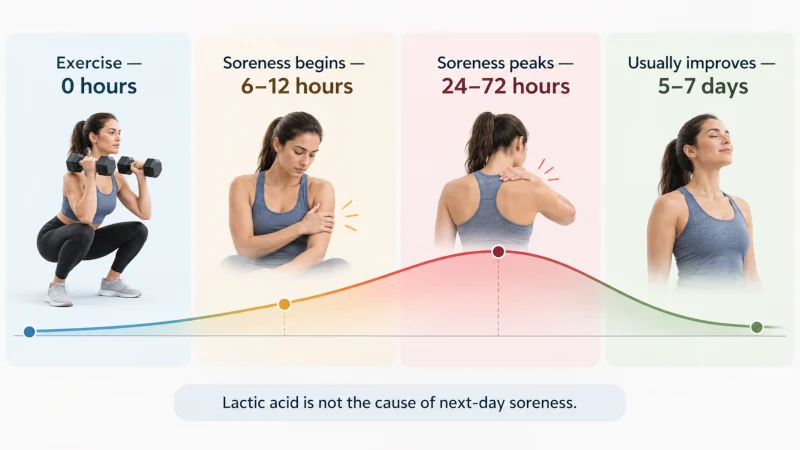
The ache that shows up the morning after a new workout, a long hike, or a weekend of yard work has a name: delayed onset muscle soreness, or DOMS. Hard or unfamiliar exercise causes tiny amounts of damage in the muscle, and the temporary inflammation that follows brings soreness and stiffness. It usually starts 6 to 12 hours after exercise, peaks between 24 and 72 hours, and eases within five to seven days [Banner Health, 2026].
Lactic acid isn’t the culprit. It clears from your muscles shortly after you stop exercising, well before next-day soreness arrives [Banner Health, 2026]. So any product promising to “remove lactic acid” is solving a problem you don’t have. What an essential oil can realistically change is how the soreness feels while it runs its course.
Essential oils for muscle soreness, ranked by the evidence
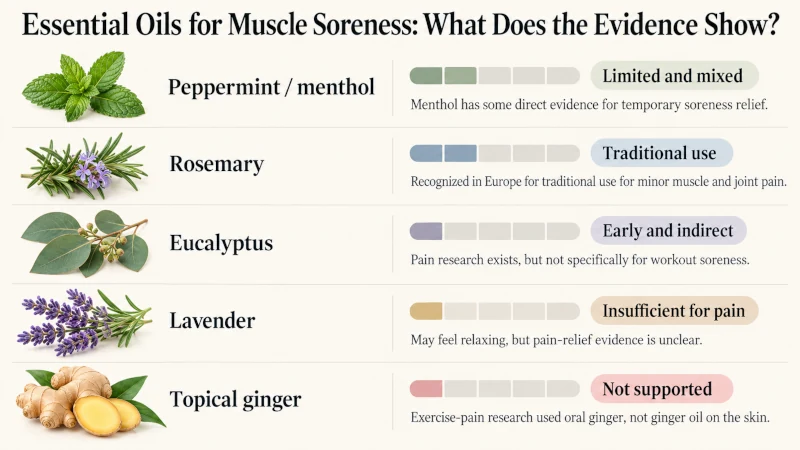
Most essential oils sold for sore muscles have never been tested on sore muscles in people. A few have something to go on. Here is how the common ones stack up.
| Oil | What the research actually shows | Evidence level |
| Peppermint (menthol) | A 3.5% menthol gel eased post-exercise soreness more than ice in 16 adults [Johar et al., 2012]. Peppermint-oil massage did no better than Vaseline massage in 22 men [Özmen et al., 2020]. | Limited and mixed |
| Rosemary | Approved in Europe as a traditional remedy for minor muscle and joint pain at 6–10% in a cream or ointment — based on long use, not trials [EMA, 2024]. | Traditional use |
| Eucalyptus | Inhaled 3% eucalyptus oil lowered pain scores after knee replacement surgery in 52 adults [Jun et al., 2013]. Not studied for workout soreness. | Early and indirect |
| Lavender | Effect on pain is unclear [NCCIH, 2025]. May help you relax. | Insufficient for pain |
| Ginger | Oral ginger capsules reduced exercise-induced pain by about 25% [Black et al., 2010]. Ginger applied to the skin hasn’t been shown to help knee osteoarthritis [NCCIH, 2025]. | Oral: limited. Topical: not supported |
| Marjoram, clary sage, black pepper, cypress, chamomile | We found no human trials of these oils for muscle soreness. | Insufficient |
Peppermint (menthol)
Peppermint has the most direct research, and it’s worth reading closely. In a small trial, 16 active adults did exercises designed to make their arm muscles sore. Two days later, a 3.5% menthol gel cut pain ratings by about 63% compared with ice [Johar et al., 2012]. That’s a meaningful difference in how people felt. But the study was tiny, it tested a commercial menthol gel rather than diluted peppermint oil, and it was supported by a research fund linked to the gel’s maker.
A 2020 trial adds a useful reality check. Researchers gave 22 young men a 10-minute massage on their sore forearm using either peppermint oil or plain Vaseline. Both eased soreness at 24 and 48 hours, and there was no difference between them [Özmen et al., 2020]. In other words, the rubbing may be doing much of the work.
Peppermint oil can cause skin rashes and irritation, and it should never be applied to the face of an infant or young child, because breathing in the menthol can cause serious problems [NCCIH, 2025]. For the bigger picture on what peppermint does and doesn’t do, see our guide to peppermint benefits.
Rosemary
Rosemary has the most official standing of any oil here, though not the strongest science. The European Medicines Agency recognizes rosemary oil as a traditional herbal medicine for minor muscle and joint pain, applied two or three times a day as a cream, gel or ointment containing 6–10% rosemary oil [EMA, 2024]. “Traditional use” means regulators accept decades of safe use; it does not mean trials have shown it beats a placebo rub.
The same monograph sets sensible limits: adults only, never on broken or irritated skin, keep it away from eyes, and see a clinician if symptoms last more than four weeks [EMA, 2024]. Our full rosemary evidence review covers its other uses and the camphor caution.
Eucalyptus
The best eucalyptus study wasn’t about workouts at all. In 52 adults recovering from knee replacement, breathing eucalyptus oil (3% in almond oil) for 30 minutes a day over three days lowered pain scores compared with almond oil alone [Jun et al., 2013]. A correction to that paper has since been published, and the setting — older adults after major surgery, inhaling rather than rubbing — is far from a sore hamstring. Treat it as a hint, not proof.
Eucalyptus is also one of the oils that can cause seizures if swallowed [Poison Control], so the bottle belongs well out of children’s reach.
Lavender
Lavender is lovely in a massage oil, but there’s no good evidence that it relieves pain; the research on lavender aromatherapy and pain is inconclusive [NCCIH, 2025]. Where it may earn its place is in helping you unwind, which is why it appears in the evening blend below. Topical lavender can trigger allergic skin reactions in some people [NCCIH, 2025]. Our lavender evidence guide explains where it does have support.
Ginger, marjoram and the “warming” oils
You’ll often see ginger oil recommended for sore muscles, usually backed by a 2010 study. That study is real and interesting: people who took 2 grams of ginger in capsules daily for 11 days had about 25% less pain after a hard arm workout than people taking a placebo [Black et al., 2010]. But those people swallowed ginger. It says nothing about ginger oil on the skin, and topical ginger hasn’t been shown to help joint pain either [NCCIH, 2025]. If you’re curious about the oral route, our ginger guide covers doses and who should avoid it.
Marjoram, clary sage, black pepper, cypress and Roman chamomile appear in many muscle-blend recipes, including the earlier version of this page. We looked for human studies of these oils for muscle soreness and didn’t find any. They may smell warming or relaxing, and that’s a fine reason to use them — just not a medical one.
How to use essential oils on sore muscles
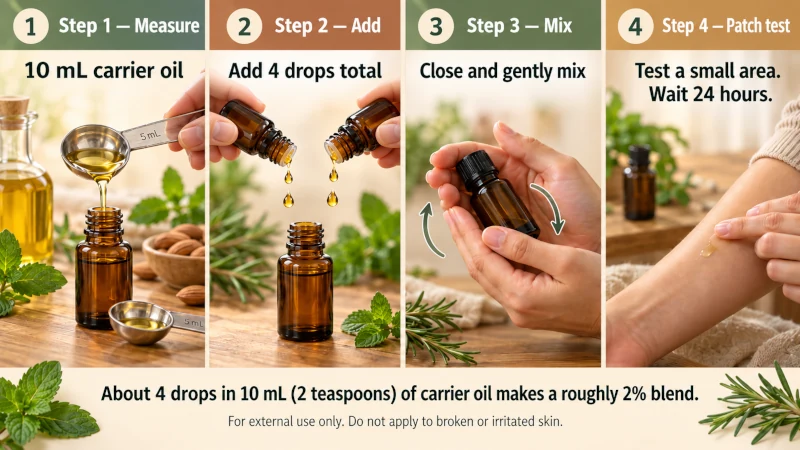
Essential oils are concentrated. Diluting them in a carrier oil is the best way to avoid a skin reaction [Poison Control], and it makes the oil easier to massage in, which is where much of the benefit seems to come from.
There’s no single official dilution standard for home massage oils. We’ve set the blends below at roughly 2% — about 4 drops in 10 mL (2 teaspoons) of carrier oil. That’s well under the 6–10% the EMA accepts for rosemary in a cream [EMA, 2024], and it’s a deliberate choice: massage oils get spread over large areas and reapplied, and lower strength leaves room for sensitive skin. Drop sizes vary between bottles, so treat drop counts as approximate. (The earlier version of this page used 3.5–6%.)
Three simple blends at a sensible strength
| Blend | Recipe (in 10 mL carrier oil) | How to use | Honest expectation |
| After-workout massage oil | 2 drops peppermint 1 drop rosemary 1 drop lavender Carrier: jojoba or sweet almond | Massage into sore legs, shoulders or back for 5–10 minutes. Wash hands afterward. | Cooling sensation plus the proven benefit of massage. |
| Evening neck and shoulder oil | 2 drops lavender 2 drops marjoram Carrier: sweet almond | Rub into neck and shoulders as part of winding down. | Chosen for scent and relaxation; no trials for pain. |
| Menthol-free option | 2 drops rosemary 2 drops lavender Carrier: jojoba | For people who dislike the menthol chill or live with young children. | Mostly a pleasant massage medium. |
If you’d rather not mix your own, a ready-made menthol gel is closer to what was actually studied [Johar et al., 2012], and a rosemary cream at 6–10% matches the European traditional-use product [EMA, 2024].
Ground rules for every blend
- Test first. Dab a little on the inside of your forearm and wait a day before using it widely. If a rash appears, stop and wash the area [Poison Control].
- Skip damaged skin. Don’t apply oils to cuts, scrapes, or broken or irritated skin [Poison Control] [EMA, 2024].
- Keep it away from eyes and mucous membranes [EMA, 2024].
- Never swallow essential oils. Several common oils are dangerous even in small amounts when swallowed [Poison Control].
- Store bottles locked away from children and pets [Poison Control].
What helps sore muscles more than any oil
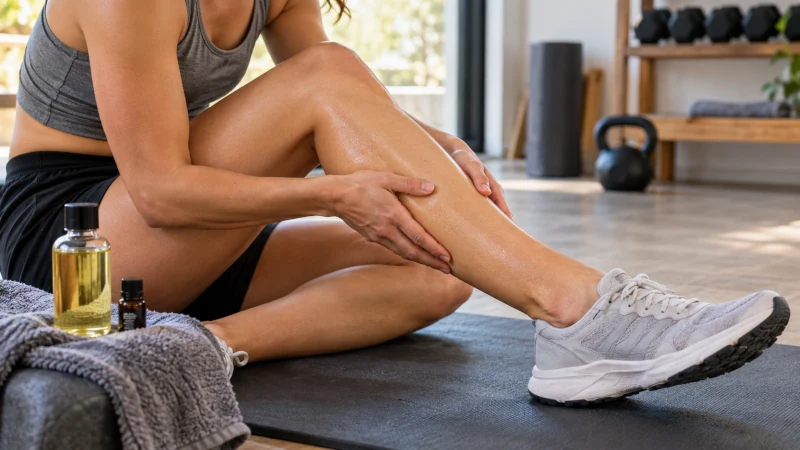
A 2018 meta-analysis pooling 99 studies compared recovery methods head to head. Massage had the largest effect on muscle soreness. Compression garments, cold-water immersion, contrast baths, cryotherapy and light “active recovery” exercise produced smaller but real reductions [Dupuy et al., 2018].
Stretching, despite its reputation, didn’t help. A Cochrane review of randomized trials found that stretching before, after, or before and after exercise does not produce clinically important reductions in soreness [Herbert et al., Cochrane, 2011], and the 2018 analysis agreed [Dupuy et al., 2018]. Stretch for flexibility if you like — just don’t expect it to shorten DOMS.
Put together, the most evidence-friendly way to use essential oils is as a reason to give yourself a proper massage. If soreness is keeping you up at night, our guide to natural remedies for insomnia covers what actually helps you sleep. And if what you’re dealing with is a sudden, painful knot rather than a slow ache, that’s a cramp, which we cover separately in essential oils for muscle cramps.
Side effects, interactions and who should skip them
Applied correctly, these oils are low-risk for most adults. The problems come from skipping dilution, using them on children, or swallowing them.
| Concern | What to know |
| Skin reactions | Peppermint can cause rashes and irritation [NCCIH, 2025]; lavender can cause allergic reactions [NCCIH, 2025]; rosemary can cause contact dermatitis, and allergic asthma has been reported [EMA, 2024]. Skip oils if you react to fragrances. |
| Swallowing | Wintergreen oil is chemically like aspirin; eucalyptus, sage and camphor can cause seizures; pennyroyal can damage the liver [Poison Control]. If someone swallows an essential oil, call Poison Control at 1-800-222-1222. |
| Infants and children | Never put peppermint oil on a baby’s or young child’s face [NCCIH, 2025]. Rosemary oil products aren’t recommended under 18 [EMA, 2024]. Children’s thinner skin and immature livers make them more vulnerable [Poison Control]. A few cases of breast swelling have been reported in children using topical lavender products, though it’s unclear whether lavender caused them [NCCIH, 2025]. |
| Pregnancy and breastfeeding | Medicinal rosemary oil isn’t recommended because safety hasn’t been established [EMA, 2024]. Little is known about lavender [NCCIH, 2025] or medicinal amounts of peppermint [NCCIH, 2025] in pregnancy or breastfeeding. Check with your obstetric provider before using them. |
| Medications | Interactions with diluted topical oils are poorly studied. Because wintergreen behaves like aspirin [Poison Control], ask a pharmacist before using wintergreen rubs if you take a blood thinner or are allergic to aspirin. If muscle pain began after starting or changing a statin, call your prescriber rather than treating it at home [MedlinePlus, 2025]. |
| Seizure history | Ask your clinician before using camphor- or eucalyptus-containing products, and never swallow them [Poison Control]. |
When sore muscles need a doctor
Ordinary workout soreness builds over a day or two and fades within a week. Get checked if your pain started suddenly during exercise, feels sharp or stabbing, sits in one spot, is getting worse instead of better, lasts longer than a week, or comes with swelling, bruising, redness or weakness [Banner Health, 2026]. For muscle aches that aren’t clearly from exercise, contact a provider if they last more than three days, are severe and unexplained, follow a tick bite or rash, or began with a new medicine such as a statin [MedlinePlus, 2025].
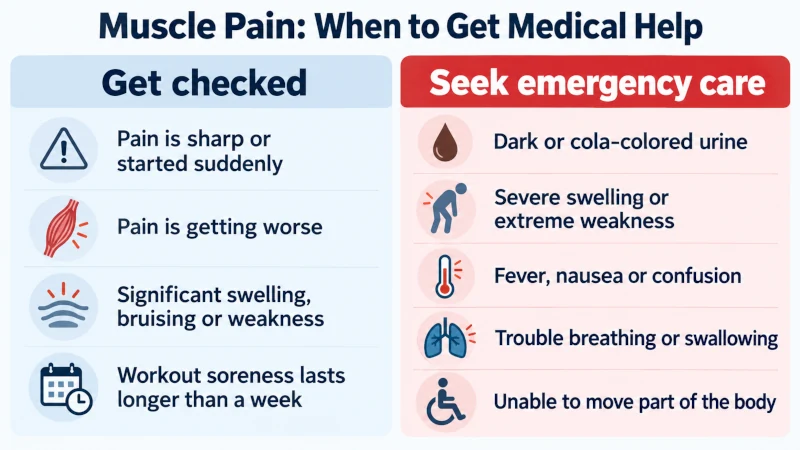
Get emergency care now if muscle pain comes with any of these:
- Dark or cola-colored urine, severe swelling, extreme weakness, fever, nausea or confusion — possible signs of rhabdomyolysis, a rare but serious breakdown of muscle [Banner Health, 2026]
- Urinating much less than usual, sudden weight gain or water retention [MedlinePlus, 2025]
- Trouble breathing or swallowing, or being unable to move part of your body [MedlinePlus, 2025]
- A very stiff neck with high fever, or vomiting [MedlinePlus, 2025]
| Health Disclaimer: This article is for general education and is not medical advice, diagnosis or treatment. Essential oils are not proven to treat any disease, and “natural” does not mean risk-free: they can irritate skin, cause allergic reactions, and be poisonous if swallowed. Talk with a doctor, pharmacist or other qualified clinician before using essential oils if you are pregnant or breastfeeding, using them on a child, taking prescription medication, or managing a health condition. If muscle pain is severe, sudden, or comes with dark urine, weakness, fever or confusion, seek medical care right away. If someone swallows an essential oil, call Poison Control at 1-800-222-1222. |
Frequently Asked Questions
What is the best essential oil for sore muscles?
Peppermint, because of its menthol, has the most direct research — a menthol gel eased soreness more than ice in one small trial [Johar et al., 2012]. Rosemary has European approval as a traditional remedy for minor muscle pain in 6–10% creams [EMA, 2024]. Neither has been shown to make muscles recover faster.
Can I put peppermint oil directly on my skin?
It’s better not to. Undiluted peppermint oil can irritate skin [NCCIH, 2025], and diluting oils in a carrier is the best way to avoid a reaction [Poison Control]. About 2 drops per 10 mL of carrier oil is plenty for a massage blend.
Do essential oils help muscles heal faster?
There’s no good evidence they do. Soreness comes from small amounts of muscle damage and inflammation that resolve over several days [Banner Health, 2026]. Oils may change how it feels in the meantime; massage, compression and cold water have better evidence for reducing soreness [Dupuy et al., 2018].
Is it safe to use essential oils for sore muscles while pregnant?
It isn’t well studied. Medicinal rosemary oil isn’t recommended in pregnancy or breastfeeding [EMA, 2024], and little is known about lavender or medicinal peppermint [NCCIH, 2025] [NCCIH, 2025]. Ask your obstetric provider before using them.
Should I use homemade oil or a store-bought menthol gel?
The research that exists mostly tested a commercial menthol gel [Johar et al., 2012], and Europe’s rosemary approval is for creams of a set strength [EMA, 2024]. A homemade blend is fine as a massage oil, but a standardized product is closer to what was studied.
References
- National Center for Complementary and Integrative Health. Peppermint Oil: Usefulness and Safety. View source
- National Center for Complementary and Integrative Health. Lavender: Usefulness and Safety. View source
- National Center for Complementary and Integrative Health. Ginger: Usefulness and Safety. View source
- National Center for Complementary and Integrative Health. Aromatherapy. View source
- European Medicines Agency, Committee on Herbal Medicinal Products. View source
- Johar P, Grover V, Topp R, Behm DG. A comparison of topical menthol to ice on pain, evoked tetanic and voluntary force during delayed onset muscle soreness.View source
- Özmen T, Doğan H, Güneş GY. Effect of classic massage with peppermint oil on muscle soreness and muscle strength during recovery from exercise. View source
- Jun YS, Kang P, Min SS, et al. Effect of eucalyptus oil inhalation on pain and inflammatory responses after total knee replacement: a randomized clinical trial. View source
- Black CD, Herring MP, Hurley DJ, O’Connor PJ. Ginger (Zingiber officinale) reduces muscle pain caused by eccentric exercise. J Pain. View source
- Herbert RD, de Noronha M, Kamper SJ. Stretching to prevent or reduce muscle soreness after exercise. View source
- Dupuy O, Douzi W, Theurot D, Bosquet L, Dugué B. An evidence-based approach for choosing post-exercise recovery techniques to reduce markers of muscle damage, soreness, fatigue, and inflammation: a systematic review with meta-analysis. Front Physiol. View source
- Troutman WG, Soloway RAG. Essential Oils: Poisonous When Misused. National Capital Poison Center (Poison Control). View source
- Olsson R. What Is Delayed Onset Muscle Soreness After a Workout? Banner Health. View source
- MedlinePlus. Muscle aches. U.S. National Library of Medicine. View source


