
Organic skincare products can be lovely to use and perfectly good for your skin. What they can’t do is promise that they’re safer, gentler, or more effective than conventional products, because the word “organic” describes how the plant ingredients were grown, not how your skin will react to them. The FDA says it plainly: an ingredient’s source does not determine its safety [FDA, 2022].
That isn’t a reason to skip organic skincare products. It’s a reason to shop them the way a dermatologist would: read the seal, read the ingredient list, know which botanicals have real evidence behind them, and test anything new before it goes on your face.
What “organic” means on a skincare label
In the U.S., the FDA regulates cosmetics but doesn’t define “organic.” That definition comes from the USDA’s National Organic Program, which certifies agricultural ingredients. A cosmetic that makes an organic claim has to meet both sets of rules: USDA’s for the claim and FDA’s for safety and labeling [FDA, 2022].
Skincare that’s certified under the program uses the same four labeling tiers as organic food [USDA AMS, n.d.; USDA NOP, n.d.]:
| What the front label says | Organic content | USDA seal allowed? |
| “100 percent organic” | All ingredients organic (water and salt excluded) | Yes |
| “Organic” | At least 95% organic (water and salt excluded) | Yes |
| “Made with organic ingredients” | At least 70% organic | No |
| Less than 70% organic | Can’t use “organic” on the main front panel | No |
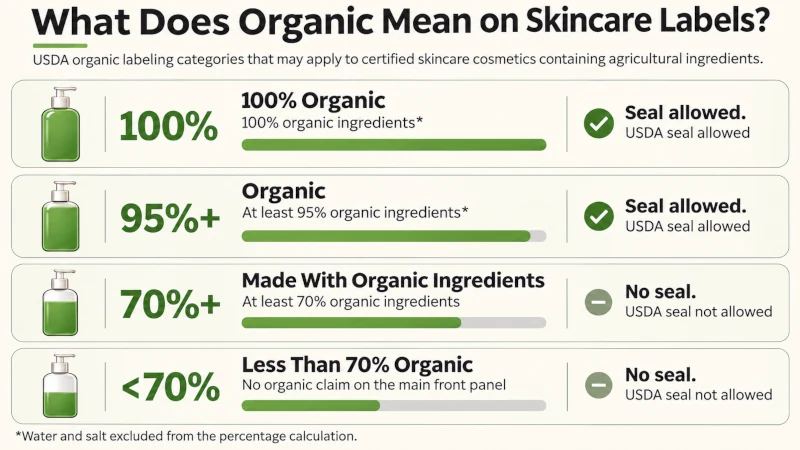
Two things follow from that table. A jar that says “made with organic aloe and chamomile” may contain a fair amount of nonorganic material, which is fine as long as you know it. And a product that simply says “organic” with no seal and no named certifier gives you less to go on. USDA can act against products that falsely claim USDA-certified status, but it has no authority over products that make no USDA organic claim [USDA NOP, n.d.].
You’ll also see European certifications, most often COSMOS. It’s run by a nonprofit association in Brussels founded by five certifiers, including Ecocert and the Soil Association, and it offers separate ORGANIC and NATURAL signatures [COSMOS-standard, 2026]. If a brand cites COSMOS, check which signature it holds.
Organic is not the same as hypoallergenic
Plants make a lot of chemistry, and some of it irritates skin or triggers allergies whether or not the plant was grown organically [FDA, 2022]. The American Academy of Dermatology (AAD) specifically advises caution with products containing plant-based botanical ingredients, because they may still carry fragrance-related compounds [AAD, n.d.-a]. If your skin reacts to fragrance, an organic lavender cream can bother it just as much as a synthetic one.
Common ingredients in organic skincare products: what the evidence says
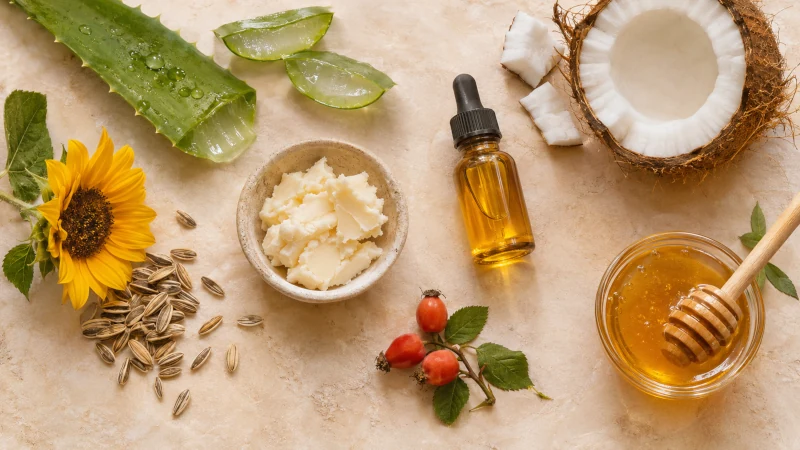
Most of the botanicals you’ll see on organic labels are reasonable to use. The honest question is how much the research shows, and the answer ranges from “decent clinical evidence” to “promising in a petri dish.”
| Ingredient | What the research shows | Strength of evidence | Watch for |
| Aloe vera gel | May speed burn healing and ease burn pain [NCCIH, 2025a] | Clinical research for burns; limited for psoriasis | Occasional burning, itching, rash |
| Virgin coconut oil | Reduced severity in children with mild to moderate atopic dermatitis; similar to mineral oil for dry skin [Lin et al., 2018] | Small human trials | Patch test first |
| Sunflower seed oil | Linked to better barrier integrity and hydration in adults [Lin et al., 2018] | Small human study | Patch test first |
| Shea butter | Anti-inflammatory in cell studies; one eczema product comparison [Lin et al., 2018] | Mostly lab | Not a sunscreen |
| Jojoba oil | Wax esters may help a damaged barrier; few human study details [Lin et al., 2018] | Mostly theoretical | Patch test first |
| Argan and rosehip oils | Small or poorly described studies [Lin et al., 2018] | Limited | Patch test first |
| Olive oil | Worsened barrier function and raised water loss in a small human study [Lin et al., 2018] | Small human study pointing toward caution | Think twice on dry or eczema-prone skin |
| Tea tree oil | 5% gel may help acne; slower than benzoyl peroxide but may irritate less [Mayo Clinic, n.d.; NCCIH, 2025b] | Limited | Irritation, allergic rash; never swallow |
| Honey (topical) | Medical-grade kanuka honey added to soap didn’t beat soap alone for acne [Semprini et al., 2016] | One randomized trial, negative | Fine as a soothing treat |
The ones with the most human evidence
Aloe is the best supported of the bunch, though mostly for burns. Clinical research suggests topical aloe gel may speed burn healing and reduce burn pain; for psoriasis there’s only a small amount of research, and for everyday “glow” there’s none to speak of. Topical gel is generally well tolerated, with occasional reports of burning, itching, and rash [NCCIH, 2025a]. For a fuller rundown, see what aloe vera can and can’t do for your skin.
Among plant oils, a 2018 review of topical oils found the most direct human support for coconut and sunflower seed oil. Virgin coconut oil reduced severity in children with mild to moderate atopic dermatitis, and sunflower seed oil was linked to better barrier integrity in adults. The same review flagged olive oil as the main caution: in a small study, it made the skin barrier worse [Lin et al., 2018]. That’s worth knowing, because olive oil turns up in a lot of DIY recipes.
The popular ones with thinner support
Shea butter, jojoba, argan, and rosehip are staples of organic skincare products, and they’re pleasant, rich emollients. But the evidence for anything beyond moisturizing is mostly lab work or small, loosely described studies [Lin et al., 2018]. Use them because they feel good on dry skin, not because a label promises collagen or repair. If shea is your go-to, here’s more on using shea butter lotion for dry skin.
Witch hazel shows up in organic toners as an astringent. It can feel refreshing on oily skin, but astringents aren’t a great match for dry or reactive skin. Our guide covers what the evidence supports for witch hazel.
Tea tree oil and honey for acne
Tea tree oil is the one “natural” acne ingredient with a bit of trial data. A gel with 5% tea tree oil may help acne, and it may be less irritating than benzoyl peroxide, though it probably works more slowly [Mayo Clinic, n.d.]. The NIH’s complementary-health center still rates the evidence as limited [NCCIH, 2025b]. It can cause redness, itching, stinging, and allergic rashes, and Mayo Clinic advises against it if you have eczema or very sensitive skin [Mayo Clinic, n.d.].
Honey has a reputation as an acne fighter, but the best test so far didn’t bear it out. In a 12-week randomized trial of 136 adults, adding a medical-grade kanuka honey product to antibacterial soap didn’t significantly improve acne compared with the soap alone [Semprini et al., 2016]. A honey mask can still feel nice. Just don’t expect it to clear breakouts.
Organic skincare for eczema-prone or sensitive skin
If you have eczema, “organic” matters far less than “fragrance-free.” The AAD’s advice for atopic dermatitis is specific [AAD, n.d.-b]:
- Choose products labeled “fragrance free.” Skip ones labeled “unscented,” which can contain masking fragrance that still triggers flares.
- Use a thick cream or ointment rather than a lotion.
- Keep baths or showers to 5 to 10 minutes in warm water, then moisturize while your skin is still damp.
- Test every new product before using it on your face or a flare.
That rules out a surprising number of organic skincare products, since many are scented with essential oils or botanical extracts. Look for short ingredient lists built on a plain oil or butter, and leave tea tree oil out entirely [Mayo Clinic, n.d.]. Small trials of virgin coconut oil in children with eczema are encouraging [Lin et al., 2018], but none of this replaces the treatment plan a dermatologist gives you. If your eczema keeps flaring despite good skin care, that’s a sign you need more than a new moisturizer.
A simple organic skincare routine
Your skin doesn’t need a seven-step ritual. For most people, three products cover it:
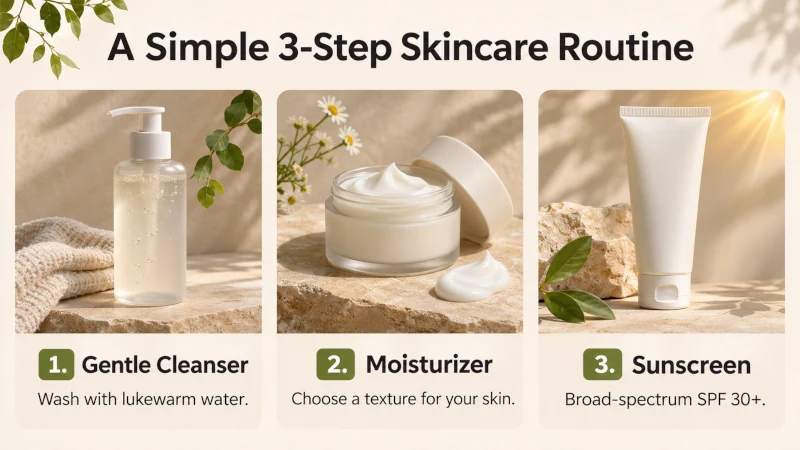
- A gentle cleanser. Fragrance-free if you’re sensitive. Use lukewarm water and your fingertips, not a scrub.
- A moisturizer that suits your skin. Richer creams and butters for dry skin, lighter lotions or gels for oily skin.
- Sunscreen every morning. This is the step that does the most long-term good, organic or not.
Toners, masks, and exfoliants are optional. If you exfoliate, keep it gentle and occasional, and stop if your skin stings or looks red. Add one new product at a time so you can tell what’s helping and what isn’t.
Sunscreen: where “organic” matters least
The AAD recommends a sunscreen that’s broad-spectrum, SPF 30 or higher, and water resistant, reapplied about every two hours outdoors and after swimming or sweating. For sensitive skin, dermatologists recommend mineral (physical) sunscreens [AAD, n.d.-c]. The two mineral filters, zinc oxide and titanium dioxide, are the only active ingredients the FDA proposed in 2019 as generally recognized as safe and effective [FDA, 2019].
Zinc and titanium are minerals, not crops, so they can’t be “organic” in the USDA sense; any organic claim on a sunscreen refers to the other ingredients. And no plant oil or butter replaces a tested SPF. Shea butter is a good moisturizer, not sun protection.
DIY organic skincare: what to make and what to skip
Making your own skincare can be fun and cheap. A few popular recipes, though, can hurt your skin.
Skip lemon or lime juice on your skin. Citrus juice plus sunlight can cause phytophotodermatitis, a blistering, sunburn-like reaction. Lemons and limes are both known culprits [Snaidr & Lowe, 2017]. The rash typically appears 24 to 48 hours after sun exposure, and the dark marks it leaves can last for years [Coulson, 2021]. That’s a steep price for a “brightening” scrub.
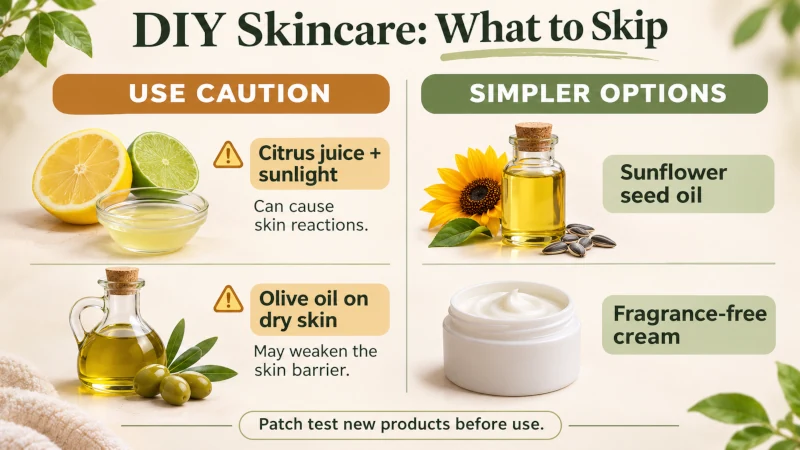
Rethink olive oil, especially on dry skin. Given the evidence that olive oil can weaken the skin barrier [Lin et al., 2018], swap in sunflower seed oil or a plain fragrance-free cream if you have dry or eczema-prone skin.
Be wary of water-based recipes. Store-bought products contain preservatives for a reason. Microbial contamination is a common reason for cosmetic recalls, and germs get in through water, other ingredients, and fingers dipped into jars. Adding water also dilutes whatever preservative a product has [FDA, 2024]. Homemade aloe gels, toners, and yogurt masks have no preservative at all. Mix single-use amounts, use a clean spoon, and throw out anything that changes smell, color, or texture.
Keep expectations modest. An oil-based cleansing balm or a honey-and-yogurt mask made fresh can feel soothing. Neither is likely to treat acne or any other skin condition.
How to patch test anything new
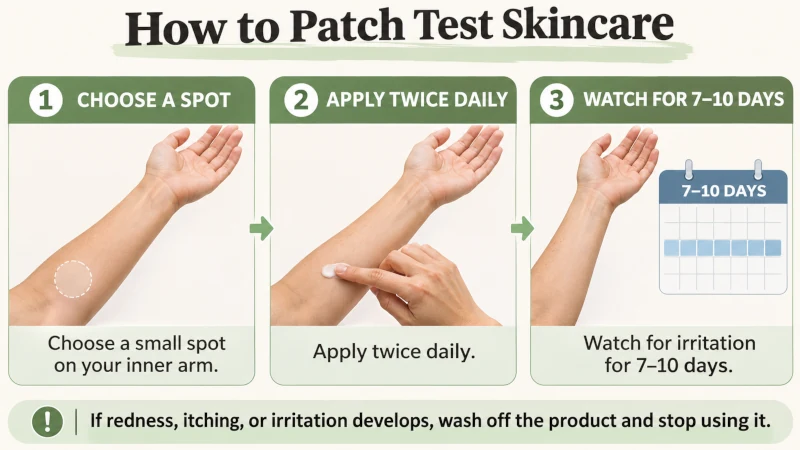
Dermatologists recommend this method for every new product, homemade or bought [AAD, n.d.-a]:
- Pick a quarter-sized spot where it won’t rub off, such as the inside of your arm or the bend of your elbow.
- Apply it twice a day, in the amount you’d normally use, for 7 to 10 days. Leave wash-off products on for about five minutes before rinsing.
- If your skin stays clear, go ahead. If it reacts, wash it off and stop using it. See a dermatologist if the reaction is severe.
How to choose organic skincare products worth buying
- Check the certification tier. Look for the USDA seal (“100 percent organic” or “organic”) or a named certifier such as COSMOS, and check what percentage claim the label makes.
- Read the whole ingredient list. Essential oils, “parfum,” and botanical extracts matter more to sensitive skin than organic status does.
- Shop for your skin’s needs. A fragrance-free organic cream for dry skin is a sensible buy. An organic serum promising to reverse aging is selling a hope, not a result.
- Know what the premium pays for. Higher prices on organic products reflect farming and certification, not proven extra benefit for your skin.
- Try samples when you can. Then patch test before committing to a full-size jar.
Side effects, pregnancy, and who should be careful
Common side effects. Any skincare product, organic or not, can cause irritation (stinging, redness, dryness) or allergic contact dermatitis (an itchy rash that can spread beyond where you applied it). Aloe occasionally causes burning, itching, or rash [NCCIH, 2025a]. Tea tree oil is more likely to irritate if the bottle is old or has been exposed to heat, light, or air [NCCIH, 2025b].
Never swallow essential oils. Tea tree oil taken by mouth can cause confusion, loss of muscle control, and coma [NCCIH, 2025b]. Store it out of children’s reach. Mayo Clinic also notes a single case report of breast-tissue swelling in a young boy linked to lavender and tea tree oil, though the cause wasn’t confirmed [Mayo Clinic, n.d.]. Ask your pediatrician before using essential-oil products on young children.
Medications. The sources reviewed for this article don’t flag drug interactions for topical use of these ingredients. The practical risk is stacking irritation: if you use a prescription skin treatment, such as a retinoid or an acne medicine, check with your prescriber before adding strong botanicals like tea tree oil.
Pregnancy and breastfeeding. NCCIH says topical tea tree oil products may be safe during pregnancy and breastfeeding [NCCIH, 2025b]. Aloe taken by mouth may be unsafe in pregnancy and breastfeeding; NCCIH doesn’t address topical aloe and advises talking with a health care provider [NCCIH, 2025a]. When in doubt, check new products with your obstetric clinician or pharmacist.
Take extra care if you: have eczema or very sensitive skin; have a known allergy to a plant family (chamomile and calendula, for example, are in the daisy family); have broken, burned, or infected skin; or are treating a diagnosed skin condition.
When to see a dermatologist or get urgent care
Get emergency care right away if, after using any product, you develop swelling of the face, lips, tongue, or eyes, trouble breathing or swallowing, or a rapidly spreading rash with feeling unwell.
See a dermatologist or your doctor if:
- A reaction is severe, blisters, or doesn’t improve within a few days of stopping the product [AAD, n.d.-a].
- You get blistering or dark streaks after using citrus on your skin and then going outside.
- Your skin shows signs of infection, such as oozing, honey-colored crusts, warmth, spreading redness, or fever.
- Eczema, acne, or rosacea isn’t controlled by gentle skin care. These are medical conditions, and effective prescription treatments exist.
| HEALTH DISCLAIMER: This article is for general education and isn’t a substitute for advice from a dermatologist, doctor, or pharmacist who knows your health history. Skincare products, including organic and homemade ones, can cause irritation and allergic reactions. If you have a skin condition, are pregnant or breastfeeding, take prescription medicines, or are choosing products for a child, talk with a qualified health professional before starting something new. Stop using any product that causes a reaction, and get urgent care for swelling of the face or trouble breathing. Read our full medical advice disclaimer. |
Frequently Asked Questions
Are organic skincare products better for your skin?
Not automatically. “Organic” means the agricultural ingredients met USDA farming and handling standards. The FDA notes that an ingredient’s source doesn’t determine its safety [FDA, 2022]. A well-formulated product, organic or not, that suits your skin type and avoids your triggers is what makes the difference.
Is “organic” the same as “natural” or “clean”?
No. “Organic” has a USDA certification path with defined tiers and a seal [USDA NOP, n.d.]. There’s no USDA seal for “natural” or “clean,” so those words tell you much less. The AAD also warns that botanical products can still contain fragrance-related ingredients [AAD, n.d.-a].
Can organic skincare help eczema?
A fragrance-free, thick cream or ointment applied right after a short bath is what helps most [AAD, n.d.-b]. Whether it’s organic matters less. Small trials of virgin coconut oil in children are promising [Lin et al., 2018], but avoid fragranced products and tea tree oil, and keep using the treatment your dermatologist prescribes.
Do organic skincare products expire faster?
Homemade ones do, because they usually have no preservative, and contamination is a real risk with water-based mixes [FDA, 2024]. Commercial products vary with how they’re preserved. Check the date or open-jar symbol, and throw out anything that changes smell, color, or texture.
Is mineral sunscreen organic?
Zinc oxide and titanium dioxide are minerals, so they can’t be USDA organic. Any organic claim on a mineral sunscreen refers to the other ingredients. Mineral sunscreens are still the type dermatologists recommend for sensitive skin [AAD, n.d.-c].
References
- American Academy of Dermatology. How to test skin care products. View source
- American Academy of Dermatology. Eczema types: Atopic dermatitis skin care. View source
- American Academy of Dermatology. Sunscreen FAQs. View source
- Coulson, I. Phytophotodermatitis. DermNet. View source
- COSMOS-standard AISBL. View source
- Lin, T.-K., Zhong, L., & Santiago, J. L. Anti-inflammatory and skin barrier repair effects of topical application of some plant oils. View source
- Mayo Clinic. Tea tree oil. View source
- National Center for Complementary and Integrative Health. Aloe vera. View source
- National Center for Complementary and Integrative Health. Tea tree oil. View source
- Semprini, A., Braithwaite, I., Corin, A., et al. Randomised controlled trial of topical kanuka honey for the treatment of acne. View source
- Snaidr, V. A., & Lowe, P. M. Phytophotodermatitis from lime juice. Medical Journal of Australia, View source
- U.S. Department of Agriculture, Agricultural Marketing Service. Cosmetics, body care, and personal care products. View source
- U.S. Department of Agriculture, National Organic Program. Cosmetics, body care products, and personal care products. View source
- U.S. Food and Drug Administration. Fact sheet: FDA proposed rule — Sunscreen drug products for over-the-counter human use. View source
- U.S. Food and Drug Administration. “Organic” cosmetics. View source
- U.S. Food and Drug Administration. Microbiological safety and cosmetics. View source


