Witch hazel earns its place in the bathroom cabinet as a topical astringent — a liquid or ointment that tightens skin, calms minor irritation, and takes the sting out of itchy, inflamed spots like hemorrhoids. That much is well supported. The trouble starts when older herbals push it further: as a tea for diarrhea, a wash for the eyes, or a remedy for bleeding “from the lungs, uterus, stomach, and bowels.” Those uses are traditional, not proven, and a couple of them are unsafe. So this guide sorts the real from the folkloric — what witch hazel does on your skin, where the evidence thins out, and the one rule that matters most: keep it on the outside.
What witch hazel actually is (and why “water” vs. “extract” matters)
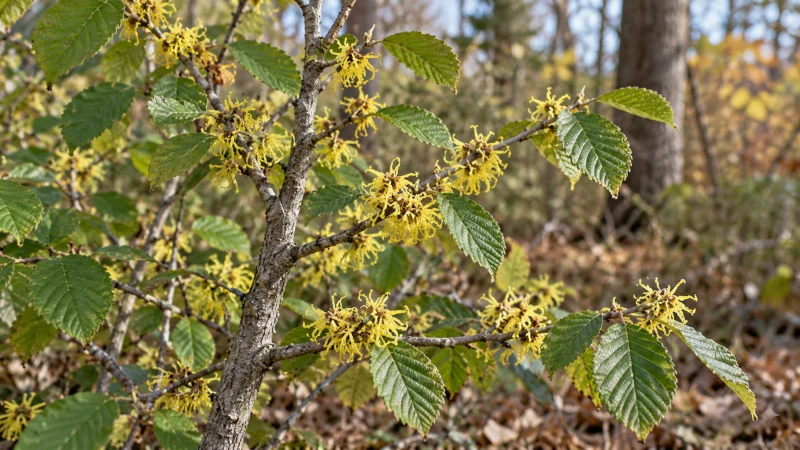
Witch hazel comes from Hamamelis virginiana, a shrub native to North America, and the medicinal parts are the leaves and bark. (The “witch” has nothing to do with magic — it traces to an old word for “bendable,” a nod to the forked branches once used as dowsing rods.) The bark and leaves are rich in tannins, especially hamamelitannin, along with gallic acid, flavonoids, and proanthocyanidins. Those tannins are what make it astringent, and in laboratory models they also show antioxidant and anti-inflammatory activity [Piazza, 2022].
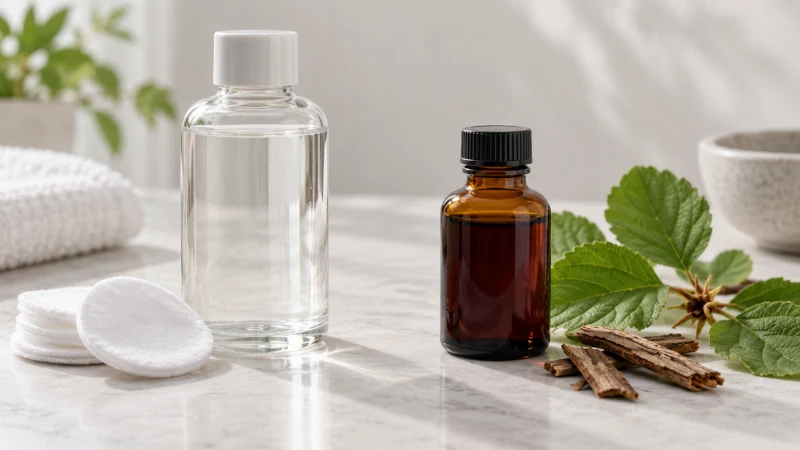
One distinction changes everything about what you buy. The clear “witch hazel water” on most drugstore shelves is a steam distillate that contains little to no tannin, and it often gets much of its bite from added alcohol — around 14% in many products. Tannin-rich bark or leaf extracts are a different preparation entirely [Drugs.com]. If you want the astringent, tannin-driven effect, the distilled water is the weaker choice; if your skin is dry or reactive, the alcohol in that same water can be the thing that irritates you.
What the evidence says about witch hazel, at a glance
| Use | How strong is the evidence? |
| Soothing minor skin irritation, redness, sensitive skin | Moderate for short-term redness; limited overall |
| Hemorrhoids and postpartum perineal soreness (topical) | Moderate; FDA-recognized OTC astringent |
| Acne / oily skin (as a toner) | Limited, early |
| Eczema (atopic dermatitis) | Mixed to weak — hydrocortisone works better |
| Minor cuts, insect bites, sunburn | Traditional; plausible, little trial data |
| Oral use (diarrhea, “internal bleeding,” colds) | Insufficient — not recommended |
| Eye washes or drops | Not recommended (safety concern) |
| “Curing” varicose veins | Insufficient |
Calming irritated, red, or sensitive skin
This is where witch hazel has its best human data, and it’s still modest. In a controlled study, a hamamelis distillate reduced skin redness triggered by UV light and by tape-stripping — though 1% hydrocortisone outperformed it [Korting, 1993]. Laboratory work adds a plausible mechanism: witch hazel bark extract and hamamelitannin dampened several inflammatory signals in human skin cells engineered to mimic eczema [Piazza, 2022]. That’s cell-level evidence, not proof of a clinical cure, and it’s worth keeping those two tiers separate.
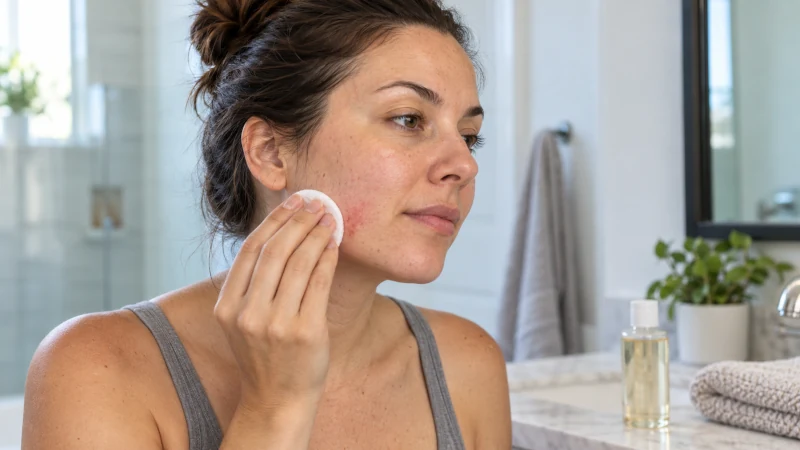
The practical read: witch hazel is a reasonable choice for transient redness and irritation, the kind that comes from a mild sunburn, a razor, or a rough day for sensitive skin. Expect soothing, not steroid-strength results. For a wider look at which skin herbs actually hold up, the evidence-graded guide to herbs for skin is a useful companion.
Hemorrhoids and postpartum perineal soreness
If witch hazel has a signature use, this is it. Its astringent tannins constrict small blood vessels and calm inflamed tissue, which eases the itching, irritation, and minor surface bleeding that make hemorrhoids miserable [Hemorrhoid review, 2025]. The regulatory picture backs the everyday use: the FDA recognizes witch hazel as an over-the-counter astringent for external anorectal relief, and you’ll find it in medicated pads, wipes, and foams at concentrations up to 50% — all labeled for external use only [DailyMed]. It’s also a mainstay of postpartum perineal care, layered onto a pad after a vaginal delivery.
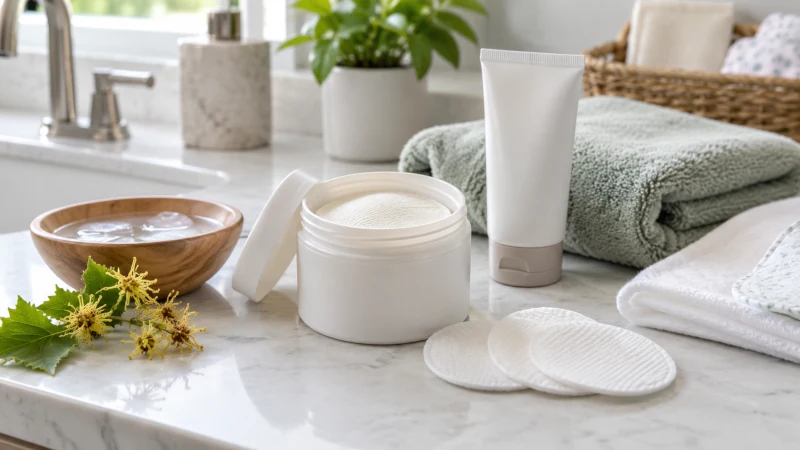
The honest caveat is that this reputation rests on a plausible mechanism, long clinical use, and regulatory recognition rather than large randomized trials. Think relief, not repair — it soothes the symptom, it doesn’t shrink the underlying vein. For where it sits against other options, see how herbs for hemorrhoids rank by the evidence.
Acne and oily skin
Witch hazel is a fixture in toners, and the rationale — astringent plus anti-inflammatory — is reasonable. The direct clinical evidence for acne, though, is scarce and early; most of what exists is laboratory or mechanistic work rather than trials in people with acne [Acne study, 2022]. In practice it can make skin feel less oily and calm some redness, but the alcohol-heavy versions can over-dry and leave skin more irritated than when you started. If you try it, choose an alcohol-free product and stop if your skin tightens or flakes.
Eczema — where witch hazel underperforms
Here the evidence is genuinely mixed, and mostly disappointing. Head-to-head, topical hydrocortisone was the more effective treatment, and a 14-day trial of a witch hazel cream did not meaningfully improve moderate eczema [RxList/NatMed]. Witch hazel is fine as a short-term soother on irritated skin, but it isn’t a treatment for atopic dermatitis, and it shouldn’t replace one that works.
Where the evidence runs out (the traditional oral and eye uses)
Older herbals — including the earlier version of this page — recommend witch hazel tea or tincture for diarrhea, dysentery, coughing or vomiting blood, tuberculosis, colds, and “uterine hemorrhage.” These are traditional uses, not conclusions from modern human trials, and taking witch hazel by mouth is specifically not recommended because of its tannin content [Drugs.com]. For diarrhea in particular, the proven approach is rehydration, not an astringent tea — the rundown of what actually causes diarrhea covers what helps. And while witch hazel is often linked to circulation, dabbing it on won’t reverse varicose veins; at most it may briefly soothe aching skin over them.
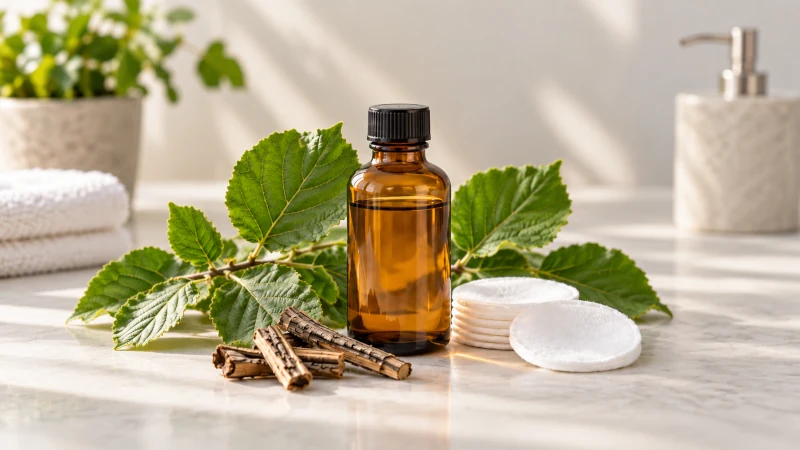
The eye use deserves a flat no. FDA labeling on witch hazel products tells you to avoid contact with the eyes, and there’s a documented case of eyelid swelling that developed after someone used a witch hazel eye gel [DailyMed] [CIR]. Whatever tradition says about “eye washes,” don’t put it in or near your eyes.
How to use witch hazel safely
Match the form to the job. For hemorrhoids or postpartum soreness, reach for OTC witch hazel pads, wipes, or foams designed for that use. For skin, a toner or distillate is fine — pick alcohol-free if your skin runs dry or reactive, and a tannin-rich extract if you want a stronger astringent effect. Whatever you choose, patch-test first: dab a little on the inner forearm and wait a day before using it more widely. Keep it external, off the eyes, and off deep or open wounds. If it burns, stings, or dries your skin out, stop. And don’t drink it.
Side effects, interactions, and who should be careful
Used on the skin, witch hazel is well tolerated for most people. The usual issues are mild — dryness or a temporary sting, mostly from the alcohol in distilled products — and, less commonly, an allergic contact dermatitis in people sensitive to it [Drugs.com] [CIR]. Taken by mouth, it’s a different story: the tannins can cause stomach upset, nausea, and vomiting, and large amounts may stress the liver, which is why internal use isn’t advised [Drugs.com] [RxList/NatMed]. Witch hazel does contain trace safrole, a compound of toxicological interest, but the amounts are generally considered too small to be a concern [RxList/NatMed].
No meaningful drug interactions are documented for topical use. The relevant interaction is another argument against swallowing it: tannin-rich preparations taken internally can interfere with the absorption of iron and other nutrients [Drugs.com]. People who are prone to constipation or who have iron-deficiency anemia have particular reason to avoid the oral route, and witch hazel should be kept off infants’ skin and out of reach if there’s any chance of it being swallowed.
Pregnancy and breastfeeding
Topical use — including the witch hazel pads so often handed out after delivery — is common and generally considered acceptable in pregnancy and postpartum, but the rigorous safety data are limited, so this sits in the “widely used, thinly studied” category rather than “proven safe” [RxList/NatMed]. The clearer rule is about the oral route: don’t take witch hazel by mouth while pregnant or breastfeeding [RxList/NatMed] [Drugs.com]. As with any remedy in pregnancy, run it by your OB-GYN, doctor, or pharmacist first.
| HEALTH DISCLAIMER: This article is for general education and information only. It is not medical advice and is not a substitute for diagnosis or treatment from a qualified healthcare professional. Witch hazel is intended for external use; do not take it by mouth or use it in your eyes. If you are pregnant or breastfeeding, treating a child, taking prescription medicines, or living with a long-term condition, talk to your doctor or pharmacist before using any herbal product. Rectal bleeding, a spreading or infected rash, or symptoms that don’t improve should be evaluated by a clinician rather than self-treated. |
When to see a professional
- New, changing, or heavier rectal bleeding, or black, tarry stools. Don’t assume blood is “just hemorrhoids” — get it checked. Witch hazel product labels themselves tell you to stop and see a doctor if rectal bleeding occurs.
- Hemorrhoid or skin symptoms that don’t improve after about a week, or a hemorrhoid that’s suddenly very painful or forms a hard, tender lump.
- Redness that’s spreading, warm, and swollen, especially with fever — possible skin infection, which needs medical care, not an astringent.
- A rash after starting any new product, or anything affecting the eye.
Frequently Asked Questions
Is witch hazel safe to use on hemorrhoids?
Yes, applied externally to the skin around the anus, where it can soothe itching and irritation. Don’t insert it, and skip alcohol-heavy pads if they sting.
Can you drink witch hazel or take it as a tea?
It’s not recommended. The tannins can upset your stomach, and large amounts may affect the liver; its safety taken internally isn’t well established.
Is distilled witch hazel the same as witch hazel extract?
No. The clear “water” is a steam distillate with little tannin and often added alcohol; tannin-rich extracts are a stronger, different preparation.
Is witch hazel safe during pregnancy?
Topical use, including postpartum perineal pads, is common and generally considered acceptable, but data are limited — and you should not take it by mouth. Check with your clinician.
Does witch hazel help acne?
It may modestly reduce oiliness and redness, but the direct evidence for acne is limited and early. Choose an alcohol-free product and stop if it over-dries.
Can I put witch hazel in my eyes?
No. Product labels say to avoid the eyes, and eyelid swelling has been reported after use of a witch hazel eye gel.
References
- Korting HC, Schäfer-Korting M, Hart H, Laux P, Schmid M. Anti-inflammatory activity of hamamelis distillate applied topically to the skin. Eur J Clin Pharmacol. 1993;44(4):315–318. DOI 10.1007/BF00316465. View source
- Piazza S, Martinelli G, Magnavacca A, et al. Hamamelis virginiana L. bark extract impairs keratinocyte inflammatory cascade typical of atopic eczema. Int J Mol Sci. 2022;23(16):9279. DOI 10.3390/ijms23169279 (PMC9408886). In vitro / mechanistic. View source
- Anti-inflammatory and anti-acne effects of Hamamelis virginiana bark in human keratinocytes. PMC9220085. View source
- Natural products in hemorrhoid management: a literature review. 2025. PMC12128686. View source
- Drugs.com (Wolters Kluwer). Witch Hazel — professional monograph. View source
- RxList / Natural Medicines. Witch Hazel. View source
- DailyMed (U.S. National Library of Medicine / FDA). Witch Hazel (U.S.P.) drug label. View source
- Cosmetic Ingredient Review. Safety Assessment of Hamamelis virginiana (Witch Hazel)-Derived Ingredients. View source
