
If you’re deciding whether LifeSeasons Rest-ZZZ is worth trying, here’s the short version. It’s a two-capsule nightly blend built around a deliberately low 1 mg dose of melatonin plus six calming ingredients: valerian, chamomile, passionflower, GABA, hawthorn berry, and lemon balm. [LifeSeasons Rest-ZZZ supplement facts, 2026] For an occasional restless night, it’s a low-risk thing to try. For insomnia that has been going on for months, it isn’t the answer, and the evidence behind most of these ingredients is thinner than the marketing suggests.
That gap matters. Two of the ingredients LifeSeasons Rest-ZZZ leans on hardest, melatonin and valerian, are the two the American Academy of Sleep Medicine specifically advises clinicians not to use for chronic insomnia, on the grounds that the evidence isn’t strong enough. [AASM clinical practice guideline, 2017] That doesn’t make the product useless. It does change what you should reasonably expect from it.
Below is what’s actually in the bottle, how good the evidence is for each ingredient, who should steer clear, and the point at which a supplement stops being the right tool.
What’s actually in LifeSeasons Rest-ZZZ
A serving is two capsules, and one bottle of the regular-strength 60-count product is a 30-day supply. Here’s the label, per serving. [LifeSeasons Rest-ZZZ supplement facts, 2026]
| Ingredient | Per 2 capsules | Why it’s in there |
| Melatonin | 1 mg | Signals sleep timing to the body clock |
| Valerian root extract (4:1) | 300 mg | Traditional sedative herb |
| Chamomile extract (4:1) | 200 mg | Traditional calming herb |
| Passionflower extract (3.5% vitexins) | 175 mg | Traditional herb for nervous tension |
| GABA | 100 mg | The brain’s main calming neurotransmitter, taken orally |
| Hawthorn berry | 100 mg | A cardiovascular herb; the reason for a specific caution below |
| Lemon balm leaf | 50 mg | Traditional calming herb |
LifeSeasons also lists an Extra Strength version of Rest-ZZZ. Its per-serving amounts aren’t published in the product page text, so check the label on the bottle before assuming the doses above apply.
One thing worth noticing right away: 1 mg of melatonin is a small dose by supplement-aisle standards, where 5 and 10 mg products are common. For melatonin, small is not a weakness. It’s closer to what the body produces, and the research on sleep timing has never shown that more works better.
What the evidence actually says, ingredient by ingredient
Herbal sleep blends are hard to judge because almost nobody studies the blend. They study one ingredient at a time, usually in small groups, usually for a few weeks. So the honest way to read a formula like this is ingredient by ingredient, and to be clear about which claims are well supported and which are traditional use with thin data behind them.
Melatonin: the best-supported ingredient, for a narrow job
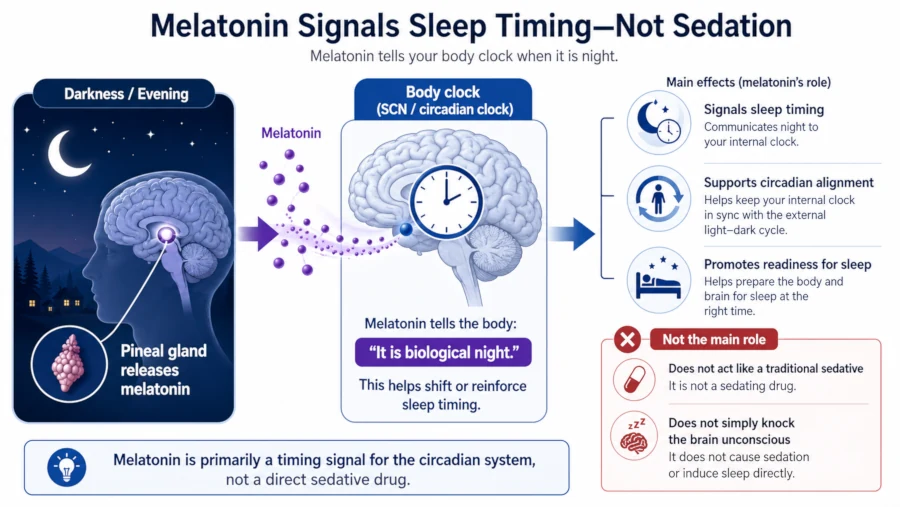
Melatonin is a hormone your brain releases in response to darkness, and its main role is telling your body when to sleep rather than forcing sleep to happen. That distinction explains where it works and where it doesn’t. [NCCIH on melatonin, 2024]
The clearest benefits are in timing problems. Federal reviewers describe reasonable evidence for jet lag, and for delayed sleep-wake phase disorder, the pattern where you can’t fall asleep before 2 to 6 a.m. In one small review of two studies covering 52 people, melatonin cut about 22 minutes off the time it took to fall asleep. A larger four-week trial of 307 people with the same disorder found that melatonin taken an hour before a fixed bedtime moved sleep onset about 34 minutes earlier and improved daytime functioning. [NCCIH on melatonin, 2024]
For ordinary chronic insomnia, the picture flips. The AASM’s 2017 guideline suggests clinicians not use melatonin for sleep-onset or sleep-maintenance insomnia, and the American College of Physicians strongly recommends cognitive behavioural therapy for insomnia (CBT-I) as the first treatment instead. [AASM clinical practice guideline, 2017] [NCCIH on melatonin, 2024] Shift work is a third case, and there the reviews are small and inconclusive.
Valerian: genuinely inconsistent, not simply unproven
Valerian has centuries of use behind it and a real research literature, but the trials disagree with each other. NCCIH’s assessment is blunt: there isn’t enough evidence to say valerian is useful for any health condition, and the sleep evidence specifically is inconsistent. The AASM guideline recommends against it for chronic insomnia. [NCCIH on valerian, 2025]
Rest-ZZZ supplies 300 mg of a 4:1 root extract. For context, valerian has been used with apparent safety at 300 to 600 mg daily for up to six weeks, which puts this formula at the bottom of the commonly studied band. [NCCIH on valerian, 2025] If you want the longer version of the valerian story, including how the preparations differ, see our guide to valerian root for sleep and anxiety.
Chamomile: reassuring for anxiety, thin for sleep
Chamomile is the most familiar ingredient here and the one with the least sleep evidence. NCCIH notes that a 2019 review turned up a single insomnia study, and it found no benefit. What preliminary evidence exists points instead at generalised anxiety and associated low mood. [NCCIH on chamomile, 2024] If it helps you wind down, that may be doing more for tension than for sleep architecture, which is not nothing but is a different claim.
Passionflower: a small, mixed sleep signal
A modest amount of research suggests oral passionflower may increase total sleep time in adults with insomnia, though its effects on how fast you fall asleep and whether you stay asleep are mixed across studies. Its better-supported use is short-term anxiety, including nerves before a procedure. [NCCIH on passionflower, 2025] Our fuller write-up on passion flower benefits and evidence goes through the individual trials.
GABA: the mechanism is shakier than it sounds
This is the ingredient most likely to be oversold. GABA really is the brain’s main inhibitory neurotransmitter, so the story writes itself. The problem is getting swallowed GABA into the brain. As of a 2020 systematic review of 14 placebo-controlled human trials, there were still no human data showing whether oral GABA crosses the blood-brain barrier at all. The same review graded the evidence as limited for stress and very limited for sleep, and flagged that authors of 11 of the 14 studies were employed by industry at the time of publication. [Hepsomali et al., Frontiers in Neuroscience, 2020]
The trials that did find something tended to find it for sleep onset rather than staying asleep, at doses of 100 to 300 mg used for one to four weeks. Rest-ZZZ’s 100 mg sits at the low end of that. Treat it as plausible but unsettled.
Hawthorn and lemon balm
Hawthorn berry is the odd one out. It’s a cardiovascular herb with a long traditional record for heart complaints, not a sleep herb, and it’s the ingredient behind the most specific safety caution in this article. Read more in our overview of hawthorn berry and heart health, and see the interactions section below before combining it with any heart medication.
Lemon balm appears at 50 mg, a small amount. It belongs to the traditional family of calming nervine herbs rather than to any body of strong clinical sleep evidence; our nervine tea guide covers where it sits alongside chamomile and passionflower.
How the evidence stacks up
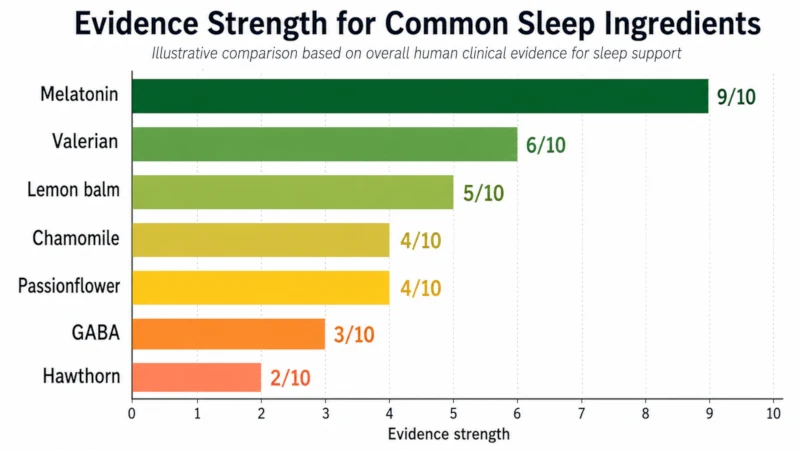
| Ingredient | Strength of evidence for sleep | Best-supported use |
| Melatonin | Moderate for timing disorders; guidelines advise against it for chronic insomnia | Jet lag, delayed sleep-wake phase disorder |
| Valerian | Mixed and inconsistent | No condition has enough evidence to call it useful |
| Chamomile | Very limited; one insomnia study found no benefit | Preliminary signal for generalised anxiety |
| Passionflower | Small and mixed | Short-term anxiety, including before procedures |
| GABA (oral) | Very limited; mechanism unresolved in humans | Possibly sleep onset, at 100-300 mg over weeks |
| Hawthorn berry | Not a sleep ingredient | Studied for cardiovascular use, not sleep |
| Lemon balm | Traditional use; limited clinical data | General calming, mild tension |
What you can reasonably expect
Put the evidence together and a realistic ceiling emerges. Rest-ZZZ may help you feel calmer and drift off a little more easily on a night when your mind won’t settle, and the low melatonin dose may nudge your body clock if your schedule has drifted. It is not going to restructure your sleep, and it isn’t a treatment for a sleep disorder.
The manufacturer’s own framing is that customers report falling asleep within about 30 minutes of taking it. [LifeSeasons product information, 2026] Customer reports aren’t clinical evidence, and with sedating botanicals the placebo response on subjective sleep measures is substantial. If you try it, judge it over a couple of weeks rather than one night, and keep a rough note of bedtimes and wake times so you’re not relying on memory.
A supplement also works best when it isn’t doing the job alone. Consistent sleep and wake times, a dark cool room, no caffeine after mid-afternoon, and a genuine wind-down period all move the needle more than any capsule. If the racing-mind part is your main problem, a guided wind-down or meditation routine is worth pairing with it.
Rest-ZZZ vs Rest-ZZZ Melatonin-Free
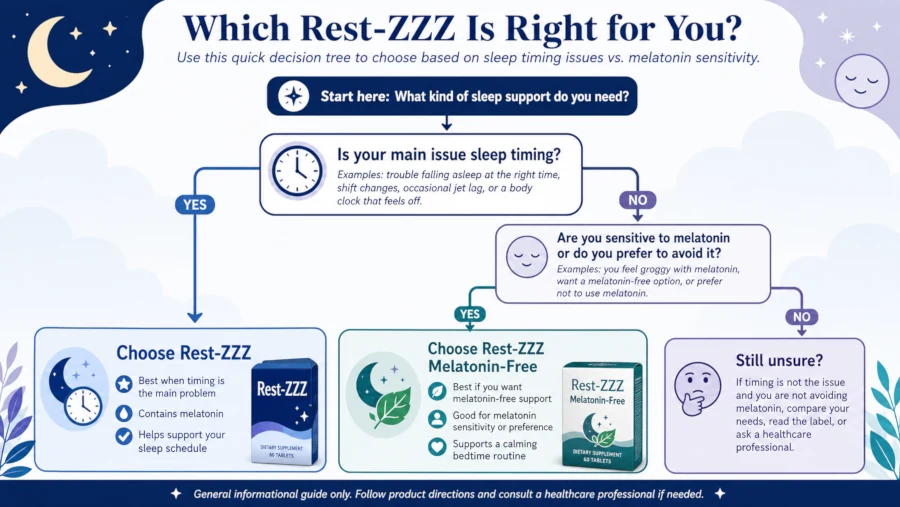
LifeSeasons sells a melatonin-free version, and the choice between them is less about strength than about whether melatonin suits you.
Choose the standard formula if your problem looks like a timing problem: jet lag, a schedule that has slid late, shift changes. That’s where melatonin has the most support.
Choose Melatonin-Free if melatonin gives you vivid dreams, grogginess, or headaches, if you’ve been advised against hormone supplements, or if your issue is more about tension than timing. That version drops the melatonin and adds magnesium at 100 mg, keeping chamomile at 200 mg, passionflower at 175 mg, and lemon balm at 50 mg, alongside valerian and GABA. [Rest-ZZZ Melatonin-Free label listing, 2026] The retailer listing we checked didn’t spell out the valerian and GABA amounts for that version, so read the panel on the bottle if the exact doses matter to you.
Neither version is stronger in a meaningful sense. They aim at different reasons for a bad night.
How to take it
The label directs two capsules about 30 minutes before bed, with or without food. [LifeSeasons Rest-ZZZ label, 2026] A few practical points that the label doesn’t cover:
- Take it once you’re actually winding down. Melatonin works on timing, so taking it and then staring at a bright screen for two hours works against the thing you swallowed.
- Don’t stack it. Combining it with another melatonin product, an antihistamine sleep aid, or a prescription hypnotic is the most common way people run into trouble.
- Give it two weeks, not two nights, before deciding. Several of these ingredients show whatever effect they have with repeated use.
- Don’t plan to drive or use machinery after taking it. Drowsiness is the intended effect.
- Keep it out of reach of children. Flavoured melatonin products drive a large share of paediatric ingestions, and capsules should be stored with the same care.
On duration: the safety data for these botanicals is short-term. Valerian has been used with apparent safety for up to about six weeks, and passionflower extract for up to about eight weeks. [NCCIH on valerian, 2025] [NCCIH on passionflower, 2025] Long-term nightly use hasn’t been well studied for any of them, which is a reason to treat Rest-ZZZ as something you use for a rough patch rather than something you take indefinitely without discussing it with a clinician.
Side effects, interactions, and who should avoid it
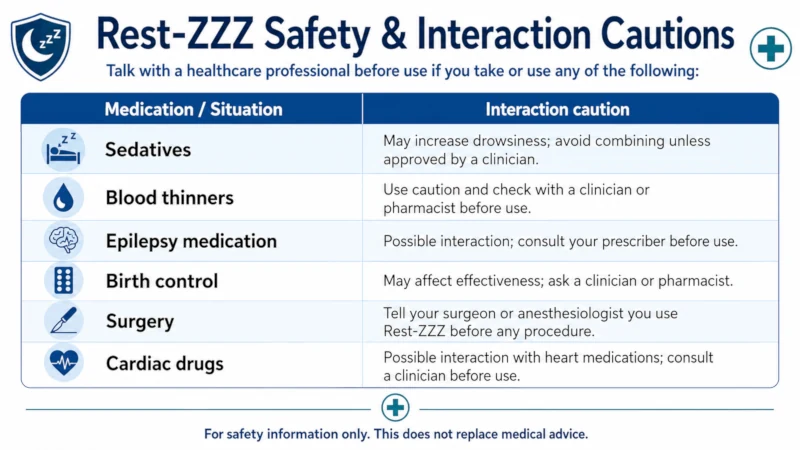
This is a seven-ingredient product, which means seven safety profiles rather than one. Most people who take it short-term will have no trouble, but the cautions below are specific and worth reading before a first dose.
Common side effects
- Melatonin: headache, dizziness, nausea, and daytime sleepiness are the ones reported in short-term studies. [NCCIH on melatonin, 2024]
- Valerian: headache, stomach upset, mental dullness, excitability, uneasiness, and vivid dreams. Stopping abruptly after long use has been linked to withdrawal-type symptoms. Rare cases of liver injury have been reported, usually with combination herbal products. [NCCIH on valerian, 2025]
- Chamomile: side effects are uncommon but include nausea and dizziness. Allergic reactions, including rare severe ones, are more likely if you react to ragweed, chrysanthemums, marigolds, or daisies. [NCCIH on chamomile, 2024]
- Passionflower: drowsiness, dizziness, and confusion. [NCCIH on passionflower, 2025]
Interactions to take seriously
Sedatives and alcohol. Several ingredients here have sedating effects, and valerian in particular should not be combined with alcohol or sedatives. That includes prescription sleep medication, benzodiazepines, opioids, and sedating antihistamines. [NCCIH on valerian, 2025]
Blood thinners and epilepsy medication. People taking anticoagulants and people with epilepsy should be under medical supervision when using melatonin. Interactions between chamomile and warfarin have also been reported, along with interactions involving drugs metabolised by the liver. [NCCIH on melatonin, 2024] [NCCIH on chamomile, 2024]
Birth control pills and estrogen-sensitive conditions. Chamomile may have some estrogen-like effects. Preliminary work suggests it might reduce the effect of birth control pills, and it may not be appropriate if you have a condition sensitive to estrogen. [NCCIH on chamomile, 2024]
Upcoming surgery. Passionflower may interact with anaesthesia and other drugs used around an operation. Talk to your care team if you’re taking it within two weeks of a scheduled procedure. [NCCIH on passionflower, 2025]
Heart medication, where the sources genuinely disagree. This one deserves care rather than a flat answer. A randomised crossover study in eight healthy volunteers found that a standardised hawthorn extract taken for three weeks did not meaningfully change digoxin’s pharmacokinetics, and the authors concluded the two could be given together. [Tankanow et al., Journal of Clinical Pharmacology, 2003]
A later laboratory study reached the opposite practical conclusion: hawthorn interfered with one common digoxin immunoassay and showed a pharmacodynamic interaction in heart-muscle cells, leading those authors to advise that patients on digoxin avoid hawthorn. [Dasgupta et al., 2010] These are different kinds of study asking slightly different questions, and neither settles it. If you take digoxin, a beta-blocker, or any other cardiac medication, treat the hawthorn content as a reason to check with your prescriber before starting, not a reason to panic if you’ve already taken a dose.
Who should avoid Rest-ZZZ
- Anyone pregnant. Passionflower should not be used during pregnancy because it may stimulate uterine contractions, and safety data for the other botanicals in pregnancy is limited or absent. [NCCIH on passionflower, 2025]
- Anyone breastfeeding. Little is known about valerian, chamomile, or passionflower during breastfeeding, and melatonin safety while nursing hasn’t been researched adequately.
- Children and teenagers, unless a clinician has advised it. Melatonin is a hormone, and its long-term effects on development aren’t established. [NCCIH on melatonin, 2024]
- Older adults with dementia. AASM guidance from 2015 recommends against melatonin use in this group, and melatonin can stay active longer in older people, causing daytime drowsiness. [NCCIH on melatonin, 2024]
- Anyone allergic to ragweed and related plants, because of the chamomile. [NCCIH on chamomile, 2024]
- Anyone on cardiac medication, anticoagulants, sedatives, or anti-epileptic drugs, without clearing it with a prescriber first.
- Anyone with liver disease, given the rare valerian-associated liver injury reports.
A note on what’s in the capsule
Supplements in the United States aren’t approved by the FDA before sale, and label accuracy is a real issue in this category. A 2017 analysis of 31 melatonin supplements found that most did not match the melatonin content stated on the label, and 26 percent contained serotonin. A 2023 study of 25 over-the-counter melatonin gummies found 22 were inaccurately labelled, with melatonin ranging from 74 to 347 percent of the stated amount. [NCCIH on melatonin, 2024] Those studies tested other products, not Rest-ZZZ, but they’re the reason third-party testing is worth looking for on any melatonin-containing supplement.
When a supplement isn’t the right tool
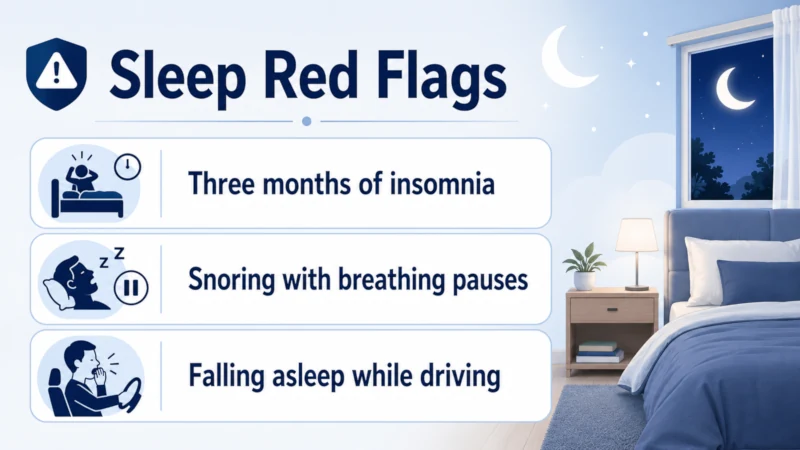
Poor sleep is sometimes a habit problem and sometimes a symptom. These are the situations where reaching for a sleep aid can delay something that needs attention.
Book an appointment if:
- You’ve had trouble falling or staying asleep at least three nights a week for three months or more. That pattern meets the definition of chronic insomnia, and the recommended first-line treatment is CBT-I, not medication or supplements.
- You snore loudly, gasp or stop breathing in your sleep, wake with headaches, or feel exhausted despite spending enough time in bed. These point toward sleep apnoea, which no supplement treats.
- You have an uncomfortable urge to move your legs at night that eases when you move them.
- Your sleep problem arrived alongside low mood, anxiety, or loss of interest in things you used to enjoy.
- You’re taking a sleep aid most nights and it has stopped working, or you feel unable to sleep without it.
Seek urgent care if:
- You’ve fallen asleep, or nearly fallen asleep, while driving.
- You wake with chest pain, severe shortness of breath, or a sensation of choking.
- You have thoughts of harming yourself. In the US and Canada you can call or text 988 at any hour. Sleeplessness with hopelessness is a medical situation, not a supplement one.
| Health Disclaimer: This article is for general education only. It is not medical advice and is not a substitute for diagnosis or treatment by a qualified healthcare professional. Dietary supplements are not reviewed by the FDA for safety or effectiveness before they are sold, and they are not intended to diagnose, treat, cure, or prevent any disease. Talk to your doctor or pharmacist before taking LifeSeasons Rest-ZZZ, especially if you are pregnant, breastfeeding, under 18, scheduled for surgery, taking prescription medication, or managing a health condition. Never stop or change a prescribed treatment without medical guidance. If you are in crisis, contact your local emergency number or a crisis line immediately. |
Frequently Asked Questions
How long does LifeSeasons Rest-ZZZ take to work?
The label suggests taking it 30 minutes before bed, and the manufacturer says customers commonly report feeling ready for sleep in about that window. [LifeSeasons product information, 2026] Those are customer reports rather than trial results. The ingredients with any sleep-onset evidence behind them, GABA in particular, showed their effects after one to four weeks of nightly use, so judge it over a couple of weeks.
Is it non-habit-forming?
None of these ingredients causes the kind of physical dependence associated with benzodiazepines. That said, NCCIH notes that some people report withdrawal-type symptoms, including anxiety, irritability, and insomnia, if valerian is stopped abruptly after long-term use. [NCCIH on valerian, 2025] Psychological reliance on any bedtime ritual is also common. If you find you can’t sleep without it, that’s worth raising with a clinician.
Will 1 mg of melatonin do anything, or is it too low?
Low doses are appropriate for melatonin. Its job is signalling timing rather than sedating you, and larger doses haven’t been shown to work better for that. The relevant question isn’t whether the dose is big enough but whether a timing signal is what your sleep problem needs. If you can fall asleep fine but keep waking at 3 a.m., melatonin is probably aimed at the wrong target.
Can I take it every night indefinitely?
The safety evidence doesn’t extend that far. Valerian has been used with apparent safety for up to about six weeks and passionflower extract for up to about eight, and the long-term safety of melatonin supplementation is described as lacking. [NCCIH on valerian, 2025] [NCCIH on melatonin, 2024] Nightly indefinite use is a conversation to have with your doctor rather than a decision to make from a label.
Can I take it with my blood pressure or heart medication?
Ask your prescriber first. The hawthorn berry content is the reason: it acts on the heart, and the published evidence on whether it interacts with digoxin is genuinely mixed. [Tankanow et al., 2003] [Dasgupta et al., 2010] This is a case where a five-minute question to your pharmacist is worth more than any article.
What’s the difference between Rest-ZZZ and Rest-ZZZ Melatonin-Free?
The standard formula includes 1 mg of melatonin and is aimed at sleep-timing problems. The melatonin-free version swaps that out for magnesium and keeps the calming botanicals, which suits people who react badly to melatonin or have been advised to avoid hormone supplements. [Rest-ZZZ Melatonin-Free label listing, 2026]
References
- National Center for Complementary and Integrative Health. Melatonin: What You Need To Know. NIH; last updated May 2024. View source
- National Center for Complementary and Integrative Health. Valerian: Usefulness and Safety. NIH; last updated May 2025. View source
- National Center for Complementary and Integrative Health. Chamomile: Usefulness and Safety. NIH; last updated November 2024. View source
- National Center for Complementary and Integrative Health. Passionflower: Usefulness and Safety. NIH; last updated April 2025. View source
- Sateia MJ, Buysse DJ, Krystal AD, Neubauer DN, Heald JL. Clinical Practice Guideline for the Pharmacologic Treatment of Chronic Insomnia in Adults. Journal of Clinical Sleep Medicine. 2017;13(2):307-349. PMID 27998379; DOI 10.5664/jcsm.6470. View source
- Hepsomali P, Groeger JA, Nishihira J, Scholey A. Effects of Oral Gamma-Aminobutyric Acid (GABA) Administration on Stress and Sleep in Humans: A Systematic Review. Frontiers in Neuroscience. 2020;14:923. DOI 10.3389/fnins.2020.00923. View source
- Tankanow R, Tamer HR, Streetman DS, et al. Interaction study between digoxin and a preparation of hawthorn (Crataegus oxyacantha). Journal of Clinical Pharmacology. 2003;43(6):637-642. PMID 12817526. View source
- Dasgupta A, Kidd L, Poindexter BJ, Bick RJ. Interference of hawthorn on serum digoxin measurements by immunoassays and pharmacodynamic interaction with digoxin. 2010. PMID 20670141. View source
- Professional Supplement Center. Rest-ZZZ, by LifeSeasons – supplement facts and warnings. Accessed July 2026. View source
- Professional Supplement Center. Rest-ZZZ Melatonin-Free, by LifeSeasons – supplement facts. Accessed July 2026. View source
- LifeSeasons. Rest-ZZZ Sleep Support – product information. Accessed July 2026. View source
