
The celandine plant — properly called greater celandine, Chelidonium majus — has been a folk remedy for warts and liver complaints for close to two thousand years. Here is the short answer most people want: dabbing its orange sap on a wart is a traditional practice that has barely been tested in people, and swallowing celandine as a tea, tincture, or capsule carries a documented risk of liver injury that European regulators judged to outweigh any proven benefit EMA, 2011a. If you are weighing the celandine plant for a wart or a stomach complaint, this guide covers what it is, what the evidence does and doesn’t show, and how to stay safe.

| Quick answer Do not take greater celandine by mouth. Tea, tincture, capsules, and celandine-containing digestive blends have been linked to acute hepatitis.On the skin, the evidence is thin. Sap on warts is folk medicine with lab support and one published case, not clinical trials.Better-tested wart options exist, such as over-the-counter salicylic acid. |
What is the celandine plant?
Greater celandine is a member of the poppy family. It grows along walls, roadsides, and shady garden edges across Europe and western and central Asia, and it has become established in North America Zielińska et al., 2018. Look for small four-petaled yellow flowers, lobed leaves that are bluish underneath, and the giveaway: yellow-orange latex that oozes from any broken stem.
Old names include tetterwort, swallow-wort, rock poppy, and devil’s milk EMA, 2011b. The genus name comes from the Greek chelidon, swallow, because the plant tends to bloom when the swallows return Zielińska et al., 2018.
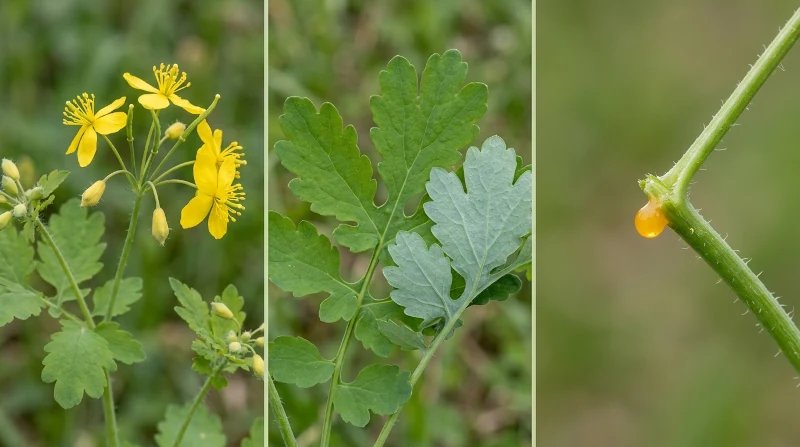
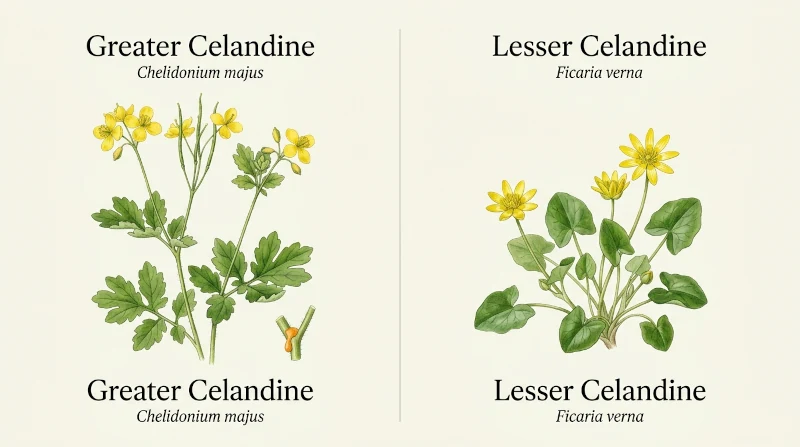
One identification point matters for your safety. Lesser celandine (Ficaria verna, formerly Ranunculus ficaria) is a different plant that is unrelated to greater celandine NIH LiverTox. Labels and online recipes don’t always make the distinction. Everything here is about Chelidonium majus.
Two thousand years of folk use
In the first century A.D., Pedanius Dioscorides wrote that celandine blooms with the swallows’ arrival, and passed on a legend that swallows restore sight to their blind nestlings with it Zielińska et al., 2018. That story helps explain why eye disease was the plant’s main use in antiquity, when its juice was boiled with honey for failing vision. Nobody should repeat that today: the fresh latex is an irritant.

Later traditions moved toward the liver. From the sixteenth century, partly because of the plant’s yellow sap, celandine was used for jaundice, colic, and gallbladder complaints. In Central and Eastern Europe, rubbing fresh sap onto warts became one of its most common household uses Zielińska et al., 2018, and warts are still the main reason people look it up.
What is in the plant
Greater celandine contains more than 20 alkaloids, among them chelidonine, sanguinarine, chelerythrine, berberine, coptisine, and protopine EMA, 2011a. In test tubes and animals these compounds show antiviral, antimicrobial, antispasmodic, and cell-killing activity EMA, 2011b.
That chemistry is real, and it is also the reason celandine is not a gentle tea herb. Compounds strong enough to stop cells dividing in a dish can do harm in a body, and lab activity rarely carries over neatly into a safe treatment.
What the evidence actually shows
| Use | What has been studied | Evidence | What it means for you |
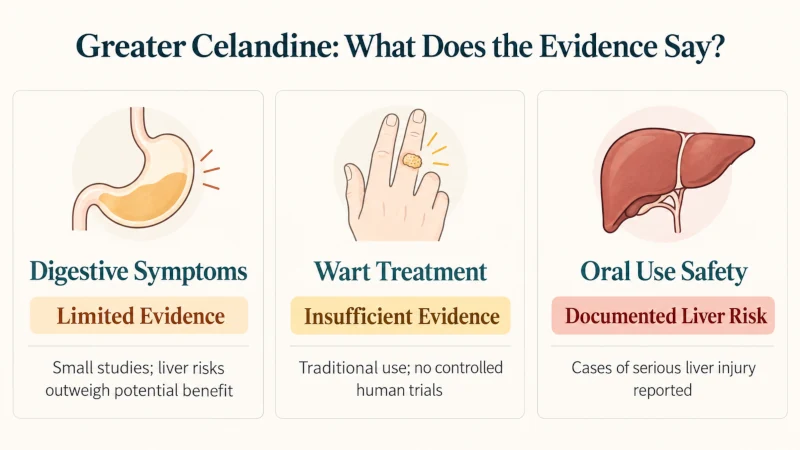
| Indigestion, cramping upper-abdominal pain (by mouth) | Two small randomized trials (60 and 76 people) plus older observational studies | Limited | Possible modest symptom relief, outweighed by liver risk |
| Gallbladder and bile complaints (by mouth) | Older open studies without proper control groups | Weak | Not recommended |
| Warts, corns, calluses (sap on skin) | Folk use, lab antiviral data, one published case report | Traditional / insufficient | Untested; skin irritation possible |
| Cancer (Ukrain, an injectable derivative) | Seven small randomized trials, mostly poor quality, no independent replication | Insufficient | Not a cancer treatment |
| Eye problems | Ancient tradition only | None | Do not use; latex irritates |
| “Liver protection” | Animal studies only | Contradicted by human case reports | Avoid |
Sources for table: EMA, 2011b; EMA, 2011a; Nawrot et al., 2020; Ernst & Schmidt, 2005; Zielińska et al., 2018.
Indigestion and gallbladder complaints
The best human data concern cramp-like stomach discomfort. In a 1993 double-blind trial, 60 people with functional upper-abdominal complaints took a celandine extract or placebo for six weeks, and symptom scores fell further with celandine. A 1999 pilot trial in 76 patients combined celandine with turmeric for three weeks and found modest benefit on some measures, though not a clear win on its main outcome EMA, 2011b.
When the European Medicines Agency’s herbal committee reviewed this work in 2011, it concluded there was not enough evidence for an established medical use. It also declined to endorse traditional oral use because of the number of liver reports, and noted that safer herbal products exist for the same complaints EMA, 2011a.
Greater celandine also turns up in multi-herb digestive blends. The best known, the nine-herb extract STW 5 (sold as Iberogast), has trials in functional dyspepsia, but nobody has shown celandine is the ingredient doing the work Zielińska et al., 2018. After new reports of serious liver injury, one of them fatal, the manufacturer added liver warnings in Germany in 2018, and Germany’s drug commission concluded the celandine-containing product could no longer be recommended AkdÄ, 2019. If you use a herbal stomach formula, check the label for Chelidonium or greater celandine.
Warts, corns, and calluses
Here the evidence is thin rather than negative. Lab studies show the alkaloids act against several viruses and slow the growth of skin cells EMA, 2011b, which makes the folk use plausible. But no controlled human trial has tested the sap on warts. A 2020 report that reviewed the literature could add only a single case: a four-year-old whose parents applied fresh sap twice daily until his hand warts cleared after about two months. The authors called for proper trials Nawrot et al., 2020.
One case can’t tell you much, because many warts disappear on their own given months to years AAD, 2025. The EMA likewise found the skin indication was not adequately supported for single-herb products EMA, 2011a.
Cancer and the Ukrain controversy
An injectable product called Ukrain was promoted as a celandine-based cancer drug. A systematic review found seven randomized trials, all favorable, but judged most of them poor in quality and said independent, rigorous studies were urgently needed before any positive conclusion Ernst & Schmidt, 2005. Later chemical analyses questioned whether the product was even the compound it claimed to be Zielińska et al., 2018. Celandine is not a cancer treatment, and no one should delay proven care to try it.
The liver problem with greater celandine
This is the main reason for caution. More than a dozen published reports, mostly from Europe, describe clinically apparent acute liver injury in people who took greater celandine NIH LiverTox. A clinical review of 16 European patients in whom celandine was a probable or highly probable cause found an acute, hepatitis-type injury: jaundice and very high liver enzymes in virtually every case. Most recovered fully once they stopped, despite a severe course Teschke et al., 2012.
The reaction is idiosyncratic, which means it strikes some people unpredictably rather than everyone who takes a large dose NIH LiverTox. Cases followed teas, capsules, and combination products. Symptoms typically appeared weeks to a few months after starting, and liver tests usually returned to normal within two to six months of stopping. In at least two people, restarting celandine brought the hepatitis back EMA, 2011b, which is strong evidence that the herb itself was responsible.
The experts don’t fully agree on dose. One analysis prepared for the EMA linked the better-documented cases to high daily alkaloid intakes, while the regulators were not reassured that any “safe” dose limit was scientifically sound EMA, 2011b. No single compound has been pinned down as the culprit Teschke et al., 2012. A 2017 literature review concluded that the risk-to-benefit balance of celandine products is negative Pantano et al., 2017.
Celandine isn’t the only traditional herb with this problem. Hound’s tongue, another old European remedy, carries its own well-documented liver warning.
How regulators responded
By May 2011, the World Health Organization’s adverse-reaction database held 124 liver and bile reactions from 56 case reports tied to celandine products, mostly from Germany EMA, 2011a. In 2008, Germany withdrew every product supplying more than 2.5 mg of celandine alkaloids a day. Lower-dose products had to carry warnings: not for people with current or past liver disease or taking other liver-damaging drugs, not in pregnancy or breastfeeding, and liver testing if use continues beyond four weeks EMA, 2011b. In 2011 the EMA declined to publish an EU herbal monograph for the plant EMA, 2011a. LiverTox notes no reported cases from the Americas, likely because the herb has been used far less here NIH LiverTox.
Signs of liver trouble
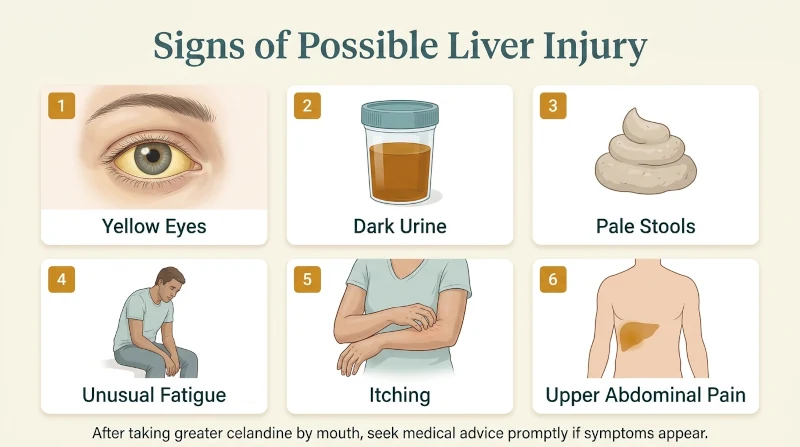
The case reports describe a fairly consistent picture EMA, 2011b:
- Yellowing of the skin or the whites of the eyes
- Dark urine, or pale, clay-colored stools
- Itching, unusual tiredness, loss of appetite, or nausea
- Pain or discomfort in the upper abdomen
Our guide to the best foods for the liver lists the wider set of liver warning signs and explains why “liver detox” herbs deserve skepticism.
Is celandine safe on the skin?
Putting sap on the skin avoids most of the liver concern, but not every risk. The published liver cases involve swallowing the herb. That is reassuring, not proof: no one has measured how much of the alkaloid load crosses the skin Nawrot et al., 2020.
Skin reactions do happen. A woman who used celandine on her warts developed allergic contact dermatitis, with intense itching, redness, and bumps that settled within days of stopping EMA, 2011b. Reviewers have also raised possible sun sensitivity, and report that in 2008 the Council of Europe judged the safety data too limited to allow celandine extract in cosmetics Nawrot et al., 2020.
If you still choose to try it, these steps reduce the risk without removing it:
- Be certain of the plant’s identity before you cut it.
- Apply only to the wart itself, on unbroken skin, and wash your hands afterward.
- Never use it on the face, genitals, broken or irritated skin, or anywhere near the eyes.
- Keep treated skin out of strong sun.
- Stop at the first sign of blistering, spreading redness, or a rash.
- Do not use it on children without asking a clinician first.
- If nothing has changed after a few weeks, stop and switch to a tested treatment.
Who should not use celandine at all
- Anyone thinking of swallowing it, in any form or amount.
- Pregnant or breastfeeding people. German rules list it as contraindicated, and the EMA advises against use in pregnancy EMA, 2011b.
- Children. Fatal poisonings have been described in children who ate the plant EMA, 2011b. Keep it out of reach in the garden.
- Anyone with current or past liver disease, or who drinks heavily.
- Anyone taking medicines or supplements that can stress the liver. Your pharmacist can tell you which of yours do EMA, 2011b.
Side effects and drug interactions
Taken by mouth, the serious risk is liver injury; large amounts can also irritate the gut EMA, 2011b. On the skin, expect possible irritation and, less often, allergic dermatitis.
On interactions, the evidence is genuinely mixed. There are no formal interaction studies. Many of the reported liver cases involved people taking other medicines or herbs at the same time, and investigators have suggested interactions may contribute; yet a German post-marketing survey of 608 patients found no interactions EMA, 2011b. Given that uncertainty, Germany’s rule of thumb is the sensible one: don’t combine celandine with anything that can harm the liver.
Safer options for warts and stomach complaints
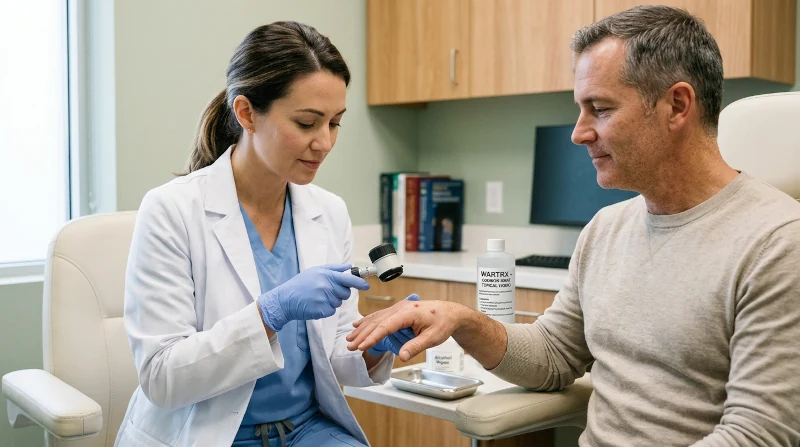
For warts, dermatologists note that most are harmless and many clear without treatment, though that can take months to years. Over-the-counter salicylic acid is a common at-home option, applied after soaking the wart and sometimes covered with tape or a bandage; a dermatologist can freeze stubborn warts AAD, 2025. Our guide to herbs for skin issues covers which plant remedies have real evidence and which to leave alone.
For indigestion or gallbladder-type pain, see a clinician before reaching for any herb, because the same symptoms can come from gallstones, an ulcer, or something else that needs treatment. Our gallbladder-friendly foods guide covers dietary approaches.
When to get medical help
Stop celandine and contact a doctor promptly if you took it by mouth and notice yellow skin or eyes, dark urine, pale stools, persistent nausea, unusual fatigue, itching, or pain under the right ribs. Bring the product, and say how much you took and for how long.
Get emergency care for confusion, vomiting blood, or severe abdominal pain. If a child swallows any part of the plant, call Poison Control at 1-800-222-1222 in the US, available 24/7 Poison Control, 2026.
See a dermatologist rather than self-treating if a wart is on your face or genitals; is changing, painful, itchy, or bleeding; if you have many warts or aren’t sure it is a wart; or if you have diabetes or a weakened immune system AAD, 2025.
| HEALTH DISCLAIMER: This article is for general education and is not medical advice, diagnosis, or treatment. Greater celandine can cause serious liver injury when taken by mouth; do not use it internally. Talk with a doctor or pharmacist before using any herbal product, especially if you are pregnant or breastfeeding, treating a child, taking prescription medicines, or have liver disease or another health condition. If you notice signs of liver trouble, stop the product and seek medical care. In a poisoning emergency in the US, call 1-800-222-1222; for a medical emergency, call 911. |
Frequently Asked Questions
Is celandine tea safe to drink?
No. Oral celandine products, including teas, have been linked to acute hepatitis, and European regulators judged the benefit-risk balance of oral use to be negative EMA, 2011a. There is no home dose shown to be safe.
Does celandine sap really remove warts?
It might, but nobody has shown it in a controlled trial. The support is folk tradition, lab studies, and a single published case Nawrot et al., 2020. Because many warts clear on their own, that isn’t enough to know whether the sap helps.
What is the difference between greater and lesser celandine?
They are unrelated plants that share a common name. Greater celandine (Chelidonium majus) is in the poppy family and bleeds orange latex; lesser celandine (Ficaria verna) is a different species NIH LiverTox. The liver reports involve greater celandine.
Can celandine harm my liver if I only put it on my skin?
The published liver cases involve swallowing it, so the risk from skin use appears much lower. It has not been measured, though, because skin absorption of celandine has never been studied Nawrot et al., 2020. Use it only on unbroken skin, and only briefly.
Why do some websites still recommend celandine for the liver?
Mostly tradition. Its yellow sap made it a historic jaundice remedy, and some animal studies suggest liver protection. Human case reports point the other way, and reviewers rate the risk-to-benefit balance as negative Pantano et al., 2017.
I’ve been taking a celandine product and feel fine. Should I worry?
Stop taking it. Liver injury can be silent early on, so if you used it for more than a few weeks, ask your doctor whether a liver blood test makes sense. German rules call for testing after four weeks of use EMA, 2011b.
References
- European Medicines Agency, Committee on Herbal Medicinal Products. Public statement on Chelidonium majus L., herba. → View source
- European Medicines Agency, Committee on Herbal Medicinal Products. Assessment report on Chelidonium majus L., herba. → View source
- National Institute of Diabetes and Digestive and Kidney Diseases. Greater Celandine. LiverTox: Clinical and Research Information on Drug-Induced Liver Injury. → View source
- Teschke R, Frenzel C, Glass X, Schulze J, Eickhoff A. Greater Celandine hepatotoxicity: a clinical review. Annals of Hepatology. → View source
- Pantano F, Mannocchi G, Marinelli E, et al. Hepatotoxicity induced by greater celandine (Chelidonium majus L.): → View source
- Zielińska S, Jezierska-Domaradzka A, Wójciak-Kosior M, Sowa I, Junka A, Matkowski AM. Greater Celandine’s Ups and Downs — 21 Centuries of Medicinal Uses of Chelidonium majus From the Viewpoint of Today’s Pharmacology. → View source
- Nawrot J, Wilk-Jędrusik M, Nawrot S, et al. Milky Sap of Greater Celandine (Chelidonium majus L.) and Anti-Viral Properties. International Journal of Environmental Research and Public Health. → View source
- Ernst E, Schmidt K. Ukrain – a new cancer cure? A systematic review of randomised clinical trials. BMC Cancer. → View source
- Rosien U. Iberogast® verursacht potenziell lebensbedrohliche Leberschäden: Endlich werden Warnhinweise … umgesetzt. → View source
- American Academy of Dermatology. Warts: Diagnosis and treatment. Last updated 8 May 2025. → View source
- Poison Control (National Capital Poison Center). → View source


