
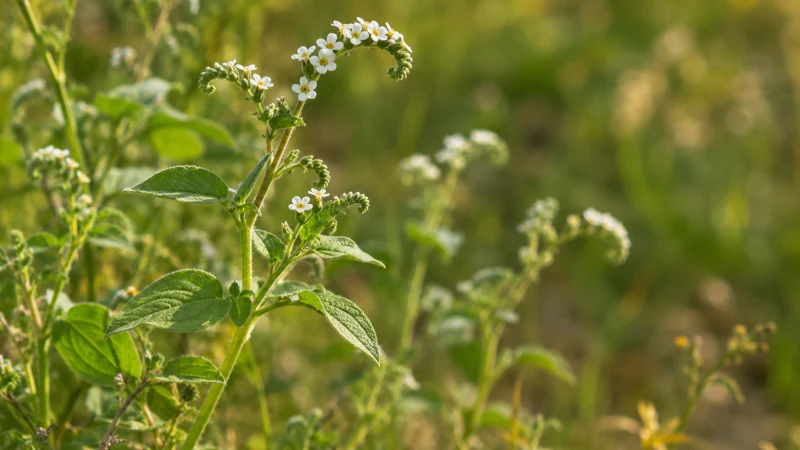
The heliotrope plant has been pressed onto warts for close to two thousand years, and the habit left its mark on the language: in Spanish, one of its names is verrucaria, the wart herb. What it hasn’t left behind is any human evidence that it works. European heliotrope (Heliotropium europaeum) also contains pyrrolizidine alkaloids, plant toxins that damage the liver, so heliotrope tea carries real risk.
If you came here with a wart or a slow-healing sore, you have better options, and they’re near the end of this article. First, what heliotrope actually is, and why toxicologists and veterinarians know it far better than herbalists do.
Heliotrope plant at a glance
| Fact | Detail |
| Botanical name | Heliotropium europaeum L. [Royal Botanic Gardens Kew, n.d.] |
| Common names | European heliotrope, heliotrope, turnsole, verrucaria [USDA ARS, n.d.] |
| Family | Boraginaceae (borage family) [Knight, 2008] |
| Native range | Macaronesia and Europe through the Mediterranean to India and the Arabian Peninsula; introduced in parts of the U.S., Australia and southern Africa [Royal Botanic Gardens Kew, n.d.] |
| Plant type | Annual herb [Royal Botanic Gardens Kew, n.d.] |
| Toxins | Pyrrolizidine alkaloids — heliotrine, lasiocarpine, europine and others are found in Heliotropium species [Knight, 2008] |
| Traditional uses | Warts, skin growths, fever, bile flow, bringing on menstruation [USDA ARS, n.d.] [Morales Valverde / Moleiro, n.d.] |
| Human clinical trials | None found for any traditional use |
| Safety status | Toxic if eaten; Kew records it as used both as a poison and a medicine [Royal Botanic Gardens Kew, n.d.] |
Three different things called heliotrope
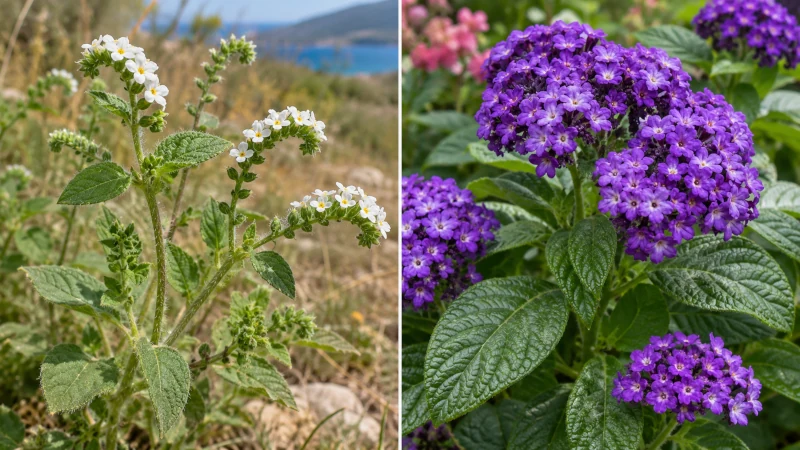
Most of the confusion online comes from one name covering three things.
European heliotrope (H. europaeum) is the plant in old herbals. It’s a small, hairy annual weed of fields and roadsides with tiny white flowers on curled sprays. The curl gave it another ancient name, scorpiuron, for the scorpion’s tail, and its habit of turning toward the sun gave it the Greek name heliotrope [Morales Valverde / Moleiro, n.d.].
Garden heliotrope (H. arborescens) is the purple, sweet-smelling bedding plant sometimes called cherry pie, and it’s the one usually meant by “Peruvian heliotrope.” It’s a separate species in the same genus, and veterinary references list it among the toxic heliotropes [Knight, 2008]. Claims that it can stand in for quinine or soothe bladder infections have no research behind them. A bladder infection needs a proper diagnosis, and fevers that once got quinine need real medical care.
Heliotropin is a perfume ingredient, not a plant. It’s piperonal, an aromatic aldehyde used in fragrance and flavoring. It was named after the cherry-pie note in heliotrope flowers, even though it isn’t part of the flower’s natural scent [Wikipedia, 2026]. Some herbal sources still describe heliotropin as the plant’s healing alkaloid. It isn’t: the alkaloids that matter in heliotrope are the toxic ones covered below.
Where the wart reputation comes from
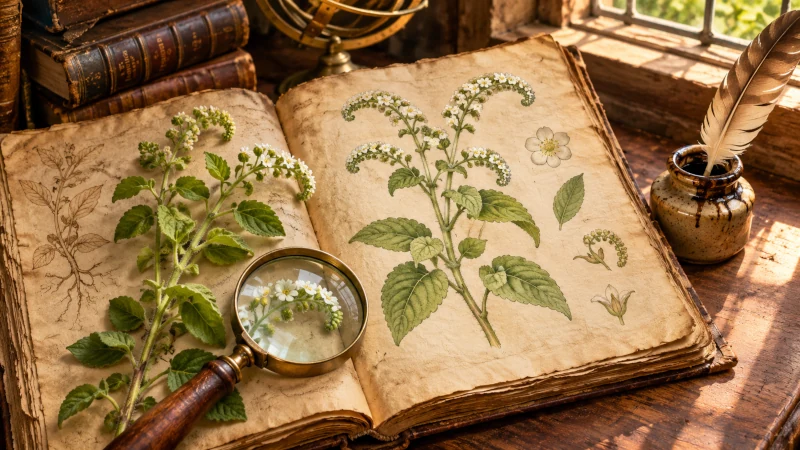
The story starts with Dioscorides, the first-century Greek physician whose De Materia Medica shaped European medicine for some 1,500 years. In a Renaissance edition of his text, heliotrope seed applied as a poultice is said to dry up warts and other skin growths [Morales Valverde / Moleiro, n.d.]. The same entry credits the plant with treating scorpion stings, ending recurring fevers, preventing conception, and bringing on menstruation and labor.
That last claim matters more than the wart one. A plant traditionally used to start periods and labor is a plant to keep well away from pregnancy.
Folk use carried on long after Dioscorides. The USDA’s Dr. Duke’s ethnobotany database records heliotrope used for warts in Belgium, for fever and bile flow in Turkey, and to bring on menstruation in Spain, Turkey and Iraq. The same record also files it under “poison” [USDA ARS, n.d.].
What the research shows
Almost nothing in people. A search of the published literature turns up no clinical trials of European heliotrope for warts, wounds, abscesses, ulcers, rashes or fever.
What exists is laboratory work. A 2025 study profiled the chemistry of H. europaeum extracts and tested them for antioxidant and enzyme activity in test tubes and computer models [Food Science & Nutrition, 2025]. Rat studies on a related species, Indian heliotrope (H. indicum), found that leaf extracts sped the healing of experimental wounds [Dash & Murthy, 2011]. Neither tells you whether a heliotrope compress clears a wart on a human hand, how strong it would need to be, or what it would do to your liver along the way.
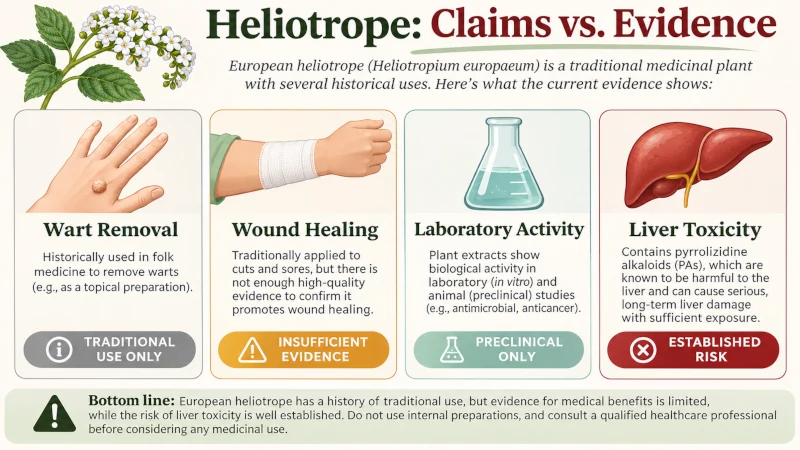
| Claim | What the evidence shows | Grade |
| Removes warts | Traditional use dating to Dioscorides; no human studies | Traditional only |
| Heals wounds, abscesses, varicose ulcers | Animal studies on a related species; none in people | Insufficient |
| Lowers fever / replaces quinine | Folk use; no clinical data | Insufficient |
| Antioxidant or antimicrobial activity | Test-tube and computer-model studies | Lab only |
| Damages the liver when eaten | Human outbreaks with closely related heliotropes, repeated livestock poisoning, and European regulatory risk assessments of its alkaloids | Strong |
Why heliotrope is a liver risk
How pyrrolizidine alkaloids injure the liver
Heliotropium species carry pyrrolizidine alkaloids, or PAs, with the young plants and seeds holding the most [Knight, 2008]. PAs aren’t especially harmful as swallowed. The liver converts them into reactive compounds that attack its own cells [Kakar et al., 2010], and liver enzymes including CYP3A4 drive that activation [Neuman et al., 2015].
The signature injury is sinusoidal obstruction syndrome, also called hepatic veno-occlusive disease. The tiny vessels that drain blood from the liver are damaged and clog. According to NIH’s LiverTox, it typically shows up as a swollen, tender liver, fluid collecting in the abdomen and weight gain, sometimes with jaundice, and steady low-dose exposure can produce a slower, quieter version [NIDDK LiverTox, 2019].
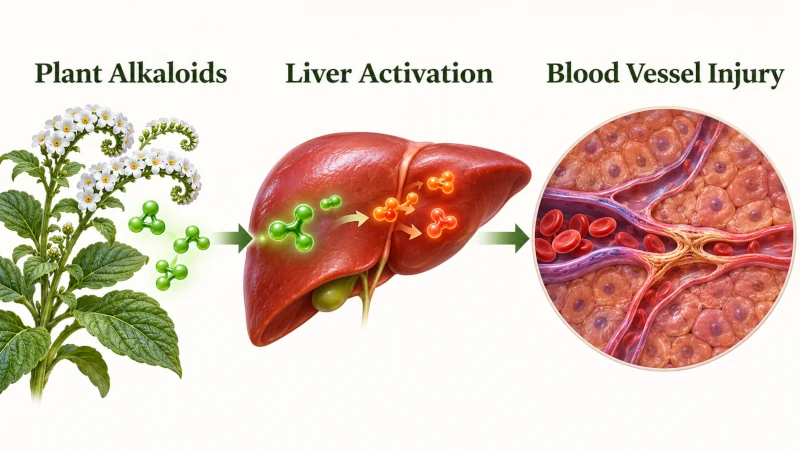
The damage adds up. In animals, repeated small doses accumulate in the liver, and by the time signs of liver failure appear the injury is usually severe and permanent [Knight, 2008].
European regulators take these compounds seriously. The European Food Safety Authority concluded that PAs in herbal teas and supplements are a possible long-term cancer concern, and that supplements made from PA-producing plants could cause short-term poisoning [EFSA, 2017]. The European Medicines Agency limits PAs in licensed herbal medicines to under 1 microgram a day for adults — one millionth of a gram [EMA, 2021] [EMA, 2024]. Nobody can measure, let alone control, the PA content of a homemade tea brewed from wild leaves.
When heliotrope seeds got into bread
The clearest human evidence comes from western Afghanistan. From 1974 to 1976, an outbreak of liver disease in Gulran district affected an estimated 7,800 people and killed about 1,600. It was traced to bread made from wheat contaminated with the seeds of a local heliotrope, Heliotropium popovii subsp. gillianum, whose main alkaloid was heliotrine [Kakar et al., 2010].
It happened again. In a 2008 outbreak, patients developed sudden, massive swelling of the abdomen from fluid, and people who most often ate bread on its own had about 36 times the odds of falling ill. Flour from affected homes contained heliotrine and lasiocarpine [Kakar et al., 2010].
That species isn’t European heliotrope. But heliotrine and lasiocarpine occur across the genus [Knight, 2008], and veterinary toxicology references describe human epidemics both from contaminated bread and from herbal medicines containing heliotrope alkaloids [Knight, 2008].
Livestock, pets and garden clippings
In Australia, European heliotrope is a familiar pasture weed and a known poison. New South Wales Local Land Services warns that it causes chronic liver damage in stock; cattle and horses are more sensitive, while sheep are affected more often because they’re likelier to eat it [NSW Local Land Services, 2026]. Heliotrope seeds mixed into feed have poisoned feedlot cattle [Hill et al., 1997], and alkaloids consistent with the plant turned up in wild wombats with liver disease in South Australia [Woolford et al., 2014]. The ASPCA lists heliotrope species as toxic to horses, causing liver disease after large or prolonged intake [ASPCA, n.d.].
If you grow garden heliotrope, enjoy it, but keep prunings away from horses and other livestock — veterinary guidance specifically flags clippings fed to animals [Knight, 2008].
Is heliotrope safer on the skin?
Probably safer than drinking it. But nobody has measured it for heliotrope, and the places it was traditionally used are the worst possible places to find out.
Intact skin is a fairly good barrier to PAs. In lab tests using human skin, only about 0.04% to 0.22% of a PA from a comfrey ointment passed through in 24 hours [Jedlinszki et al., 2017]. That was a controlled product on unbroken skin, from a different plant.
Comfrey is the best-studied PA herb, and Europe’s rules for it are strict. The EMA’s monograph allows licensed comfrey creams only on unbroken skin, for no more than 10 days, not for anyone under 18, and not during pregnancy or breastfeeding, with PAs kept below 1 microgram a day [EMA, 2024].
Now look at heliotrope’s traditional list: wounds, abscesses, weeping rashes, varicose ulcers. Every one is broken skin. A homemade heliotrope compress has an unknown alkaloid content and would go exactly where absorption is highest. That’s why you won’t find a recipe for one here.
Heliotrope tea: why there’s no safe dose
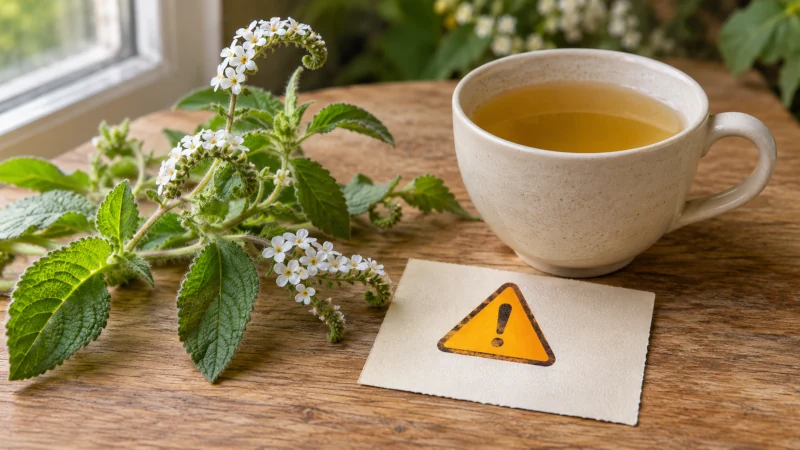
Some herbal guides still recommend drinking a heliotrope leaf infusion several times a day. Don’t. No safe oral dose has ever been established, the alkaloid content of wild plants varies with their age and parts [Knight, 2008], and the liver damage PAs cause can build silently before you feel anything [NIDDK LiverTox, 2019]. A safe-sounding cup a day is precisely the kind of repeated low-level exposure that causes trouble.
Safety: side effects, interactions and who should avoid it
Side effects
The main harm is liver injury, which may give no early warning. Symptoms, when they come, look like those in the warning-signs section below. On skin, there’s no reliable information on irritation or allergy; any redness, itching or blistering is a reason to stop and wash the area.
Medicine and herb interactions
No interaction studies exist for heliotrope. Because the liver activates PAs, anything else that strains the liver could, in theory, add to the risk: alcohol, medicines known to affect the liver, and other PA-containing herbs such as comfrey. Medicines that ramp up CYP3A4 activity could theoretically increase production of the toxic metabolites [Neuman et al., 2015]. If you take regular medication and have used heliotrope, tell your doctor or pharmacist.
Pregnancy and breastfeeding
Avoid heliotrope completely. Lasiocarpine, one of the alkaloids found in heliotropes, caused liver damage in unborn rats when given during pregnancy, and the EMA doesn’t recommend even topical comfrey during pregnancy or breastfeeding for lack of safety data [EMA, 2024]. Add the plant’s traditional use for bringing on menstruation and labor [Morales Valverde / Moleiro, n.d.], and there’s no reason to take the chance.
Who should avoid heliotrope
- Everyone, by mouth — as tea, tincture, capsule or fresh leaf.
- Anyone pregnant, trying to conceive or breastfeeding.
- Children and teenagers; the EMA hasn’t established even topical comfrey use under 18 [EMA, 2024].
- Anyone with liver disease, heavy alcohol use, or on medicines that affect the liver.
- Anyone thinking of putting it on broken skin, wounds, ulcers or weeping rashes.
- Horses and livestock — keep them out of infested pasture and away from garden clippings [NSW Local Land Services, 2026] [Knight, 2008].
Warning signs: when to get medical help
| If someone has swallowed heliotrope — especially a child — or has been drinking heliotrope tea, call Poison Help at 1-800-222-1222 (U.S.) now, even if they feel fine [HRSA Poison Help, n.d.]. If they’re unconscious or struggling to breathe, call 911. Get urgent medical care for any of these after heliotrope use: A belly that is swelling or tight, or sudden unexplained weight gainPain or tenderness under the right ribsYellowing of the skin or the whites of the eyesUnusual tiredness, nausea, or loss of appetite that doesn’t pass These can develop over weeks of repeated use rather than right away [NIDDK LiverTox, 2019] [Kakar et al., 2010]. For a broader list of liver warning signs, see our guide to foods that support liver health and the symptoms that need a doctor. |
Better options for warts and minor wounds
For one or a few small warts, the American Academy of Dermatology recommends three at-home treatments: over-the-counter salicylic acid, which slowly peels the wart away; silver duct tape, alone or over salicylic acid; and at-home freezing products [AAD, 2025]. Soften the wart in warm water first, file it gently with a disposable emery board you use for nothing else, and wash your hands after touching it.
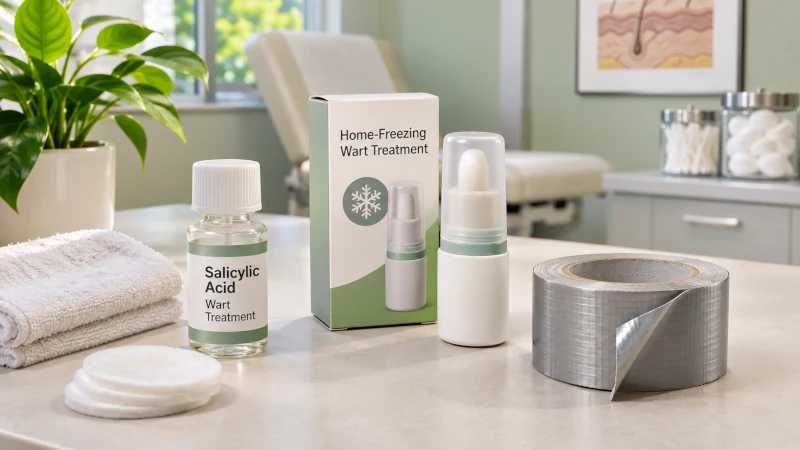
The AAD says to see a dermatologist instead if you have warts on your face or genitals, many warts, or a wart that changes, hurts, itches, burns or bleeds; if you aren’t sure it’s a wart; if home treatment hasn’t worked; or if you have diabetes or a weakened immune system. People with diabetes, poor circulation or numbness in the area should check with a dermatologist before using salicylic acid [AAD, 2025].
If you’re drawn to plant remedies, it helps to know where heliotrope sits among them. Houseleek, another old wart plant, has a gentler safety profile but similarly thin evidence. For scrapes and minor skin irritation, calendula has the strongest case of the traditional skin herbs, with European regulators accepting its use on the basis of long tradition. And our evidence-graded guide to herbs for skin issues sorts the useful plants from the ones on old herbal lists that you should leave alone.
| HEALTH DISCLAIMER: This article is for general information and education. It is not medical advice and is not a substitute for diagnosis or treatment from a qualified healthcare professional. European heliotrope and related heliotropes contain pyrrolizidine alkaloids that can cause serious liver damage; do not take any part of the plant by mouth or apply it to broken skin. Talk to your doctor or pharmacist before using any herbal remedy, especially if you are pregnant or breastfeeding, treating a child, taking prescription medicines, or living with liver disease or another long-term condition. If you think someone has swallowed heliotrope, call Poison Help at 1-800-222-1222 (U.S.). For a medical emergency, call 911. |
Frequently Asked Questions
Is the heliotrope plant poisonous?
Yes, if eaten. European heliotrope contains pyrrolizidine alkaloids that the liver turns into compounds that damage it, and the harm builds with repeated exposure [Knight, 2008] [Kakar et al., 2010]. Brief handling while gardening isn’t the main concern; eating it, drinking it as tea, or putting it on broken skin is.
Does heliotrope really remove warts?
There’s no human evidence that it does. The idea goes back to Dioscorides [Morales Valverde / Moleiro, n.d.], but no clinical trial has tested it. Salicylic acid, duct tape and at-home freezing products are the at-home treatments dermatologists recommend [AAD, 2025].
Is garden heliotrope safe to grow?
Yes, as an ornamental, with sensible precautions. Garden heliotrope (H. arborescens) is listed among the toxic heliotropes [Knight, 2008], so keep children from eating it and keep clippings away from horses and other livestock [ASPCA, n.d.] [Knight, 2008].
Is heliotropin in perfume the same thing as the toxin in the plant?
No. Heliotropin is piperonal, an aromatic aldehyde used in fragrance and flavoring [Wikipedia, 2026]. The plant’s dangerous compounds are pyrrolizidine alkaloids, a different class of chemical.
What is Peruvian heliotrope used for?
Mostly as a fragrant garden plant. Claims that it can replace quinine for fever or treat bladder inflammation don’t have research behind them, and the species belongs to a genus whose members contain toxic alkaloids [Knight, 2008]. A fever or a suspected bladder infection needs a medical diagnosis.
Is heliotrope dangerous to pets and livestock?
Livestock are the best-documented victims. Heliotrope poisoning causes chronic liver damage in cattle, sheep and horses [NSW Local Land Services, 2026], and the ASPCA lists heliotrope as toxic to horses [ASPCA, n.d.]. If you think a pet or animal has eaten it, call your veterinarian or the ASPCA Animal Poison Control Center at (888) 426-4435 [ASPCA, n.d.].
References
- ASPCA. Heliotrope — Toxic and Non-toxic Plants. ASPCA Animal Poison Control Center, n.d. View source
- American Academy of Dermatology. Warts: Dermatologists’ tips for at-home treatment. View source
- Dash GK, Murthy PN. Studies on wound healing activity of Heliotropium indicum Linn. leaves on rats. View source
- European Food Safety Authority. Pyrrolizidine alkaloids in tea, herbal infusions and food supplements View source
- European Medicines Agency, HMPC. Public statement on the use of herbal medicinal products containing toxic, View source
- European Medicines Agency, HMPC. European Union herbal monograph on Symphytum officinale L., radix. View source
- Food Science & Nutrition. Mapping the chemodiversity, View source
- Health Resources and Services Administration. The Poison Help Line (1-800-222-1222). View source
- Hill BD, Gaul KL, Noble JW. Poisoning of feedlot cattle by seeds of Heliotropium europaeum. View source
- Jedlinszki N, Balázs B, Csányi E, Csupor D. Penetration of lycopsamine from a comfrey ointment through human epidermis. View source
- Kakar F, Akbarian Z, Leslie T, et al. An outbreak of hepatic veno-occlusive disease in Western Afghanistan associated with exposure to wheat flour contaminated with pyrrolizidine alkaloids. View source
- Knight A. Heliotropium species: Heliotrope. In: Guide to Poisonous House and Garden Plants. View source
- Morales Valverde R (Real Jardín Botánico de Madrid), commentary; View source
- National Institute of Diabetes and Digestive and Kidney Diseases. Sinusoidal Obstruction Syndrome (Veno-occlusive Disease). View source
- Neuman MG, Cohen L, Opris M, Nanau RM, Jeong H. Hepatotoxicity of pyrrolizidine alkaloids. View source
- NSW Government, Local Land Services. Plants poisonous to livestock. View source
- Royal Botanic Gardens, Kew. Heliotropium europaeum L. Plants of the World Online, View source
- U.S. Department of Agriculture, ARS. Ethnobotanical Plant: Heliotropium europaeum. View source
- Wikipedia. Piperonal. View source
- Woolford L, Fletcher MT, Boardman WSJ. Suspected pyrrolizidine alkaloid hepatotoxicosis in wild southern hairy-nosed wombats (Lasiorhinus latifrons). View source


