
The cat’s foot plant is a small, woolly mountain wildflower with a long history in European folk medicine, mostly as a tea for coughs, sore throats, and sluggish digestion. Here is the honest answer up front: there are no human studies showing that cat’s foot helps any health condition, and no safe or effective dose has been established [WebMD cat’s foot overview]. What does exist is generations of traditional use and a handful of lab studies on what the flowers contain.
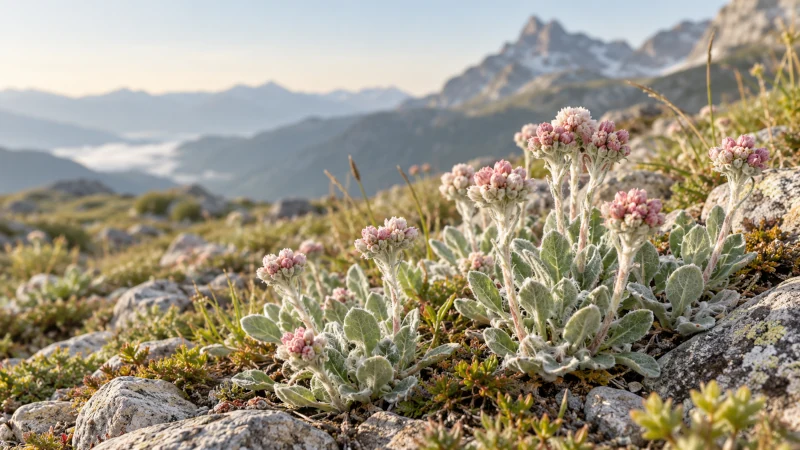
That doesn’t make the plant dangerous or useless. It means you should know exactly what you’re getting — a traditional herb with interesting chemistry and almost no testing in people — before you brew a cup.
What is the cat’s foot plant?
Cat’s foot (Antennaria dioica) is a low, creeping perennial in the daisy family, Asteraceae. You’ll also see it called mountain everlasting, cat’s ear flower, pied de chat in French, and pie de gato in Spanish [RxList cat’s foot monograph]. The name comes from the soft, rounded flower clusters, which look a bit like the pads of a cat’s paw.
The plant has separate male and female plants. Its stems and the undersides of its leaves are covered in dense white wool, the flower heads range from pale to deep pink, and female heads are roughly twice as wide as male ones — about 12 mm versus 6 mm [BSBI species account, 2017]. It spreads through creeping stems that root as they go, forming low patches in dry grassland, heath, and rocky mountain slopes.
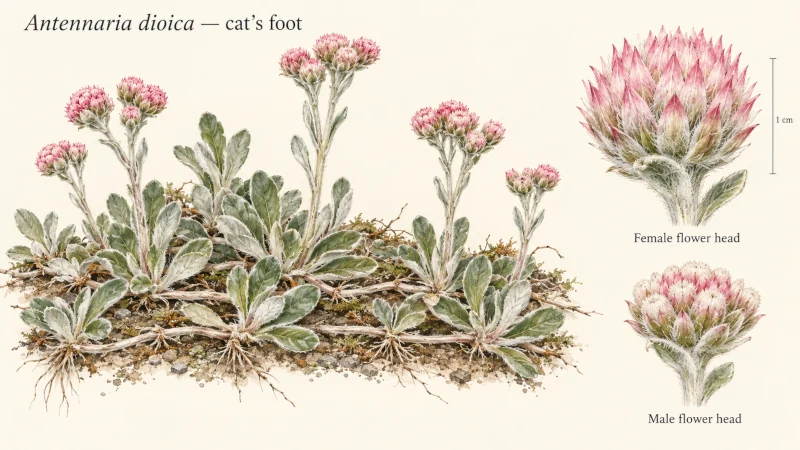
Cat’s foot grows across temperate and arctic Europe and Asia. In North America it is confined to Alaska’s western Aleutian Islands [BSBI species account, 2017], so a similar-looking woolly plant in the lower 48 states is likely a different species.
| Quick facts | |
| Scientific name | Antennaria dioica |
| Plant family | Asteraceae (daisy family) |
| Other names | Mountain everlasting, cat’s ear flower, pied de chat, pie de gato |
| Where it grows | Temperate and arctic Europe and Asia; in North America, only Alaska’s western Aleutians |
| Part used | Fresh or dried flower heads |
| Human studies | None |
Don’t confuse it with these
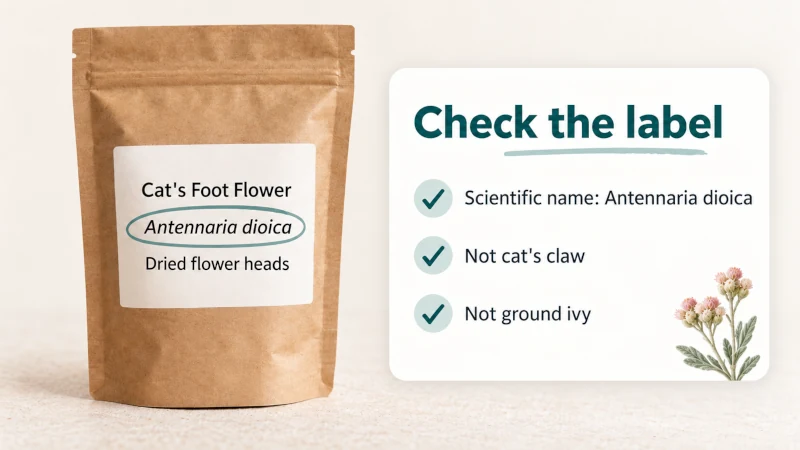
Two very different plants share the name. Cat’s claw is an unrelated herb, and cudweed is not the same plant either [WebMD cat’s foot overview]. Ground ivy is also sometimes sold as “cat’s foot” [RxList cat’s foot monograph]. If you buy a product, check that the label names Antennaria dioica.
How cat’s foot has traditionally been used
In European folk medicine, cat’s foot has been used for biliary (gallbladder and bile-flow) complaints and respiratory ailments, and as an astringent and a remedy to help stop bleeding [Zheleva-Dimitrova et al., Food Science & Nutrition, 2026]. Romanian traditional medicine also valued the flowers as a diuretic and anti-inflammatory [Babotă et al., Molecules, 2018]. Today, people mostly take it for stomach and intestinal complaints and for water retention [RxList cat’s foot monograph].
Traditional use tells you what people hoped a plant would do, and that they kept reaching for it. It can’t tell you whether a cup of tea did more than rest, fluids, and time. That takes studies in people, and for cat’s foot those haven’t been done.
What the research on cat’s foot actually shows
What’s in the flowers
The flowers are rich in plant polyphenols. A 2018 study of Romanian cat’s foot found chlorogenic acid as the main compound in its ethanol-water extract, along with flavonoids such as quercitrin, kaempferol, luteolin, and apigenin, and plant sterols including beta-sitosterol [Babotă et al., Molecules, 2018]. A more detailed 2026 analysis of the above-ground parts catalogued 130 compounds, many of them caffeic-acid derivatives and flavonoids [Zheleva-Dimitrova et al., Food Science & Nutrition, 2026].
These are common, well-studied compound families. Finding them in a plant is a reason to study it further, not evidence that the plant treats anything.
What lab studies found
- Antioxidant activity. Extracts neutralized free radicals in test-tube assays [Babotă et al., Molecules, 2018]. Test-tube antioxidant scores say little about what happens in your body.
- Antibacterial and antifungal activity. The strongest cat’s foot extract slowed the growth of Staphylococcus aureus and E. coli, but only at concentrations roughly 65 to 260 times higher than the comparison antibiotic, streptomycin. The researchers themselves described the antimicrobial results as modest [Babotă et al., Molecules, 2018].
- Enzyme effects. A concentrated methanol extract blocked starch-digesting enzymes and cholinesterases (the enzymes some dementia drugs target) in lab assays, and computer modeling flagged a few compounds worth a closer look [Zheleva-Dimitrova et al., Food Science & Nutrition, 2026]. That extract is not a tea, and none of it was tested in animals or people.
- Animal work. Some animal experiments suggest cat’s foot might ease intestinal spasms and increase bile flow, but there isn’t enough information to know whether that applies to people [RxList cat’s foot monograph].
What hasn’t been studied
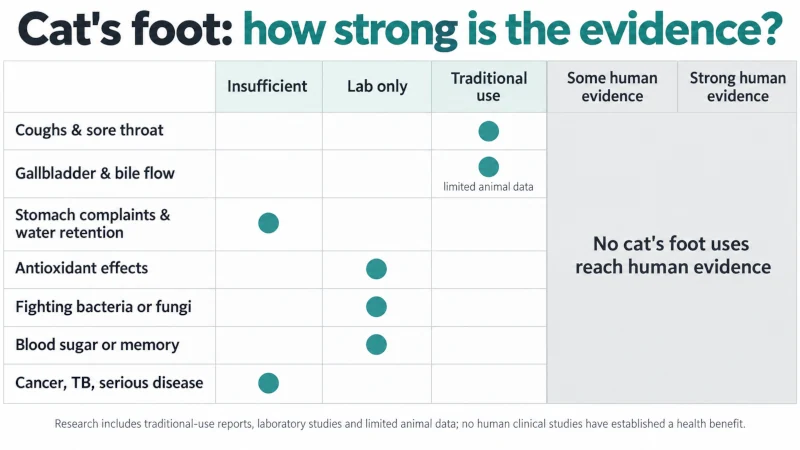
Anything in people. WebMD and RxList, whose herb monographs draw on the Natural Medicines database, rate the evidence as insufficient for every use and say there’s no good scientific evidence to support any of them [WebMD cat’s foot overview].
| Claimed use | What the evidence shows | Evidence grade |
| Coughs, sore throat, chest congestion | Traditional use only; no human studies | Traditional use |
| Gallbladder and bile flow | Traditional use; limited animal data suggesting more bile flow | Traditional use, early animal data |
| Stomach and intestinal complaints, water retention | No reliable human evidence | Insufficient |
| Antioxidant “protection” | Test-tube assays only | Lab only |
| Fighting bacteria or fungi | Modest activity, only at high concentrations in lab dishes | Lab only |
| Blood sugar or memory | Enzyme assays and computer modeling only | Lab only |
| Cancer, tuberculosis, or any serious disease | No supporting evidence | Insufficient |
Cat’s foot for coughs and sore throats
This is the plant’s best-known traditional job, and it’s the one where you have the most alternatives. For a scratchy throat or a lingering cough, several options have far more evidence behind them than cat’s foot does. Our evidence-rated guide to herbs for the lungs and cough relief walks through honey, thyme, and others, and our guide to great mullein for sore throat and dry cough covers a soothing herb with official traditional-use recognition in the EU.
If you still like the idea of a cat’s foot tea for a mild cold, the realistic expectation is comfort from something warm, not treatment. A cough that brings red-flag symptoms needs a doctor, not a different tea (see below).
Cat’s foot and the gallbladder
Herbalists have long classed cat’s foot as a cholagogue, a plant thought to help the gallbladder empty bile. The only support for that is traditional use and limited animal work [RxList cat’s foot monograph].
That traditional action is exactly why people with gallstones should be careful. Our guide to herbs for the gallbladder and liver explains why pushing bile through a blocked duct is the wrong move, and which gallbladder herbs have actual human trials. Cat’s foot has never been tested for safety in people with gallbladder disease.
How cat’s foot tea is used, and why there’s no set dose
Traditionally, the dried flower heads are steeped in hot water as a tea, and the same tea is sometimes used as a gargle and spit out. You’ll find specific gram amounts in older herbal books, but those numbers don’t come from clinical studies. There isn’t enough reliable information to know what an appropriate dose is [WebMD cat’s foot overview].
If you decide to try it anyway:
- Talk with a pharmacist first if you take any prescription medicine.
- Buy from a seller that names the plant as Antennaria dioica, to avoid mix-ups with ground ivy or cat’s claw.
- Keep it occasional and short-term.
- Stop and contact your doctor if you notice a rash, itching, swelling, or stomach upset [NCCIH on using supplements wisely, 2019].
Don’t pick it in the wild. Cat’s foot has declined seriously across much of Europe, is threatened in several countries, and has disappeared entirely from Belgium and Luxembourg [BSBI species account, 2017]. In the US outside Alaska’s Aleutians, a wild look-alike is probably a different plant.
Side effects, allergies, and who should avoid cat’s foot
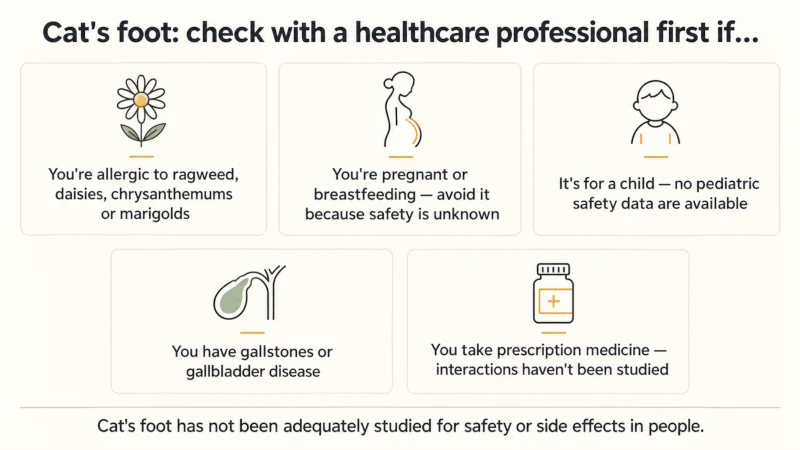
The plain truth is that no one knows how safe cat’s foot is by mouth or what its side effects are, because it hasn’t been studied [WebMD cat’s foot overview]. “Unknown” is not the same as “safe.” These groups should skip it or check with a doctor first:
| If this is you | What to know |
| Allergic to ragweed, daisies, chrysanthemums, or marigolds | Cat’s foot belongs to the same plant family and may cause an allergic reaction [RxList cat’s foot monograph] |
| Pregnant or breastfeeding | There’s no reliable safety information; avoid it [WebMD cat’s foot overview] |
| Giving it to a child | Many herbal supplements have never been tested in children [NCCIH on using supplements wisely, 2019]; cat’s foot has no pediatric data at all |
| Living with gallstones or gallbladder disease | Talk to your doctor first; herbs used to move bile are a poor fit for a blocked duct |
| Taking prescription medicine | No interaction studies exist, which means interactions are unknown, not ruled out. Supplements can interact with medicines, so tell your doctor and pharmacist, especially before surgery [NCCIH on using supplements wisely, 2019] |
One more thing to keep in mind: the FDA does not review herbal supplements for safety or effectiveness before they’re sold [NCCIH on using supplements wisely, 2019]. What’s in the bag depends on the seller.
When to see a doctor instead
Skip the tea and get help when symptoms point to something more than a minor cold or an off day for your stomach.
Call 911 for:
- Shortness of breath or trouble breathing
- Hives, or a swollen face or throat with difficulty swallowing — which can also signal a serious allergic reaction to an herb [MedlinePlus on cough, 2025]
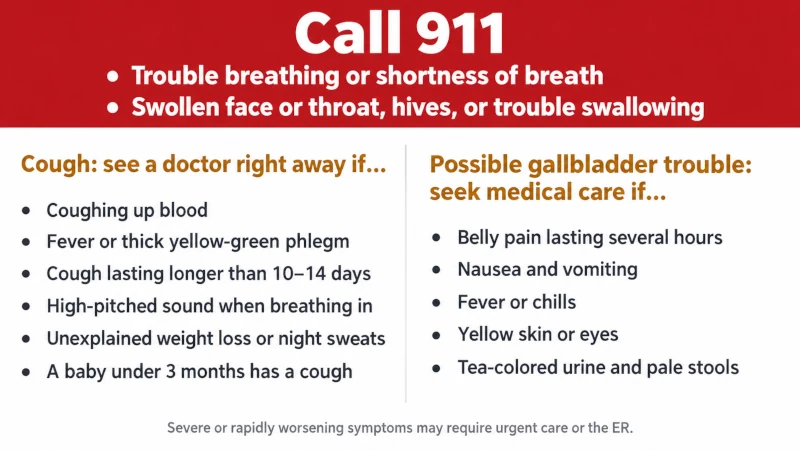
Contact your doctor right away if you have a cough and:
- You’re coughing up blood
- You have a fever, or thick, foul-smelling, yellow-green phlegm
- The cough has lasted longer than 10 to 14 days
- You hear a high-pitched sound when breathing in
- You’re losing weight without trying or having night sweats
- The person coughing is a baby younger than 3 months [MedlinePlus on cough, 2025]
See a doctor right away — or go to urgent care or the ER if it’s severe — for possible gallbladder trouble:
- Belly pain lasting several hours
- Nausea and vomiting
- Fever, even a low one, or chills
- Yellowing of the skin or the whites of the eyes
- Tea-colored urine and light-colored stools [NIDDK on gallstone symptoms]
| Health disclaimer: This article is for general education. It isn’t medical advice, and it isn’t a recommendation to use cat’s foot for any condition. Cat’s foot has not been studied in people, and its safety, side effects, and drug interactions are unknown. Talk with your doctor or pharmacist before using any herbal remedy, especially if you’re pregnant or breastfeeding, caring for a child, taking prescription medicine, allergic to daisy-family plants, or living with gallbladder or lung disease. Call 911 for trouble breathing, swelling of the face or throat, or severe symptoms. |
Frequently Asked Questions
Is cat’s foot the same as cat’s claw?
No. Cat’s claw is a completely different plant with its own uses and risks [WebMD cat’s foot overview]. Ground ivy is sometimes sold as “cat’s foot” too, so look for Antennaria dioica on the label.
Is cat’s foot tea safe to drink?
Nobody knows yet. There isn’t enough reliable information on its safety or side effects [WebMD cat’s foot overview]. Avoid it if you’re pregnant, breastfeeding, or allergic to ragweed or daisies, and check with a pharmacist if you take medication.
Does cat’s foot help a cough?
It has a long traditional reputation for coughs and sore throats, but it has never been tested for them in people. Honey, thyme, and mullein all have more evidence behind them.
Does cat’s foot help the gallbladder?
It’s traditionally used to promote bile flow, and a few animal experiments point the same way [RxList cat’s foot monograph]. There’s no human evidence. If you have gallstones or gallbladder symptoms, see a doctor rather than trying an herb.
Can I pick cat’s foot in the wild?
It’s better not to. The plant has declined sharply in Europe and is threatened in several countries [BSBI species account, 2017]. In the US it grows wild only in Alaska’s western Aleutians, so a woolly look-alike elsewhere is likely a different species.
References
- WebMD. “Cat’s Foot: Overview, Uses, Side Effects, Precautions, Interactions, Dosing and Reviews.” Licensed from Therapeutic Research Center (Natural Medicines). View source
- RxList. “Cat’s Foot: Health Benefits, Side Effects, Uses, Dose & Precautions.” View source
- Zheleva-Dimitrova D, Zengin G, Lessigiarska I, Tsakovska I, Nikolova-Kejova R, Zheleva-Kyuchukova I, Momekov G, Gevrenova R. “Antennaria dioica (L.) Gaertn. (Asteraceae): From Metabolite Profiling to Comprehensive Evaluation of In Vitro and In Silico Enzyme Inhibitory Activity.” Food Science & Nutrition, 2026;14(5):e71854. DOI: 10.1002/fsn3.71854. PMID 42136793; PMCID PMC13169136. View source
- Babotă M, Mocan A, Vlase L, Crișan O, Ielciu I, Gheldiu AM, Vodnar DC, Crișan G, Păltinean R. “Phytochemical Analysis, Antioxidant and Antimicrobial Activities of Helichrysum arenarium (L.) Moench. and Antennaria dioica (L.) Gaertn. Flowers.” Molecules, 2018;23(2):409. DOI: 10.3390/molecules23020409. View source
- Walker KJ. “Species account: Antennaria dioica (L.) Gaertn., Mountain Everlasting.” Botanical Society of Britain and Ireland, published December 15, 2017. View source
- National Center for Complementary and Integrative Health. “Using Dietary Supplements Wisely.” NIH/NCCIH, last updated January 2019. View source
- MedlinePlus Medical Encyclopedia. “Cough.” National Library of Medicine, review date April 1, 2025. View source
- National Institute of Diabetes and Digestive and Kidney Diseases. “Symptoms & Causes of Gallstones.” NIDDK, View source


