Great mullein (Verbascum thapsus) is one of the oldest respiratory herbs still in regular use. In the European Union, a standardized mullein flower extract has official recognition as a traditional herbal medicine for sore throat with dry cough and colds — not because it’s been proven in large clinical trials, but because centuries of documented use meet the EU’s traditional-use bar.

That’s a useful way to think about great mullein generally: it has real, defensible uses, but they sit closer to “soothing and traditionally supported” than “clinically proven cure.” This guide walks through what the plant is, what it’s used for, what the evidence actually shows for each use, and — just as importantly — who shouldn’t take it.
For how mullein compares with other respiratory herbs — eucalyptus, thyme, licorice root, and the rest — see our broader guide to herbs for the lungs.
What Is Great Mullein?
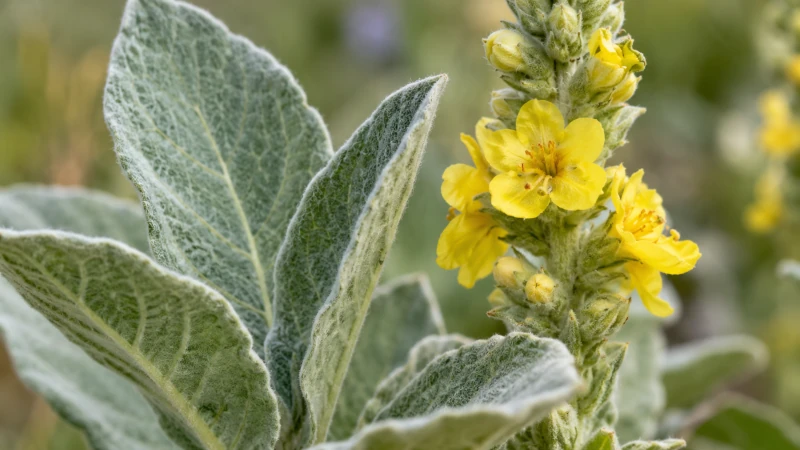
Great mullein is a biennial plant in the figwort family, native to Europe, North Africa, and western and central Asia, and now naturalized across North America. In its first year it grows a low rosette of thick, velvety, silver-green leaves; in its second year it sends up a flowering stalk that can reach 1.5 to 2 meters, topped with a dense spike of small yellow flowers.
The leaves and flowers are the parts used medicinally. You’ll also see the plant called Aaron’s rod, candlewick plant, flannel leaf, velvet plant, or, in Spanish-speaking regions, gordolobo — a name that shows up often on herbal-tea packaging. (rxlist.com/supplements/mullein.htm)
A Plant With a Long Medicinal History
Mullein’s use as a lung remedy goes back to classical antiquity — Dioscorides described it for chest complaints — and it has been a fixture of European and Native American herbal traditions since. The soft, hairy leaves were also used practically, as lamp wicks and, historically, as an improvised soft wrapping — hence some of its older folk names.
That long track record is exactly what the EU’s Committee on Herbal Medicinal Products relied on when it evaluated mullein flower: the monograph’s approved use — relief of sore throat associated with dry cough and cold — is explicitly a traditional-use indication, based on long-standing, documented experience rather than modern randomized trials. [European Medicines Agency, 2007]
What’s Actually in Great Mullein
The leaves and flowers contain mucilage — a gel-forming substance that coats and soothes irritated mucous membranes — along with saponins, flavonoids, iridoid glycosides, and phenylethanoid glycosides such as verbascoside. A 2022 review in Phytotherapy Research catalogued these compounds and the laboratory work behind mullein’s antioxidant, anti-inflammatory, antimicrobial, and antiviral activity.
It’s worth being precise about what that review does and doesn’t establish: it’s a summary of mostly lab and animal research, not a body of large human trials. [Gupta et al., Phytotherapy Research, 2022]
What Great Mullein Is Used For — and What the Evidence Shows
Soothing coughs, sore throat, and colds
This is mullein’s best-supported use. The mucilage coats irritated throat and airway tissue, which is why it’s traditionally taken as a tea for a dry, tickly cough or a sore throat. Cleveland Clinic notes that mullein acts as an expectorant, helping thin mucus so it’s easier to cough up, and that its mucilage content can calm airway inflammation during a cold or chest infection.
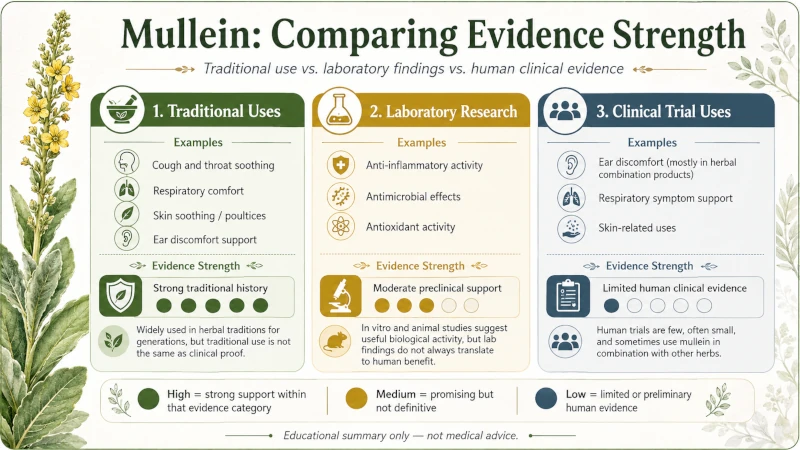
Evidence rating: Moderate for traditional use, officially recognized by EU regulators for this specific indication; supported by mechanistic and laboratory evidence rather than large human trials. [Cleveland Clinic, 2022] Mullein tea is sometimes paired with a diet adjustment during a chest cold or bronchitis — see our list of foods to eat when sick with bronchitis for what else may help while you recover.
Easing ear pain
Mullein oil is a long-standing folk remedy for earache, usually blended with garlic, calendula, and St. John’s wort. This combination has actually been tested: a randomized trial of 180 children with acute otitis media found that ear drops containing this herbal blend relieved pain about as well as a standard anesthetic ear-drop product over three days.
That’s a real, published result — but it tested a four-herb combination product for pain relief, not mullein alone, and not as a treatment for the underlying infection. RxList similarly rates a specific mullein-containing ear-drop product as “possibly safe” for short-term use, including in children, while noting the evidence doesn’t extend to treating the infection itself. [Sarrell, Cohen & Kahan, Pediatrics, 2003]; [RxList]
Evidence rating: Moderate for short-term pain relief as part of a combination ear-drop product; not evidence that mullein treats an ear infection, and not a substitute for medical evaluation of ear pain in a child.
Skin, burns, and hemorrhoids
Mullein-infused oils and leaf poultices have a long tradition of use for minor burns, chilblains, hemorrhoids, and irritated skin, based on the plant’s soothing, mildly anti-inflammatory mucilage content. Cleveland Clinic notes that salves and oils containing mullein can help relieve pain and irritation in minor skin wounds.
Evidence rating: Traditional use with a plausible mechanism; not backed by clinical trials for any of these specific skin conditions. [Cleveland Clinic, 2022]
Laboratory studies have found that mullein extracts can inhibit the growth of some bacteria, including strains linked to pneumonia and staph infections, and show activity against influenza and herpes simplex virus in test-tube studies. These are genuinely interesting mechanistic findings — they help explain why the plant has a long history of use against chest infections — but “active in a test tube” is a long way from “effective in a sick person,” and none of this has been confirmed in human clinical trials.
Evidence rating: Early-stage laboratory evidence only. [Cleveland Clinic, 2022]; [Gupta et al., 2022]
What great mullein doesn’t do
Mullein has not been shown to cure, prevent, or reverse asthma, COPD, bronchitis, pneumonia, or any other respiratory disease. If you have asthma or another diagnosed lung condition, mullein is not a substitute for prescribed medication, and any herbal addition should be discussed with the clinician managing your care first. If you’re building a broader diet-and-lifestyle approach around asthma, our guide to the 10 best foods for asthma covers what actually helps and what to avoid.
How Great Mullein Is Used
Mullein tea, made from the dried leaves and flowers, is the most traditional preparation. It’s also sold as a tincture, liquid extract, oil (mainly for ear or skin use), and capsule or powder form.
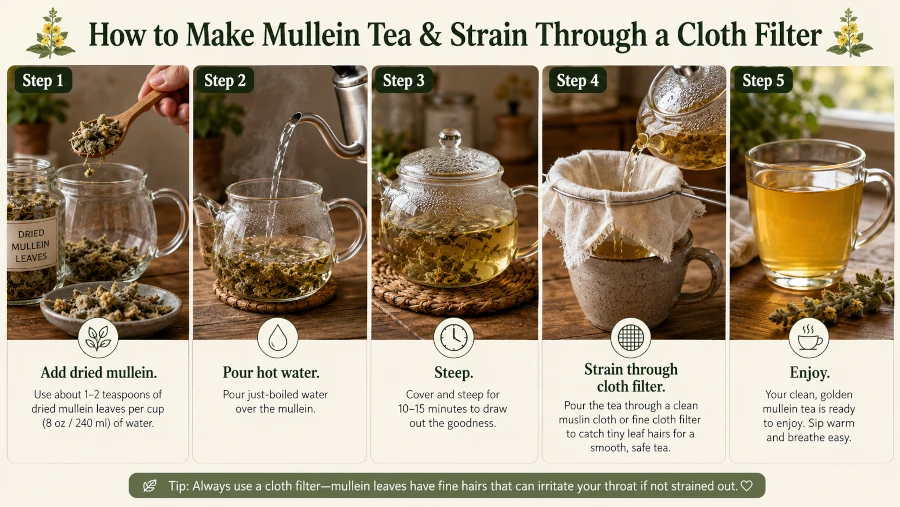
- Tea: steep 1–2 teaspoons of dried leaf and flower per cup of hot water for 10–15 minutes, then strain thoroughly through a cloth or fine filter — the tiny leaf hairs can irritate the throat if you don’t.
- Tincture and liquid extract: available as commercial products; follow the manufacturer’s label, since there’s no single agreed dose.
- Oil: typically made by infusing the flowers in a carrier oil, and used for ear or skin applications rather than taken by mouth.
On dosage, it’s more honest to say plainly: there is no established, agreed dose for mullein. RxList states directly that there isn’t enough scientific information to determine an appropriate dosage range, and recommends following the label on whatever product you’re using or the guidance of a pharmacist or healthcare provider. Older herbal references sometimes list precise gram or drop amounts, but those figures don’t trace back to a verifiable clinical source, so we’re not repeating them here. [RxList]
Safety, Side Effects, and Who Should Avoid It
Mullein has a good overall safety record — Cleveland Clinic notes there are no reports of serious toxic side effects from typical use — but “generally safe” isn’t the same as “safe for everyone.” A few groups need to be more careful:
| Group | What to know |
| Pregnant or breastfeeding | Avoid. There isn’t enough safety data, and both RxList and the EU’s official herbal monograph advise against use in pregnancy and lactation. |
| Children under 12 | The EU monograph limits the standardized mullein-flower product to adults and adolescents over 12. A short course of mullein-containing ear oil has been studied in children as young as 5–6 under medical guidance — that’s a different use case from giving a child mullein tea or capsules on your own. |
| People with plant allergies | Mullein has caused contact dermatitis in documented case reports. If you’re sensitive to related plants, patch-test before broader use. |
| Anyone with a perforated eardrum | Don’t put any oil-based ear preparation, mullein included, into the ear canal if the eardrum may be ruptured. |
| People on blood thinners, diabetes medication, or diuretics | Some references flag a theoretical interaction (mullein has been reported to contain coumarin-type compounds), but this isn’t well established in human studies. Mention any herbal use to your prescriber regardless. |
| Anyone gathering mullein themselves | Use only the leaves and flowers. The seeds contain rotenone, a compound that’s toxic if ingested in quantity, and commercial products shouldn’t contain them. |
Because mullein is an unregulated dietary supplement in the US, product quality and potency vary by brand. Choosing a product from a reputable manufacturer that discloses third-party testing is a reasonable safeguard, and it’s worth telling any healthcare provider you see that you’re using it, especially before surgery or if you take prescription medication.
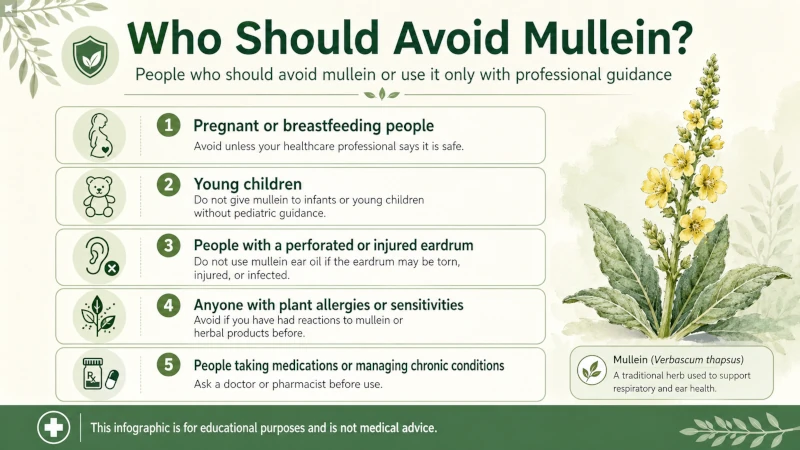
HEALTH DISCLAIMER: This article is for educational purposes only and isn’t a substitute for professional medical advice, diagnosis, or treatment. It isn’t a recommendation to use great mullein for any specific condition. Talk to a doctor, pharmacist, or qualified healthcare provider before using mullein or any herbal remedy — especially if you’re pregnant, breastfeeding, caring for a child, managing a chronic condition, or taking prescription medication. Seek prompt medical care for severe or worsening symptoms, including breathing difficulty, high fever, or an ear infection with intense pain or discharge.
Frequently Asked Questions
Is great mullein safe for children?
Not as a general home remedy without medical guidance. A specific mullein-containing ear-drop combination has been studied in children as young as 5–6 for short-term ear pain relief, but the standardized mullein flower product recognized in the EU is limited to adults and adolescents over 12. Talk to your pediatrician before giving a child mullein in any form.
Can I use mullein while pregnant or breastfeeding?
It’s best to avoid it. There isn’t enough safety data, and both RxList and the EU’s official herbal monograph recommend against use during pregnancy and breastfeeding.
Why do I need to strain mullein tea so carefully?
The leaves and flowers are covered in fine hairs that can irritate your throat if swallowed. Straining through a cloth or coffee filter removes them.
Does mullein oil actually work for ear infections?
A herbal combination containing mullein, garlic, calendula, and St. John’s wort performed about as well as anesthetic ear drops for pain relief in a controlled trial — but that’s evidence for short-term pain relief from a combination product, not proof that mullein treats the underlying infection. Never put ear drops of any kind into an ear with a possibly perforated eardrum, and see a doctor for ear pain in a young child.
Can mullein cure or treat asthma or bronchitis?
No. There’s no clinical evidence that mullein cures, prevents, or reverses asthma, bronchitis, or any other respiratory disease. It may offer soothing, traditional support for a cough or sore throat, but it isn’t a substitute for prescribed asthma or respiratory medication.
What’s the difference between great mullein and other “mullein” plants?
Several related Verbascum species — including orange mullein (V. phlomoides) and dense-flowered mullein (V. densiflorum) — are used interchangeably in herbal medicine and are, in fact, all accepted sources of the standardized “mullein flower” recognized in European pharmacopoeia standards. Great mullein (V. thapsus) is simply the most common and most studied of the group.
References
- Khan, S. (reviewer). “How Mullein Benefits Your Lungs.” Cleveland Clinic Health Essentials, Dec. 19, 2022. health.clevelandclinic.org/mullein-benefits
- Gupta, A., Atkinson, A.N., Pandey, A.K., & Bishayee, A. “Health-promoting and disease-mitigating potential of Verbascum thapsus L. (common mullein): A review.” Phytotherapy Research, 36(4), 1507–1522 (2022). DOI: 10.1002/ptr.7393 (PMID 35088467)
- Sarrell, E.M., Cohen, H.A., & Kahan, E. “Naturopathic Treatment for Ear Pain in Children.” Pediatrics, 111(5), e574–e579 (2003). DOI: 10.1542/peds.111.5.e574. pubmed.ncbi.nlm.nih.gov/12728112
- European Medicines Agency, Committee on Herbal Medicinal Products (HMPC). “Verbasci flos — herbal medicinal product.” ema.europa.eu/en/medicines/herbal/verbasci-flos
- RxList. “Mullein: Health Benefits, Side Effects, Uses, Dose & Precautions.” rxlist.com/supplements/mullein.htm
- “Simultaneous contact dermatitis caused by Asteraceae and Verbascum thapsus.” PubMed, PMID 28386973. pubmed.ncbi.nlm.nih.gov/28386973
