
Intermittent fasting means you eat during a set window and go without food the rest of the time, either for part of every day or on a couple of days each week. It changes when you eat, not what you eat. The most popular version, 16:8, has you fast for 16 hours and eat within eight, and most of those 16 hours pass while you’re asleep.

Here’s the honest summary before you start: for weight loss, intermittent fasting works about as well as ordinary calorie cutting. Not better. A 2026 Cochrane review of 22 randomized trials found little to no difference in weight loss between intermittent fasting and standard dietary advice [Garegnani et al., 2026]. That isn’t a reason to skip it. If a shorter eating window is what helps you eat less without feeling deprived, it’s a reasonable tool, as long as you’re someone it’s safe for.
How intermittent fasting works
After several hours without food, your body runs through the sugar it keeps on hand and starts burning more fat. Johns Hopkins neuroscientist Mark Mattson, who has studied fasting for about 25 years, calls this metabolic switching [Johns Hopkins Medicine, 2026]. The shift is real. What’s much less clear is whether it does anything for people that eating the same smaller amount of food on a normal schedule wouldn’t. The striking results, such as longer lifespans and protection against disease, come mostly from animal studies. Human trials have mostly lasted a few months [de Cabo & Mattson, 2019].
The 16:8 schedule reached a wide audience through Martin Berkhan’s Leangains blog, which described an overnight-and-morning fast followed by a roughly eight-hour eating window [Berkhan, 2010]. Researchers call the daily version time-restricted eating.
Intermittent fasting schedules compared
There’s no single plan. Here are the common ones, roughly from easiest to hardest:
| Schedule | How it works | Good fit for |
| 12:12 | Fast 12 hours overnight, e.g. 8 p.m. to 8 a.m. | A first step. Many people are already close. |
| 14:10 | Fast 14 hours, eat within 10 | Building toward 16:8, or a comfortable place to stay |
| 16:8 | Fast 16 hours, eat within 8, e.g. 11 a.m. to 7 p.m. | The best-known daily plan |
| 5:2 | Eat normally five days a week; eat very little or nothing on two days | People who’d rather have two hard days than a daily rule |
| Alternate-day | Alternate normal days with no-food days, or with days of about 25% of your usual calories | The most demanding. Best done with professional support. |
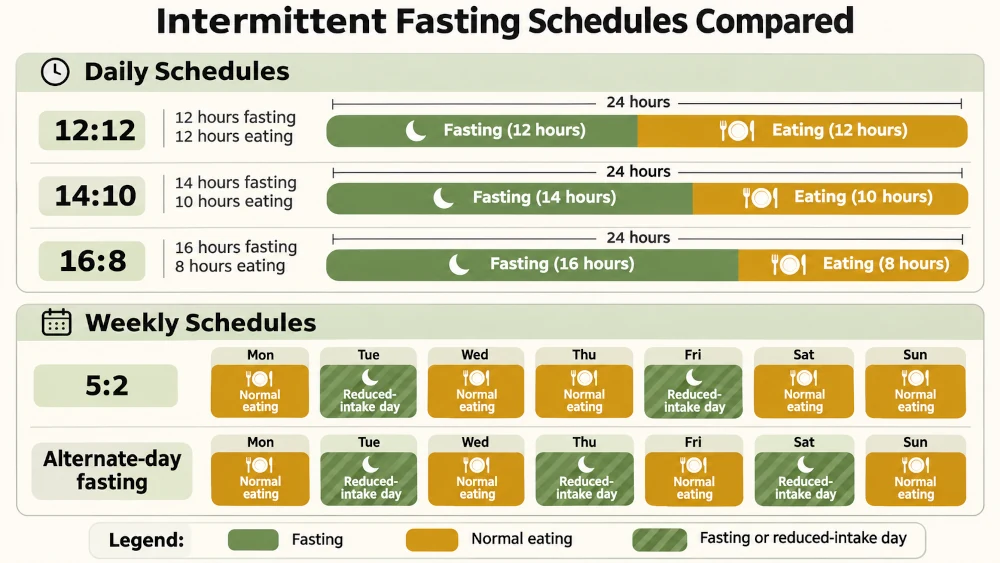
Schedule definitions follow Mayo Clinic [Mayo Clinic, 2025].
Some people eat earlier and fast through the evening; others skip breakfast and eat later. Both count [Mayo Clinic, 2025]. Choose the one that fits your work, family meals and sleep, because fit is what keeps you on it.
What intermittent fasting can and can’t do
Weight loss: about the same as cutting calories
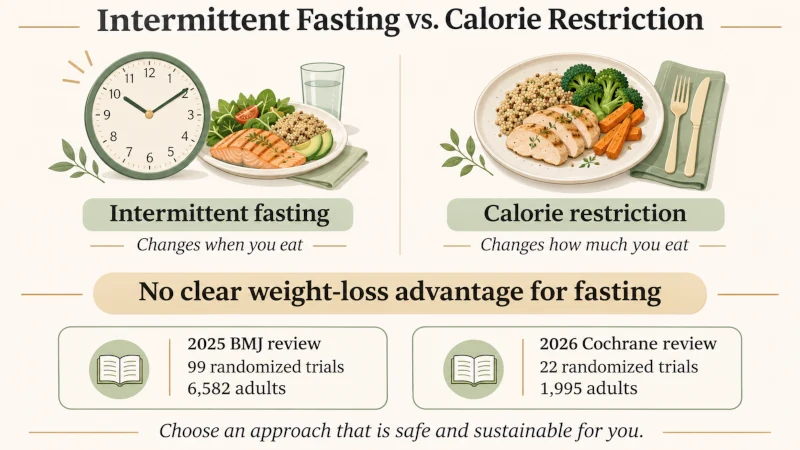
The two largest recent summaries of the research point the same way. A 2025 BMJ analysis pooled 99 randomized trials with 6,582 adults. Every fasting approach led to some weight loss compared with eating freely, but the effects were small. Daily time-restricted eating produced about 1.7 kg (3.8 lb), which the authors rated trivial. Alternate-day fasting beat standard calorie restriction by about 1.3 kg (2.9 lb). But in trials lasting 24 weeks or longer, no fasting method beat plain calorie restriction [Semnani-Azad et al., 2025]. The Cochrane review reached a similar conclusion, though it rated its certainty low to very low for most outcomes [Garegnani et al., 2026].
Two trials show why. In the TREAT study, 116 adults ate only between noon and 8 p.m. for 12 weeks, with no calorie targets. They lost no more weight than a group eating three regular meals a day [Lowe et al., 2020]. In a year-long trial in China, 139 adults with obesity all cut calories, and half also ate only between 8 a.m. and 4 p.m. The time-restricted group lost 8.0 kg (17.6 lb) versus 6.3 kg (13.9 lb), a difference that wasn’t statistically significant [Liu et al., 2022].
The practical lesson: the window helps only if it leads you to eat less. Treat it as a structure that makes eating less easier, not a metabolic shortcut.
Blood sugar and heart health: mixed
In people with type 2 diabetes, many studies show lower fasting insulin and less insulin resistance. Nutrition researcher Krista Varady, though, points out that most of these studies ran only two to three months with small groups [NIDDK, 2024]. Across the BMJ analysis, fasting made no difference to HbA1c, the long-term blood sugar marker, compared with other diets [Semnani-Azad et al., 2025].
Heart health is where the evidence is genuinely split. A 2025 analysis of U.S. survey data on nearly 20,000 adults found that people who ate all their food within less than eight hours a day had a higher rate of cardiovascular death over about eight years than people eating across 12 to 14 hours. It found no link with death from all causes.
The authors say they can’t tell whether the short window itself is responsible or whether people who eat that way differ in other ways, and eating windows were estimated from just two days of food recall [Diabetes Metab Syndr, 2025]. A second analysis of the same survey reported the lowest risk at an eating window of roughly 11 to 12 hours, with higher risk at both shorter and longer windows [Aging Cell, 2025].
These are observational studies, not proof that fasting harms the heart. They are a fair reason not to squeeze your eating window much below eight hours. For a fuller look at research on inflammation, brain health and aging, see our review of the health benefits of fasting.
Muscle loss
When you lose weight, some of what you lose is lean tissue. In TREAT, the 16:8 group lost significantly more muscle in the arms and legs than the regular-meals group: 0.64 kg versus 0.17 kg [Lowe et al., 2020]. Varady calls some lean-mass loss a natural result of weight loss but urges caution for older adults [NIDDK, 2024]. Strength training and a protein source at each meal are the sensible counterweights.
Who should not try intermittent fasting
Skip it, unless a doctor is supervising, if you:
- Are under 18 [Mayo Clinic, 2022].
- Are pregnant or breastfeeding [Mayo Clinic, 2022]. Varady notes there are no studies in pregnancy yet [NIDDK, 2024].
- Have a current or past eating disorder [Mayo Clinic, 2022]. In a survey of 2,762 Canadians aged 16 to 30, intermittent fasting was linked with eating disorder behaviors such as binge eating. A one-time survey can’t show which came first [Ganson et al., 2022].
- Are underweight or trying to gain weight. A plan built around eating less isn’t meant for you.
Talk to your doctor first if you:
- Have diabetes, especially if you take insulin or a sulfonylurea. Varady’s own trial didn’t find more low blood sugar episodes, but she stresses that people on these drugs need to work closely with their doctor to adjust doses [NIDDK, 2024]. Our diabetes and blood sugar resource center covers the basics.
- Are an older adult, because of the extra risk of muscle loss [NIDDK, 2024].
- Take a medication that has to be taken with food. Ask your pharmacist how to time it around your eating window.
- Have any other ongoing medical condition [Mayo Clinic, 2022].
- Train hard for a sport. Athletes can find it difficult to fuel and refuel on a fasting schedule [Mayo Clinic, 2022].
How to start intermittent fasting: eight steps
- Pick a schedule you can live with. For most beginners a daily window is easier than fasting whole days, because you never go a full day without food. Build it around your real life. If your family eats dinner at 7, a window that closes at 5 won’t last.
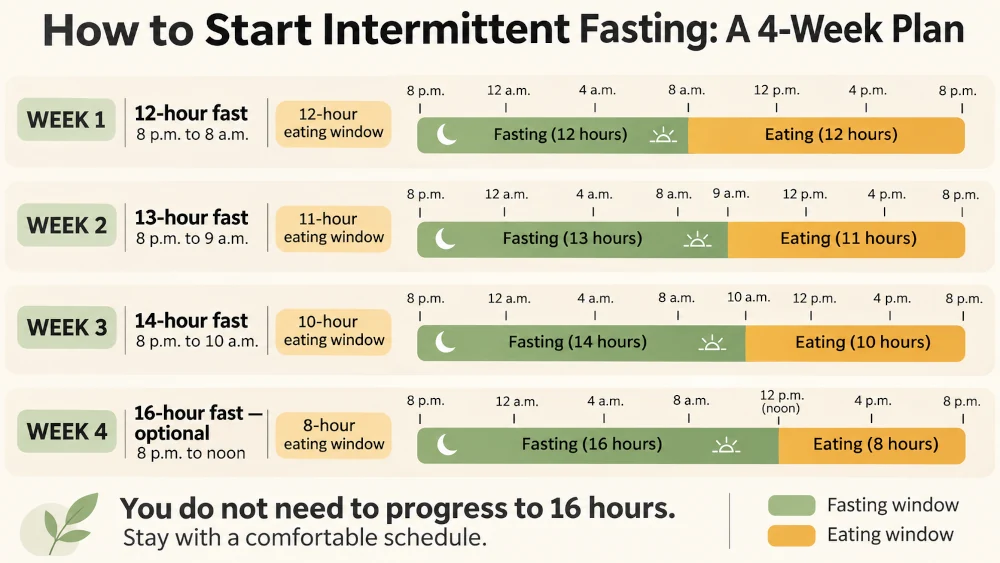
- Start at 12 hours. Close the kitchen after dinner and eat breakfast 12 hours later, say 8 p.m. to 8 a.m. Do that for the first week.
- Stretch slowly. Push your first meal back an hour every few days until you reach 14 hours. Go to 16 only if 14 feels easy. There’s no need to go further than 16:8, and given the observational heart data above, a window shorter than eight hours isn’t worth it for most people.
- Know what you can drink. Water, black coffee and plain tea are fine during the fast [Johns Hopkins Medicine, 2026]. Diet soda, sugar-free gum and a small splash of milk in coffee are gray areas; the original Leangains guide allowed them [Berkhan, 2010]. Anything with real calories, such as juice, a latte or a smoothie, ends the fast.
- Eat real meals in your window. You’re unlikely to lose weight or get healthier if you pack the window with high-calorie food or much bigger portions than usual [Johns Hopkins Medicine, 2026]. Build meals around protein, vegetables, fruit, whole grains and beans; our guide to the healthiest foods to eat has ideas. Break the fast with a normal meal, not a feast.
- Use a planner if you want numbers. The NIH Body Weight Planner estimates the calories you need to reach a goal weight and then stay there. It’s built for adults and isn’t meant for pregnancy or breastfeeding [NIDDK Body Weight Planner].
- Keep lifting. Regular strength training helps protect the muscle you’d otherwise lose. If you work out while fasted and feel dizzy or weak, move the session into your eating window.
- Judge it after a month. Your body can take two to four weeks to adjust, and you may feel hungry or cranky in that stretch [Johns Hopkins Medicine, 2026]. After a month, check in honestly. If you aren’t eating less overall, your sleep has suffered, or food has started to take over your thoughts, stop. Intermittent fasting isn’t the right tool for everyone.

What the first few weeks feel like
Mayo Clinic lists hunger, fatigue, insomnia, irritability, trouble concentrating, nausea, constipation and headaches as common side effects, and says most fade within a month [Mayo Clinic, 2022]. Easing in gradually instead of jumping straight to 16 hours makes those weeks noticeably easier. So does drinking enough water and getting enough fiber from vegetables, fruit, beans and whole grains in your window.
When to stop and get help
- Eat something now if you feel shaky, sweaty, dizzy or confused, or your heart is racing. These can be signs of low blood sugar, and they matter most if you take diabetes medication. Our guide to blood sugar levels explains what counts as low and how to treat it.
- Get emergency care for fainting, chest pain, trouble speaking, or confusion that doesn’t clear after eating.
- Stop and talk to a doctor or an eating disorder specialist if you find yourself bingeing when the window opens, feeling guilty about eating, or stretching fasts to make up for meals.

| HEALTH DISCLAIMER: This article is for general education and is not a substitute for advice from your doctor, a registered dietitian or another qualified health professional. Intermittent fasting is not safe for everyone. If you are pregnant or breastfeeding, under 18, have diabetes or a history of disordered eating, take regular medication, or have any ongoing health condition, talk to a healthcare professional before changing when or how much you eat. |
Frequently Asked Questions
Does black coffee break a fast?
No. Black coffee and plain tea are considered fine during the fasting window [Johns Hopkins Medicine, 2026]. Cream and sugar add calories, so most plans count them as breaking the fast. A small splash of milk is a gray area that some plans allow [Berkhan, 2010].
Is 16:8 better than 14:10?
There’s no good evidence that one daily window beats another for weight loss. Overall, fasting performs about like calorie cutting [Semnani-Azad et al., 2025], so the better window is the one you can keep. If 14:10 helps you eat less, it may be all you need.
Do women need a different fasting schedule?
No separate rulebook is needed. The gradual 12 → 14 → 16-hour build-up works for anyone. Women who are pregnant, breastfeeding or have a history of disordered eating should skip fasting [Mayo Clinic, 2022].
Can I exercise while intermittent fasting?
Yes, and many people do. If you feel weak or lightheaded during a fasted workout, train during your eating window instead. People who train hard for a sport may find fasting makes it difficult to fuel and recover [Mayo Clinic, 2022].
How long does it take to get used to intermittent fasting?
Usually two to four weeks. Hunger and irritability are common at first [Johns Hopkins Medicine, 2026], and most side effects fade within a month [Mayo Clinic, 2022].
Is intermittent fasting safe long term?
That isn’t known yet. Trials in the Cochrane review ran for up to 12 months [Garegnani et al., 2026], and only five of the 99 trials in the BMJ analysis lasted a year or longer [Semnani-Azad et al., 2025]. Short-term side effects usually fade, but long-term effects haven’t been established.
References
- de Cabo R, Mattson MP. Effects of intermittent fasting on health, aging, and disease. View source
- Association of eating duration less than 8 h with all-cause, cardiovascular, and cancer mortality. Diabetes Metab Syndr. View source
- Association of eating window with mortality among US adults: insights from a nationally representative study. Aging Cell. View source
- Ganson KT, Cuccolo K, Hallward L, Nagata JM. Intermittent fasting: describing engagement and associations with eating disorder behaviors and psychopathology among Canadian adolescents and young adults. View source
- Garegnani LI, Oltra G, Ivaldi D, et al. Intermittent fasting for adults with overweight or obesity. View source
- Johns Hopkins Medicine. Intermittent fasting: what is it, and how does it work? Medically reviewed by Mark Mattson, View source
- Berkhan M. The Leangains guide. Leangains.com. View source
- Liu D, Huang Y, Huang C, et al. Calorie restriction with or without time-restricted eating in weight loss. View source
- Lowe DA, Wu N, Rohdin-Bibby L, et al. Effects of time-restricted eating on weight loss and other metabolic parameters in women and men with overweight and obesity: the TREAT randomized clinical trial. View source
- Weiss C. Mayo Clinic Q and A: Is intermittent fasting good for weight loss? Mayo Clinic News Network. View source
- Mayo Clinic Staff. What is intermittent fasting? Does it have health benefits? Mayo Clinic. View source
- National Institute of Diabetes and Digestive and Kidney Diseases. What can you tell your patients about intermittent fasting and type 2 diabetes? View source
- National Institute of Diabetes and Digestive and Kidney Diseases. Body Weight Planner. View source
- Semnani-Azad Z, Khan TA, Chiavaroli L, et al. Intermittent fasting strategies and their effects on body weight and other cardiometabolic risk factors: systematic review and network meta-analysis of randomised clinical trials. View source


