

Fasting does a few things well and a great many things maybe. The strongest research says it helps you lose weight — about as well as eating less every day, not better — and lowers fasting insulin in people with obesity or prediabetes. Past that, the health benefits of fasting get thinner quickly: small, inconsistent effects on inflammation, early and interesting findings on the brain, striking animal data on aging that nobody has reproduced in people, and at least one large human study pointing in the wrong direction on heart risk.
That is a more useful starting point than a list of promises. Here is what holds up, what is still open, and who should leave fasting alone.
Health Benefits of Fasting: What Happens in Your Body When You Stop Eating
For the first several hours after a meal, you run on glucose, drawing on glycogen stored in the liver. When those stores run down, the liver starts converting fat into ketones, which most tissues — including the brain — can burn instead. Researchers call this the metabolic switch, and it typically happens somewhere between 12 and 36 hours after your last meal, depending on how full your glycogen stores were to begin with and how much energy you burn during the fast [Anton et al., Obesity, 2018].
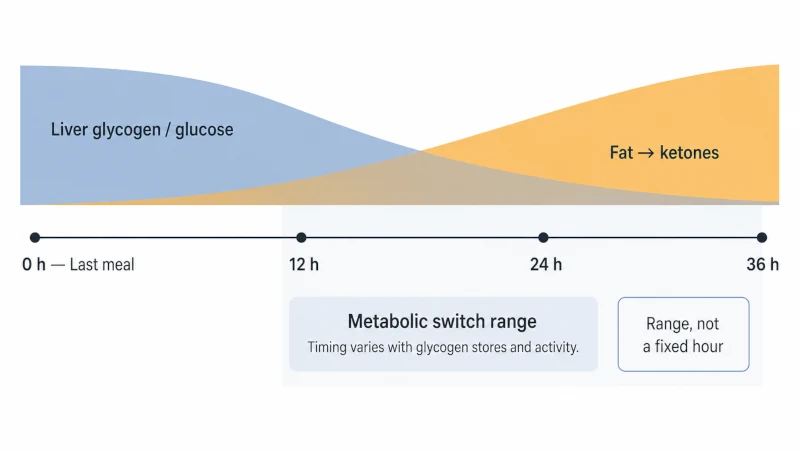
That range matters more than most fasting advice admits. A 16-hour overnight fast after a carbohydrate-heavy dinner, spent mostly sitting, may never flip the switch at all. The same 16 hours after a moderate dinner and a morning walk probably will.
Ketones are not only fuel. The National Institute on Aging describes them as signaling molecules that activate pathways strengthening the body’s defenses against oxidative and metabolic stress, and that trigger repair or removal of damaged molecules [National Institute on Aging, 2020]. That is the mechanism behind most of fasting’s bigger claims. It is also where the caution belongs: NIA notes that most human trials have been short, and most enrolled overweight, middle-aged adults, which leaves open how any of this applies over years or in other populations.
The Main Fasting Methods
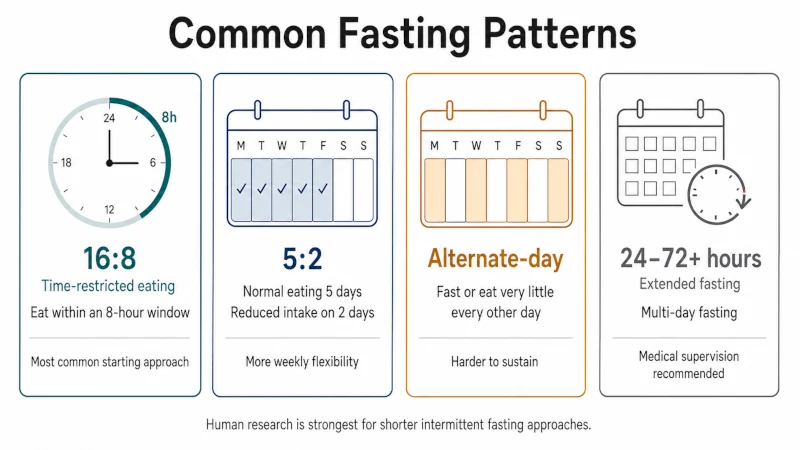
Research is not spread evenly across these. Time-restricted eating dominates recent human trials; extended multi-day fasting has almost none outside supervised settings.
| Method | Schedule | Who it suits | Key consideration |
| 16:8 time-restricted eating | Eat within an 8-hour window, fast 16 | Most healthy adults; the usual starting point | Skipping breakfast doesn’t suit everyone; morning-hungry people often do better shifting the window earlier |
| 5:2 | Normal eating 5 days, roughly 500–600 calories on 2 | People who prefer weekly flexibility | Fast days need planning, especially around social meals |
| Alternate-day fasting | Fast or very-low-calorie every other day | Heavily used in research; hard to sustain | Highest dropout rates in trials |
| Extended fasting (24–72+ hours) | Multi-day, minimal calories | Supervised settings only | Requires medical oversight; not a beginner option |
Weight Loss: The Best-Supported Benefit, With an Asterisk
Restrict when you eat and most people eat less overall. Weight comes off. That much is not in dispute.
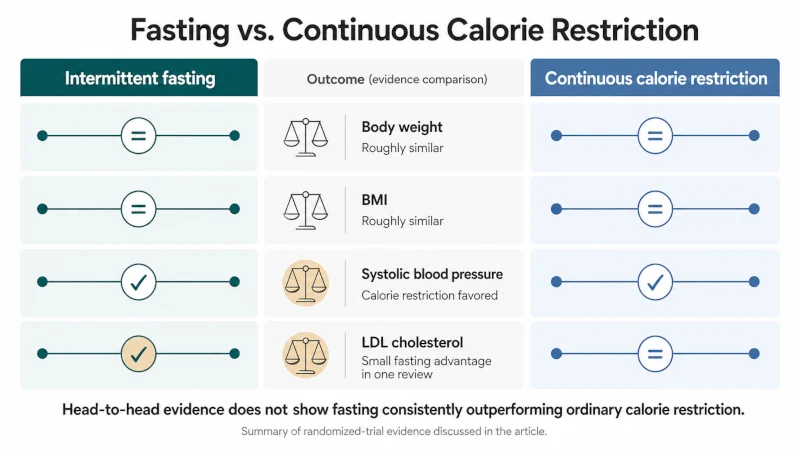
The asterisk is what fasting is being compared to. A 2024 umbrella review in eClinicalMedicine pulled together systematic reviews and meta-analyses of randomized trials and graded 351 separate associations. Against no intervention, fasting produced high-certainty reductions in waist circumference — about 1 cm — and in fasting insulin over one to three months in adults with overweight or obesity. Against continuous calorie restriction, though, the high-certainty evidence showed no significant advantage for body weight or BMI [Sun et al., eClinicalMedicine, 2024]. NIDDK reports the same pattern from trial data: time-restricted eating and ordinary calorie cutting both landed around 5% weight loss at 12 months [NIDDK on intermittent fasting and type 2 diabetes, 2024].
So fasting works. It works because it is a way of eating less, not because the clock does something calorie counting can’t. If restricting hours is easier for you to stick with than tracking portions, that’s a real and legitimate advantage — adherence is the variable that decides most diet outcomes. If it isn’t easier, you are not missing out on anything.
Some of the early drop is water. Lower carbohydrate and sodium intake causes the kidneys to shed fluid, and glycogen holds water with it. That comes back. Losses that persist across weeks reflect fat.
One clarification worth making: juice fasts and cleanse programs are not the protocols in this research. They deliver a substantial sugar load and little protein, and they have not been tested the way time-restricted eating has. If you’re weighing that approach, our breakdown of juicing for weight loss covers where it falls short.
Blood Sugar and Insulin
This is fasting’s second-strongest area. Insulin resistance — cells responding poorly to insulin, so blood sugar stays elevated — sits underneath type 2 diabetes and metabolic syndrome, and fasting appears to move it.
NIDDK reports that studies in people with obesity and prediabetes consistently show reductions in fasting insulin and improvements in insulin resistance, and that some studies in people who already have type 2 diabetes found up to a full-point drop in A1C within three to six months. Continuous glucose monitor data also showed more time in target glucose range [NIDDK on intermittent fasting and type 2 diabetes, 2024]. The umbrella review’s high-certainty finding on fasting insulin points the same direction [Sun et al., eClinicalMedicine, 2024].
The medication issue is the one that actually sends people to the hospital. Anyone taking insulin or a sulfonylurea needs their prescriber involved before changing when they eat, because doses are timed to meals. Worth noting honestly: NIDDK says the studies did not find higher rates of hypoglycemia in fasting groups than in controls. That is reassuring for trial conditions, where medications were adjusted and participants were monitored. It is not permission to improvise at home. If you want to know what a low blood sugar episode feels like and what to keep on hand, see our hypoglycemia food list, and for day-to-day eating, our guide to diabetic-friendly foods.
Heart Health: The Most Complicated Section on This Page
Fasting’s cardiovascular story is usually told as settled. It isn’t.
The most rigorous synthesis is a Cochrane review of intermittent fasting for preventing cardiovascular disease, covering 26 randomized trials. It found weight reduction versus eating freely, at low to very low certainty, and lower systolic blood pressure versus eating freely but not versus continuous calorie restriction. For LDL, HDL, and triglycerides it found no evidence of a difference. The authors concluded that fasting cannot yet be recommended for clinical practice on cardiovascular grounds [Cochrane review, Allaf et al., 2021].
The umbrella review adds a finding that rarely makes it into fasting articles: compared with continuous calorie restriction, intermittent fasting was less effective at lowering systolic blood pressure, and that was one of its high-certainty results. It did find a small LDL reduction versus calorie restriction at high certainty [Sun et al., eClinicalMedicine, 2024]. So on lipids the two best sources disagree — Cochrane found nothing, the umbrella review found a small effect — and on blood pressure the umbrella review actively favors ordinary calorie restriction. Treat anyone who tells you fasting is straightforwardly good for your heart as ahead of the evidence.
Then there is the signal in the other direction. In 2024 the American Heart Association presented an analysis of roughly 20,000 U.S. adults followed for a median of eight years, in which people who ate within an 8-hour daily window had a 91% higher risk of death from cardiovascular disease. The caveats are heavy and the AHA states them plainly: it was a conference abstract that had not been peer reviewed, eating windows were inferred from just two days of self-reported diet recall, key confounders were not accounted for, and the senior author said directly that this does not mean time-restricted eating caused those deaths [American Heart Association, 2024].
One preliminary observational analysis does not overturn the trial evidence. But it is the largest long-term human dataset anyone has looked at on this question, and no randomized trial has ever shown that fasting prevents a heart attack or a stroke. Short-term marker improvements are not the same as fewer events.
Inflammation
Chronic low-grade inflammation is linked to heart disease, some cancers, and cognitive decline, so it’s a reasonable thing to want to lower. Fasting does something here — less than the headlines suggest.
A 2025 systematic review with network meta-analysis pooled 21 controlled studies in 839 adults. Fasting produced a small but statistically significant reduction in C-reactive protein and a somewhat larger one in TNF-alpha, with time-restricted eating showing the biggest TNF-alpha effect. For interleukin-6 there was no significant effect at all. The authors flagged short trial durations, small numbers of studies for some comparisons, and varied baseline inflammation among participants [Khalafi et al., Nutrients, 2025].
An individual trial illustrates both the effect and its cost. Thirty-four resistance-trained men followed either 16:8 time-restricted eating or normal meal timing for eight weeks with calories and macronutrients matched between groups. The fasting group ended with lower TNF-alpha, higher adiponectin, and greater fat loss — and with significantly lower testosterone and IGF-1 [Moro et al., Journal of Translational Medicine, 2016]. That trade-off gets left out of most summaries.
Some of the inflammatory benefit almost certainly comes from what disappears from the plate rather than from the fasting window itself. People who compress their eating hours tend to cut late-night snacking, alcohol, and ultra-processed food along the way. If lowering inflammation is your actual goal, our review of anti-inflammatory supplements and our look at modern diet problems address the parts of this that don’t require skipping meals.
Brain Health: Early, Interesting, Not Settled
In 2024 the NIA reported a Cell Metabolism trial of 40 older adults with insulin resistance, average age 63, randomized for eight weeks to either a 5:2 fasting pattern or a USDA-style healthy eating diet. Both diets slowed the measured pace of brain aging and improved cognition and insulin resistance. The fasting group showed greater gains in executive function and lost more weight. Alzheimer’s biomarkers did not change in either group [National Institute on Aging, 2024].
Forty people, eight weeks, and both diets worked. That is a promising pilot, not a reason to fast for your brain.
The more dramatic findings are in mice. In genetically engineered mice that overproduce beta-amyloid, time-restricted feeding restored disrupted circadian rhythms, lowered amyloid plaque levels and inflammatory activity, and improved maze memory to the level of healthy control animals. The NIA’s own framing is that this needs to be tested in people before conclusions get drawn [National Institute on Aging, on fasting and Alzheimer’s]. Nothing here supports the idea that fasting prevents or treats dementia.
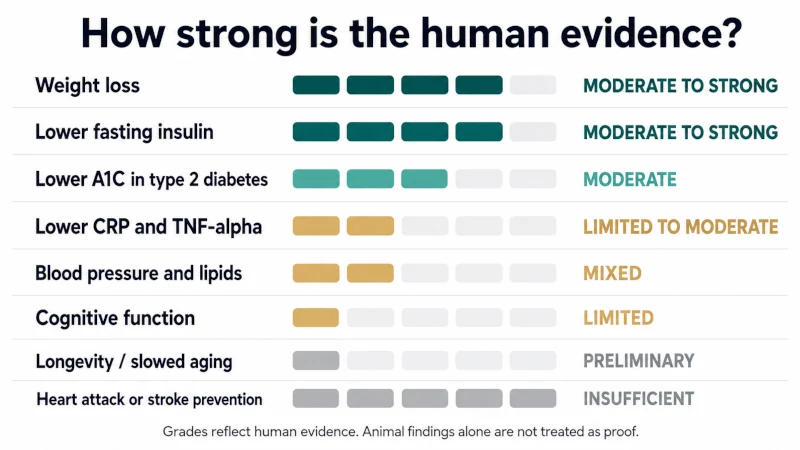
How Strong Is the Evidence for Each Health Benefit of Fasting?
| Benefit | Evidence quality | What the caveat actually is |
| Weight loss | Moderate to strong | Real, but not better than continuous calorie restriction; long-term data thin |
| Lower fasting insulin / insulin resistance | Moderate to strong | Strongest in overweight and prediabetic adults; medication timing must be managed |
| Lower A1C in type 2 diabetes | Moderate | Reported in some studies, not all; requires medical supervision |
| Reduced CRP and TNF-alpha | Limited to moderate | Small effect sizes; no effect on IL-6; short trials; diet quality confounds it |
| Blood pressure and lipids | Mixed | Cochrane found no lipid difference; umbrella review favors calorie restriction for blood pressure |
| Cognitive function | Limited (human) | One 40-person 8-week trial; strong animal data that has not been replicated in people |
| Longevity / slowed aging | Preliminary | Compelling in animals; no long-term human trials exist |
| Prevention of heart attack or stroke | Insufficient | No trial has tested it; one large observational analysis raised a concern |
Side Effects and Trade-Offs
Fasting is not free of costs, and the adjustment period is real. Johns Hopkins Medicine puts adaptation at two to four weeks, during which hunger and irritability are common, and advises contacting a doctor if you develop unusual anxiety, headaches, or nausea [Johns Hopkins Medicine, intermittent fasting].
Beyond the first few weeks, three trade-offs are worth knowing about:
Hormonal shifts. The eight-week time-restricted eating trial in trained men found significant drops in testosterone and IGF-1 despite matched calories [Moro et al., 2016]. Comparable sex-stratified data in women is sparse, which is itself a limitation — most fasting research has been done in overweight, middle-aged adults without breaking results out by sex [National Institute on Aging, 2020].
Lean mass and bone. NIDDK raises concern about excessive muscle loss in older adults who fast. In the NIA’s summary of the CALERIE calorie-restriction trial, participants saw slight declines in bone density, lean body mass, and aerobic capacity, generally in proportion to weight lost [National Institute on Aging, calorie restriction]. That trial tested sustained calorie restriction rather than intermittent fasting, but the underlying issue — losing tissue you’d rather keep — applies to any approach that reduces intake.
Eating behavior. A clinical commentary reviewing the emerging literature found that among adolescents and young adults, fasting use was common and associated with disordered eating behaviors, most consistently in women, and that combining fasting with low-carbohydrate dieting was linked to substantially higher odds of binge eating in college students [Blumberg et al., Clinical Diabetes and Endocrinology, 2023].
It also bears saying that the NIA’s standing position on this family of diets is that there is not yet enough evidence to recommend any particular calorie-restriction or fasting regimen [National Institute on Aging, calorie restriction].
How to Fast More Safely
- Start at 12 hours. An overnight fast from 8 p.m. to 8 a.m. is a genuine starting point and costs you nothing. Extend only if it feels sustainable.
- Give it a month before you judge it. Hunger and irritability in the first two to four weeks are expected and usually fade [Johns Hopkins Medicine].
- Protect protein and resistance training. These are what preserve muscle while you’re eating less — particularly if you’re over 60.
- Drink. Water, black coffee, and plain tea are fine during fasting hours and blunt hunger.
- Don’t let the eating window become a free-for-all. Much of the metabolic benefit tracks with eating less processed food, not with the clock.
- Sort out medications first. Insulin, sulfonylureas, blood pressure drugs, and anything you take with food all need review by your prescriber before you change your eating schedule.
- Stop for red flags. Fainting, near-fainting, heart palpitations, confusion, severe or persistent headache, cold sweats with shakiness or dizziness, or vision changes mean eat something and get medical advice. Confusion, fainting, or a seizure in someone taking diabetes medication is an emergency — call 911.
Who Should Not Fast
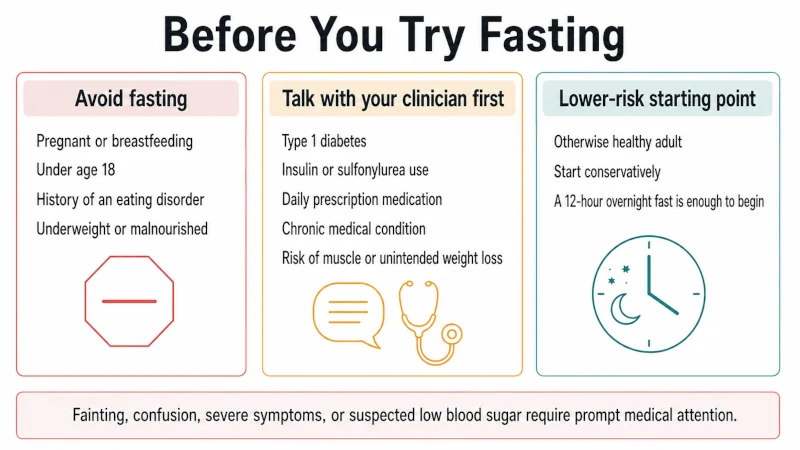
Some people should avoid fasting outright; others need it supervised.
- Pregnant or breastfeeding people. Energy and nutrient demands are elevated; restriction risks both fetal development and milk supply. Johns Hopkins and NIDDK both advise against it [Johns Hopkins Medicine].
- Anyone under 18. Growing bodies need consistent intake [Johns Hopkins Medicine].
- People with a history of an eating disorder, or current disordered eating patterns. Fasting can reactivate restriction-binge cycles [Blumberg et al., 2023].
- People with type 1 diabetes, or type 2 diabetes treated with insulin or sulfonylureas — unless a doctor is actively managing the dose changes [NIDDK, 2024].
- People who are underweight or malnourished, or losing weight without trying.
- Older adults at risk of sarcopenia or unintended weight loss. Possible with oversight and enough protein, but not a default [NIDDK, 2024].
- Anyone with a chronic condition or on daily prescription medication should talk to their doctor or a registered dietitian first, rather than after.
| HEALTH DISCLAIMER: This article is for educational and informational purposes only. It is not a substitute for professional medical advice, diagnosis, or treatment. Talk with your doctor before making significant changes to how or when you eat, especially if you have a medical condition, take prescription medication, or are pregnant or breastfeeding. If you think you may be having a medical emergency, call 911. |
Frequently Asked Questions
Is fasting the same as starving?
No. Fasting is a planned pause in eating, after which normal nutrition resumes. Starvation is prolonged, involuntary food deprivation that eventually forces the body to break down muscle and organ tissue. The short fasting protocols studied in trials don’t do that. Very extended fasting is a different matter, which is why multi-day fasts belong under medical supervision.
How long before I notice anything?
Most trials measure weight and metabolic changes over 8 to 12 weeks. Personally, expect the first two to four weeks to be the hard part — hunger and irritability are the usual complaints while your body adjusts [Johns Hopkins Medicine].
Will fasting wreck my metabolism?
Severe, sustained calorie restriction can lower resting metabolic rate, and the CALERIE trial saw declines in lean mass and aerobic capacity alongside weight loss [National Institute on Aging]. The shorter intermittent protocols used in trials haven’t shown that pattern. Adequate protein and resistance training are what protect muscle either way.
Does coffee break a fast?
Plain black coffee is essentially calorie-free and won’t meaningfully interrupt the metabolic state — it may also blunt appetite. Adding milk, cream, or sugar changes that. Be aware there’s no agreed clinical definition of “breaking a fast,” so most of what’s written on this is inference rather than measurement.
Is fasting safe for women?
There’s a real evidence gap here. Most fasting research has been conducted in overweight, middle-aged adults, often without reporting results separately by sex [National Institute on Aging, 2020]. Hormonal effects have been documented — an eight-week trial in men found reduced testosterone and IGF-1 [Moro et al., 2016] — but comparable data in women is limited. Women who are pregnant, breastfeeding, or trying to conceive should not fast. Others can start conservatively and check in with a doctor, particularly if menstrual cycles change.
Should I fast if I’m already at a healthy weight?
The evidence base barely covers you. Trials have overwhelmingly enrolled people with overweight, obesity, or metabolic risk factors [National Institute on Aging, 2020], and the benefits identified are largely benefits of losing excess weight. There’s no good reason to expect the same returns at a healthy weight, and the muscle-loss and eating-behavior risks still apply.
References
- Anton SD, Moehl K, Donahoo WT, et al. (2018). Flipping the Metabolic Switch: Understanding and Applying Health Benefits of Fasting. Obesity (Silver Spring), 26(2). DOI: 10.1002/oby.22065. PMID: 29086496. → View source
- National Institute on Aging. (2020). Research on intermittent fasting shows health benefits. National Institutes of Health. → View source
- National Institute on Aging. (last updated 2018). Calorie restriction and fasting diets: What do we know? National Institutes of Health. → View source
- National Institute on Aging. (2024). Diet may improve brain health in older adults with obesity. National Institutes of Health. → View source
- National Institute on Aging. Could fasting reset the body’s clock and protect the brain against Alzheimer’s? National Institutes of Health. → View source
- National Institute of Diabetes and Digestive and Kidney Diseases. (2024). What can you tell your patients about intermittent fasting and type 2 diabetes? National Institutes of Health. → View source
- Sun ML, et al. (2024). Intermittent fasting and health outcomes: an umbrella review of systematic reviews and meta-analyses of randomised controlled trials. eClinicalMedicine, 70:102519. DOI: 10.1016/j.eclinm.2024.102519. → View source
- Allaf M, Elghazaly H, Mohamed OG, et al. (2021). Intermittent fasting for the prevention of cardiovascular disease. Cochrane Database of Systematic Reviews, 1(1):CD013496. DOI: 10.1002/14651858.CD013496.pub2. → View source
- American Heart Association. (2024). 8-hour time-restricted eating linked to a 91% higher risk of cardiovascular death. AHA Newsroom. → View source
- Khalafi M, et al. (2025). The Effects of Intermittent Fasting on Inflammatory Markers in Adults: A Systematic Review and Pairwise and Network Meta-Analyses. Nutrients, 17(15):2388. DOI: 10.3390/nu17152388. → View source
- Moro T, Tinsley G, Bianco A, et al. (2016). Effects of eight weeks of time-restricted feeding (16/8) on basal metabolism, maximal strength, body composition, inflammation, and cardiovascular risk factors in resistance-trained males. Journal of Translational Medicine, 14:290. DOI: 10.1186/s12967-016-1044-0. → View source
- Blumberg J, Hahn SL, Bakke J. (2023). Intermittent fasting: consider the risks of disordered eating for your patient. Clinical Diabetes and Endocrinology, 9. DOI: 10.1186/s40842-023-00152-7. → View source
- Johns Hopkins Medicine. Intermittent Fasting: What Is It, And How Does It Work? → View source
