
If you can hear your own heartbeat in your ear — a whoosh, thump or throb that keeps time with your pulse — you are describing pulsatile tinnitus. Unlike the steady ringing most people mean by “tinnitus,” this kind usually has a physical source: blood moving through a vessel near the ear in a way your hearing can pick up. That is why pulsatile tinnitus deserves a proper medical evaluation rather than a wait-and-see approach. The encouraging part is that once the cause is found, it is often treatable [Penn Medicine, n.d.]; [Northwestern Medicine, n.d.].

What makes pulsatile tinnitus different
Most tinnitus is a ringing, hissing or buzzing that comes from changes in the hearing system itself. Pulsatile tinnitus is far less common — fewer than 1 in 10 people with tinnitus have the pulsing kind [Hofmann et al., 2013] — though that still adds up to an estimated 3 to 5 million Americans [Narsinh et al., 2022].
People describe it as thumping, whooshing or throbbing. It usually speeds up and slows down with your heart rate, may stand out more at night when the room is quiet, and can be constant or come and go [Penn Medicine, n.d.]. Occasionally a doctor can hear the sound too, through a stethoscope placed near the ear or neck. That is called objective tinnitus, and it often has an identifiable, treatable cause [NIDCD, n.d.].
One detail is worth noting before your appointment: is it in one ear or both? In one review, a cause was found in 88% of people with one-sided pulsatile tinnitus, compared with 42% when it was in both ears [Hofmann et al., 2013].
Common causes of pulsatile tinnitus
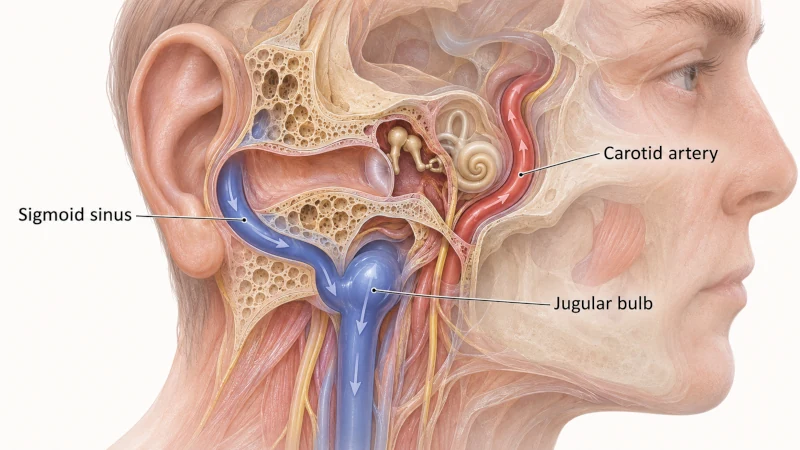
The sound comes from blood flow that is turbulent, faster than usual, or running unusually close to the ear — or from a change in the ear that makes normal flow easier to hear. Doctors usually sort causes by where the sound begins: in an artery, in a vein, or at an abnormal connection between the two [Hofmann et al., 2013].
Sources don’t agree on which cause tops the list. StatPearls, a widely used clinical reference, names atherosclerotic disease of the carotid artery as the most common cause [Lenkeit & Al Khalili, 2023]. UCSF’s pulsatile tinnitus program names venous sinus stenosis and idiopathic intracranial hypertension instead [UCSF Radiology, n.d.]. Pooled data from six case series put the two groups close together [Hofmann et al., 2013]. The ranking depends on who was studied and how thoroughly they were tested, so treat the table below as a rough guide, not a prediction for any one person.
| Cause group | What is going on | Share in pooled case series* |
| Narrowed arteries | Plaque or other narrowing (for example in the carotid artery) makes blood flow turbulent | 18% |
| Raised pressure inside the skull | Includes idiopathic intracranial hypertension (IIH) | 16% |
| Venous variations | Sinus diverticulum, jugular bulb anomalies, venous sinus narrowing | 12% |
| Dural arteriovenous fistula | Abnormal artery-to-vein connection in the brain’s covering | 7% |
| Blood-vessel-rich tumors | Mainly paragangliomas (glomus tumors) | 6% |
| Increased local blood flow | “Capillary hyperemia” | 3% |
| No cause found | Even after testing | 23% |
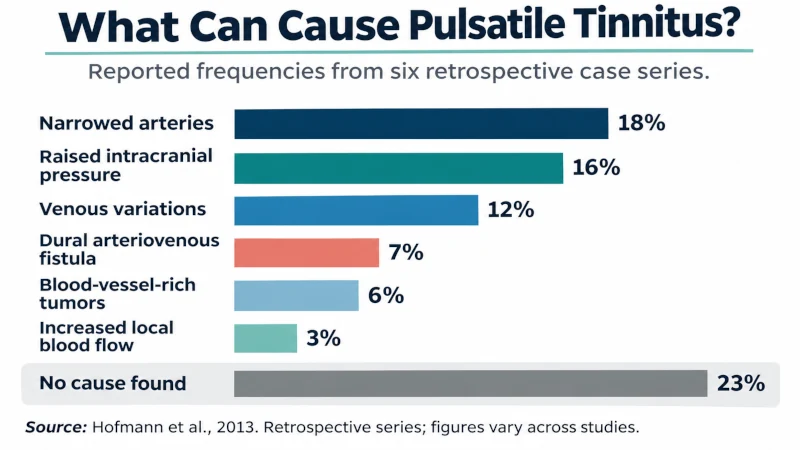
*Pooled from six retrospective series reviewed by [Hofmann et al., 2013]. The authors note there are no prospective studies and that figures vary widely between series.
Narrowed or stiffened arteries
When plaque narrows the carotid artery in the neck, blood squeezes through a tighter channel and the turbulence can be heard on that side [Lenkeit & Al Khalili, 2023]. This matters beyond the noise: carotid narrowing is a risk factor for stroke [Northwestern Medicine, n.d.]. Plaque builds up over years, driven in part by LDL cholesterol — see what actually raises LDL and contributes to plaque. Less common arterial causes include fibromuscular dysplasia and a tear in the artery wall (dissection) [Hofmann et al., 2013].
Blood pressure belongs here too. StatPearls describes uncontrolled high blood pressure as perhaps the most common cause of pulsatile tinnitus that comes and goes [Lenkeit & Al Khalili, 2023]. If yours is high, evidence-based lifestyle steps for high blood pressure can support the treatment your doctor recommends.
Raised pressure inside the skull
Idiopathic intracranial hypertension (IIH) means the pressure of the fluid around the brain is too high without an obvious reason. It is most common in women aged 20 to 50, and the risk rises with a BMI over 30 or recent weight gain [National Eye Institute, n.d.]. Headaches and vision problems — blind spots, double vision, brief episodes of blindness, loss of side vision — are typical, because the pressure affects the optic nerve [National Eye Institute, n.d.]. In IIH, the pulsing is often heard in both ears [Lenkeit & Al Khalili, 2023].
The vision risk is why IIH is not something to self-manage. A whooshing in both ears plus new headaches or vision changes needs prompt assessment.
Venous variations near the ear
Some people have small differences in the large veins that drain the brain past the ear: an outpouching of the sigmoid sinus (a diverticulum), a thin or missing bony wall over it, a high-riding jugular bulb, or a narrowed venous sinus [UCSF Radiology, n.d.]; [Northwestern Medicine, n.d.]. Northwestern Medicine describes sinus diverticula as rare and not dangerous, and a “venous hum” as benign [Northwestern Medicine, n.d.]. These causes can still be loud and distressing, and several are treatable.
Dural arteriovenous fistula
A dural arteriovenous fistula (dAVF) is an abnormal direct connection between an artery and a vein in the tough covering of the brain. UCSF calls it the most potentially dangerous cause of pulsatile tinnitus [UCSF Radiology, n.d.]. Fistulas range from low-grade to high-grade, and high-grade ones must be treated [Northwestern Medicine, n.d.] because the priority is lowering the risk of bleeding in the brain [Narsinh et al., 2022].
One counterintuitive point: if pulsatile tinnitus from a known fistula suddenly stops, that is not automatically good news. It can mean the drainage pattern has changed for the worse [Narsinh et al., 2022]. Tell your specialist promptly.
Tumors and ear problems
Paragangliomas, also called glomus tumors, are blood-vessel-rich growths in the middle ear, the base of the skull near the jugular vein, or the carotid body in the neck. They are usually one-sided, and a doctor may see a pulsing mass behind the eardrum [Lenkeit & Al Khalili, 2023].
Problems that block sound from reaching the inner ear — conductive hearing loss, such as from a perforated eardrum — can make normal blood flow easier to hear [Northwestern Medicine, n.d.]. A thin spot in the bone over one of the inner ear’s balance canals (superior semicircular canal dehiscence) turned up in 5% of one hospital series [Hofmann et al., 2013].
Whole-body causes: anemia, thyroid, pregnancy, medications
Anything that makes the heart pump more blood, faster, can make that flow audible. StatPearls lists anemia, an overactive thyroid and pregnancy among these “high-output” states [Lenkeit & Al Khalili, 2023], which is why basic blood and thyroid tests are part of a standard workup [Penn Medicine, n.d.]. If tests show iron-deficiency anemia, the cause of the iron loss needs finding; diet supports recovery but won’t fix it alone — vitamin C foods such as kiwi help you absorb iron, for example, without replacing treatment.
Medications can play a part. One review notes ACE inhibitors and calcium-channel blockers, both common blood pressure drugs, as possible contributors [Hofmann et al., 2013]. Don’t stop a prescribed medicine on your own; ask your doctor whether an alternative makes sense.
When no cause turns up
Even after careful testing, a clear source is not always found — Penn Medicine puts it at about one in three patients [Penn Medicine, n.d.], and pooled case series at about one in four [Hofmann et al., 2013]. A thorough workup that rules out the dangerous causes is useful information in itself, and the sound can still be managed.
Is pulsatile tinnitus dangerous? Warning signs to act on
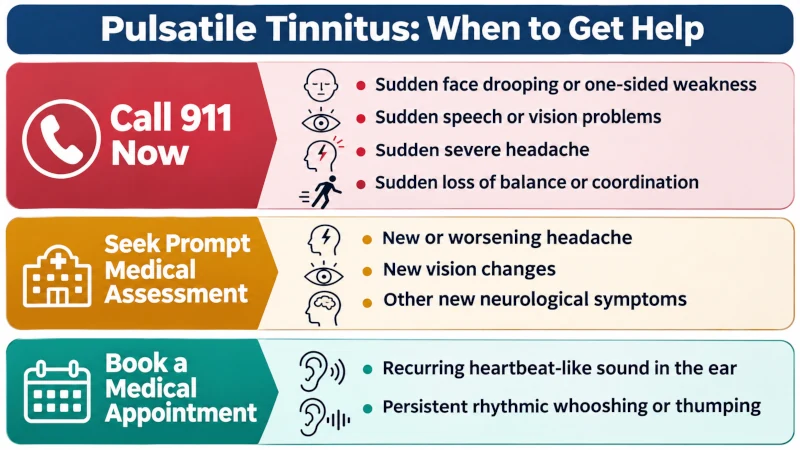
Most causes are benign or manageable. A few — carotid narrowing, a dural fistula, raised brain pressure — can threaten the brain or eyesight, and pulsatile tinnitus is sometimes the first clue [Narsinh et al., 2022]; [UCSF Radiology, n.d.]. That is the case for getting it checked even when it feels like a nuisance.
| When to get help Call 911 now if the pulsing comes with any sudden stroke sign [CDC, n.d.]: face drooping, or numbness or weakness in the face, arm or leg, especially on one sideconfusion, slurred speech or trouble understanding otherssudden trouble seeing, dizziness, loss of balance or coordinationa sudden, severe headache with no known cause Don’t drive yourself — wait for the ambulance. If the symptoms pass within minutes, still tell a clinician right away [CDC, n.d.]. See a doctor within a day or two if you have pulsatile tinnitus with: new or worsening headaches, or vision changes such as blind spots, double vision or brief blackouts [National Eye Institute, n.d.]numbness, weakness or other new neurological symptoms [Hofmann et al., 2013]a sound that is very loud or unbearable [Lenkeit & Al Khalili, 2023], or one someone else can hear [Hofmann et al., 2013]a known fistula whose pulsing suddenly stops, especially followed by headache, nausea or clumsiness [Narsinh et al., 2022]pregnancy or the weeks after birth, with headaches or vision changes Book a regular appointment for any pulsing sound that keeps returning or doesn’t go away, even without other symptoms. |
How doctors diagnose pulsatile tinnitus
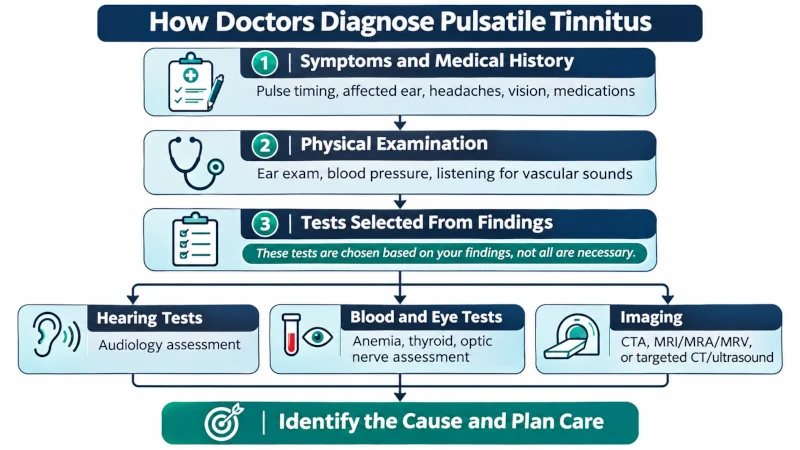
A primary care doctor is a reasonable first stop; they will check your ears and blood pressure and review your medications before referring you to an ear, nose and throat (ENT) specialist and an audiologist [NIDCD, n.d.]. Complex cases are often handled by a team that includes radiology and neurology [Northwestern Medicine, n.d.]; [UCSF Radiology, n.d.].
The history and exam
Expect questions about which ear, when it started, whether it is constant, what makes it louder or softer, and whether you have hearing loss, dizziness, headaches or vision changes [Lenkeit & Al Khalili, 2023]. It helps to check your pulse at the wrist while you listen, so you can tell the doctor whether the sound really keeps time with your heartbeat.
The doctor may listen with a stethoscope over your neck, around the ear and over the skull. Gentle pressure on the neck or turning your head can change the sound, and how it changes hints at the source: if pressing on an artery quiets it, an arterial cause is likely, while a venous cause often softens with pressure on the vein on the same side or when you turn your head toward that side [Lenkeit & Al Khalili, 2023]. Leave these maneuvers to the clinician. You may also have a hearing test, an eye exam to look for swelling of the optic nerve from raised brain pressure, and blood tests for anemia and thyroid problems [Penn Medicine, n.d.].
Imaging tests
Imaging is usually needed, especially when the tinnitus pulses [NIDCD, n.d.]. Options include ultrasound of the neck vessels, MRI with angiography or venography (MRA/MRV), CT angiography (CTA), and CT of the temporal bone. Conventional catheter angiography is invasive and is typically reserved for suspected high-grade fistulas or for planning treatment [Northwestern Medicine, n.d.].
No single scan suits everyone. A 2023 systematic review of 17 studies covering 1,232 patients pooled how often each test found a cause: about 86% for CTA, 58% for MRI/MRA and 78% for multi-test combinations. Carotid ultrasound found a cause only 21% of the time overall, but it was highly specific for neck artery disease when the doctor could hear a bruit [Cao et al., 2023]. The authors caution that the studies differed too much for a fair head-to-head comparison and that yield improves when the test is chosen to fit the exam findings [Cao et al., 2023]. In other words, a good history and exam decide which scan you get.
Pulsatile tinnitus treatment depends on the cause

There is no one treatment for pulsatile tinnitus because it is a symptom, not a disease. Once the source is identified, cure rates are high [Penn Medicine, n.d.], and medication alone can handle several causes, including an overactive thyroid, anemia, IIH and high blood pressure [Northwestern Medicine, n.d.].
| Cause | Usual approach | What to know |
| High blood pressure | Bring blood pressure under control first | Especially when the pulsing comes and goes [Lenkeit & Al Khalili, 2023] |
| Anemia, overactive thyroid | Treat the underlying condition | [Northwestern Medicine, n.d.] |
| IIH | Weight loss and acetazolamide first; surgery if these fail | Losing about 5–10% of body weight can ease symptoms [National Eye Institute, n.d.]. For refractory IIH with worsening vision, venous sinus stenting is an option: complications about 6.6% (major 2.3%), relapse 10–26% [Narsinh et al., 2022] |
| Sigmoid sinus diverticulum or wall defect | Catheter coiling or surgical resurfacing | Resurfacing resolved symptoms in 74% of one small series, with complications in up to 24%. If IIH is behind it, the pressure must be treated too [Narsinh et al., 2022] |
| Dural arteriovenous fistula | Usually catheter-based embolization; low-risk fistulas may be watched | Reducing bleeding risk takes priority over silencing the sound [Narsinh et al., 2022] |
| Carotid narrowing | Medicines, image-guided procedures, surgery or a combination | [UCSF Radiology, n.d.]. Evidence on tinnitus outcomes comes from small case series [Narsinh et al., 2022] |
When no fixable cause is found
No medicine is approved by the U.S. Food and Drug Administration to treat tinnitus [NIDCD, n.d.]. What helps is changing how much the sound intrudes. Sound therapy uses background sound, wearable sound generators or hearing aids (if you have hearing loss) to mask the noise or help the brain tune it out. Cognitive behavioral therapy (CBT) teaches practical ways to reduce the distress, and tinnitus retraining therapy pairs counseling with low-level sound [NIDCD, n.d.]; [Northwestern Medicine, n.d.]. These approaches were studied mostly in ordinary tinnitus, and there are no trials specific to the pulsatile kind [Lenkeit & Al Khalili, 2023], so expect help with coping rather than a guarantee of silence.
Emotional support is part of treatment, not an extra. UCSF reports that nearly 60% of people with pulsatile tinnitus also have depression or anxiety [UCSF Radiology, n.d.]. If the sound is wrecking your sleep or mood, say so — that is a reason to escalate care. For a broader look at self-help claims, see what the evidence shows about natural tinnitus remedies.
What you can do on your own
Self-care can’t open a narrowed artery or close a fistula, so treat these steps as support for a medical workup, not a substitute.
- Know your blood pressure. If you have a home monitor, log readings alongside your symptoms; the pattern is useful to your doctor.
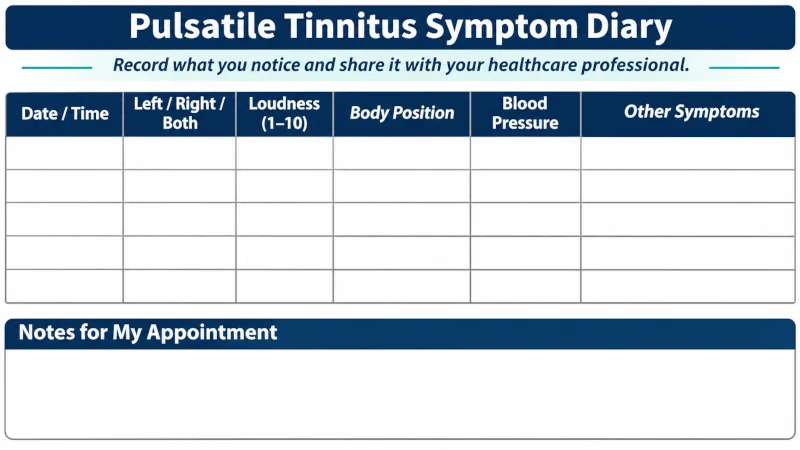
- Keep a short symptom diary. Note which ear, time of day, body position, loudness, and any headache or vision change.
- Bring a full medication list, including supplements, and ask whether any could be contributing.
- Use background sound at night. A fan or quiet sound machine can make the pulsing less noticeable when you are trying to sleep.
Cutting caffeine and salt is common advice, but the evidence is weak. For tinnitus in general, a 2019 review found no good evidence for caffeine restriction; in the one well-controlled study, stopping caffeine did not change tinnitus severity and caused withdrawal headaches. Evidence for salt restriction was also poor [Hofmeister, 2019]. StatPearls notes caffeine reduction is sometimes suggested for pulsatile tinnitus, without trials to back it [Lenkeit & Al Khalili, 2023]. If you notice that coffee clearly makes your pulsing worse, cutting back is reasonable. If your doctor has told you to reduce salt for blood pressure, that advice still stands.
Be wary of supplements sold for tinnitus. Vitamins, herbal extracts and other supplements have not been proven to work [NIDCD, n.d.], and the same 2019 review advised clinicians not to recommend them, citing Cochrane reviews that found ginkgo and zinc no better than placebo [Hofmeister, 2019]. Some carry real risk: ginkgo can increase bleeding, particularly with aspirin or other blood thinners — medicines that people with artery disease are often prescribed.
If you are pregnant or breastfeeding, mention any new pulsing sound to your obstetric provider rather than waiting, and check with them before taking any supplement or herbal product.
| HEALTH DISCLAIMER: This article is for general education and is not a substitute for medical advice, diagnosis or treatment. Pulsatile tinnitus can be a sign of a condition that needs prompt care. If you notice a pulsing sound in your ear, speak with a qualified healthcare professional, and seek emergency care right away for any stroke warning signs. Don’t start, stop or change any medication or supplement without talking to your doctor or pharmacist. |
Frequently Asked Questions
Is pulsatile tinnitus serious?
Often it isn’t, but it can be, and you can’t tell which from the sound alone. Most causes are benign or treatable, while a few, such as a dural fistula, carotid narrowing or raised brain pressure, can threaten the brain or vision [UCSF Radiology, n.d.]; [Narsinh et al., 2022]. That is why it should be evaluated.
Can pulsatile tinnitus go away on its own?
It can fade when the thing driving it changes, such as blood pressure brought under control or anemia that is treated. But disappearance isn’t proof that the cause is gone; with a dural fistula, the sound stopping can signal a worsening problem [Narsinh et al., 2022].
Why is it louder at night?
Pulsatile tinnitus often seems louder at night [Penn Medicine, n.d.], at least partly because the room is quiet and there is little sound to cover it. Gentle background sound often helps.
What kind of doctor treats pulsatile tinnitus?
Start with your primary care doctor, who can refer you to an ENT specialist and an audiologist [NIDCD, n.d.]. Depending on the cause, care may also involve neurology, neuro-ophthalmology or a neurointerventional radiologist [UCSF Radiology, n.d.].
Can anxiety cause pulsatile tinnitus?
Stress doesn’t cause the vascular problems behind most pulsatile tinnitus, but anxiety and the sound often feed each other, and many people with pulsatile tinnitus also live with anxiety or depression [UCSF Radiology, n.d.]. Physical causes should be checked first; support for anxiety is worthwhile either way.
References
- Cao AC, Hwa TP, Cavarocchi C, et al. Diagnostic yield and utility of radiographic imaging in the evaluation of pulsatile tinnitus: View source
- Centers for Disease Control and Prevention. Signs and symptoms of stroke. View source
- Hofmann E, Behr R, Neumann-Haefelin T, Schwager K. Pulsatile tinnitus: imaging and differential diagnosis. View source
- Hofmeister M. Do dietary factors significantly influence tinnitus? Australian Journal of General Practice. View source
- Lenkeit CP, Al Khalili Y. Pulsatile tinnitus. In: StatPearls. View source
- Narsinh KH, Hui F, Duvvuri M, Meisel K, Amans MR. Management of vascular causes of pulsatile tinnitus. View source
- National Eye Institute. Idiopathic intracranial hypertension. View source
- National Institute on Deafness and Other Communication Disorders (NIDCD). Tinnitus. View source
- Northwestern Medicine. Pulsatile tinnitus FAQ. View source
- Penn Medicine. Pulsatile tinnitus. View source
- UCSF Radiology & Biomedical Imaging. Pulsatile tinnitus. View source


