
Both of these tropical fruits sit at the very top of the “richest natural vitamin C” lists, and both get sold as immune-boosting superfruit powders. So here’s the honest bottom line up front: in the acerola cherry vs camu camu matchup, camu camu holds the raw vitamin C concentration record per gram of fresh fruit, but acerola wins on almost everything that shapes a daily-use decision — cost, availability, taste, versatility, and a longer research track record. For most people who just want a reliable whole-food vitamin C source, acerola is the more practical pick. Camu camu earns its place if you specifically want its distinct phytonutrients or the variety.
Neither one is a cure for anything, and both provide far more vitamin C in a small serving than you actually need. The interesting differences are in the details, so let’s go through them.
The Short Answer
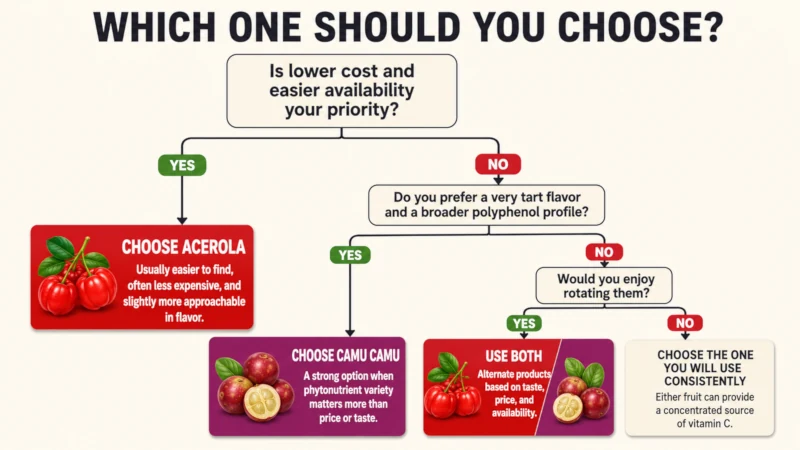
Choose camu camu if you want the highest vitamin C concentration per gram of fresh fruit, you’re specifically interested in its ellagitannin and ellagic-acid content, and you don’t mind paying a premium.
Choose acerola if you want lower cost per serving, easier sourcing, a gentler flavor, more product formats, and a deeper body of research. For most people, this is the sensible default.
Use both if you’re a vitamin C enthusiast who wants variety — their phytonutrient profiles are genuinely different, so they complement rather than duplicate each other. Just count your total vitamin C from both.
Meet the Two Fruits
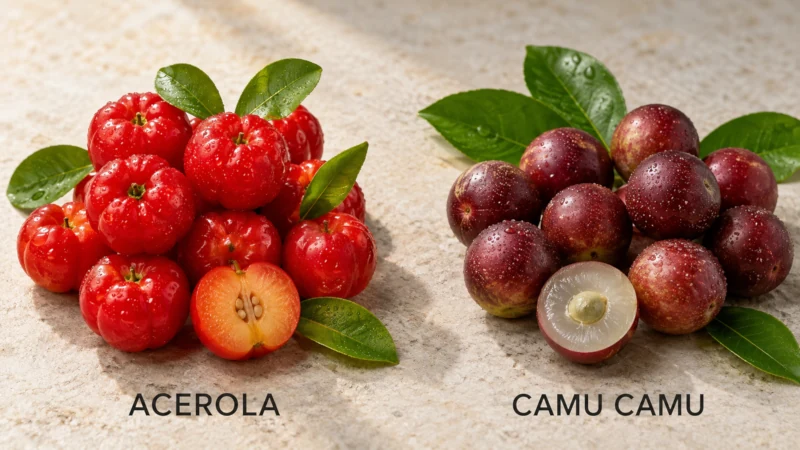
Acerola Cherry (Malpighia emarginata)
Acerola is a small, bright-red, cherry-like fruit — though botanically it isn’t a cherry at all — native to the southern Caribbean, Central America, and southern Mexico. It grows on a shrub or small tree, and each fruit is roughly 1–3 cm across with thin skin, juicy tart pulp, and a few small seeds. Brazil has been cultivating it commercially since the mid-20th century and remains the world’s largest producer, which is a big reason acerola supplements are so widely available and comparatively affordable today [USDA FoodData Central; Prakash & Baskaran, 2018]. For a fuller breakdown of the fruit itself, see the complete acerola cherry guide.
Camu Camu (Myrciaria dubia)
Camu camu is a small, round, reddish-purple berry that grows on a low shrub in the flooded forests of the Amazon basin — Peru, Brazil, Colombia, and neighboring regions. The shrub is unusual: it tolerates months partially submerged during seasonal flooding, and the fruit itself is about 1–3 cm across with one to four seeds inside [Langley et al., 2015; Akter et al., 2011]. Indigenous Amazonian communities have used it for generations, but it only became a globally traded “superfruit” over roughly the past 25 to 30 years, once analysis confirmed its extraordinary vitamin C content.
Vitamin C: The Head-to-Head Number
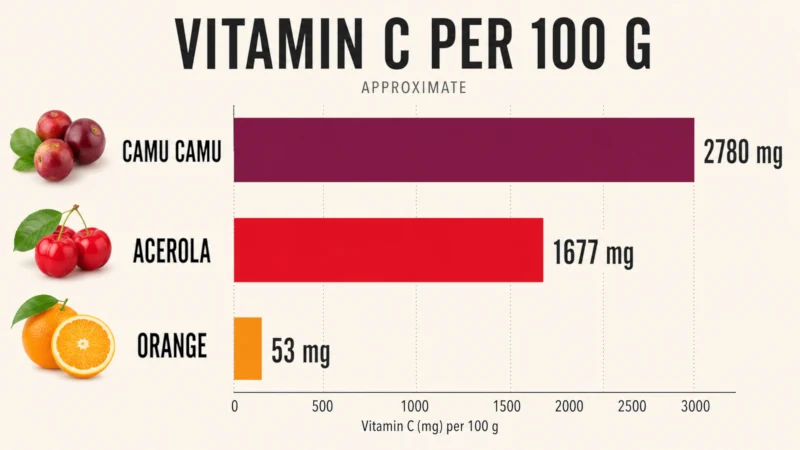
This is the question most people are here for, so here it is directly, with peer-reviewed numbers.
| Fruit (per 100 g fresh) | Vitamin C | Source |
| Camu camu | 2780 mg (up to ~3,000 in some analyses) | Nemirovsky/Villanueva et al., 2014; Langley et al., 2015 |
| Acerola cherry | 1,677 mg average (range ~1,000–4,000+) | USDA FoodData Central; Delva & Schneider |
| Rosehip | 426 mg | USDA |
| Guava | 228 mg | USDA |
| Blackcurrant | 181 mg | USDA |
| Red bell pepper | 128 mg | USDA |
| Kiwifruit | 93 mg | USDA |
| Orange | 53 mg | USDA |
On a per-gram basis, camu camu generally wins, with most analyses placing it above acerola’s USDA average [Nemirovsky/Villanueva et al., 2014; Langley et al., 2015]. But notice how close they are compared to everything else on the list — both fruits carry roughly 30 to 50 times the vitamin C of an orange. The gap between the two is real, but small next to the gap between either fruit and ordinary produce.
One honest caveat: these numbers move a lot. Acerola’s vitamin C ranges from about 1,000 to over 4,000 mg per 100 g depending on cultivar and ripeness — it’s highest when the fruit is slightly underripe and falls as it reddens. Camu camu varies too. So the “winner” depends partly on which sample you measure. For a closer look at how these numbers compare to everyday fruit, see acerola cherry vs orange vitamin C.
What Happens at Real Serving Sizes
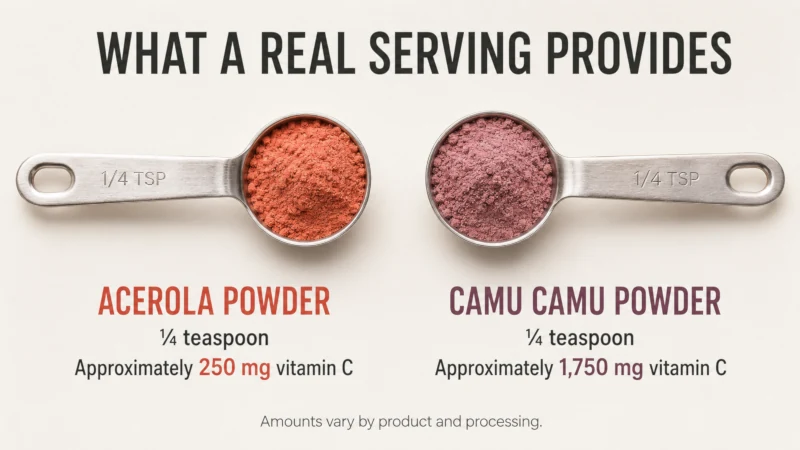
Almost nobody eats 100 grams of either fruit. You take a small scoop of powder or a capsule — and here the fresh-fruit ranking can flip. Freeze-dried acerola powders are often standardized to a high vitamin C concentration, commonly around 17–30% by weight, partly by using unripe fruit [acerola cherry powder guide]. Camu camu powders are frequently less concentrated per gram. So a quarter-teaspoon of a good freeze-dried acerola powder can deliver as much vitamin C as — or more than — the same amount of camu camu powder. The practical takeaway: at the doses people actually use, both easily supply more vitamin C than you need, and the fresh-fruit headline stops being decisive.
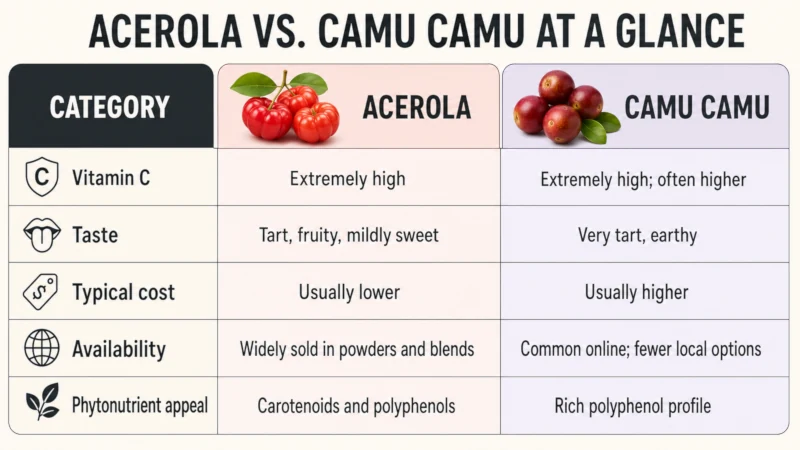
Acerola Cherry vs Camu Camu at a Glance
| Factor | Acerola Cherry | Camu Camu |
| Scientific name | Malpighia emarginata | Myrciaria dubia |
| Native region | Caribbean, Central America, S. Mexico | Amazon basin (Peru, Brazil, Colombia) |
| Largest producer | Brazil | Peru |
| Vitamin C (fresh, /100 g) | ~1,678 mg average (wide range) | ~1,800–2,800 mg |
| Taste | Tart, fruity | More astringent, sharply tart |
| Notable phytonutrients | Quercetin, rutin, anthocyanins, carotenoids | Ellagitannins, ellagic acid, anthocyanins, carotenoids |
| Eaten fresh? | Possible but rare outside tropics | Almost never — too acidic |
| Availability | Wide, mainstream | Specialty |
| Price | Lower | Higher (often 2–3× acerola) |
| Forms | Powder, capsule, juice, pulp, gummies | Powder, capsule, frozen pulp |
| Research history | Decades | Mostly post-2000 |
| Sustainability | Largely cultivated | Largely wild-harvested |
Taste and Palatability
Neither fruit tastes like a sweet dessert cherry, whatever the packaging suggests. Both are intensely sour. The difference is degree. Acerola is tart and citrusy — think very sour cherry or tangy cranberry — and some people tolerate it stirred into water. Camu camu is sharper and more astringent, with a puckering quality that makes it essentially unpalatable straight; it isn’t eaten fresh even in its native region [Langley et al., 2015]. Both work best blended into smoothies, juice, or yogurt with sweeter ingredients. If you plan to mix powder into plain water, acerola is the more forgiving choice.
Beyond Vitamin C: The Phytonutrient Difference
Vitamin C is the headline for both, but it isn’t the whole story — and this is where the two fruits genuinely differ rather than compete.
Acerola’s Profile
Acerola carries bioflavonoids such as quercetin and rutin, along with anthocyanins, carotenoids, and phenolic acids. In laboratory testing, its total antioxidant activity runs higher than its vitamin C content alone would predict, which suggests these polyphenols add something on their own [Mezadri et al., 2008; Prakash & Baskaran, 2018]. For the full breakdown, see the acerola cherry nutrition facts page.
Camu Camu’s Profile
Camu camu leans toward a different set of compounds, dominated by ellagitannins and ellagic-acid derivatives alongside flavonols and anthocyanins. That ellagitannin content is unusually high and is part of what gives the fruit its astringency [García-Chacón et al., 2023; Langley et al., 2015]. These are the compounds most of camu camu’s newer research focuses on.
The Iron Wrinkle Worth Knowing
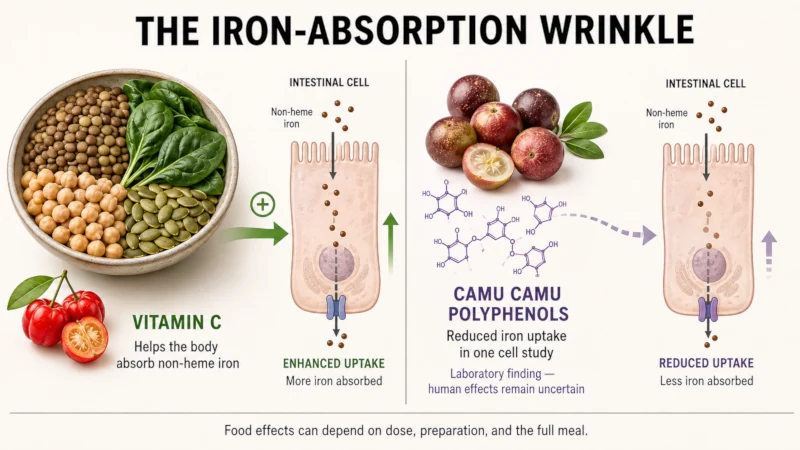
Here’s a practical difference that most comparisons miss. Plain vitamin C is a well-known enhancer of non-heme (plant) iron absorption — one of the everyday reasons to pair vitamin C with plant iron sources. But in one cell-model (Caco-2) study, camu camu juice actually reduced non-heme iron availability rather than boosting it, apparently because its polyphenols outweighed the vitamin C effect. The reduction was statistically significant in a low-polyphenol wheat-porridge meal, but there was no significant effect in an already polyphenol-rich rice-and-lentils meal [Nemirovsky/Villanueva et al., 2014].
Take that finding for what it is — a single in-vitro study, not a human trial — but it points in a real direction. If a major reason you’re taking a vitamin C fruit is to improve iron absorption from plant foods, acerola’s simpler flavonoid profile is the safer bet, since it doesn’t carry the same iron-binding polyphenol load.
What the Research Actually Shows
Be clear-eyed here: neither fruit has the large human clinical-trial base that medications have. Most evidence for both comes from lab studies, animal models, and small human studies, and it should be read as preliminary.
Acerola
The strongest thread is vitamin C itself, which has decades of human research behind it for normal immune function and collagen synthesis. Acerola-specific work is thinner: a small human study found vitamin C from acerola juice was absorbed efficiently and cleared a bit more slowly than plain synthetic ascorbic acid — promising, but a single-dose finding in a handful of people, not a settled advantage [Uchida et al., 2011]. Laboratory and animal research also points to anti-inflammatory activity from its polyphenols [Olędzki & Harasym, 2024].
Camu Camu
Camu camu actually has some specialized research acerola lacks, particularly around metabolic markers. A review of the fruit’s biofunctional properties summarizes antioxidant, antihyperglycemic, antihypertensive, and antiobesity activity across cell, animal, and some human studies — an interesting signal, but one still resting mostly on small and preclinical work rather than large trials [García-Chacón et al., 2023]. A systematic review reached a similar bottom line: promising antioxidant and anti-inflammatory potential tied to its unusual vitamin C, flavonoid, and anthocyanin content, but preliminary [Langley et al., 2015].
| Where the evidence stands: both fruits are best understood as concentrated whole-food vitamin C sources with a supporting cast of antioxidant compounds — not as treatments for any disease. |
Availability, Price, and Sustainability
Acerola’s 70-plus years of commercial cultivation give it mature supply chains, so it turns up in mainstream health stores in many forms — freeze-dried and spray-dried powder, capsules, gummies, juice, and frozen pulp — usually at a lower price. Camu camu remains more of a specialty item, generally sold online or in well-stocked stores and often costing two to three times more per gram.
Sourcing differs too. Most camu camu is still wild-harvested from Amazon floodplain forests, which can support local livelihoods but raises sustainability questions as global demand climbs; cultivated camu camu is growing but remains a minority of supply. Acerola is largely commercially cultivated, which means more predictable supply and less pressure on wild ecosystems. If sourcing transparency matters to you, acerola currently has the edge — or look specifically for cultivated camu camu.
How to Use Either Fruit
Whichever you choose, the practice is nearly identical. Both are typically sold as powder or capsules, both are intensely tart, and both deliver plenty of vitamin C in a small serving.
A common daily amount is about ¼ to 1 teaspoon of powder, roughly 200–500 mg of vitamin C, which sits comfortably above the adult RDA (75–90 mg) and well below the 2,000 mg/day upper limit for total vitamin C from all sources [NIH ODS, 2021]. Because these powders are so concentrated, start low and check your product’s label for milligrams per serving. The same principles apply to both fruits — for the detail, see the acerola dosage guide.
A few practical notes: mix the powder into cold or room-temperature drinks, smoothies, or yogurt; avoid heating, since vitamin C degrades with heat; take it with food to reduce the chance of stomach upset; and add up vitamin C from all sources so your total stays under 2,000 mg/day. For choosing a quality product — stated vitamin C per serving, short ingredient list, third-party testing, transparent sourcing — the acerola cherry powder guide covers criteria that apply equally to camu camu.
Safety, Side Effects, and Who Should Be Careful
For most healthy adults, both fruits are well tolerated in food and normal supplement amounts — the cautions are really about vitamin C at higher intakes, plus a few specific groups.
Common side effects. High vitamin C intake, generally above the 2,000 mg/day upper limit (sometimes lower in sensitive people), can cause nausea, stomach cramps, and diarrhea. This is the main reason to keep your total intake in check [NIH ODS, 2021].
Talk with a healthcare professional first if you:
- Have a history of kidney stones or reduced kidney function — large vitamin C doses raise urinary oxalate, which can promote calcium-oxalate stones in susceptible people.
- Have hemochromatosis or another iron-overload condition — vitamin C increases iron absorption. (This interaction is complex, so get individual advice.)
- Take warfarin or other prescription medications — high-dose vitamin C may affect warfarin and can skew certain lab tests, including some glucose meters and stool occult-blood tests.
- Are pregnant or breastfeeding — food amounts are generally considered fine, but there isn’t enough data to confirm the safety of concentrated supplemental doses; check with your prenatal provider.
Realistic expectations. These are whole-food vitamin C sources, not medicine. Routine vitamin C doesn’t reliably prevent colds in the general population, and no fruit powder treats or cures disease.
Red flags — when to get medical care. A food-based vitamin C powder won’t cause an emergency on its own, but don’t use it to self-treat symptoms that need attention. Seek prompt care for hives, swelling, or trouble breathing after taking either fruit — call 911 for breathing difficulty, which can signal a serious allergic reaction. Get evaluated at urgent care or your primary-care provider for flank or back pain that could be a kidney stone, and see a professional before combining either supplement with prescription medication rather than adjusting your dose on your own.
Health Disclaimer
| Medical disclaimer: This article is for general education only. It is not medical advice and is not intended to diagnose, treat, cure, or prevent any disease. Supplements can interact with medications and health conditions. Talk with a qualified healthcare professional before adding acerola, camu camu, or any new supplement to your routine — especially if you are pregnant, breastfeeding, managing a medical condition, or taking prescription medication. |
Frequently Asked Questions
Which has more vitamin C, acerola or camu camu?
Camu camu is generally higher per gram of fresh fruit — roughly 1,800–2,800 mg per 100 g versus acerola’s ~1,678 mg average — but both figures vary widely with ripeness and cultivar. In powder form the gap often narrows or reverses, because freeze-dried acerola is frequently standardized to a higher concentration. Both supply far more vitamin C than you need in a small serving [Nemirovsky/Villanueva et al., 2014; USDA].
Is camu camu better than acerola cherry?
Not across the board. Camu camu leads on raw vitamin C concentration and has some interesting metabolic research; acerola leads on price, availability, taste, versatility, and depth of research. The right choice depends on your priorities, not one number.
Can I take acerola and camu camu together?
Yes — they aren’t duplicates. Acerola is richer in quercetin and rutin; camu camu is richer in ellagitannins and ellagic acid. Just add up the vitamin C from both and keep your total under 2,000 mg/day.
Why is camu camu more expensive?
It’s mostly wild-harvested from remote Amazon floodplains with limited cultivated supply, while acerola has been commercially farmed in Brazil for over 70 years. Limited supply, longer transport, and labor-intensive harvesting push camu camu to roughly two to three times acerola’s price.
Which is better for immune support?
Both provide more than enough vitamin C to support normal immune function at typical servings. Regular vitamin C (about 200 mg/day or more) doesn’t prevent colds in the general population but has been found to modestly shorten cold duration — around 8% in adults and 14% in children in a large review [Hemilä & Chalker, 2013]. Neither fruit has been shown superior head-to-head.
Which is more sustainable?
Acerola generally, because it’s largely cultivated with established supply chains. Camu camu is mostly wild-harvested from Amazon floodplains, which raises sustainability concerns as demand grows. If sourcing matters to you, look for cultivated camu camu or choose acerola.
References
- USDA FoodData Central. Acerola (West Indian cherry), raw. FDC #171686. View source
- NIH Office of Dietary Supplements (2021). Vitamin C: Fact Sheet for Health Professionals. View source
- García-Chacón, J.M., Marín-Loaiza, J.C., & Osorio, C. (2023). Camu Camu (Myrciaria dubia): An Amazonian Fruit with Biofunctional Properties—A Review. ACS Omega, 8(6), 5169–5183. View source
- Langley, P.C., Pergolizzi, J.V. Jr., Taylor, R. Jr., & Ridgway, C. (2015). Antioxidant and Associated Capacities of Camu Camu (Myrciaria dubia): A Systematic Review. J Altern Complement Med, 21(1), 8–14. View source
- Akter, M.S., Oh, S., Eun, J.B., & Ahmed, M. (2011). Nutritional compositions and health promoting phytochemicals of camu-camu (Myrciaria dubia) fruit: A review. Food Research International, 44(7), 1728–1732. View source
- Nemirovsky, Y., Zavaleta, N., Villanueva, M.E., Armah, S.M., Iman, S.A., & Reddy, M.B. (2014). Negative Effect of Camu-Camu Despite High Vitamin C Content on Iron Bioavailability, Using a Caco-2 Cell Model. Pol J Food Nutr Sci, 64(1), 45–48. View source
- Mezadri, T., et al. (2008). Antioxidant compounds and antioxidant activity in acerola fruits and derivatives. J Food Composition and Analysis, 21(4), 282–290. View source
- Prakash, A., & Baskaran, R. (2018). Acerola, an untapped functional superfruit: a review on latest frontiers. J Food Science and Technology, 55(9), 3373–3384. View source
- Uchida, E., et al. (2011). Absorption and excretion of ascorbic acid alone and in acerola juice: comparison in healthy Japanese subjects. Biol Pharm Bull, 34(11), 1744–1747. View source
- Olędzki, R., & Harasym, J. (2024). Acerola (Malpighia emarginata) anti-inflammatory activity — a review. Int J Mol Sci, 25(4), 2089. View source
- Hemilä, H., & Chalker, E. (2013). Vitamin C for preventing and treating the common cold. Cochrane Database Syst Rev, (1), CD000980. View source
