
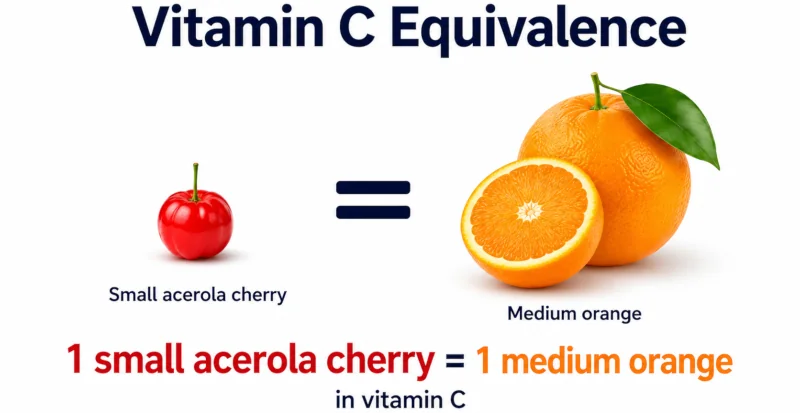
The short version of the acerola cherry vs orange vitamin C comparison is this: one small acerola cherry holds about as much vitamin C as a whole orange. Using standard USDA figures, raw acerola carries roughly 1,678 mg of vitamin C per 100 grams, while a raw orange carries about 53 mg [USDA, acerola] [USDA, orange]. That makes acerola around 30 times more concentrated, gram for gram.
But concentration is one number, not the whole picture. Once you weigh cost, availability, calories, and what else each fruit brings to the table, the gap narrows fast. Oranges stay popular for reasons that have little to do with milligrams per gram. Here is how the two stack up — and when each one earns a place in your day. For background on the smaller fruit, see the complete guide to acerola cherry.
The vitamin C numbers, side by side
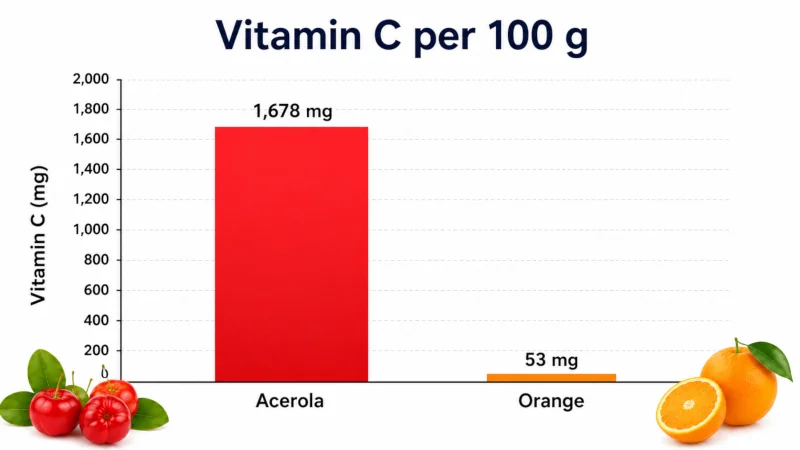
These figures come from USDA FoodData Central, the reference database for U.S. food composition. Acerola is listed as raw fruit; the orange figure is for raw oranges, all commercial varieties.
| Source | Vitamin C (mg/100g) | % Daily Value* | Times adult RDA |
| Acerola, raw | ~1,678 mg | 1,864% | ~19× |
| Orange, raw | ~53 mg | 59% | ~0.6× |
| Fresh orange juice | ~50 mg | 56% | ~0.6× |
*Based on a 90 mg Daily Value. Sources: USDA FoodData Central; NIH Office of Dietary Supplements.
A typical acerola cherry weighs only 4–5 grams, yet packs 70–80 mg of vitamin C — enough on its own to meet the adult daily requirement. A medium orange (about 130–150 g) delivers a similar 70–80 mg. So the headline holds up: one little cherry roughly equals one orange. The difference is that you would struggle to eat 100 grams of fresh acerola in a sitting, while 100 grams of orange is barely half a fruit.
Why acerola is so loaded with vitamin C
Acerola evolved in hot, high-light tropical conditions, and its flesh stores an unusual amount of ascorbic acid. Two things move the number around a lot.
Ripeness matters more than most people expect. Acerola holds the most vitamin C while it is still green or just turning, and the level falls as the fruit reddens and sweetens. Growers often blend ripe and slightly underripe fruit to balance taste against potency [Prakash & Baskaran, 2018].
Cultivar and climate matter too. Across varieties and growing regions, reported vitamin C runs anywhere from about 1,500 to 4,500 mg per 100 g [Prakash & Baskaran, 2018]. That wide range is why you will see acerola described as anything from 30 to 100 times richer than an orange, depending on which sample someone measured. Oranges, by contrast, vary little — roughly 45–70 mg per 100 g.
Beyond vitamin C: the fuller nutrition picture
Vitamin C is the headline, but it is not the only line on the label. Per 100 grams, the two fruits trade strengths.
| Nutrient (per 100 g) | Acerola, raw | Orange, raw |
| Calories | 32 kcal | 47 kcal |
| Vitamin C | ~1,678 mg | ~53 mg |
| Vitamin A | 767 IU | 225 IU |
| Folate | 14 mcg | 30 mcg |
| Potassium | 146 mg | 181 mg |
| Calcium | 12 mg | 40 mg |
| Fiber | 1.1 g | 2.4 g |
| Sugars | Low | 9.4 g |
Source: USDA FoodData Central. Values are approximate and shift with cultivar, ripeness, and growing conditions.
Acerola takes vitamin C and vitamin A. Oranges carry more folate, fiber, and calcium, plus the natural sugars and bulk that make a piece of fruit feel like a snack. Both are low in calories and mostly water. For the granular breakdown, see the full acerola nutrition profile.
Does your body absorb them differently?
Vitamin C is one molecule — L-ascorbic acid — whether it arrives in an acerola cherry, an orange, or a tablet. What can differ is the company it keeps. Whole fruit comes packaged with flavonoids, and some research suggests those compounds help the body take up and hold onto the vitamin.
In one small Japanese study, healthy young men took single doses of plain ascorbic acid (50 to 500 mg) or the same amount delivered as acerola juice. Blood levels ran slightly higher and urinary losses slightly lower after the juice, hinting that something in the fruit — likely its flavonoids — improves retention [Uchida et al., 2011]. Keep that in proportion, though: the trial was small, used juice rather than whole fruit, was run by a food company, and compared acerola to a synthetic supplement — not to oranges.
The Linus Pauling Institute’s read is steadier: for people already getting enough vitamin C from food, the difference between food-based and synthetic vitamin C is unlikely to matter much in everyday terms [Linus Pauling Institute]. Both fruits bring their own flavonoids — acerola has quercetin, rutin, and anthocyanins; oranges have hesperidin and naringenin — and both deliver vitamin C your body absorbs well. On absorption alone, there is no clear winner between them.
Where oranges win: cost, access, and everyday use
This is the part that flips the comparison. Per gram, acerola dominates. In real life, oranges are usually the easier call.
Acerola cherry vs orange vitamin C: Availability
Oranges sit in every grocery store, year-round, for a dollar or less. Fresh acerola barely travels — it bruises easily and spoils within a few days of picking, so outside the tropics you will almost only find it as powder, juice, capsules, or frozen pulp from specialty sellers.
Cost per milligram of vitamin C
Acerola’s higher sticker price can be misleading. A 4-ounce tub of powder runs about $15–$30 and yields roughly 50 quarter-teaspoon servings, each delivering around 250–300 mg of vitamin C. Worked out per milligram, concentrated acerola powder can land at or below the cost of getting the same vitamin C from oranges — though the exact figure depends heavily on the product.
| Source | Typical cost | Vitamin C / serving | Per 100 mg |
| Medium orange | $0.30–$1.00 | 70–80 mg | $0.40–$1.30 |
| Acerola powder (¼ tsp) | $0.30–$0.60 | 250–300 mg | $0.10–$0.20 |
Illustrative U.S. retail estimates, early 2026. Actual prices vary by region, brand, and product potency.
Calories, sugar, and snack value
A medium orange brings about 60–70 calories and 12–15 grams of natural sugar; a quarter-teaspoon of acerola powder brings under 5 calories and almost no sugar. If you are counting carbs, acerola is the leaner way to hit a vitamin C target. But the orange is the one you can actually peel and eat — it satisfies, hydrates, and fits into a meal without thinking about it. A scoop of powder in water does the nutritional job without the same payoff. If you do go the supplement route, our guide to choosing an acerola supplement walks through what to look for on a label.
How much vitamin C do you actually need?
Before chasing the biggest number, it helps to know the target. The recommended intake is modest.
| Group | Vitamin C per day |
| Adult men | 90 mg |
| Adult women | 75 mg |
| Pregnancy | 85 mg |
| Breastfeeding | 120 mg |
| Smokers | Add 35 mg to the above |
| Upper limit (adults) | 2,000 mg |
Source: NIH Office of Dietary Supplements. [NIH ODS]
One medium orange covers the full adult requirement. So do a couple of small acerola cherries. Most people who eat some fruit and veg already clear the bar without trying.
Some aim higher — 200 mg a day or more, often for cold season. A Cochrane review of controlled trials found that taking at least 200 mg daily, regularly, did not stop healthy people from catching colds, but it did modestly shorten how long colds lasted — by about 8% in adults and 14% in children. Starting vitamin C only after symptoms appeared showed no consistent benefit [Hemilä & Chalker, 2013]. Vitamin C also supports normal immune function as part of an adequate diet [Carr & Maggini, 2017]. Reaching 200 mg from oranges means three or four a day; acerola gets you there in a quarter-teaspoon. For practical amounts, see the acerola dosage guide.
So which should you choose?
They are not really rivals. They do different jobs.
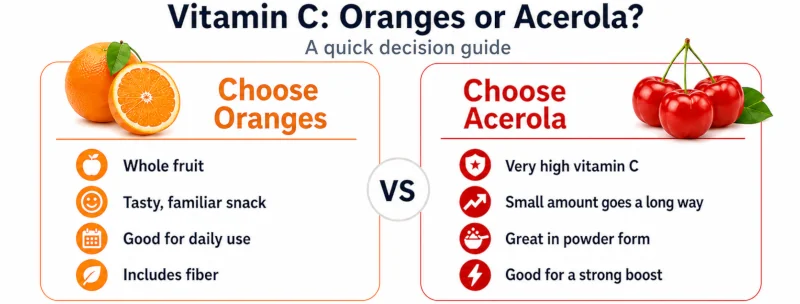
Reach for oranges when:
- you want a whole-food snack with vitamin C as a bonus;
- convenience and year-round availability matter most;
- you also want fiber, folate, and natural hydration.
Reach for acerola when:
- you want a concentrated, near-zero-calorie vitamin C top-up;
- you are watching sugar or carbohydrates;
- you want a shelf-stable form for travel, or intake above what a few oranges practically give.
For most people the honest answer is both. Oranges handle everyday nutrition and the pleasure of eating fruit; acerola is a tidy way to lift vitamin C when you actually want more — cold season, heavy training, a skin-care routine. Treat them as teammates, not competitors.
Safety, side effects, and who should be careful
Vitamin C from whole fruit is about as safe as food gets. The cautions below apply mainly to concentrated acerola supplements and high-dose vitamin C — not to eating an orange.
- Too much at once: above the adult upper limit of 2,000 mg a day, vitamin C can cause stomach cramps, nausea, and diarrhea [NIH ODS]. A quarter-teaspoon of acerola powder sits well under that; stacking scoops can push you over.
- Kidney stones: high-dose vitamin C supplements raise urinary oxalate and have been linked to a higher stone risk, mainly in men. If you have had calcium-oxalate stones, keep supplemental vitamin C modest and check with your clinician [NIH ODS].
- Iron overload: vitamin C boosts iron absorption from food, which helps most people but is a reason for caution if you have hemochromatosis or another iron-overload condition.
- Medications: if you take a blood thinner such as warfarin, mention any high-dose vitamin C to your prescriber before starting.
- Pregnancy and breastfeeding: vitamin C from food — oranges or modest acerola — is encouraged. Routine high-dose supplements are not advised in pregnancy, and acerola supplement safety in pregnancy is not well studied, so ask your provider first [NIH ODS].
Who should be cautious with concentrated acerola: anyone prone to oxalate kidney stones, people with iron overload, those on blood thinners, and anyone pregnant or breastfeeding who is considering more than food amounts.
A realistic expectation: neither fruit is a cold cure or an immune shield. Vitamin C supports normal immunity, but more stops helping once you are replete — your body simply flushes the excess. Think of acerola as a convenient way to top up, not as medicine.
| This article is for general education only. It is not medical advice and is not intended to diagnose, treat, cure, or prevent any disease. Talk with a qualified healthcare professional before changing your diet or starting any supplement, especially if you are pregnant or breastfeeding, take prescription medication, or have a kidney, iron, or other health condition. Individual needs vary. |
Frequently asked questions
How much more vitamin C does acerola have than an orange?
Using standard USDA values — about 1,678 mg per 100 g for acerola versus roughly 53 mg for an orange — acerola has around 30 times more vitamin C per gram. Because acerola’s content varies widely by cultivar and ripeness, some samples push that ratio higher. A single small cherry holds about as much vitamin C as one medium orange.
Is acerola powder better than orange juice for vitamin C?
Per serving, acerola is far more concentrated: a quarter-teaspoon of powder typically delivers 250–300 mg, while a glass of orange juice gives about 50–120 mg. Orange juice still offers folate, fluid, and the simple pleasure of a drink that powder in water doesn’t match.
Can I replace oranges with an acerola supplement?
You can cover the vitamin C, but you’d lose the fiber, folate, hydration, and snack value an orange provides. A practical approach uses both: oranges for everyday eating, acerola when you want a concentrated top-up.
How many oranges equal a teaspoon of acerola powder?
A teaspoon of freeze-dried acerola powder provides roughly 1,000–1,200 mg of vitamin C — in the ballpark of 13 to 16 medium oranges. Potency varies by product, so check the label for vitamin C per serving.
Is acerola or orange vitamin C better absorbed?
Both are well absorbed. A small study found acerola juice produced slightly higher blood levels and lower urinary losses than synthetic ascorbic acid, but that compared acerola to a supplement, not to oranges. For people getting enough from food, the practical difference between the two fruits is minimal.
References
- U.S. Department of Agriculture, FoodData Central. Acerola (West Indian cherry), raw (FDC 171686). → View source
- U.S. Department of Agriculture, FoodData Central. Oranges, raw, all commercial varieties (FDC 169097). → View source
- NIH Office of Dietary Supplements. Vitamin C: Fact Sheet for Health Professionals (updated 2025). → View source
- Linus Pauling Institute, Oregon State University. Vitamin C — Micronutrient Information Center. → View source
- Uchida E, et al. Absorption and excretion of ascorbic acid alone and in acerola juice: comparison in healthy Japanese subjects. Biol Pharm Bull. 2011;34(11):1744–1747. → View source
- Prakash A, Baskaran R. Acerola, an untapped functional superfruit: a review on latest frontiers. J Food Sci Technol. 2018;55(9):3373–3384. → View source
- Hemilä H, Chalker E. Vitamin C for preventing and treating the common cold. Cochrane Database Syst Rev. 2013;(1):CD000980. → View source
- Carr AC, Maggini S. Vitamin C and immune function. Nutrients. 2017;9(11):1211. → View source
