
The best foods for healthy arteries aren’t exotic “artery cleansers” — they’re everyday plants and unsaturated fats that lower the things which damage blood vessels over time: high LDL cholesterol, high blood pressure, and chronic inflammation. No food scrubs plaque out of a clogged artery. But the right pattern of eating can slow how fast plaque forms, help stabilize what’s already there, and measurably lower your risk of a heart attack or stroke.
That distinction matters. A lot of online advice promises foods that “unclog” or “clean” arteries. Arteries are living tissue, not drainpipes, and the science doesn’t back the scrubbing image. What it does back is steady, unglamorous prevention — and that’s what this guide focuses on.
What “healthy arteries” actually means
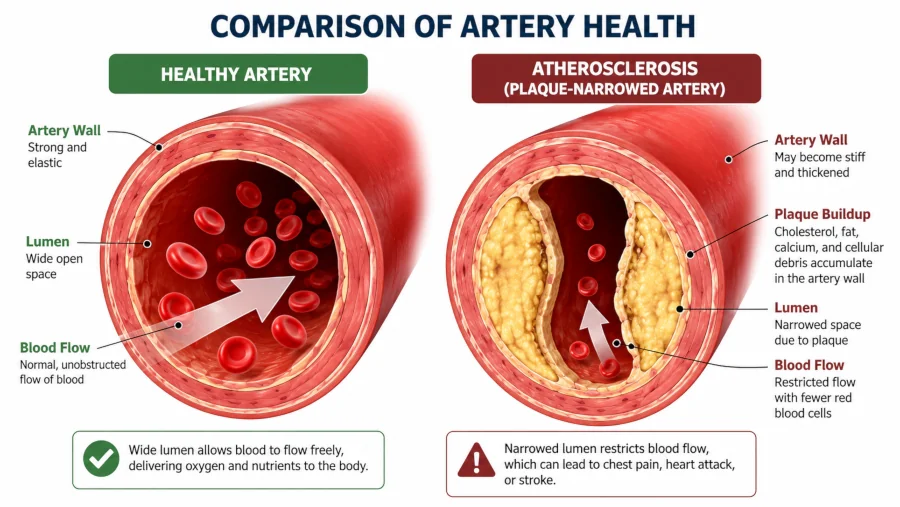
Arteries carry oxygen-rich blood from your heart to the rest of your body. Their main threat is atherosclerosis — a slow buildup of cholesterol-rich plaque inside the artery wall that narrows the channel blood flows through [MedlinePlus / NHLBI, 2024]. When too much LDL (“bad”) cholesterol circulates in your blood, it collects in the wall and feeds that plaque. If a plaque ruptures and a clot blocks the vessel, the result is a heart attack or stroke [MedlinePlus / NHLBI, 2024].
HDL (“good”) cholesterol works the other way, ferrying cholesterol back to the liver to be cleared [Mayo Clinic, 2024]. Diet and exercise can nudge HDL up — but medicines designed only to raise HDL haven’t lowered heart-attack rates, so chasing HDL for its own sake isn’t the goal [Mayo Clinic, 2024].
So when a food genuinely helps your arteries, it’s usually doing one of a few concrete things: lowering LDL, lowering blood pressure, calming inflammation, or improving how the artery lining (the endothelium) controls blood flow. Hold onto those four mechanisms — they’re how you separate a real claim from a marketing one.
The eating pattern that protects arteries most
Single “hero” foods get the headlines, but the strongest evidence is for an overall pattern. In the PREDIMED trial, 7,447 older Spanish adults at high cardiovascular risk were randomly assigned to a Mediterranean diet supplemented with either extra-virgin olive oil or mixed nuts, or to a lower-fat control diet. Over roughly five years, both Mediterranean groups had about 30% fewer major cardiovascular events — heart attack, stroke, or cardiovascular death — than the control group [Estruch et al., NEJM 2018]. That’s some of the best evidence we have that a way of eating, not a supplement, protects arteries.
The American Heart Association’s 2021 dietary guidance describes the same idea in plain food terms [AHA, 2021]:
- Plenty and a variety of fruits and vegetables
- Whole grains rather than refined ones
- Protein mostly from plants — beans, lentils, nuts — with fish and seafood, and lean unprocessed meat if you eat meat
- Liquid plant oils (olive, canola) instead of tropical oils, butter, or partially hydrogenated fats
- Minimally processed foods over ultra-processed ones, with little added sugar and little salt
You don’t have to call it “Mediterranean.” The components are what matter.
Foods for healthy arteries, and what each one does
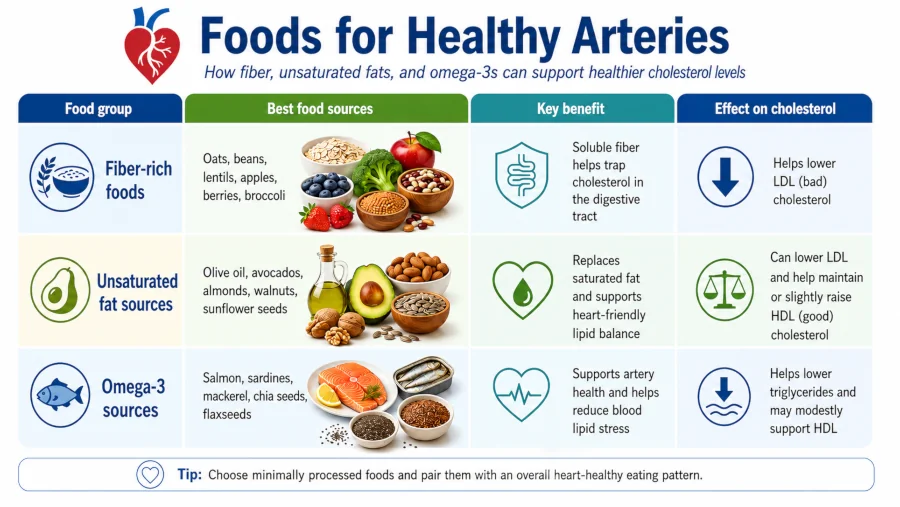
Here’s how the main groups compare, with the realistic size of the effect rather than the hype.
| Food group | Helpful component | What the evidence shows | Realistic effect |
| Oats, barley, beans, lentils, psyllium | Soluble fiber (incl. oat beta-glucan) | ≥3 g/day of oat beta-glucan lowered LDL ~0.25 mmol/L (~10 mg/dL) across 28 trials [Whitehead et al., 2014]. | Modest, reliable LDL drop |
| Olive oil, nuts, seeds, avocado | Unsaturated fats | Replacing saturated fat with these lowers LDL; EVOO and nuts drove the ~30% event reduction in PREDIMED [Estruch et al., 2018]. | Strong, when they replace sat fat |
| Salmon, sardines, mackerel | Omega-3 fats | Lower triglycerides and inflammation; a core protein in the AHA pattern [AHA, 2021]. | Supportive |
| Vegetables, fruit, leafy greens, beets | Potassium, polyphenols, nitrate | Potassium offsets sodium’s effect on blood pressure; dietary nitrate becomes nitric oxide, which relaxes vessels. | Supportive, BP-focused |
| Whole grains | Fiber, B vitamins, minerals | Higher whole-grain intake is part of every artery-protective pattern [AHA, 2021]. | Supportive |
Soluble-fiber foods
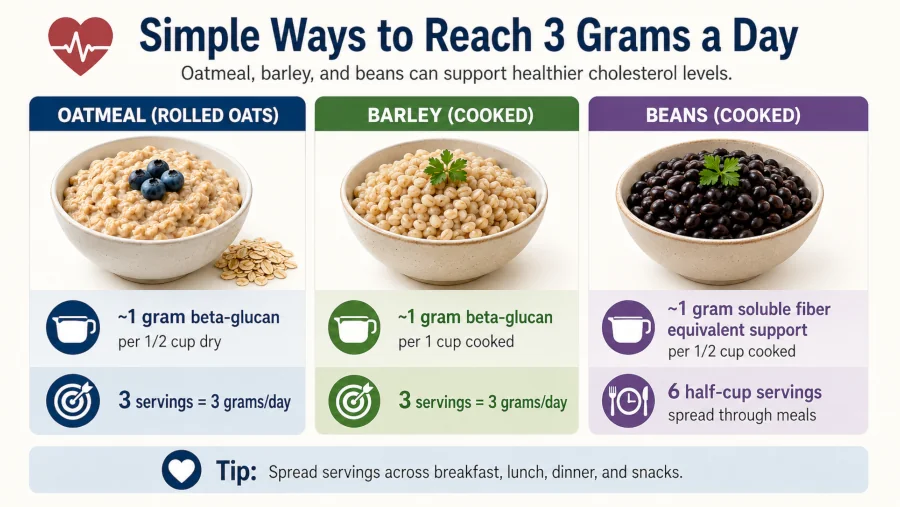
Oats, barley, beans, lentils, chickpeas, psyllium, and the pectin in apples, pears, and citrus form a gel in your gut that traps cholesterol and carries it out. In a meta-analysis of 28 randomized trials, getting at least 3 grams a day of oat beta-glucan — the soluble fiber in oats — lowered LDL by about 0.25 mmol/L, roughly 10 mg/dL, without touching the helpful HDL [Whitehead et al., 2014]. A single bowl of oatmeal gives only about 1.5–2 grams, so you usually need a second source to reach 3. Beans and lentils pull double duty: fiber plus plant protein that displaces meat. They sit among the other foods studied for arterial health worth rotating into your week.
Unsaturated fats
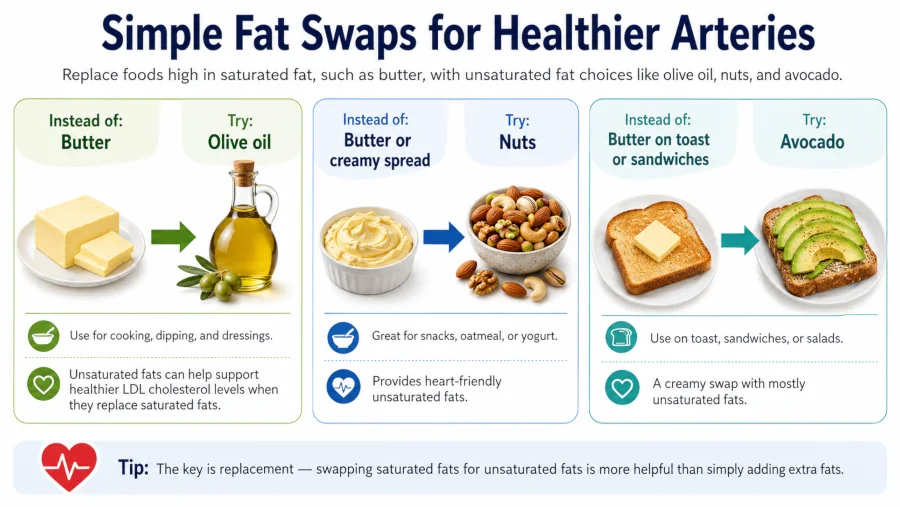
Swapping saturated fat — butter, fatty meat, full-fat dairy — for unsaturated fat from olive oil, nuts, seeds, and avocado is one of the most dependable ways to lower LDL. Extra-virgin olive oil and mixed nuts were the exact supplements behind the PREDIMED benefit [Estruch et al., 2018]. In a controlled study published by the AHA, eating one avocado a day as part of a moderate-fat, cholesterol-lowering diet improved LDL in overweight adults — but the gain came from putting avocado in place of saturated fat, not piling it on top of an unchanged diet [AHA, 2019]. The word “replace” does the heavy lifting every time.
Fatty fish, produce, and whole grains
Salmon, sardines, mackerel, and herring supply omega-3 fats that lower triglycerides and calm inflammation, which is why the AHA keeps fish and seafood as a core protein [AHA, 2021]. Vegetables and fruit add potassium to counter sodium’s push on blood pressure, plus polyphenols tied to better vessel function; leafy greens and beets are rich in nitrate that the body turns into vessel-relaxing nitric oxide. Whole grains keep the bran and fiber that refined flour strips away. You can see how these fit alongside a broader list of heart-healthy foods and foods linked with lower stroke risk.
Foods that work against your arteries
What you cut matters as much as what you add. The AHA suggests keeping saturated fat under 6% of daily calories — about 13 grams on a 2,000-calorie day — and replacing it with unsaturated fat [AHA, Saturated Fats]. Trans fats from partially hydrogenated oils are worse and worth avoiding outright. Excess sodium drives up blood pressure, and most of it hides in bread, deli meat, canned soup, and restaurant meals rather than the salt shaker. Ultra-processed foods and sugary drinks round out the list. For the full picture, see foods that clog arteries.
How much difference can food really make?
Be realistic. Diet alone won’t dissolve an established blockage, and it isn’t a substitute for prescribed medicine if your risk is high. What a good pattern does is shift the numbers that drive risk — a few LDL points from fiber here, a notch of blood pressure from less sodium and more potassium there — and those small moves compound over years.
One caution: antioxidant-rich foods track with healthier arteries, but antioxidant supplements are not the same thing. Large trials of vitamin E pills, for example, did not cut heart attacks or strokes, even though vitamin E–rich foods like nuts and seeds belong in a heart-healthy diet. The benefit rides with whole foods, not isolated high-dose capsules. Food also works best stacked with the rest of prevention: not smoking, regular movement, a healthy weight, and taking any statin or blood-pressure medicine your clinician prescribes.
Safety, interactions, and who should take care
Most of these foods are safe for most people. A few real interactions are worth knowing.
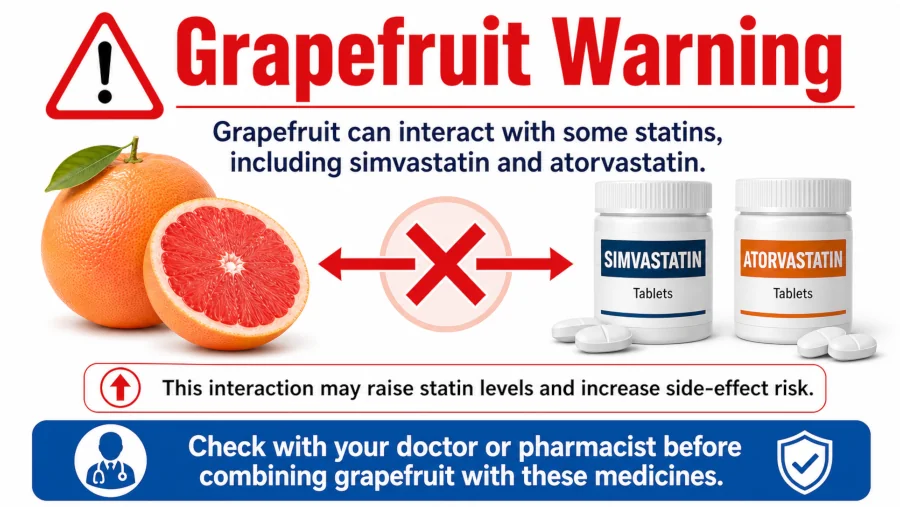
Grapefruit and certain statins. This is the big one, and it cuts against old “grapefruit cleans your arteries” advice. Grapefruit and its juice block an intestinal enzyme (CYP3A4) that breaks down some cholesterol drugs, which can push drug levels too high and raise the risk of muscle damage. The FDA names simvastatin (Zocor) and atorvastatin (Lipitor) specifically [FDA]. Rosuvastatin and pravastatin are affected far less. If you take a statin, ask your pharmacist whether grapefruit is safe with yours.
Leafy greens and warfarin. Greens are high in vitamin K, which affects the blood thinner warfarin. You don’t have to avoid them — keep intake steady week to week and tell whoever manages your warfarin dose.
Potassium and kidney or blood-pressure medicines. Potassium-rich foods help most people’s blood pressure, but with kidney disease or an ACE inhibitor, ARB, or potassium-sparing diuretic, too much potassium can be dangerous. The same caution applies to “salt substitutes,” which often swap sodium for potassium chloride. Check with your clinician first.
Adding fiber. Build up soluble fiber gradually and drink water, or you may get bloating and gas. Fiber can also slow how some medicines absorb, so separate a large fiber dose from your pills by a couple of hours.
Pregnancy and breastfeeding. These are ordinary foods and generally fine. The exception is fish — during pregnancy, choose lower-mercury options like salmon and sardines and limit high-mercury fish. Skip high-dose supplements unless your clinician recommends them.
Signs you shouldn’t try to manage with diet
Diet is prevention, not first aid. Call emergency services for chest pain or pressure, pain spreading to the arm, neck, or jaw, sudden shortness of breath, or stroke signs — face drooping, arm weakness, or slurred speech. Cramping leg pain when you walk that eases with rest can signal narrowed leg arteries and deserves a prompt medical visit. And if you simply don’t know your cholesterol or blood-pressure numbers, that’s the cue to book a check-up rather than self-treat.
Health Disclaimer
This article is for general education only and is not medical advice or a substitute for care from a qualified professional. It does not diagnose, treat, cure, or prevent any disease. Talk to your doctor, pharmacist, or a registered dietitian before making major diet changes — especially if you have heart, kidney, or liver disease, are pregnant or breastfeeding, or take prescription medication such as statins or blood thinners. If you think you are having a heart attack or stroke, call your local emergency number right away.
Frequently asked questions
Can any food actually unclog arteries?
No. No food removes plaque that has already formed. A heart-healthy pattern can slow new buildup, help stabilize existing plaque, and lower your risk — but significant blockages are treated medically, not with groceries.
How long before a better diet changes my cholesterol?
Soluble fiber and fat swaps can move LDL within a few weeks. Lowering your actual artery-disease risk is a longer game, measured in months and years of consistent habits.
Is grapefruit good or bad for arteries?
Grapefruit is nutritious, but it interacts dangerously with some statins, including simvastatin and atorvastatin. If you take one of those, check with your pharmacist before eating it.
Are supplements as good as the foods?
Usually not. Whole foods carry the benefit; antioxidant pills such as vitamin E have not reduced heart attacks or strokes in large trials. Spend your effort on the diet, not the capsule.
What’s the single most effective change?
Replacing saturated fat with unsaturated fat — olive oil, nuts, seeds — while cutting ultra-processed and salty foods. The pattern beats any one “superfood.”
Do I still need medication if I eat well?
Maybe. Diet complements but doesn’t always replace a statin or blood-pressure medicine. Never stop a prescribed drug without talking to your clinician.
References
- American Heart Association. “An avocado a day may help keep bad cholesterol at bay.” 2019. → View source
- MedlinePlus / National Heart, Lung, and Blood Institute. “LDL: The ‘Bad’ Cholesterol.” Updated 2024. → View source
- Mayo Clinic. “HDL cholesterol: How to boost your ‘good’ cholesterol.” 2024. → View source
- Estruch R, et al. “Primary Prevention of Cardiovascular Disease with a Mediterranean Diet Supplemented with Extra-Virgin Olive Oil or Nuts.” N Engl J Med. 2018. doi:10.1056/NEJMoa1800389. → View source
- Lichtenstein AH, et al. “2021 Dietary Guidance to Improve Cardiovascular Health: A Scientific Statement From the American Heart Association.” Circulation. 2021. → View source
- American Heart Association. “Saturated Fats.” → View source
- Whitehead A, et al. “Cholesterol-lowering effects of oat β-glucan: a meta-analysis of randomized controlled trials.” Am J Clin Nutr. 2014;100(6):1413–1421. → View source
- U.S. Food and Drug Administration. “Grapefruit Juice and Some Drugs Don’t Mix.” → View source
