Acerola cherry is a small red tropical fruit prized for one unusual trait: gram for gram, it contains more vitamin C than almost any other food. Raw acerola supplies roughly 1,678 mg of vitamin C per 100 grams — more than 18 times an adult’s daily requirement and around 30 times the amount in an orange [USDA FoodData Central; NIH ODS, 2021]. Most of its researched benefits trace back to that vitamin C, alongside a mix of plant antioxidants. The evidence is strongest for immune and antioxidant roles; several other promising effects remain at the early, mostly laboratory stage.
| Quick answer. Acerola (Malpighia emarginata) is a whole-food source of vitamin C, sold mostly as powder, capsules, juice, and frozen pulp. A practical daily amount for general wellness is 100–500 mg of vitamin C from acerola, kept below the 2,000 mg/day upper limit for total vitamin C. It’s generally safe for most adults, but people with a history of kidney stones, those taking warfarin, anyone with a latex allergy, and people who are pregnant or breastfeeding should talk to a clinician before using supplemental doses. |
What Is Acerola Cherry?
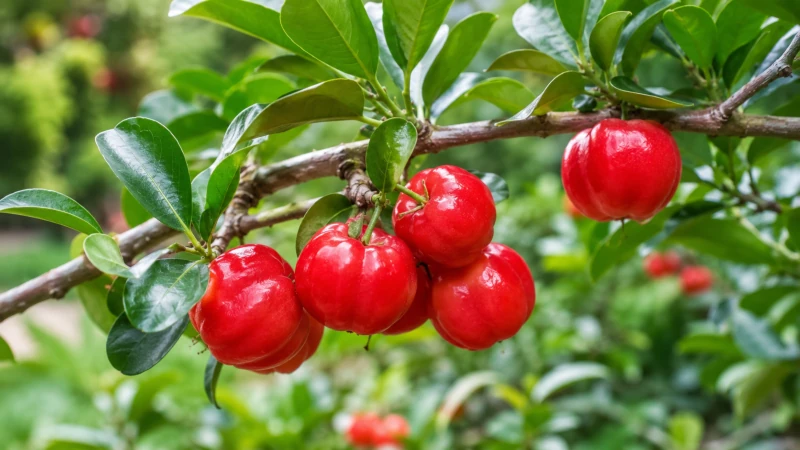
Acerola cherry is the fruit of Malpighia emarginata, a shrub or small tree in the Malpighiaceae family. Despite the name, it is not a true cherry — true cherries belong to the genus Prunus, a completely different plant family. The “cherry” label comes from the fruit’s small size and bright red color, not its botany.
What sets acerola apart is its vitamin C concentration. Mid-20th-century research at the University of Puerto Rico identified it as one of the richest known natural sources of the nutrient — a position it still shares with only a few fruits, most notably camu camu (Myrciaria dubia), an Amazonian berry [Moscoso, 1956]. Today acerola is consumed worldwide as a whole-food vitamin C source, and nutrition researchers have described it as “an untapped functional superfruit” worth closer study [Prakash & Baskaran, 2018].
Botanical profile
Malpighia emarginata is an evergreen shrub or small tree that usually grows 2–3 meters (6–10 feet) tall, occasionally reaching 6 meters. It produces clusters of small pink-to-red flowers from spring through late autumn, followed by cherry-like fruits that ripen from green to bright red over three to four weeks. Each fruit weighs about 3–5 grams, has a three-lobed shape, and holds two to three small seeds. Ripe flesh is juicy and tart, with a flavor often compared to a sour apple.
The plant favors well-drained sandy soil and full sun, and it cannot tolerate temperatures much below freezing. Its shallow root system makes it sensitive to strong winds but well suited to container growing [Delva & Schneider, 2013]. Brazil is the world’s largest commercial producer, and a national germplasm collection has been maintained in Pernambuco to preserve the plant’s genetic diversity [Assis et al., 2008].
The name confusion — Barbados cherry, West Indian cherry, and more
If you’ve seen “Barbados cherry,” “West Indian cherry,” “Puerto Rican cherry,” or “cereza” on a label, you’ve met acerola under a different name. The fruit carries at least a dozen regional names, which causes real confusion for shoppers and researchers. The word “acerola” itself traces back through Spanish to an Arabic term for a similar-looking Mediterranean fruit; 16th-century Spanish explorers applied that familiar name to the unrelated Caribbean fruit they found.
The science has been muddled too. Older sources and some product labels still use Malpighia glabra or Malpighia punicifolia, but botanists now accept Malpighia emarginata DC. as the correct name [Assis et al., 2008]. All of these refer to the same fruit.
Where acerola grows
Acerola is native to the southern Caribbean and ranges naturally from southern Mexico through Central America into northern South America. It has since been introduced across India, parts of Southeast Asia, and subtropical Africa. In the United States, it grows in southern Florida, the Lower Rio Grande Valley of Texas, and Hawaii, and it can be raised as a container plant in milder areas of Southern California. If you’d like to grow your own, our guide to growing acerola cherry trees covers climate zones, soil, and harvesting.
Acerola Cherry Nutrition
Acerola’s nutritional story centers on vitamin C, but the fruit is more than a single nutrient. The values below are USDA FoodData Central figures for raw acerola (West Indian cherry) per 100 grams.
| Nutrient | Per 100 g raw acerola |
| Calories | 32 kcal |
| Protein | 0.4 g |
| Total carbohydrate | 7.7 g |
| Dietary fiber | 1.1 g |
| Total sugars | ~5 g |
| Total fat | 0.3 g |
| Water | 91.4 g |
| Vitamin C | 1,678 mg (1,864% DV) |
| Vitamin A | 38 µg RAE |
| Niacin (B3) | 0.4 mg |
| Pantothenic acid (B5) | 0.31 mg |
| Folate | 14 µg |
| Calcium | 12 mg |
| Magnesium | 18 mg |
| Potassium | 146 mg |
| Copper | 0.09 mg |
Source: USDA FoodData Central, FDC #171686. DV = Daily Value based on a 2,000-calorie diet.
Two points stand out. The vitamin C figure is exceptional — one 100-gram serving provides more than 18 times the adult daily target. And acerola is very low in calories and fat, which makes it one of the more nutrient-dense fruits by any measure. For a fuller breakdown including phytonutrients, see our acerola cherry nutrition facts page.
Vitamin C compared with other fruits
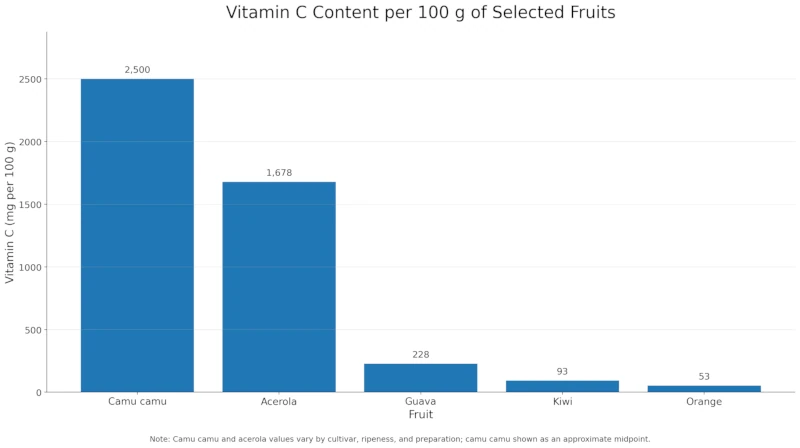
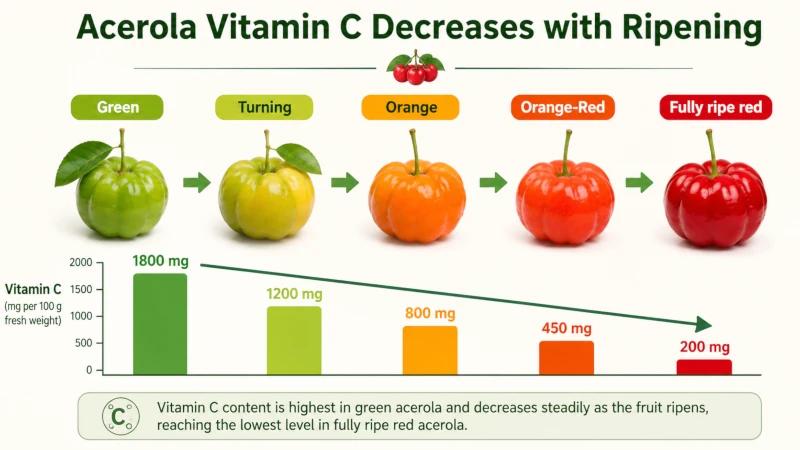
Acerola’s vitamin C content varies widely with cultivar, growing conditions, and ripeness — published values run from about 1,000 mg to more than 4,500 mg per 100 grams. The fruit is richest in vitamin C when slightly underripe; levels fall as it matures and after harvest [Delva & Schneider, 2013]. Here is how it compares with other well-known sources per 100 grams of raw fruit.
| Fruit | Vitamin C / 100 g | % DV | Context |
| Acerola cherry | ~1,678 mg | ~1,864% | About 30x an orange |
| Camu camu | ~2,000–2,145 mg | ~2,300% | One of the few fruits that exceeds acerola |
| Rosehip | ~426 mg | ~473% | Used in teas and supplements |
| Guava | 228 mg | ~253% | Accessible tropical fruit |
| Kiwifruit | 93 mg | ~103% | Common grocery fruit |
| Orange | 53 mg | ~59% | The cultural benchmark |
| Lemon | 53 mg | ~59% | Similar to orange |
Camu camu is the main fruit that consistently outpaces acerola, but acerola is easier to find, more palatable, and better studied. For a closer look, see our acerola vs camu camu comparison and our acerola vs orange breakdown.
Other vitamins, minerals, and phytonutrients
Beyond vitamin C, acerola contains polyphenols, flavonoids (including quercetin and rutin), anthocyanins (the source of its red color), and carotenoids such as beta-carotene [Mezadri et al., 2008; Prakash & Baskaran, 2018]. These compounds matter because they appear to act together: in laboratory testing, acerola’s total antioxidant activity is higher than its vitamin C content alone would predict, which suggests the polyphenols and flavonoids add to the effect [Mezadri et al., 2008]. The fruit also contains organic acids — chiefly malic acid — that give it its tart taste.
Health Benefits of Acerola Cherry
Acerola’s benefits come mainly from vitamin C and its polyphenols. Honesty about evidence matters here. Vitamin C itself has decades of human research behind it, but most studies on acerola specifically are laboratory or animal studies; long-term human trials on the fruit are limited. Each benefit below is labeled accordingly. For deeper coverage, see our guide to evidence-based acerola cherry benefits.
Immune support
Vitamin C is essential for normal immune function. It supports the activity of white blood cells, acts as an antioxidant inside immune cells, helps maintain the skin and mucosal barriers that keep pathogens out, and contributes to both innate and adaptive immune responses [Carr & Maggini, 2017]. Because acerola is one of the most concentrated whole-food sources of vitamin C, it’s widely used for immune support. A small human pharmacokinetic study also found that vitamin C from acerola juice was absorbed efficiently and excreted more slowly than synthetic ascorbic acid [Uchida et al., 2011], and a follow-up cell study pointed to acerola polyphenols increasing a key intestinal vitamin C transporter [Takino et al., 2020].
Evidence level: Strong human evidence that adequate vitamin C supports immune function. Preliminary evidence for any acerola-specific absorption advantage. Note that vitamin C does not reliably prevent the common cold in the general population. For the nuance, see our article on acerola cherry and immunity.
Antioxidant activity
In laboratory tests, acerola shows strong free-radical-scavenging activity, with its mix of vitamin C, polyphenols, anthocyanins, and carotenoids outperforming vitamin C alone [Mezadri et al., 2008; Motohashi et al., 2004]. This whole-food effect is one reason some people prefer acerola to isolated ascorbic acid: you get a range of antioxidant compounds rather than a single molecule.
Evidence level: Strong laboratory evidence. What this means for long-term health in people is not yet established by clinical trials.
Skin and collagen
Vitamin C is a required cofactor for collagen synthesis, the structural protein behind skin firmness. Adequate intake supports wound healing, helps defend against UV-related oxidative damage, and may improve skin texture over time [Pullar et al., 2017]. Acerola has also drawn cosmetic-science interest as a topical ingredient, though that research is early.
Evidence level: Strong human evidence for vitamin C and skin health. Preliminary evidence for acerola-specific topical use. More in our guide to acerola cherry for skin.
Other researched effects (early-stage)
Several additional effects have appeared in cell and animal studies only, and none should guide medical decisions:
- Anti-inflammatory activity in laboratory and animal models, attributed to acerola’s polyphenols [Olędzki & Harasym, 2024].
- Blood sugar. An acerola polyphenol fraction lowered post-meal blood glucose in mice; this has not been tested in human trials [Hanamura et al., 2006].
- Anti-cancer signals. Certain acerola fractions showed tumor-selective toxicity against cancer cell lines in the lab — an in vitro finding, not evidence of preventing or treating cancer in people [Motohashi et al., 2004].
- Liver protection. Traditional use and some animal data suggest a protective effect, but clinical data are lacking.
| Read this carefully: The effects in this last section come from laboratory and animal research only. They are not proven human benefits and should not be used to make medical decisions. Human clinical trials are needed before any firm claims can be made. |
Forms of Acerola: Fresh, Powder, Juice, and Capsules
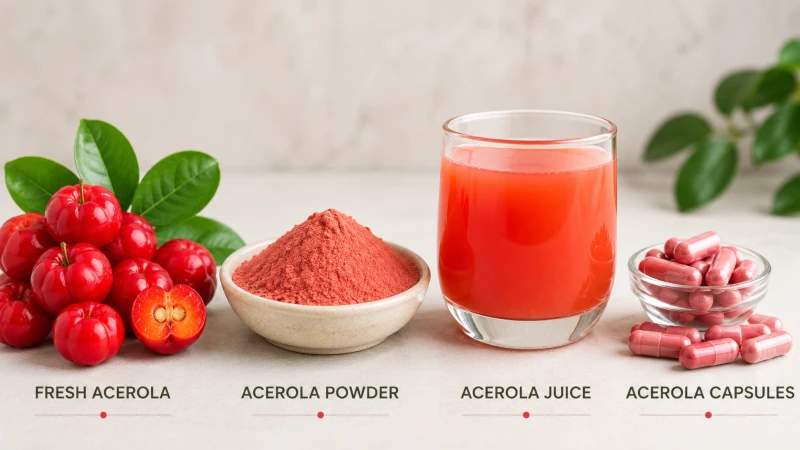
Fresh acerola spoils within a few days of harvest and loses vitamin C quickly, so most people outside tropical regions use a processed form. Each has trade-offs.
Fresh fruit. The most complete option if you can get it. Ripe berries are bright red and very tart — too sour for most people to eat in quantity. The catch: vitamin C is highest when the fruit is slightly underripe and still partly green, so the sweetest, ripest fruit is actually the least vitamin C–dense [Delva & Schneider, 2013].
Powder. The most popular supplemental form, made by dehydrating acerola juice or pulp. Freeze-dried powders generally keep more vitamin C and phytonutrients than spray-dried ones, though they cost more. Quality varies a lot — some powders are 17–25% vitamin C by weight, others much less. Check the label for a stated vitamin C amount per serving, and be wary of products that list added “ascorbic acid” separately, which can mean synthetic vitamin C was added. See our guide to choosing acerola supplements.
Juice. Usually sold blended with sweeter juices because pure acerola juice is very sour. Homemade juice from fresh or frozen berries keeps more vitamin C than most pasteurized commercial options, since heat degrades the nutrient. Our acerola juice recipes walk through preparation.
Capsules and tablets. Convenient pre-measured doses, usually providing 200–500 mg of vitamin C per serving. Look for products that use acerola as the primary vitamin C source and are third-party tested for potency and purity.
How to Use Acerola Cherry
- In smoothies: 1/4 to 1 teaspoon of powder blends well with mango, banana, or pineapple, which offset the tartness.
- In water or juice: stir powder into cold water, coconut water, or juice.
- Over yogurt or oats: sprinkle on yogurt bowls, overnight oats, or cereal.
- As a capsule: take with a meal per the label.
- In cooking: usable in jams and sorbets, but heat degrades vitamin C, so raw or lightly heated preparations keep more.
- Fresh: if you have access to the fruit, eat it raw, juice it, or freeze it right after harvest.
How Much Acerola to Take
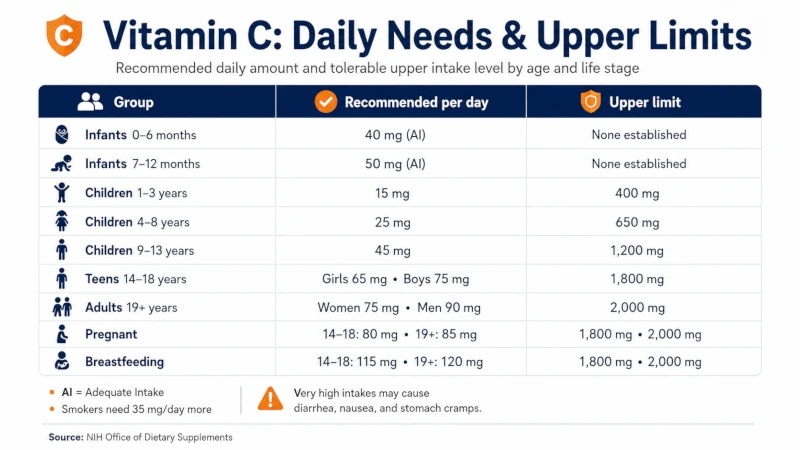
There’s no official dose for acerola itself. Because vitamin C is its main active component, intake is usually guided by vitamin C recommendations.
| Group | RDA | Upper limit (UL) |
| Adult men | 90 mg/day | 2,000 mg/day |
| Adult women | 75 mg/day | 2,000 mg/day |
| Pregnancy | 85 mg/day | 2,000 mg/day |
| Breastfeeding | 120 mg/day | 2,000 mg/day |
| Smokers | +35 mg above baseline | 2,000 mg/day |
Source: NIH Office of Dietary Supplements [NIH ODS, 2021].
For most adults, 100–500 mg of vitamin C from acerola per day is a reasonable range for general wellness — roughly 1/4 to 1 teaspoon of a typical powder, depending on the product’s stated vitamin C content. Staying under 2,000 mg/day of total vitamin C lowers the risk of side effects. For form-specific guidance, see our acerola dosage guide.
Side Effects, Safety, and Drug Interactions
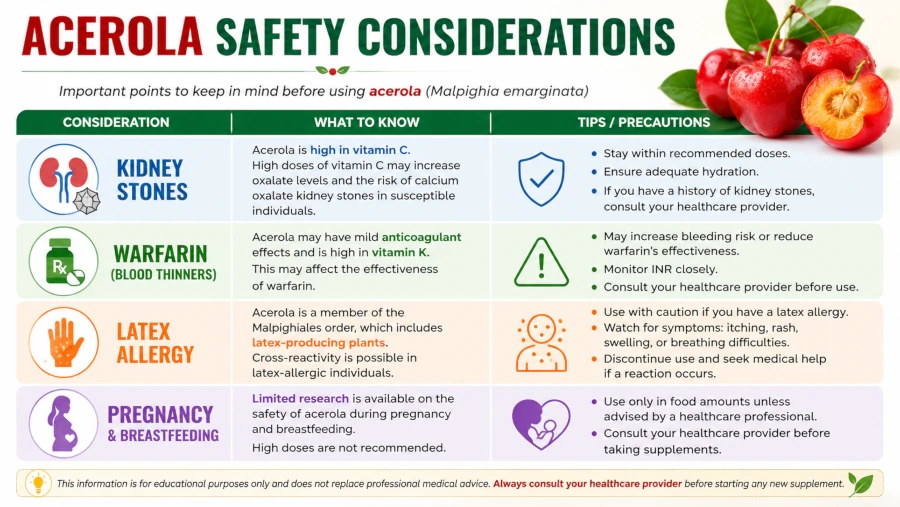
Acerola is generally safe for most adults in food amounts and in supplement doses that keep total vitamin C below 2,000 mg per day [NIH ODS, 2021]. A few cautions are worth knowing.
- Digestive effects. High vitamin C intake (generally above 2,000 mg/day) can cause nausea, cramping, and diarrhea — the most common side effect [NIH ODS, 2021].
- Kidney stones. Large vitamin C doses raise oxalate excretion, which may increase the risk of calcium-oxalate stones in susceptible people [NIH ODS, 2021].
- Latex allergy. People with a latex allergy may react to acerola; this cross-reactivity is documented [Drugs.com, 2025].
- Warfarin and other medications. High-dose vitamin C may reduce the effect of the blood thinner warfarin, and there is theoretical concern about interactions with some chemotherapy drugs [NIH ODS, 2021; Drugs.com, 2025].
- Pregnancy and breastfeeding. Food amounts are generally considered safe, but there isn’t enough data to confirm the safety of supplemental (medicinal) doses during pregnancy or lactation.
Who should be cautious or avoid it
Talk to a clinician before taking supplemental acerola if you have a history of kidney stones, take warfarin or chemotherapy, have a latex allergy, have hemochromatosis or another iron-overload condition (vitamin C increases iron absorption), or are pregnant or breastfeeding. Children can have acerola in food amounts, but supplemental doses should be cleared with a pediatrician, since children have lower vitamin C upper limits than adults.
When to talk to a healthcare professional
See a clinician if you develop hives, swelling, or trouble breathing after consuming acerola (possible allergic reaction — seek urgent care for breathing difficulty), if you have flank or back pain that could signal a kidney stone, or before combining acerola with prescription medication. Acerola is a supplement, not a treatment for any disease; persistent or severe symptoms need medical evaluation, not a higher dose. For a full review, see our acerola side effects and safety guide.
How to Choose a Quality Acerola Product
- Stated vitamin C per serving. A good product tells you the exact milligrams. Vague or missing numbers are a red flag.
- Acerola as the main vitamin C source. Separately listed “ascorbic acid” can mean synthetic vitamin C was added to inflate the figure.
- Processing method. Freeze-dried retains more vitamin C and phytonutrients than spray-dried.
- Third-party testing. Independent lab testing (NSF, USP, or similar) and a Certificate of Analysis indicate verified potency and purity.
- Short ingredient list. Avoid unnecessary fillers, artificial colors, or added sugars.
- Origin. Brazil has the most established acerola cultivation and processing.
Growing Acerola at Home
Acerola is rewarding for gardeners in warm climates. It can begin fruiting within its first year, and a mature plant may yield a substantial harvest each season. It does best in USDA zones 9b–11, in well-drained sandy soil with full sun, and it can’t survive sustained temperatures below about freezing. Because the roots are shallow, give it a wind-sheltered spot. In cooler areas, grow it in a large container that can move indoors over winter. Pick fruit frequently — it doesn’t keep well on the tree — and freeze it promptly, remembering that slightly underripe fruit holds the most vitamin C. Full instructions are in our how to grow acerola cherry guide.
| HEALTH DISCLAIMER: This article is for general education and is based on peer-reviewed research and reputable health sources. It is not medical advice and is not intended to diagnose, treat, cure, or prevent any disease. Supplements can interact with medications and health conditions. Talk with a qualified healthcare professional before adding acerola or any new supplement to your routine, especially if you are pregnant, breastfeeding, managing a medical condition, or taking prescription medication. |
Frequently Asked Questions
Is acerola cherry the same as Barbados cherry?
Yes. Acerola cherry and Barbados cherry are two common names for the same fruit, Malpighia emarginata. Other regional names include West Indian cherry and Puerto Rican cherry. The fruit, plant, and nutrition are identical.
How much vitamin C is in one acerola cherry?
A single fruit (about 4–5 grams) contains roughly 67–84 mg of vitamin C, based on the USDA average of 1,678 mg per 100 grams. In practice, a couple of fresh acerola cherries can cover an adult’s daily vitamin C target — though content varies with ripeness.
Is vitamin C from acerola better than synthetic vitamin C?
It may be, but the evidence is early. A small human study found vitamin C from acerola juice was absorbed efficiently and cleared more slowly than synthetic ascorbic acid [Uchida et al., 2011], and a cell study suggested acerola polyphenols support vitamin C uptake [Takino et al., 2020]. Larger human trials are needed before this can be stated as a clear advantage.
Does acerola interact with any medications?
It can. Because acerola delivers a lot of vitamin C, high doses may reduce the effect of warfarin, and there is theoretical concern with some chemotherapy drugs [NIH ODS, 2021; Drugs.com, 2025]. Tell your healthcare provider about any acerola use if you take prescription medication.
Can I take acerola during pregnancy?
Acerola in food amounts is generally considered safe in pregnancy, but there isn’t enough data to confirm the safety of high-dose supplements during pregnancy or breastfeeding. Check with your obstetrician or midwife before starting any supplement.
Where can I buy acerola cherry?
Fresh acerola is rarely sold outside tropical regions because it spoils fast. Powder, capsules, and frozen pulp are widely available online and in health stores. Look for Brazilian-sourced products with a clearly labeled vitamin C content and few additives.
References
- Moscoso, C.G. (1956). West Indian cherry — richest known source of natural vitamin C. Economic Botany, 10(3), 280–294. View source
- Assis, S.A., Fernandes, F.P., Martins, A.B.G., & de Faria Oliveira, O.M.M. (2008). Acerola: importance, culture conditions, production and biochemical aspects. Fruits, 63(2), 93–101. View source
- Delva, L. & Goodrich Schneider, R. (2013). Acerola (Malpighia emarginata DC): production, postharvest handling, nutrition, and biological activity. Food Reviews International, 29(2), 107–126. View source
- Mezadri, T., Villaño, D., Fernández-Pachón, M.S., García-Parrilla, M.C., & Troncoso, A.M. (2008). Antioxidant compounds and antioxidant activity in acerola fruits and derivatives. Journal of Food Composition and Analysis, 21(4), 282–290. View source
- Motohashi, N., Wakabayashi, H., Kurihara, T., et al. (2004). Biological activity of Barbados cherry extracts and fractions. Phytotherapy Research, 18(3), 212–223. View source
- Hanamura, T., Mayama, C., Aoki, H., Hirayama, Y., & Shimizu, M. (2006). Antihyperglycemic effect of polyphenols from acerola fruit. Bioscience, Biotechnology, and Biochemistry, 70(8), 1813–1820. View source
- Uchida, E., Kondo, Y., Amano, A., et al. (2011). Absorption and excretion of ascorbic acid alone and in acerola juice: comparison in healthy Japanese subjects. Biological & Pharmaceutical Bulletin, 34(11), 1744–1747. View source
- Takino, Y., Aoki, H., Kondo, Y., & Ishigami, A. (2020). Acerola promotes ascorbic acid uptake into Caco-2 cells via SVCT1 (in vitro study). Journal of Nutritional Science and Vitaminology, 66(4), 296–299. View source
- Carr, A.C. & Maggini, S. (2017). Vitamin C and immune function. Nutrients, 9(11), 1211. View source
- Pullar, J.M., Carr, A.C., & Vissers, M.C.M. (2017). The roles of vitamin C in skin health. Nutrients, 9(8), 866. View source
- Prakash, A. & Baskaran, R. (2018). Acerola, an untapped functional superfruit: a review on latest frontiers. Journal of Food Science and Technology, 55(9), 3373–3384. View source
- Olędzki, R. & Harasym, J. (2024). Acerola (Malpighia emarginata) anti-inflammatory activity — a review. International Journal of Molecular Sciences, 25(4), 2089. View source
- NIH Office of Dietary Supplements (2021). Vitamin C: Fact Sheet for Health Professionals. View source
- USDA FoodData Central. Acerola (West Indian cherry), raw. FDC #171686. View source
- Drugs.com (2025). Acerola — professional natural-products monograph. View source
