
One acerola cherry — a fruit that weighs less than a nickel — carries about as much vitamin C as a whole orange. Raw acerola supplies roughly 1,678 mg of vitamin C per 100 grams, or about 1,864% of the Daily Value, in just 32 calories [USDA FoodData Central, FDC 171686]. Nothing else in the produce aisle comes close except camu camu.
That single number is why most people search for acerola cherry nutrition. But it is not the whole label. Acerola also delivers modest amounts of vitamin A, five B vitamins, potassium, copper, and magnesium, plus a broad set of plant compounds — flavonoids, anthocyanins, carotenoids, phenolic acids, and organic acids — that an ascorbic acid tablet does not contain [Olędzki & Harasym, 2024].
Below is the full profile: what is in the fruit, what a realistic serving actually gives you, how the vitamin C compares with fruits you can buy at any grocery store, how processing changes the numbers, and where the honest limits of the evidence sit.
Acerola Cherry Nutrition Facts (Per 100 Grams)
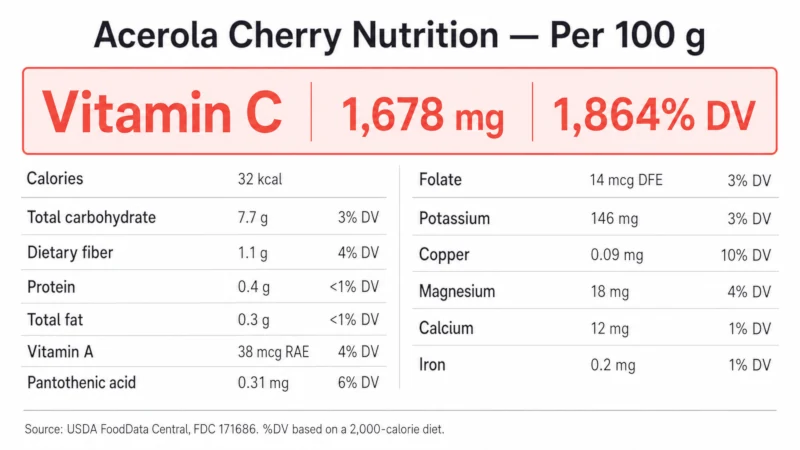
These values come from the USDA’s entry for raw acerola, also listed as West Indian cherry [USDA FoodData Central, FDC 171686]. Percent Daily Values use the FDA reference amounts for adults [NIH Office of Dietary Supplements, updated 2025].
| Nutrient | Per 100 g | % Daily Value |
| Calories | 32 kcal | — |
| Water | 91.4 g | — |
| Protein | 0.4 g | <1% |
| Total fat | 0.3 g | <1% |
| Total carbohydrate | 7.7 g | 3% |
| Dietary fiber | 1.1 g | 4% |
| Total sugars | Not reported in this USDA entry | — |
| Vitamin C | 1,678 mg | 1,864% |
| Vitamin A | 38 µg RAE (767 IU) | 4% |
| Thiamin (B1) | 0.02 mg | 2% |
| Riboflavin (B2) | 0.06 mg | 5% |
| Niacin (B3) | 0.4 mg | 2% |
| Pantothenic acid (B5) | 0.31 mg | 6% |
| Vitamin B6 | 0.009 mg | 1% |
| Folate | 14 µg DFE | 3% |
| Calcium | 12 mg | 1% |
| Copper | 0.09 mg | 10% |
| Iron | 0.2 mg | 1% |
| Magnesium | 18 mg | 4% |
| Phosphorus | 11 mg | 1% |
| Potassium | 146 mg | 3% |
| Selenium | 0.6 µg | 1% |
| Sodium | 7 mg | <1% |
| Zinc | 0.1 mg | 1% |
Source: USDA FoodData Central, SR Legacy, FDC ID 171686 (raw acerola). Daily Values based on a 2,000-calorie diet.
Two things jump out. The vitamin C figure is more than eighteen times an adult’s daily requirement in a single 100-gram portion. And it arrives inside 32 calories — a nutrient-to-calorie ratio almost nothing else matches.
Copper is the quiet second story at roughly 10% of the Daily Value. It is a trace mineral most people never think about, and it matters for iron metabolism, connective tissue, and the body’s own antioxidant enzymes.
What a Real Serving Actually Gives You
Nobody weighs acerola on a kitchen scale. The USDA lists two practical portions: one cup, which comes to 98 grams, and one fruit without the pit, which comes to 4.8 grams.
| Nutrient | 1 cup (98 g) | 1 fruit (4.8 g) |
| Calories | 31 kcal | ~1.5 kcal |
| Vitamin C | 1,644 mg | ~81 mg |
| Vitamin C, % DV | 1,827% | ~89% |
| Vitamin A | 37 µg RAE | ~1.8 µg RAE |
| Potassium | 143 mg | ~7 mg |
| Fiber | 1.1 g | ~0.05 g |
| Protein | 0.4 g | ~0.02 g |
Cup values are USDA figures; single-fruit values are calculated from the per-100-gram data using the USDA’s 4.8 g portion weight.
The right-hand column is the one worth remembering. A single cherry covers close to a full day’s vitamin C. A review of acerola research puts it plainly: three fruits a day is enough to meet an adult’s requirement [Olędzki & Harasym, 2024]. A cup of the fruit is a wildly excessive dose of vitamin C — not dangerous at that level, but far past the point where your body can use any more of it.
Acerola Cherry Vitamin C vs. Eight Common Fruits
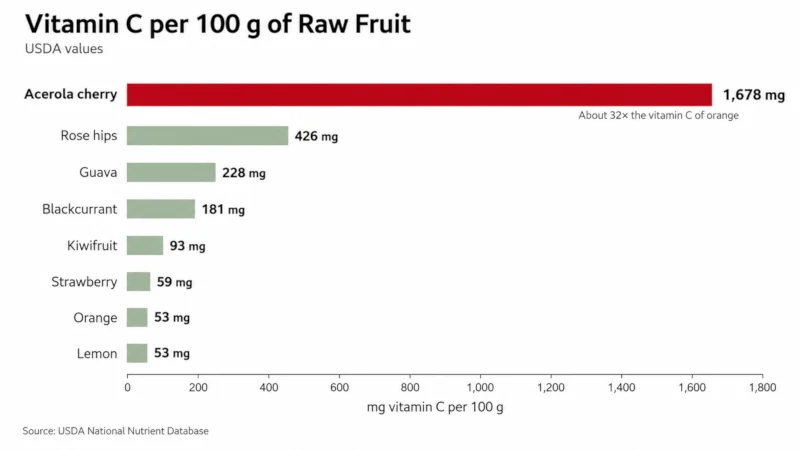
All figures below are USDA values, converted to a common 100-gram basis so they can be compared directly [USDA vitamin C content tables].
| Fruit (raw) | Vitamin C per 100 g | % DV | vs. orange |
| Acerola cherry | 1,678 mg | 1,864% | ~32x |
| Rose hips (wild) | 426 mg | 473% | ~8x |
| Guava | 228 mg | 253% | ~4.3x |
| Blackcurrant | 181 mg | 201% | ~3.4x |
| Kiwifruit (green) | 93 mg | 103% | ~1.8x |
| Strawberry | 59 mg | 65% | ~1.1x |
| Orange | 53 mg | 59% | baseline |
| Lemon (no peel) | 53 mg | 59% | ~equal |
Derived from USDA National Nutrient Database values per household measure, converted to 100 g.
Only one commonly sold fruit beats acerola: camu camu, an Amazonian berry that published reviews put in the range of roughly 2,000 to 3,000 mg per 100 grams of fresh pulp [Langley et al., 2015]. Acerola’s practical advantages are taste, price, availability, and a longer research record — the trade-offs are laid out in our acerola vs. camu camu comparison. For the everyday version of the question, see how acerola stacks up against oranges.
Why the vitamin C number moves so much
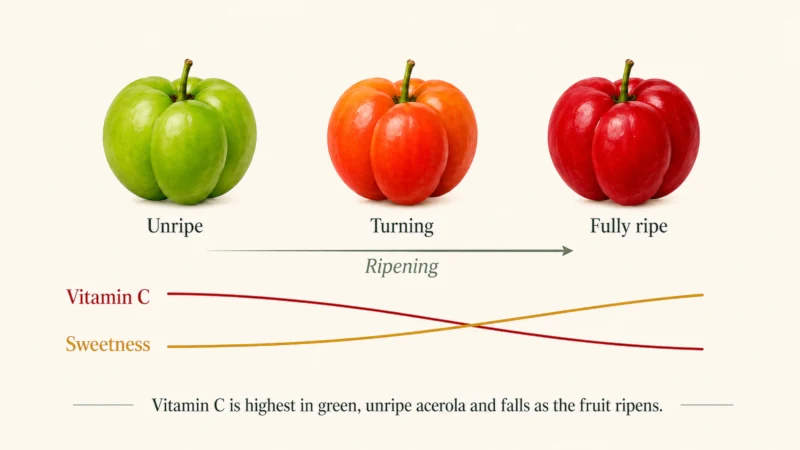
If you have seen acerola quoted anywhere from 1,000 to 4,500 mg per 100 grams, none of those sources is necessarily wrong. The fruit genuinely varies, and the USDA figure is an analyzed average, not a fixed value.
Ripeness is the biggest lever. Green, unripe acerola holds the most ascorbic acid; the level falls as the fruit reddens and sweetens [Drugs.com professional monograph, 2025; Olędzki & Harasym, 2024]. That is why the sweetest, ripest fruit is the least vitamin C–dense — and why many concentrated powders are made from underripe cherries.
Cultivar and growing conditions matter too. Across varieties and regions, reported ascorbic acid runs from about 1,500 to 4,500 mg per 100 grams — 50 to 100 times what you get from an orange or a lemon [Prakash & Baskaran, 2018].
Vitamin C starts leaving as soon as the fruit is picked. Ascorbic acid is water soluble and heat sensitive, and prolonged storage and cooking both reduce it [NIH Office of Dietary Supplements].
Other Vitamins in Acerola Cherry
Vitamin A and carotenoids
Acerola provides 38 µg RAE of vitamin A per 100 grams — about 4% of the Daily Value — mostly as pro-vitamin A carotenoids that your body converts as needed. Some older analyses report the figure in international units and put it far higher, at 4,300 to 12,500 IU per 100 grams, roughly comparable to carrots [Drugs.com professional monograph, 2025]. Treat that as a genuine disagreement between analytical methods and sample types rather than a settled number; the USDA figure is the conservative one.
The carotenoids identified in acerola include beta-carotene, lutein, alpha-carotene, and beta-cryptoxanthin, with total carotenoid content varying widely by variety and harvest season [Olędzki & Harasym, 2024]. These are fat-soluble, so eating acerola alongside a little dietary fat — yogurt, nuts, avocado — is a reasonable way to support absorption.
B vitamins
Acerola carries small, measurable amounts of five B vitamins: thiamin, riboflavin, niacin, pantothenic acid, and folate. None of them makes acerola a standout source. Pantothenic acid is the highest at about 6% of the Daily Value per 100 grams, which is a respectable contribution from a food this low in calories, but you would not eat acerola to cover your B vitamins.
Minerals in Acerola Cherry
Acerola is not a mineral powerhouse. Leafy greens and legumes do that job far better. What it offers is a modest, useful spread: 146 mg of potassium, 18 mg of magnesium, 12 mg of calcium, and 0.09 mg of copper per 100 grams.
The potassium is notable given the calorie count, and copper at roughly 10% of the Daily Value is the standout on a percentage basis. Everything else is a rounding error.
There is one indirect mineral effect worth knowing. Vitamin C improves the absorption of non-heme iron — the form found in plant foods [NIH Office of Dietary Supplements]. Acerola itself contains almost no iron (0.2 mg per 100 grams), but eating it alongside lentils, spinach, tofu, or fortified cereal can meaningfully increase how much iron you absorb from those foods. That is a real, well-established mechanism — and, for a small number of people, a reason for caution, which the safety section covers.
Phytonutrients: What Acerola Has That a Vitamin C Tablet Doesn’t
This is where acerola separates from ascorbic acid powder. The fruit carries a mixed load of polyphenols, and researchers have consistently found that its antioxidant activity depends on the combined action of vitamin C and those polyphenols rather than vitamin C alone [Righetto et al., 2005].
Flavonoids and phenolic acids
Compounds identified in acerola fruit and pomace include naringenin, quercetin glycosides, hesperidin, catechin, epicatechin, procyanidins, isorhamnetin, chlorogenic acid, caffeic acid, gallic acid, and myricetin [Olędzki & Harasym, 2024]. Reported totals swing enormously between studies — one set of analyses puts total polyphenols at 1,296 to 1,607 mg gallic acid equivalents per 100 g, another at 2,418 to 2,844 mg per 100 g. That spread reflects different varieties, ripeness, and extraction methods, and it is a good reason to treat any single polyphenol number you see on a label with skepticism.
Anthocyanins
Anthocyanins give ripe acerola its red color. The dominant one is cyanidin-3-rhamnoside, with pelargonidin-3-O-rhamnoside also present; measured pulp content sits at roughly 2.7 mg cyanidin-3-glucoside equivalents per 100 g of fresh fruit [Olędzki & Harasym, 2024]. These are the same class of pigments found in blueberries and red cabbage. The broader research linking anthocyanins to cardiovascular outcomes was not done on acerola, so it is background context, not a claim about this fruit.
Organic acids and fiber
Ascorbic acid is itself the main organic acid in acerola, with malic acid the other major contributor — together they account for the sharp, sour taste [Olędzki & Harasym, 2024; Drugs.com professional monograph, 2025]. The fruit also contains pectic polysaccharides built from glucose, arabinose, galactose, and galacturonic acid, which behave as soluble fiber [Olędzki & Harasym, 2024].
| How strong is this evidence? The composition data above is solid analytical chemistry — these compounds are measurably present. What those compounds do in the human body is a separate question. Most acerola-specific research on health effects is laboratory or animal work, with a small number of short human studies. Read the phytonutrient profile as a description of the food, not as evidence of a health outcome. |
How Processing Changes Acerola’s Nutrition
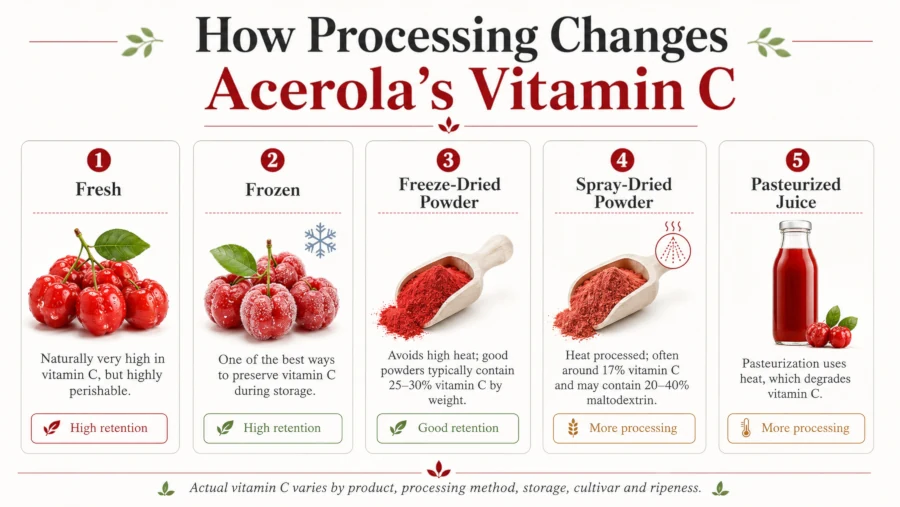
Fresh acerola bruises within a day or two of picking and barely travels, so almost everyone outside the tropics eats it processed. The form you buy changes the numbers more than most people expect.
Fresh vs. frozen
Freezing is the best preservation method for acerola’s vitamin C. In an analysis of Barbados cherry pulp under different storage conditions, freezing at −18 °C preserved a greater share of vitamin C than either room-temperature storage or refrigeration [Visentainer et al., 1998, as summarized in the Drugs.com monograph]. If you ever have access to fresh fruit, freeze it the day you get it.
Fresh vs. powder
Powder is made by drying juice, pulp, or whole fruit. Freeze-drying avoids heat and retains the most vitamin C and phytonutrients — good freeze-dried powders typically run 25–30% vitamin C by weight. Spray-drying uses high heat and requires a carrier, almost always maltodextrin, which commonly makes up 20–40% of the finished product and dilutes everything else accordingly; those powders land nearer 17% vitamin C. Our acerola cherry powder guide walks through label checks in detail.
One caveat on carriers worth knowing: a 2024 review noted that maltodextrin added during processing is itself an additional carbohydrate load, and argued this can influence the antioxidant picture of the finished product [Olędzki & Harasym, 2024]. That is an argument for reading the ingredient list, not for avoiding spray-dried powder outright.
Fresh vs. juice
Juicing keeps most of the vitamin C in the short term, but pasteurization — required for shelf-stable commercial juice — involves heat, and ascorbic acid degrades with heat [NIH Office of Dietary Supplements]. Juice made at home from fresh or frozen fruit and drunk right away will carry more than a bottled equivalent. Researchers have also found that the antioxidant activity of acerola juice depends on the combined contribution of ascorbic acid and phenolics, and that the balance differs between juice made from immature and mature fruit [Righetto et al., 2005].
Putting Acerola’s Nutrition in Perspective
Acerola does one nutritional job extraordinarily well and most others not at all. It is not a source of protein, fat, fiber, or most minerals. It complements a diet; it does not stand in for one.
It is also worth being clear about what more vitamin C buys you, because acerola makes it trivially easy to take a very large dose. Absorption runs about 70% to 90% at moderate intakes of 30 to 180 mg a day, but falls below 50% at doses above 1 gram, with the unabsorbed remainder excreted in urine [NIH Office of Dietary Supplements]. Past roughly 200 mg a day, plasma levels barely move. A quarter-teaspoon of powder already puts most people well past the point of diminishing returns.
Regular vitamin C at 200 mg a day or more does not reduce how often healthy people in the general population catch colds, though it modestly shortens duration — by around 8% in adults and 14% in children. Starting it after symptoms appear does not appear to help [NIH Office of Dietary Supplements]. That is the honest ceiling on the immune claim.
Where acerola earns its reputation is as a concentrated, low-calorie, whole-food source of vitamin C with a supporting cast of plant compounds. For a broader picture of the fruit, see our complete acerola cherry guide.
Safety, Side Effects, and Who Should Be Careful
Acerola as food is about as safe as food gets. The cautions below apply mainly to concentrated supplements — powders, capsules, and extracts — where the vitamin C dose climbs fast.
Common side effects
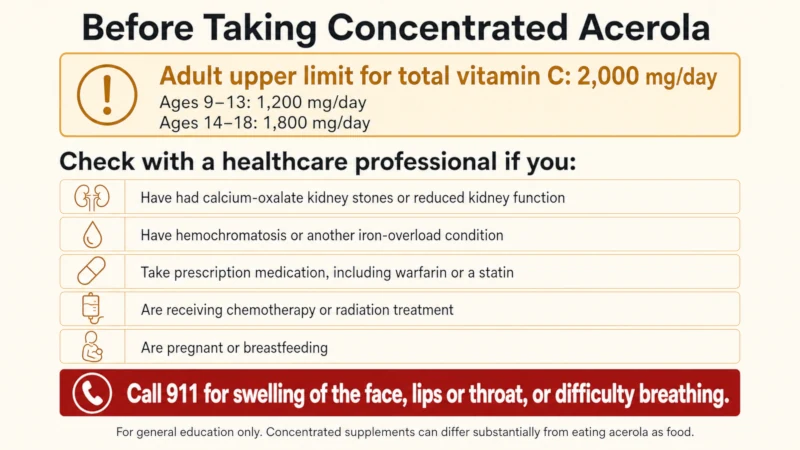
Vitamin C has low toxicity, and high intakes are not believed to cause serious adverse effects. The usual complaints are diarrhea, nausea, and abdominal cramps, caused by the osmotic effect of unabsorbed vitamin C in the gut [NIH Office of Dietary Supplements]. The Tolerable Upper Intake Level for adults is 2,000 mg a day from food and supplements combined; it is lower for children — 1,200 mg at ages 9–13 and 1,800 mg at 14–18. Large amounts of acerola seeds have separately been linked to rectal bezoars in case reports, which is a reason not to eat the fruit whole in quantity [Drugs.com professional monograph, 2025].
Medication interactions — where sources disagree
This is a point where reputable sources genuinely differ, so here is the disagreement rather than the more dramatic version of it. The Drugs.com professional monograph states that no interactions with acerola are well documented, and describes the warfarin concern as theoretical — inferred from an association between high vitamin C intake and reduced warfarin absorption, not from studies of acerola itself [Drugs.com professional monograph, 2025]. The NIH fact sheet does not list warfarin among vitamin C’s interactions at all. It does flag two others: antioxidants including vitamin C may interfere with chemotherapy and radiation therapy, and vitamin C combined with other antioxidants may blunt the HDL response to niacin–simvastatin therapy [NIH Office of Dietary Supplements].
The practical version: if you take warfarin, a statin, or are undergoing cancer treatment, tell your doctor or pharmacist before adding a concentrated acerola product. Do not change a prescription on your own.
Pregnancy and breastfeeding
Acerola in food amounts is not a concern. Concentrated supplements are a different matter: the Drugs.com monograph advises avoiding acerola in pregnancy and lactation because safety and efficacy information is lacking [Drugs.com professional monograph, 2025]. The vitamin C RDA is 85 mg a day during pregnancy and 120 mg while breastfeeding, with the same 2,000 mg upper limit [NIH Office of Dietary Supplements]. Ask your obstetrician or midwife before starting any supplemental acerola.
Who should be cautious
Talk to a doctor, registered dietitian, or pharmacist before using concentrated acerola if you:
- Have had calcium-oxalate kidney stones or reduced kidney function. High vitamin C intake can raise urinary oxalate and uric acid excretion. The research on whether this actually causes stones is conflicting, but the clearest evidence of risk is in people who already have hyperoxaluria.
- Have hereditary hemochromatosis or another iron-overload condition. In healthy people, vitamin C’s effect on iron absorption is not a concern; in hereditary hemochromatosis, chronic high doses could worsen iron overload and cause tissue damage.
- Are giving it to a child. Children have lower upper limits than adults, so clear supplemental doses with a pediatrician.
- Take prescription medication or are in cancer treatment. See the interactions note above and ask your oncologist before taking antioxidant supplements, especially at high doses.
Kidney stone, iron overload, and pediatric upper-limit details: NIH Office of Dietary Supplements.
When to seek care
A fruit powder will not create an emergency on its own, but do not use it to manage symptoms that need attention. Call 911 or go to an emergency room for hives with swelling of the lips, face, or throat, or any difficulty breathing after eating or taking acerola — that pattern can indicate a serious allergic reaction. Seek prompt care at urgent care or your primary care provider for severe flank or back pain that could be a kidney stone, for blood in your urine or stool, or for abdominal pain that is severe or does not settle. Persistent fatigue, bleeding gums, or slow-healing wounds are worth a medical evaluation rather than a higher dose of anything.
| Health disclaimer: This article is for general education and is based on peer-reviewed research and reputable health sources. It is not medical advice and is not intended to diagnose, treat, cure, or prevent any disease. Supplements can interact with medications and health conditions. Talk with a qualified healthcare professional — your doctor, a registered dietitian, or a pharmacist — before adding acerola or any new supplement to your routine, especially if you are pregnant, breastfeeding, managing a medical condition, or taking prescription medication. |
Frequently Asked Questions
How much vitamin C is in acerola cherry?
Raw acerola contains about 1,678 mg of vitamin C per 100 grams — roughly 1,864% of the Daily Value — according to USDA data. Published analyses across varieties and ripeness stages range from about 1,000 to 4,500 mg per 100 grams, with unripe green fruit at the high end.
How many acerola cherries do I need to hit my daily vitamin C?
One. A single 4.8-gram fruit supplies roughly 81 mg, which covers about 89% of the Daily Value and meets or exceeds the 75–90 mg adult RDA depending on the fruit. Reviews commonly cite three fruits a day as comfortably sufficient.
Does heat destroy acerola’s vitamin C?
Yes. Ascorbic acid is water soluble and destroyed by heat, so cooking and prolonged storage both reduce it. Raw, frozen, and freeze-dried forms retain the most; pasteurized juice and baked goods retain considerably less.
Is acerola a good source of any mineral?
Only modestly. Per 100 grams it provides 146 mg potassium, 18 mg magnesium, 12 mg calcium, and 0.09 mg copper — copper being the highest at about 10% of the Daily Value. Its bigger mineral contribution is indirect: the vitamin C improves absorption of non-heme iron from plant foods eaten at the same meal.
What does acerola contain besides vitamin C?
Flavonoids and phenolic acids including naringenin, quercetin glycosides, catechin, hesperidin, chlorogenic acid and gallic acid; anthocyanins led by cyanidin-3-rhamnoside; carotenoids including beta-carotene and lutein; malic acid; and pectic polysaccharides that act as soluble fiber. Composition varies substantially by variety and ripeness.
Is freeze-dried acerola powder better than spray-dried?
For nutrient retention, yes. Freeze-drying avoids heat and typically yields 25–30% vitamin C by weight with no carrier needed. Spray-dried powders use high heat and maltodextrin as a carrier, which often makes up 20–40% of the product, so they usually land nearer 17% vitamin C. Spray-dried is cheaper and dissolves better.
References
- U.S. Department of Agriculture, Agricultural Research Service. FoodData Central: Acerola (West Indian cherry), raw. FDC ID 171686, SR Legacy. View source
- U.S. Department of Agriculture. National Nutrient Database for Standard Reference, Release 28: Vitamin C, total ascorbic acid, ordered by nutrient content (hosted by NIH ODS). View source
- National Institutes of Health, Office of Dietary Supplements. Vitamin C: Fact Sheet for Health Professionals. Updated July 31, 2025. View source
- Prakash A, Baskaran R. Acerola, an untapped functional superfruit: a review on latest frontiers. Journal of Food Science and Technology. 2018;55(9):3373–3384. PMID 30150795; PMCID PMC6098779. View source
- Olędzki R, Harasym J. Acerola (Malpighia emarginata) Anti-Inflammatory Activity — A Review. International Journal of Molecular Sciences. 2024;25(4):2089. View source
- Righetto AM, Netto FM, Carraro F. Chemical composition and antioxidant activity of juices from mature and immature acerola (Malpighia emarginata DC). Food Science and Technology International. 2005;11(4):315–321. View source
- Drugs.com. Acerola — professional natural products monograph. Updated September 22, 2025. View source
- Delva L, Goodrich Schneider R. Acerola (Malpighia emarginata DC): production, postharvest handling, nutrition, and biological activity. Food Reviews International. 2013;29(2):107–126. View source
- Langley PC, Pergolizzi JV Jr, Taylor R Jr, Ridgway C. Antioxidant and associated capacities of camu camu (Myrciaria dubia): a systematic review. Journal of Alternative and Complementary Medicine. 2015;21(1):8–14. View source
- Visentainer JV, Vieira OA, Matsushita M, de Souza NE. Vitamin C in Barbados cherry (Malpighia glabra L.) pulp submitted to processing and to different forms of storage. Archivos Latinoamericanos de Nutrición. 1998;48(3):256–259. PMID 9951541. View source
