
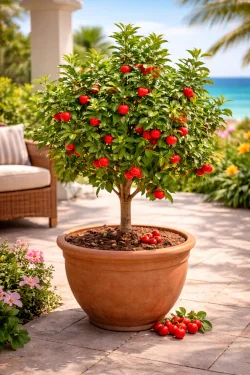
Learning how to grow acerola cherry at home is more straightforward than most gardeners expect. Malpighia emarginata — also called the Barbados cherry — is a compact tropical tree that thrives in warm climates and rewards you with multiple harvests of vitamin C-rich fruit each year. Whether you’re in Florida, Texas, Hawaii, or California, this guide covers everything from soil and sunlight to propagation, pruning, and harvest.
This small tropical tree is surprisingly manageable for home gardeners, especially in warm climates. It rewards you with multiple harvests per year, attractive pink flowers, and bright red fruit that you can eat fresh, blend into smoothies, or dry for supplementation.
This guide walks you through everything you need to know: from the right climate and soil, to propagation, pruning, pest management, and harvesting. Whether you’re gardening in Florida, Texas, Hawaii, California, or growing in a pot indoors, the information here is practical and grounded.
| Educational note: This article is for educational purposes only and is based on peer-reviewed research and reputable health sources. It is not medical advice. |
What Is the Acerola Cherry Tree?
Scientific Name and Common Names
The acerola cherry tree goes by several names depending on where you are. You’ll hear it called the Barbados cherry, West Indian cherry, Puerto Rican cherry, and wild crapemyrtle, though that last one is rarely used. Its botanical name is Malpighia emarginata, and it belongs to the family Malpighiaceae.
It’s native to the Caribbean, Central America, and northern South America, but has been cultivated across tropical and subtropical regions worldwide for decades [Morton, 1987].
Growth Habit and Size
In the ground, acerola cherry trees typically reach 10 to 15 feet (3–4.5 meters) tall, though they can be kept smaller with regular pruning. They have a spreading, multi-branched form with small, glossy dark green leaves and pink to red flowers that bloom in clusters.
They are fast growers under the right conditions, and once established, they’re relatively drought-tolerant and low-maintenance.
How to Grow Acerola Cherry Successfully: Start With the Right Zone
Best Climates
Acerola cherry is best suited to USDA hardiness zones 9b through 11. It prefers consistently warm temperatures and struggles when exposed to hard freezes. Most established trees can tolerate brief temperature dips down to about 28°F (−2°C), but prolonged frost will damage or kill the plant [Crane & Balerdi, 2005].
If you live in a climate that gets occasional light frost, you can still grow acerola — but you’ll need to provide cold protection or grow it in a container that you can move indoors.
Growing in Florida, Texas, Hawaii, and California
Florida is arguably the best mainland U.S. state for growing acerola. South Florida (zones 10–11) supports year-round outdoor growth, and Central Florida (zone 9b) can work with frost protection in winter. The University of Florida IFAS Extension has extensively documented acerola cultivation in the state [Crane & Balerdi, 2005].
Texas gardeners in the Rio Grande Valley and along the Gulf Coast (zones 9b–10a) can grow acerola outdoors with some frost preparation. Further north, container growing is more practical.
Hawaii offers nearly ideal growing conditions across most of its islands, particularly at lower elevations. The warm, humid climate closely mirrors the plant’s native range.
California gardeners in Southern California’s coastal and inland zones (9b–11) can grow acerola outdoors. In Northern California, container culture is the safest approach.
Soil Requirements for Acerola Cherry
pH Range
Acerola cherry performs best in slightly acidic soil with a pH between 5.5 and 6.5. It can tolerate a somewhat wider range but tends to show signs of nutrient deficiency — particularly yellowing leaves — when soil pH drifts too far from this window [Morton, 1987].
Test your soil before planting. Simple pH test kits are widely available, and many county extension offices offer soil testing services for a nominal fee.
Drainage and Soil Amendments
Good drainage is non-negotiable. Acerola cherry does not tolerate waterlogged roots and is prone to root rot when left sitting in poorly drained soil.
Sandy loam or loamy soil with strong drainage works well. If your native soil is heavy clay, consider raised bed planting or amending heavily with perlite, coarse sand, and organic matter to improve structure.
In Florida’s sandy soils, adding compost to the planting hole helps with water and nutrient retention without sacrificing drainage.
Sunlight and Temperature Needs
Acerola cherry is a full-sun plant. Aim for a minimum of 6 to 8 hours of direct sunlight per day. Trees grown in partial shade tend to produce fewer flowers and fruit, and they’re generally more susceptible to fungal issues.
In terms of temperature, the acerola cherry tree thrives between 65°F and 90°F (18–32°C). It can handle heat above 90°F when well-watered, but sustained temperatures below 32°F will cause damage, and anything below 28°F risks killing the plant outright.
If you’re in a zone with mild winters, planting near a south-facing wall can provide a useful buffer of warmth and reflected heat during cold snaps.
How to Plant an Acerola Cherry Tree
Best Planting Time
The best time to plant acerola cherry in the ground is late spring, after any frost risk has passed and soil temperatures have warmed. In South Florida and Hawaii, planting is possible year-round, though avoiding the hottest months reduces transplant stress.
Planting Hole and Spacing
Dig a hole roughly two to three times the width of the root ball and equal in depth. Backfill with native soil mixed with compost — resist the urge to fill with pure compost, which can create a drainage barrier between the amended hole and surrounding soil [University of Florida IFAS, 2021].
Space multiple trees 10 to 15 feet apart if you’re planting an orchard-style arrangement. This allows adequate airflow, which reduces fungal disease pressure.
Water thoroughly at planting and mulch the base with 2–3 inches of wood chip mulch, keeping mulch away from direct contact with the trunk.
Watering Acerola Cherry Plants
Young acerola trees need regular watering during their first growing season — typically once or twice per week, depending on rainfall and temperatures. The goal is consistent moisture without waterlogging.
Once established (usually after the first year), acerola cherry becomes moderately drought-tolerant. That said, regular watering during the flowering and fruiting season significantly improves yield and fruit quality.
A simple rule: water deeply and infrequently rather than shallowly and often. This encourages deep root development, which supports drought tolerance over the long term.
Drip irrigation is an excellent choice for acerola, as it delivers water directly to the root zone while keeping foliage dry — an important factor for fungal disease prevention.
Fertilizing Your Acerola Tree
Acerola cherry responds well to balanced fertilization. For established trees, a 10-10-10 or 8-3-9 granular fertilizer applied three to four times per year during the growing season is a common and effective approach [Crane & Balerdi, 2005].
Young trees benefit from lighter, more frequent applications. Start with a diluted balanced fertilizer every 4–6 weeks during the first growing season, then transition to a standard schedule in year two.
Because acerola is prone to micronutrient deficiencies — particularly iron, manganese, and zinc — in alkaline or sandy soils, a foliar micronutrient spray once or twice per year is worth considering, especially in Florida’s leached sandy soils.
Avoid heavy nitrogen applications once trees reach maturity, as this promotes leaf growth at the expense of flowering and fruiting.
How to Propagate Acerola Cherry
Cuttings (Most Reliable)
Now that you know the basics, understanding how to grow acerola cherry from scratch means choosing the right propagation method. Propagating from semi-hardwood stem cuttings is the most reliable method for home gardeners and is preferred over seed propagation because it produces true-to-type plants that retain the characteristics of the parent tree.
How to do it:
- Take a 4–6 inch cutting from a healthy, semi-hardwood stem (not new green growth, not fully woody).
- Remove lower leaves, leaving 2–3 leaves at the tip.
- Dip the cut end in rooting hormone powder or gel.
- Insert into a well-draining propagation mix (equal parts perlite and coarse sand, or a commercial cutting mix).
- Keep the cutting humid using a clear plastic bag or propagation dome.
- Place in bright indirect light at 70–80°F (21–27°C).
- Roots typically develop within 4–6 weeks.
Success rates improve with bottom heat. A seedling heat mat set to around 75°F creates favorable rooting conditions.
Air Layering
Air layering is another effective propagation method and works well with larger branches. It produces a rooted plant while still attached to the parent tree, reducing transplant shock.
Choose a healthy branch about pencil-thickness in diameter. Remove a 1-inch ring of bark, apply rooting hormone to the exposed wood, pack damp sphagnum moss around it, and wrap tightly with clear plastic wrap. Roots typically appear within 4–8 weeks. Once well-rooted, cut the branch below the rooting zone and pot it up.
Seeds (Least Recommended)
Growing acerola from seed is possible but comes with significant drawbacks: seeds are short-lived and lose viability quickly after harvest, germination is unreliable, and seedlings may not breed true to the parent plant.
If you do try seeds, plant them fresh — ideally within a few days of harvesting the fruit — in a warm, moist seed-starting mix.
Pruning and Shaping the Acerola Cherry Tree
Regular pruning keeps the acerola cherry tree healthy, manageable in size, and productive.
When to prune: Light pruning can be done year-round in frost-free climates. More significant shaping is best done after a harvest cycle or in late winter before the active growing season begins.
What to remove:
- Dead, damaged, or diseased branches
- Branches that cross and rub against each other
- Suckers growing from the base
- Inward-growing branches that reduce airflow through the canopy
Keep the center of the canopy relatively open. Good airflow reduces humidity inside the tree and significantly lowers the risk of fungal disease — a common issue in humid climates like Florida.
For container plants, annual pruning to control size is particularly important. Acerola responds well to being kept compact without sacrificing productivity.
Pest and Disease Management
Common Pests
Spider mites are the most common pest, particularly during hot, dry conditions. They cause stippled, discolored leaves. Treat with insecticidal soap, neem oil, or a strong spray of water to dislodge colonies.
Scale insects can appear on stems and undersides of leaves, secreting sticky honeydew that encourages sooty mold growth. Horticultural oil or neem oil applied during a cool part of the day is effective.
Fruit flies (especially in Hawaii and Florida) can infest ripening fruit. Baited traps and covering fruiting clusters with organza bags are practical organic management options.
Common Diseases
Root rot (Phytophthora spp.) is the most serious disease threat and is almost always linked to poor drainage. Prevention through site selection and proper soil preparation is far more effective than treatment.
Powdery mildew and other fungal issues can appear in humid conditions. Improve airflow with pruning, avoid overhead irrigation, and treat with potassium bicarbonate or sulfur-based fungicides if needed.
Anthracnose occasionally affects fruit in wet seasons. Copper fungicide applications during flowering and fruit development can reduce incidence [Pernezny et al., 2008].
Growing Acerola Cherry in Containers
For gardeners in zones 8 and 9 or those with limited space, growing acerola cherry in a container is a practical and rewarding option.
| Container Growing At a Glance Container size: Start in a 5-gallon pot; mature trees do well in 15–25 gallon containers Potting mix: High-quality, well-draining mix (citrus/tropical formula) + 20–30% perlite Watering: Check every 1–3 days in warm months; water when top inch of soil is dry Fertilizing: Every 4–6 weeks during growing season with balanced slow-release fertilizer Overwintering: Move indoors when temps drop below 35°F; place near south-facing window |
Container-grown acerola trees do produce fruit, though typically in smaller quantities than in-ground trees. Pruning to maintain a manageable size (3–5 feet) is essential.
How and When to Harvest Acerola Cherries
One of the most rewarding aspects of growing acerola cherry is that a healthy tree can flower and fruit two to three times per year in warm climates, offering near-continuous harvests from spring through fall.
When to harvest: Acerola cherries are ready to pick when they turn from green to bright red. At full ripeness, they should be slightly soft to the touch and come off the branch easily with a gentle tug.
Don’t wait for overripeness — acerola cherries are highly perishable and begin to ferment quickly once fully ripe. Unlike many fruits, they don’t ripen significantly off the tree, so picking at peak color is important.
How to harvest: Hand-picking is standard practice. Harvest into shallow containers to avoid crushing the delicate fruit under its own weight.
Post-harvest: Fresh acerola is best consumed within 2–3 days of harvest. For longer storage, freeze whole cherries immediately after harvest — they retain their nutritional profile well when frozen [Mezadri et al., 2008].
First fruit: Plants grown from cuttings or air layers typically begin producing fruit within 2–3 years of planting. Seedlings may take longer — up to 4–5 years.
Frequently Asked Questions
How fast does an acerola cherry tree grow?
Under optimal conditions, acerola cherry is a moderately fast grower, adding 12–24 inches of growth per year during its establishment period. Growth rate slows somewhat once the tree reaches maturity.
How cold can an acerola cherry tree tolerate?
Established trees can typically survive brief temperature dips to around 28°F (−2°C), but prolonged frost or hard freezes below that point can cause severe damage or kill the plant. Younger trees are more cold-sensitive than established ones.
Can I grow an acerola cherry tree indoors?
Yes, though with limitations. Acerola cherry needs very bright light — ideally 6–8 hours of direct sun or the equivalent from full-spectrum grow lights. A compact variety in a container near a large south-facing window, supplemented with grow lights, can succeed indoors.
How many times a year does an acerola cherry tree fruit?
In warm, frost-free climates, acerola cherry trees can produce two to three fruiting cycles per year. Each cycle follows a flowering period triggered largely by rainfall or irrigation changes and seasonal temperature shifts.
Is the acerola cherry tree self-fertile?
Yes. Acerola cherry is generally self-fertile and does not require a second tree for pollination. However, planting two or more trees often increases fruit set, as cross-pollination from bees and other insects improves yield.
Why is my acerola tree not fruiting?
Common reasons include: insufficient sunlight, too much nitrogen fertilizer (promotes leaves over flowers), youth (trees under 2–3 years rarely fruit), or irregular watering. Evaluate all four factors before assuming a disease issue.
What’s the difference between acerola cherry and Barbados cherry?
They’re the same plant — Malpighia emarginata. “Barbados cherry” is simply a common name used in the Caribbean and parts of the U.S. South.
Can I grow acerola cherry from store-bought fruit?
In theory, you can extract seeds from fresh fruit and attempt germination — but viability drops very quickly, and the fruit found in stores has usually been refrigerated long enough to compromise seed viability. Propagating from cuttings sourced from a local nursery or trusted online supplier is much more reliable.
Acerola Cherry Supplements: 7 Important Things to Look for Before You Buy
Key Takeaways
- Acerola cherry (Malpighia emarginata) grows best in USDA zones 9b–11, though container growing extends its range.
- Full sun (6–8 hours daily), well-drained slightly acidic soil (pH 5.5–6.5), and good drainage are non-negotiable.
- Propagation from semi-hardwood cuttings is the most reliable and fastest path to a fruiting tree.
- Trees grown from cuttings typically begin fruiting within 2–3 years; in warm climates, they produce 2–3 harvests per year.
- Container growing is viable for colder zones — use a 15–25 gallon pot with well-draining mix.
- Root rot (from poor drainage) and spider mites are the most common problems to watch for.
- Harvest when fruit is bright red and slightly soft; freeze immediately for long-term storage.
- Florida, Hawaii, and Southern California offer the best mainland and island growing conditions.
| Medical disclaimer: This content is for educational purposes only and is not intended to diagnose, treat, cure, or prevent any disease. Always consult a qualified healthcare professional before making changes to your diet, supplements, medications, or treatment plan. |
References
1. Crane, J.H., & Balerdi, C.F. (2005). Acerola Growing in the Florida Home Landscape (HS49). University of Florida IFAS Extension. https://edis.ifas.ufl.edu/publication/MG055
2. Mezadri, T., Villanó, D., Fernández-Pachón, M.S., García-Parrilla, M.C., & Troncoso, A.M. (2008). Acerola fruit: nutritional composition, biological properties, and its application in food. Journal of Food Composition and Analysis, 21(4), 282–290. https://doi.org/10.1016/j.jfca.2007.11.005
3. Morton, J. (1987). Barbados Cherry. In Fruits of Warm Climates (pp. 204–207). Julia F. Morton. https://www.hort.purdue.edu/newcrop/morton/barbados_cherry.html
4. Pernezny, K., Roberts, P.D., Murphy, J.F., & Goldberg, N.P. (Eds.). (2008). Compendium of Pepper Diseases. APS Press.
5. University of Florida IFAS Extension. (2021). Planting and Establishing Trees in the Florida Home Landscape (ENH1061). https://edis.ifas.ufl.edu
