Acerola cherry is one of the richest natural sources of vitamin C on the planet, and vitamin C is one of the few skincare nutrients with solid science behind it. That is the short version of why acerola cherry benefits for skin get so much attention. A 100-gram serving of the raw fruit holds roughly 1,678 mg of vitamin C — about 30 times the amount in an orange [USDA]. The harder question is what that vitamin C does once it reaches your skin, and where the research on acerola itself is convincing versus still preliminary.
Here is the honest answer up front: most of the proven skin benefits come from vitamin C, and acerola is a concentrated way to get it. The research on acerola fruit as a skin treatment — especially applied to the skin — is mostly laboratory work so far. Both points matter, and this guide keeps them separate. For benefits beyond skin, see the complete acerola cherry guide.
Acerola Cherry Benefits for Skin: Evidence at a Glance
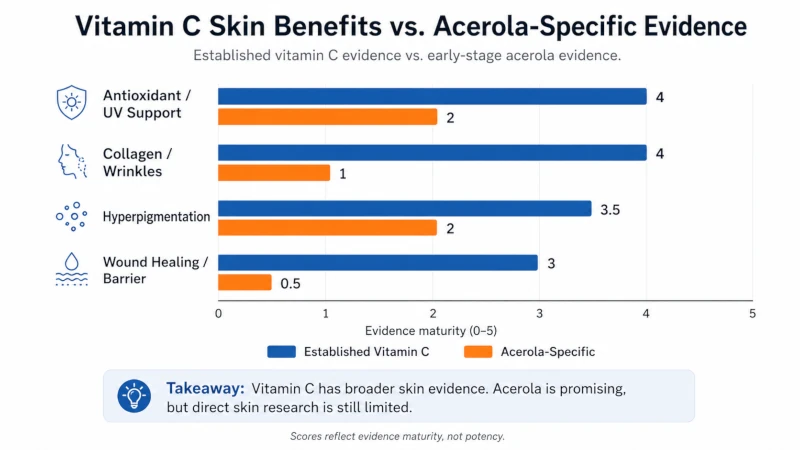
Skin claims about acerola sit on two different evidence levels. Vitamin C’s roles in skin are well established. Acerola-specific skin research is younger and mostly done in cell cultures rather than people.
| Skin effect | Established mechanism (vitamin C) | Acerola-specific evidence |
| Collagen support | Vitamin C is a required cofactor for collagen synthesis | Indirect — acerola supplies vitamin C; not tested as a skin trial |
| Antioxidant / UV defense | Vitamin C neutralizes UV-generated free radicals in skin | Lab (cell-culture) studies on acerola extract |
| Brightening / dark spots | Vitamin C inhibits tyrosinase, lowering melanin output | Preliminary cell-culture data only |
| Wound healing | Vitamin C is needed across healing phases | Indirect — no human acerola wound trials |
Why vitamin C is the active ingredient
Vitamin C is not a marketing add-on for skin; it is part of how skin is built. A widely cited 2017 review in Nutrients summarized it plainly: normal skin holds high concentrations of vitamin C that support collagen production and help defend against UV-induced damage [Pullar et al., 2017]. The Linus Pauling Institute at Oregon State University describes vitamin C as essential to skin health, both as an antioxidant and as a factor needed to make collagen [Linus Pauling Institute].
Acerola, vitamin C, and collagen
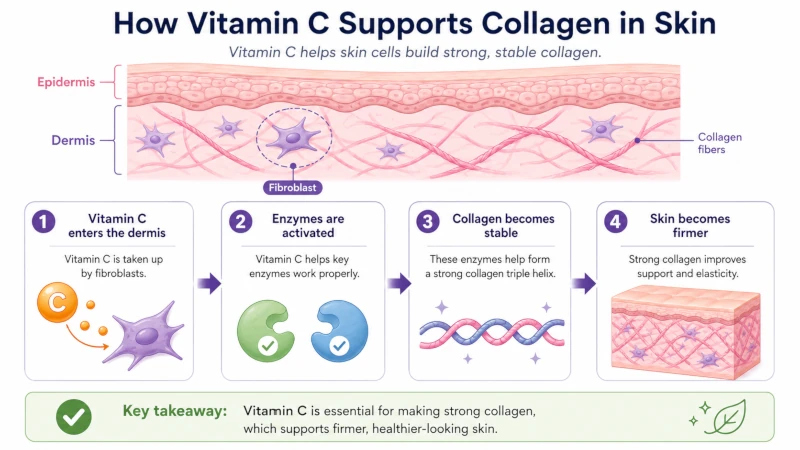
Collagen is the most abundant protein in the body and the main structural material in skin. It gives skin its firmness and elasticity, and its production naturally slows with age, which contributes to wrinkles, sagging, and thinning.
Vitamin C is a required cofactor for two enzymes — prolyl hydroxylase and lysyl hydroxylase — that stabilize the collagen molecule’s triple-helix structure. Without enough vitamin C, those reactions stall and collagen becomes unstable [Pullar et al., 2017]. The extreme version of this deficiency is scurvy, but even a mild shortfall can blunt collagen production.
What this means for acerola
Because acerola is so concentrated, a single serving of acerola powder can supply roughly 200–500 mg of vitamin C — comfortably above the daily requirement and within the range where collagen-supporting effects are documented. Acerola also delivers vitamin C alongside plant compounds such as quercetin and anthocyanins, the kind of whole-food matrix you do not get from a plain ascorbic-acid tablet. See acerola’s full nutritional profile for the complete breakdown.
Antioxidant defense against UV damage
Ultraviolet light is the single largest external driver of skin aging. UV exposure generates reactive oxygen species — free radicals that damage DNA, oxidize cell membranes, and switch on enzymes that break down collagen. Vitamin C is one of the skin’s main water-soluble antioxidants against that cascade, and UV exposure depletes the skin’s vitamin C stores [Pullar et al., 2017].
Vitamin C is not a sunscreen
This is worth stating clearly: vitamin C does not absorb UV light and does not replace SPF. It works as a second line of defense, mopping up oxidative damage after UV reaches the skin. The Linus Pauling Institute notes it limits UV-related damage but is not a substitute for sun protection [Linus Pauling Institute]. Daily broad-spectrum sunscreen still does the blocking.
Acerola’s extra antioxidants — promising, but lab-stage
Acerola’s polyphenols may add antioxidant value beyond vitamin C alone. In one in vitro study, acerola extract protected human skin fibroblasts (the cells that make collagen) from oxidative stress, reducing cell death and boosting the activity of protective enzymes such as catalase and superoxide dismutase [Alvarez-Suarez et al., 2017]. That is encouraging cell-culture work, not proof of an effect on living human skin — a distinction the existing acerola literature is careful to make [Olędzki & Harasym, 2024].
Dark spots and skin brightening
Vitamin C interferes with tyrosinase, an enzyme that drives melanin production. By reducing excess pigment formation, it can help even out tone over time. It does not bleach skin; it lowers overproduction. This is why dermatologists often recommend vitamin C for sun spots, post-inflammatory marks, and uneven tone.
What the acerola-specific research shows
Acerola extract has shown tyrosinase-inhibiting, melanin-lowering activity in laboratory cell models, and reviews of the fruit note its potential as a natural brightening ingredient [Prakash & Baskaran, 2018]. The important caveat: these are cell-culture findings, not clinical trials in people. For stubborn pigmentation, a dedicated topical vitamin C serum has far more clinical backing than dietary acerola alone.
Wound healing and skin repair
Vitamin C contributes across every phase of wound healing — antioxidant support during inflammation, collagen synthesis during tissue building, and mature collagen formation during remodeling [Pullar et al., 2017]. Deficiency clearly impairs healing. No trial has tested acerola specifically for wound healing, but its high vitamin C content makes it a reasonable dietary support where collagen production and repair matter, such as recovery from minor skin injuries.
Eating acerola vs. applying it: which works better?
This is the practical question, and recent research has shifted the picture toward diet.
The case for dietary vitamin C
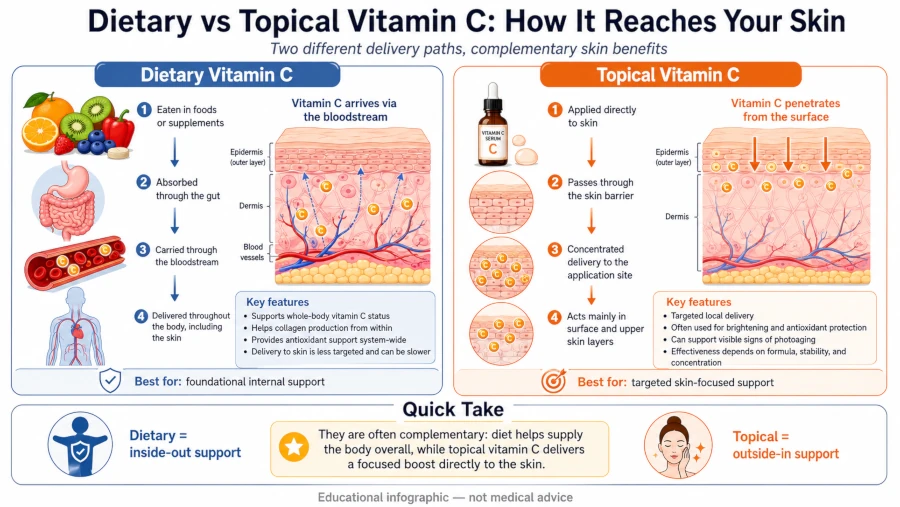
A 2025 study from the University of Otago, published in the Journal of Investigative Dermatology, gave 24 healthy adults with low baseline vitamin C two vitamin C-rich kiwifruit a day (about 250 mg) for eight weeks. Skin vitamin C levels tracked closely with blood levels, and the higher intake was linked to greater skin thickness (a marker of collagen) and faster epidermal cell renewal [Pullar et al., 2025]. The researchers noted this challenges the assumption that topical products are the only route, since vitamin C is water-soluble and penetrates the skin barrier poorly from the outside.
Two honest caveats keep this in perspective. The study was small and used participants who started with low vitamin C, so the biggest gains may apply most to people who were short on it to begin with. And not every measure improved — skin elasticity dipped slightly and UV-related oxidative protection did not change [Pullar et al., 2025]. It was also part-funded by a kiwifruit company, and it tested kiwifruit, not acerola. The takeaway is reasonable but not a sweeping promise: getting enough dietary vitamin C — from acerola or any vitamin C-rich food — supports skin from the inside.
The case for topical vitamin C
Topical vitamin C has well-documented dermatological uses, especially for localized concerns like dark spots and fine lines at specific sites. The catch is delivery: ascorbic acid penetrates the skin’s lipid barrier poorly, so effective serums usually need a low pH (below about 3.5) and stabilized formulas. Most clinically studied serums use synthetic L-ascorbic acid rather than acerola extract, so the strongest topical evidence is for those, not for acerola.
Why using both makes sense
Dietary and topical vitamin C are complementary, not competing. Diet supports collagen and antioxidant defense body-wide; a topical serum targets specific spots. For how much acerola to aim for, see the acerola dosage guide — a skin-focused range of about 250–500 mg of vitamin C daily is reasonable.
How to use acerola cherry for skin
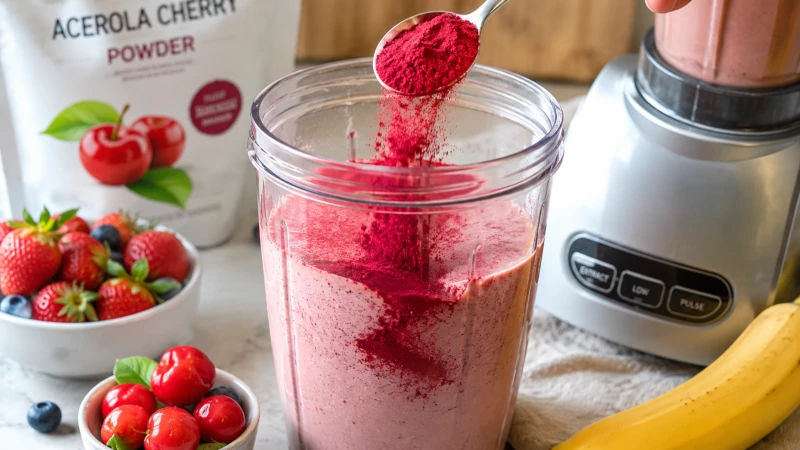
A practical framework based on the evidence above:
- Prioritize dietary intake. This is where the strongest evidence sits. A quarter to one teaspoon of acerola cherry powder in a smoothie, yogurt, or juice supplies roughly 200–500 mg of whole-food vitamin C.
- Pair it with collagen-supporting nutrients. Vitamin C does not act alone — adequate protein (collagen’s building blocks), zinc, and omega-3 fats all support skin structure and barrier function.
- Use topical vitamin C for targeted spots. For dark spots or localized lines, a well-formulated serum (often 10–20% L-ascorbic acid at low pH) remains the better-studied option.
- Protect before you repair. No amount of vitamin C replaces sunscreen. Use broad-spectrum SPF daily; vitamin C complements it.
- Be patient. Skin collagen turns over slowly. Expect to give consistent intake 8–12 weeks or more before judging results.
| Goal | Practical amount | Notes |
| Keep vitamin C levels healthy | ~250 mg/day from food | Body does not store vitamin C; aim for it daily |
| Skin-focused intake | ~250–500 mg/day from acerola (≈½–1 tsp powder) | Stay well under the upper limit |
| Upper limit (adults) | 2,000 mg/day total vitamin C | Above this raises risk of side effects |
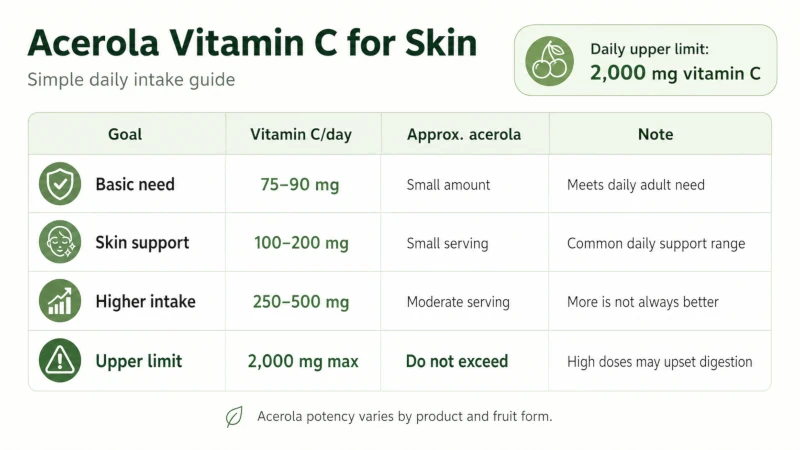
Reference values from NIH Office of Dietary Supplements.
What acerola can’t do for your skin
Being clear about limits matters as much as the benefits:
- It does not erase deep wrinkles. Vitamin C may slow new wrinkle formation, but established lines respond to treatments like retinoids, fillers, or lasers — not fruit.
- It is not a natural sunscreen. It reduces oxidative damage after UV exposure; it does not block UV. SPF is still required.
- It does not replace dermatology care. Conditions like melasma, rosacea, acne, or eczema need professional treatment.
- It is one input, not the whole picture. Sleep, hydration, sun protection, overall diet, genetics, and stress all shape skin.
Safety, side effects, and who should be cautious
Acerola as a food is generally safe for most people, and vitamin C from food is well tolerated. The cautions below mainly apply to concentrated powders and high-dose supplements. For a fuller breakdown, see acerola cherry side effects.
Common side effects of high doses. Taking more than about 2,000 mg of vitamin C a day can cause diarrhea, nausea, and stomach cramps. These usually ease when the dose drops [NIH ODS].
Kidney stones. High-dose vitamin C can increase urinary oxalate. People with a history of calcium-oxalate kidney stones or with kidney disease should be cautious and keep intake modest [NIH ODS].
Iron overload. Vitamin C boosts absorption of iron from food. Anyone with hemochromatosis or another iron-overload condition should talk to a clinician before using high-dose vitamin C [NIH ODS].
Medication and lab-test interactions. Vitamin C can interact with certain chemotherapy and radiation regimens, statins, and niacin, and very high doses may skew some blood and urine test results. If you take prescription medication, check with your prescriber [NIH ODS].
Pregnancy and breastfeeding. Acerola eaten as food is fine, and modest vitamin C intake is part of a normal diet. High-dose supplements during pregnancy or breastfeeding should be discussed with a healthcare professional first.
Applying it directly to skin. Raw acerola pulp or powder is highly acidic and can irritate skin. Use formulated products containing Malpighia emarginata (or Malpighia glabra) fruit extract at an appropriate pH rather than DIY application.
Who should check with a professional first: anyone with a history of kidney stones or kidney disease, iron-overload conditions, those on the medications above, and anyone planning high-dose supplementation rather than food amounts.
When self-care is not enough. See a dermatologist for new or changing moles, spreading or persistent pigmentation (possible melasma), painful or cystic acne, or any skin change that worries you. Seek urgent care if you develop signs of an allergic reaction after eating acerola — hives, swelling of the lips, tongue, or throat, or trouble breathing.
| Health Disclaimer: This content is for educational purposes only and is not intended to diagnose, treat, cure, or prevent any disease. It is not a substitute for professional medical advice. Talk to a qualified healthcare professional before changing your diet, starting a supplement, or adjusting any medication or treatment plan — especially if you are pregnant, breastfeeding, managing a health condition, or taking prescription drugs. |
Frequently Asked Questions
Can acerola cherry improve my skin?
Mainly through its vitamin C. Vitamin C is required for collagen synthesis, helps defend skin against UV-related oxidative damage, and helps regulate melanin. Acerola is among the most concentrated natural sources of it. Consistent intake of roughly 250–500 mg of vitamin C supports skin from within, though results take weeks and tend to be most noticeable in people whose vitamin C was previously low.
Is eating acerola better for skin than putting it on?
For overall collagen and antioxidant support, dietary vitamin C has the stronger evidence. A 2025 University of Otago study found dietary vitamin C reaches the skin through the bloodstream and was linked to greater skin thickness. Topical vitamin C is better for targeted spots like pigmentation. Using both is reasonable.
How much acerola should I take for skin?
A practical range is about 250–500 mg of vitamin C from acerola daily, roughly half to one teaspoon of a typical powder. That is above the daily requirement but well under the 2,000 mg adult upper limit.
Does acerola help with dark spots and hyperpigmentation?
Vitamin C inhibits tyrosinase, the enzyme behind melanin production, which is why it is used for uneven tone. Acerola extract shows this effect in laboratory cell studies, but not yet in clinical trials. For stubborn pigmentation, a dedicated topical vitamin C serum is likely to do more than dietary acerola alone.
Can I put acerola on my face directly?
It is not recommended. The raw fruit and powder are very acidic and can irritate skin. If you want topical benefits, choose formulated products listing Malpighia emarginata fruit extract at an appropriate pH. For dietary benefits, powder or capsules are more practical and better supported.
Is acerola better than a synthetic vitamin C serum?
Not necessarily. Synthetic L-ascorbic acid serums have a much larger clinical record for topical skin benefits. Acerola’s appeal is its whole-food matrix for dietary intake; acerola-specific topical research is still early. They suit different uses.
Key takeaways
- Vitamin C is genuinely required for collagen synthesis, antioxidant defense, melanin regulation, and wound healing — these are established biochemistry, not marketing.
- Acerola cherry is one of the most concentrated natural vitamin C sources, supplying about 1,678 mg per 100 g alongside skin-friendly polyphenols.
- Dietary vitamin C has solid support for skin; a 2025 human study linked higher intake to more skin collagen and renewal, with some limits.
- Acerola-specific skin research is promising but mostly laboratory-stage; topical acerola products lack the track record of synthetic serums.
- The strongest practical plan: dietary acerola for inside-out support, a quality topical serum for targeted spots, daily sunscreen, and patience.
References
- Pullar, J.M., Carr, A.C., & Vissers, M.C.M. (2017). The Roles of Vitamin C in Skin Health. Nutrients, 9(8), 866. View source
- Pullar, J.M., Bozonet, S.M., Segger, D., et al. (2025). Improved Human Skin Vitamin C Levels and Skin Function after Dietary Intake of Kiwifruit. Journal of Investigative Dermatology (online Oct 2025; 2026;146(5):1408–1411). View source
- Linus Pauling Institute, Oregon State University. Vitamin C and Skin Health (Micronutrient Information Center). View source
- Alvarez-Suarez, J.M., Giampieri, F., Gasparrini, M., et al. (2017). The protective effect of acerola (Malpighia emarginata) against oxidative damage in human dermal fibroblasts. (In vitro study). View source
- Olędzki, R., & Harasym, J. (2024). Acerola (Malpighia emarginata) Anti-Inflammatory Activity — A Review. Int. J. Mol. Sci., 25(4), 2089. View source
- Prakash, A., & Baskaran, R. (2018). Acerola, an untapped functional superfruit: a review. J. Food Sci. Technol., 55(9), 3373–3384. View source
- Mezadri, T., et al. (2008). Antioxidant compounds and antioxidant activity in acerola fruits and derivatives. J. Food Composition and Analysis, 21(4), 282–290. View source
- NIH Office of Dietary Supplements. Vitamin C: Fact Sheet for Health Professionals. View source
- USDA FoodData Central. Acerola (West Indian cherry), raw (FDC ID 171686). View source
