
Here’s the short version, so you’re not scrolling for it: colostrum and collagen solve different problems. Colostrum is a dairy-derived first-milk supplement aimed mostly at your immune system and gut lining. Collagen is a structural protein your body uses for skin, joints, and bone. Neither is a miracle, the marketing around both runs hot, and for many people the honest answer to “colostrum vs collagen” is “it depends on what you’re trying to fix” — with “both” being reasonable if your goals span the two.
This guide walks through what each one is, what the research genuinely supports versus what’s still thin, who should steer clear, and how to decide.
Colostrum vs collagen at a glance
| Colostrum | Collagen | |
| What it is | The first milk mammals produce after birth; supplements are usually bovine (cow) | The most abundant structural protein in your body; supplements are hydrolyzed collagen |
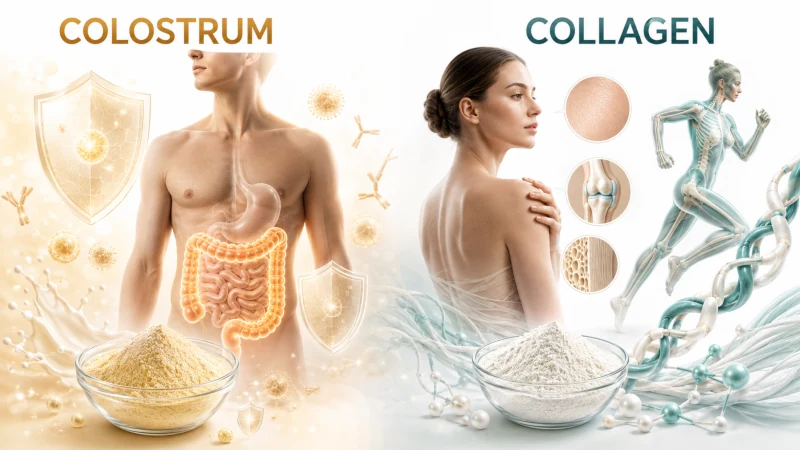
| Main target | Immune function, gut lining | Skin, joints, bone, connective tissue |
| Key components | Immunoglobulins (mainly IgG), lactoferrin, growth factors | Amino acids, especially glycine, proline, hydroxyproline |
| Source | Cow’s first milk | Cow, fish, or chicken connective tissue |
| Best-supported use | Fewer upper-respiratory infections (esp. athletes); reduced gut permeability | Skin hydration/elasticity; bone density in postmenopausal women |
| Big caveat | Contains milk proteins and lactose; skip it with a milk allergy | Joint and hair/nail evidence is mixed or thin |
What colostrum is
Colostrum is the thick “first milk” a mammal makes in the day or two after giving birth, before regular milk comes in. Compared with mature milk, it’s far more concentrated in immune proteins, lactoferrin, and growth factors, and it carries less lactose [Therapeutic effects of bovine colostrum on GI diseases, 2024]. Almost all supplements use bovine (cow) colostrum, collected in the first milkings and dried into powder or capsules.
What’s inside it
The parts that get the attention are the immunoglobulins — antibodies, mostly IgG — along with lactoferrin (a protein with antimicrobial and iron-binding roles) and a set of growth factors involved in tissue repair [Bovine Colostrum Applications: A Systematic Review, 2021]. Those components are what set colostrum apart from a plain protein powder.
What the evidence actually supports
Fewer respiratory infections — promising, mostly in athletes. The most consistent finding is that bovine colostrum may lower the rate of upper-respiratory infections. A 2022 meta-analysis of seven randomized trials found colostrum reduced the risk of these infections by roughly a third (risk ratio 0.64) compared with placebo [Bovine colostrum for upper respiratory infections: meta-analysis, 2022]. Most of that research is in athletes and physically active people, and reviewers repeatedly flag that the number of high-quality trials is small [Bovine Colostrum Applications, 2021].
Worth keeping in perspective: “supports immunity” doesn’t mean “raises your antibody levels.” A separate meta-analysis in active people found colostrum had little or no measurable effect on blood or salivary immunoglobulin concentrations [Immunological outcomes of colostrum in active people, meta-analysis]. Whatever benefit exists likely works through the gut and mucosal defenses rather than by pumping up antibodies you can measure in a lab.
Gut lining — promising in specific situations. Colostrum has been shown to reduce intestinal permeability — how easily the gut wall lets things through — in both healthy and unwell people, and to blunt the gut damage that high-dose anti-inflammatory painkillers (NSAIDs) can cause [Bovine Colostrum Applications, 2021]. This is where the popular “leaky gut” talk comes from. Treat that phrase loosely: increased intestinal permeability is real and measurable, but “leaky gut syndrome” as a catch-all diagnosis is not an established medical condition. The reasonable read is that colostrum can help protect the gut barrier under certain stressors, such as intense exercise — not that it cures a vaguely defined syndrome.

Exercise recovery — limited and mixed. Some trials suggest benefits for recovery and lean mass; a systematic review of colostrum and whey in adults 35 and older called the overall evidence inconsistent and inconclusive [Whey or colostrum in adults ≥35, systematic review]. If you’re an athlete, it’s a “might help” — not a sure thing.
What collagen is
Collagen is the most abundant protein in your body and its main structural material — it’s woven through skin, bone, tendon, cartilage, and blood vessels. It makes up roughly 30% of your body’s total protein, and scientists have identified around 28 different types [Cleveland Clinic on collagen, 2022]. Your body builds its own, but production starts a slow decline sometime in your 20s, which is part of why skin thins and lines set in over the decades. Sun exposure and smoking speed that loss up [Cleveland Clinic on collagen, 2022].
Supplements are made from animal connective tissue — cow (bovine), fish (marine), or chicken — and the good ones are “hydrolyzed,” meaning the protein is pre-broken into small peptides your gut absorbs more easily [Harvard, The Nutrition Source: Collagen, 2024]. On a label, “collagen peptides” and “hydrolyzed collagen” mean the same thing.
The main types
Three types do most of the work people care about. Type I dominates skin, bone, and tendon and drives strength and firmness. Type II makes up the cartilage that cushions your joints, so joint products often feature it. Type III shows up alongside Type I in skin, muscle, and blood vessels. Most powders are Type I and III (skin/bone focus) or Type II (joint focus).

What the evidence actually supports
Skin — the strongest case, with caveats. This is where collagen has the most human data. A 2023 systematic review pooled 26 randomized controlled trials covering 1,721 people and found that hydrolyzed collagen significantly improved skin hydration and elasticity versus placebo, with wrinkle measures improving in many individual trials [Pu et al., Nutrients, 2023]. Two honest asterisks: the authors noted meaningful risk of bias in the included studies, and many collagen trials are funded by companies that sell it. So: a real, repeatable effect on measured skin properties — not a promise you’ll look a decade younger. Because your body needs adequate vitamin C to build collagen, a produce-rich diet matters alongside any powder; the site’s guide to vitamin C and collagen for skin covers that mechanism.
Bone — promising, best shown in postmenopausal women. In a well-run 12-month randomized trial, 131 postmenopausal women taking 5 grams of specific collagen peptides daily had significant increases in bone mineral density at the spine and hip compared with placebo [König et al., Nutrients, 2018]. That’s one strong trial plus supportive follow-up work, in a specific group — encouraging, not the last word.
Joints — genuinely mixed. Here the research pulls in two directions. A 2024 meta-analysis of 35 randomized trials (3,165 patients) found collagen produced small-to-moderate reductions in osteoarthritis pain [Liang et al., Osteoarthritis and Cartilage, 2024]. But an earlier meta-analysis concluded the data did “not support strong conclusions,” and several reviews flag high risk of bias in the underlying studies [Osteoarthritis collagen meta-analysis, 2021]. Fair summary: collagen may modestly ease joint pain for some people, the effect isn’t large, and the evidence quality is uneven.
Hair and nails — mostly anecdotal. Plenty of people report stronger nails and better hair, and there’s a plausible rationale, but rigorous evidence is thin. Cleveland Clinic’s own take is that more research is needed before collagen’s benefits can be considered settled [Cleveland Clinic on collagen, 2022]. File this one under “possible, not proven.”
Where they overlap — and where they don’t
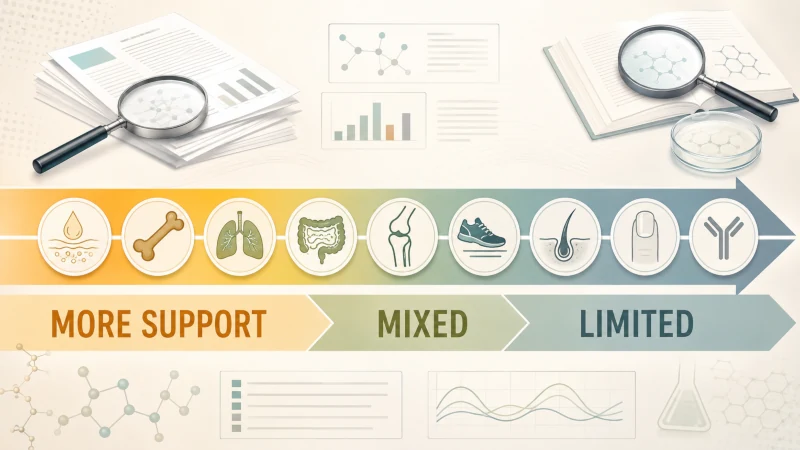
The clean way to hold the difference: colostrum mostly signals and defends (immune messengers, antibodies, gut-barrier support), while collagen mostly supplies building materials (the amino acids your body assembles into structural tissue). Because collagen is essentially a specialized protein, its amino acids — glycine, proline — feed the same repair processes any quality protein does; the site’s overview of protein and the body’s building-block nutrients puts that in context.
They brush up against each other on gut and skin, but through different routes — colostrum via immune and barrier signaling, collagen via raw material for tissue. The overlap is real but modest, and direct evidence for combining them is essentially absent.
Can you take colostrum and collagen together?
For most healthy adults, yes — there’s no known reason the two can’t be taken together, and their mechanisms don’t conflict. Many people simply stir both powders into a morning coffee or smoothie.
The honest caveat is that almost no research has tested the combination head-to-head, so any “better together” claim is reasoning from how each works separately, not proof of a synergy. If your goals span both columns — say, an athlete who wants gut and immune support (colostrum) plus joint support (collagen) — stacking them is defensible. Just don’t expect the pair to outperform what each does on its own.
Safety, side effects, and who should avoid each
Both are generally well tolerated by healthy adults, but “natural” and “over the counter” don’t mean risk-free. Neither is reviewed by the FDA for safety or effectiveness before sale, so quality varies between brands [Cleveland Clinic on bovine colostrum, 2024].
Colostrum
- Realistic expectations. The best-supported benefit is fewer upper-respiratory infections in active people; broader “cure-all” claims outrun the evidence.
- Common side effects. Mainly digestive — nausea, gas, or bloating — often when starting out [Cleveland Clinic, 2024].
- It’s a dairy product. Bovine colostrum contains milk proteins (casein and whey) and some lactose. With a cow’s-milk allergy, don’t take it; if lactose intolerant, it may cause symptoms — some products are lower-lactose [Mayo Clinic Press, 2025].
- Pregnancy and breastfeeding. Mayo Clinic advises against colostrum supplements while pregnant or lactating [Mayo Clinic Press, 2025].
- Hormone-sensitive conditions. Colostrum may contain small amounts of estrogen, so with a hormone-sensitive cancer, talk with your doctor first [WebMD: Bovine Colostrum].
- Autoimmune conditions. Because colostrum interacts with immune signaling, run it by your doctor before starting if you manage an autoimmune condition.
Collagen
- Realistic expectations. Best case for skin and bone; joints and hair/nails are less certain [Harvard, 2024].
- Common side effects. Uncommon and mild — a feeling of fullness or minor digestive upset, more likely at larger doses.
- Allergens. Marine collagen comes from fish; skip it with a fish allergy and choose a bovine or chicken source instead.
- Dose used in studies. Skin trials commonly used about 2.5–10 grams a day; the bone trial used 5 grams daily. These are amounts studied, not a personalized prescription — follow the label and give it 8–12 weeks [Pu et al., 2023]; [König et al., 2018].
Good practice for either
- Choose third-party-tested products. An independent seal (NSF, USP, or ConsumerLab) tells you the product contains what the label says — the site’s supplement-quality primer explains what those seals do and don’t guarantee.
- Start low. Begin at a modest dose to see how you tolerate it.
- Talk to a professional first — your doctor, pharmacist, or a registered dietitian — if you’re pregnant or breastfeeding, take prescription medication, or manage a chronic condition.
- Remember what they can’t do. Neither replaces a solid diet, sleep, movement, and — for skin — daily sunscreen. Food-first immune support still starts on your plate, as the site’s guide to immune-supporting foods lays out.
How to choose
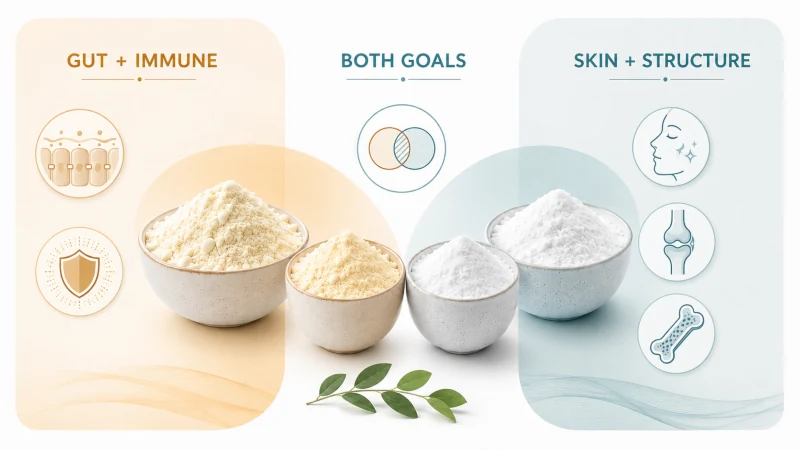
- Lean colostrum if your main goals are immune resilience (especially if you train hard) or gut-barrier support — and you tolerate dairy.
- Lean collagen if your goals are skin quality, bone density (particularly after menopause), or connective-tissue support, or if you can’t have dairy.
- Consider both if your goals genuinely span the two columns and the budget makes sense — knowing the combination itself hasn’t been formally studied.
You don’t have to commit forever. Trying one for a couple of months, seeing how you feel, and adjusting is a perfectly sensible approach.
| Health disclaimer: This article is for general education only and is not medical advice, diagnosis, or treatment. Colostrum and collagen are dietary supplements, not medicines, and they are not reviewed by the FDA for safety or effectiveness before sale. Talk with your doctor, pharmacist, or a registered dietitian before starting either — especially if you are pregnant or breastfeeding, have a milk allergy or a hormone-sensitive or autoimmune condition, take prescription medication, or manage a chronic illness. Seek urgent or emergency care (call 911) for signs of a serious allergic reaction after taking a supplement, such as hives, swelling of the lips, tongue, or throat, or trouble breathing. Don’t delay or disregard professional medical advice because of something you read here. |
Frequently Asked Questions
Is colostrum better than collagen?
Neither is “better” — they do different jobs. Colostrum targets immune function and the gut lining; collagen supports skin, bone, and connective tissue. The right pick depends on your goal, and dairy tolerance rules colostrum out for some people.
Can I take colostrum and collagen at the same time?
For most healthy adults, yes. Their mechanisms don’t conflict and many people take both. Just know the combination hasn’t been formally studied, so expect each to do its own job rather than a proven bonus. Check with your doctor if you’re pregnant, on medication, or managing a condition.
Does collagen really work for skin?
The best evidence says it modestly helps. A 2023 review of 26 randomized trials found hydrolyzed collagen improved skin hydration and elasticity versus placebo, with wrinkle measures improving in many trials — though study quality was uneven and industry funding is common. Give it 8–12 weeks and keep expectations realistic.
Is colostrum dairy? Can I take it if I’m lactose intolerant?
Bovine colostrum is a dairy product — it contains milk proteins and some lactose (less than regular milk). With a cow’s-milk allergy, avoid it. If lactose intolerant, it may cause symptoms; lower-lactose products exist, but check the label and consider asking your doctor.
How much collagen should I take?
Studies commonly used about 2.5–10 grams a day for skin and 5 grams a day in the postmenopausal bone trial. Those are the amounts researched, not a personal prescription — follow your product’s label and give it a couple of months to judge results.
Who should avoid these supplements?
Skip colostrum with a cow’s-milk allergy, and talk to your doctor first if you’re pregnant or breastfeeding, have a hormone-sensitive or autoimmune condition, or take medication. For collagen, avoid marine (fish-derived) versions with a fish allergy. When in doubt, ask a doctor, pharmacist, or registered dietitian.
References
- Cleveland Clinic. “Collagen: What It Is, Types, Function & Benefits.” 2022. View source
- Cleveland Clinic Health Essentials. “Bovine Colostrum: Why You Should Skip This Pricey Supplement.” 2024. View source
- Harvard T.H. Chan, The Nutrition Source. “Collagen.” 2024. View source
- Pu S-Y, et al. “Effects of Oral Collagen for Skin Anti-Aging: A Systematic Review and Meta-Analysis.” Nutrients. 2023;15(9):2080. DOI 10.3390/nu15092080; PMID 37432180. View source
- König D, et al. “Specific Collagen Peptides Improve Bone Mineral Density and Bone Markers in Postmenopausal Women.” Nutrients. 2018;10(1):97. DOI 10.3390/nu10010097. View source
- Liang C-W, et al. “Efficacy and safety of collagen derivatives for osteoarthritis: a trial sequential meta-analysis.” Osteoarthritis and Cartilage. 2024. View source
- “Do collagen supplements reduce symptoms of osteoarthritis? Meta-analytic results do not support strong conclusions.” PMID 34636929. View source
- “Bovine Colostrum Applications in Sick and Healthy People: A Systematic Review.” Nutrients. 2021;13(7):2194. DOI 10.3390/nu13072194. View source
- “Bovine colostrum supplementation in prevention of upper respiratory tract infections — systematic review and meta-analysis.” Journal of Functional Foods. 2022. View source
- “Immunological Outcomes of Bovine Colostrum Supplementation in Trained and Physically Active People: A Systematic Review and Meta-Analysis.” View source
- “Therapeutic effects of bovine colostrum applications on gastrointestinal diseases: a systematic review.” 2024. View source
- “Health Benefits of Whey or Colostrum Supplementation in Adults ≥35 Years: a Systematic Review.” View source
- Mayo Clinic Press. “Colostrum: Super supplement or overhyped?” 2025. View source
- WebMD. “Bovine Colostrum: Overview, Uses, Side Effects, Precautions.” View source
