The plant sold as the “mosquito plant” is pennyroyal, and the most honest answer to what its health benefits are is an uncomfortable one: they’re mostly historical, mostly unproven, and where swallowing it is concerned, genuinely dangerous.
Pennyroyal earned its name as a strong-smelling insect repellent, and that scent is still the one use with any real footing. Nearly everything else pinned on it — bringing on a period, clearing a cold, settling the stomach, expelling parasites — has not held up to scrutiny, and the concentrated oil has killed people. So if you came looking for mosquito plant health benefits, here is the version worth having: enjoy the smell, treat it as a weak backup repellent at best, and don’t drink it, dose yourself with it, or give it to a child or a pet.
That is a sharp turn from the way pennyroyal usually gets written up, so let’s go through what it is, what it was believed to do, what the evidence actually shows, and where the real danger sits.
What the “mosquito plant” actually is
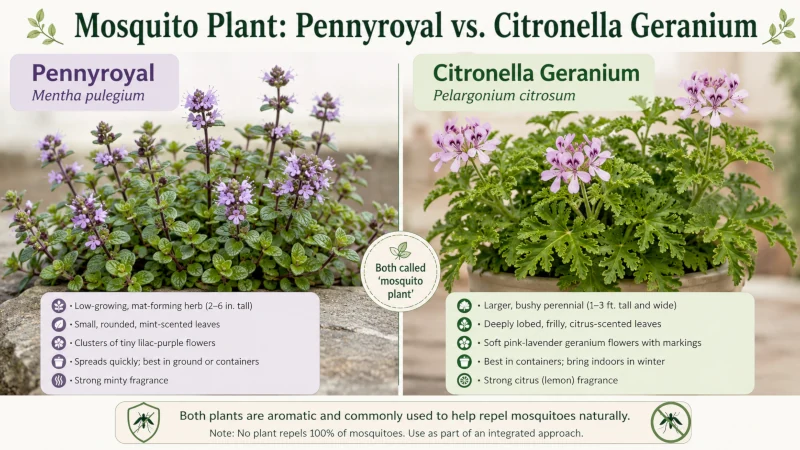
“Mosquito plant” is one of several folk names — along with squaw mint, squaw balm, tickweed, and pudding grass — for pennyroyal, a low, spreading member of the mint family [Memorial Sloan Kettering, 2022]. Two different plants share the name and the same core chemistry: European pennyroyal (Mentha pulegium) and American pennyroyal (Hedeoma pulegioides) [NIH LiverTox, 2020]. Both carry a sharp minty smell, which is exactly why insects avoid them and why people have rubbed the leaves on skin, tucked them into bedding, and planted them by the door for centuries.
The smell and the hazard come from the same source. Pennyroyal’s essential oil is mostly a volatile compound called pulegone, and European pennyroyal oil runs about 80 to 90 percent pulegone [Memorial Sloan Kettering, 2022]. Hold onto that word, because the “benefits” and the “warnings” are the same story told from two directions.
The one use with a real basis: repelling insects
Pennyroyal’s reputation as a bug deterrent isn’t imaginary. The plant’s aroma does put off mosquitoes, fleas, and other insects, which is how it got its common name and why it turns up in old flea powders and homemade repellents. If you grow it in a pot on the patio for the scent, that’s a low-stakes use.
The catch is that “a plant that smells like something insects dislike” is a long way from “an effective, safe repellent you can rely on.” A pot of pennyroyal sitting nearby won’t protect your skin, and the concentrated oil that would actually repel insects is the same oil that’s toxic to people and animals. Major medical sources list insect repellent among the uses with no supporting clinical evidence for benefit as a health product [Memorial Sloan Kettering, 2022]. In other words, the smell is real; dependable protection is not.
Safer ways to get the same result
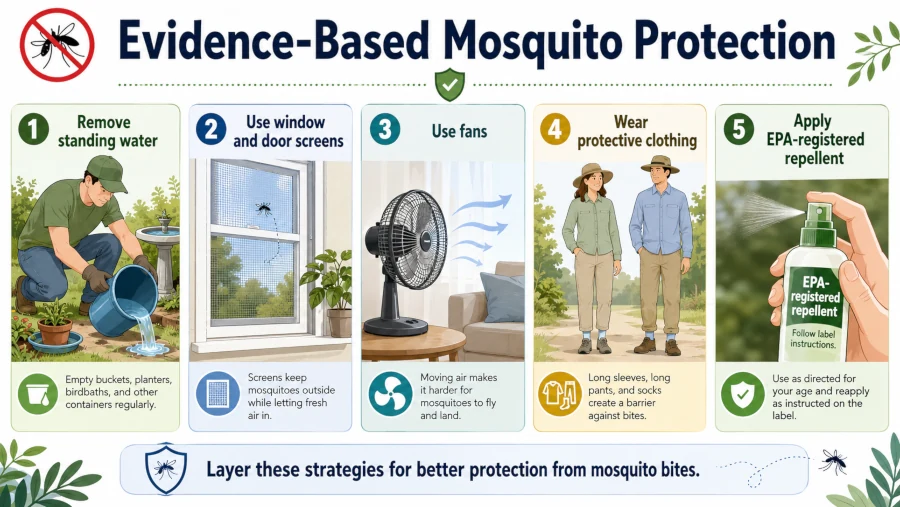
If your goal is fewer bites, the evidence points elsewhere. Removing standing water, repairing screens, running a fan where you sit, covering skin, and using an EPA-registered repellent (including plant-derived oil of lemon eucalyptus/PMD) do far more than any pennyroyal plant, without the toxicity. Our guide to home remedies for mosquito repellent that actually work walks through the options and what the research supports. If it’s the mint family you like, a safe mint relative such as peppermint oil has a much friendlier safety profile for ordinary use.
What tradition claimed vs. what the evidence shows
Pennyroyal has a long folk résumé. Being long-used is not the same as being effective or safe, and this is one of the clearest examples of that gap. Here’s how the traditional claims line up against the science.
| Traditional claim | What the evidence actually shows |
| Brings on menstruation / eases cramps | No scientific evidence of benefit; doses tied to any uterine effect overlap with poisoning, and this use has caused deaths [MSKCC, 2022] |
| Induces abortion | No safe or reliable effect; historically the deadliest use — young women have died in the attempt [LiverTox, 2020] |
| Treats colds, coughs, lung conditions | No scientific evidence of benefit [MSKCC, 2022] |
| Eases headaches | No scientific evidence of benefit [MSKCC, 2022] |
| Aids digestion / expels parasites | Not supported; traditional use only. |
| Reduces inflammation, treats toothache, PMS | No scientific evidence of benefit [MSKCC, 2022] |
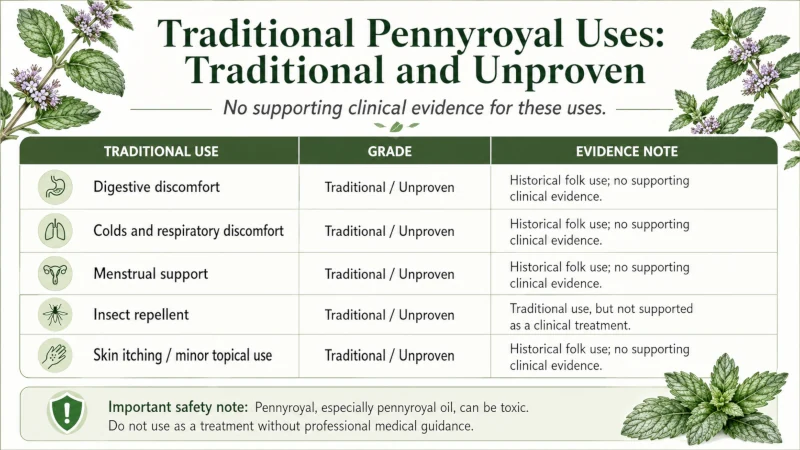
The pattern is consistent across authoritative reviews: tradition is rich, human evidence of benefit is essentially absent, and evidence of harm is well documented. That asymmetry is the whole point.
Why taking pennyroyal internally is dangerous
Once pulegone is in the body, the liver converts it into a reactive metabolite called menthofuran, and both compounds strip out glutathione, a protective molecule the liver uses to defend its own cells [NIH LiverTox, 2020]. The result is a direct chemical attack on liver tissue that, in serious cases, looks a lot like a severe acetaminophen (Tylenol) overdose — acute liver necrosis that can progress to liver failure and death [NIH LiverTox, 2020].
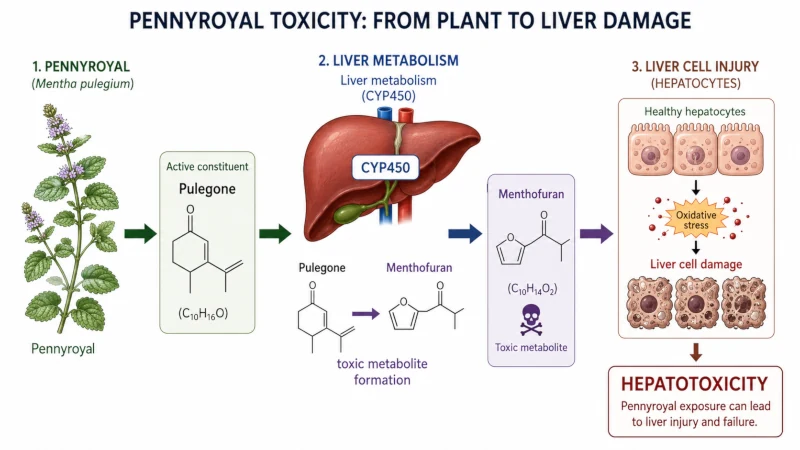
This is not a rare-in-theory risk. The literature holds at least two dozen cases of pennyroyal toxicity, including liver and kidney failure, dangerously low blood sugar, blood-clotting failure, seizures, and death [Memorial Sloan Kettering, 2022]. In one documented case, an 18-year-old who swallowed an ounce of pennyroyal oil developed multi-organ failure and died a week later [NIH LiverTox, 2020]. There are also reports of infants suffering multi-organ failure after being given pennyroyal in home-remedy teas, and of a 76-year-old woman developing acute liver failure linked to pennyroyal tea interacting with her medications [Memorial Sloan Kettering, 2022].
Tea vs. oil: it comes down to dose
It’s fair to note the nuance: pennyroyal leaf and weak traditional teas have been consumed for a long time, and low culinary amounts haven’t been tied to the same catastrophic outcomes as the oil [NIH LiverTox, 2020]. The concentrated essential oil is where the real danger lives — a single tablespoon (about 15 mL) can cause fainting, seizures, coma, cardiovascular collapse, and organ failure [NIH LiverTox, 2020].
But that nuance is not a green light for the tea, for one practical reason: the moment you use pennyroyal medicinally — steeping it strong, drinking it repeatedly, trying to “bring on a period” — you’re pushing toward the doses that cause harm, and the infant and drug-interaction cases show the tea is not automatically safe either [Memorial Sloan Kettering, 2022]. There’s no reliable safe medicinal dose, which is exactly why medical sources say pennyroyal is not recommended for internal use at all [NIH LiverTox, 2020].
As a regulatory footnote: in 2018 the U.S. FDA removed synthetic pulegone from its approved food-additive list after animal studies raised cancer concerns, though the agency noted that exposure at the tiny levels once used in food was low-risk and that the change didn’t affect natural mint foods [FDA, 2018]. It’s a small data point, but it tells you which direction official scrutiny of this compound has moved.
Safety: side effects, interactions, and who must avoid it
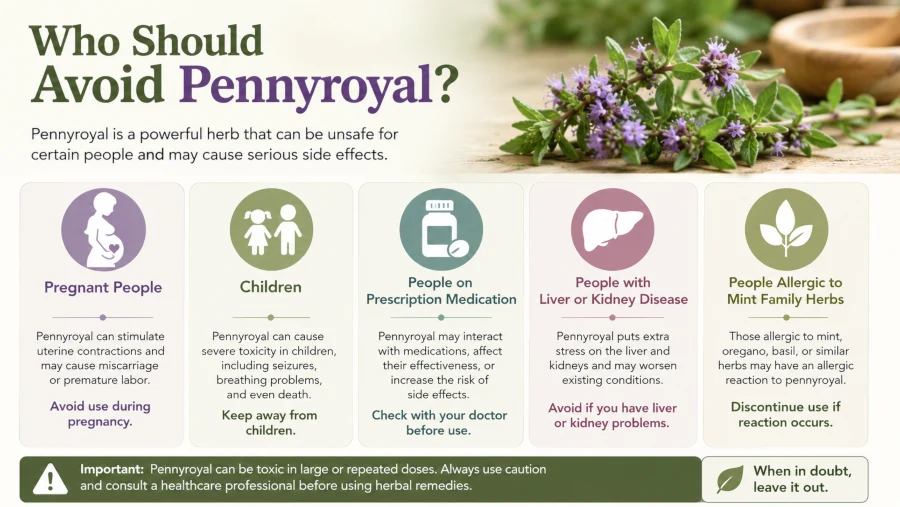
Reported side effects of pennyroyal include dizziness, weakness, hallucinations, nausea, abdominal cramps, and stomach upset, alongside the liver and kidney toxicity above [Memorial Sloan Kettering, 2022]. Because the serious effects can arrive after a delay, feeling “fine at first” is not reassurance.
Pregnancy and breastfeeding
This is the most important warning on the page. Pennyroyal should not be used by anyone who is pregnant or breastfeeding — it can cause miscarriage and other toxic effects, and its historical use as an abortion-inducer is directly tied to the deaths on record [Memorial Sloan Kettering, 2022]. If you’re pregnant and considering pennyroyal for any reason, don’t, and talk to a healthcare professional about safer options for whatever you’re trying to address.
Medication interactions
Pennyroyal is processed by the same liver enzyme systems (including CYP2E1) that handle many prescription drugs, and a case of acute liver failure was linked to pennyroyal tea interacting with a person’s medications [Memorial Sloan Kettering, 2022]. It may also cut the absorption of iron supplements by half or more [Memorial Sloan Kettering, 2022]. If you take any regular medication, this is a plant to avoid rather than experiment with.
A specific warning for pet owners
The old folk advice to rub pennyroyal on a dog’s coat or sprinkle it in pet bedding to fight fleas is actively dangerous, so please skip it. Pennyroyal oil is toxic to dogs and can cause severe liver damage, and there’s a documented case of a dog poisoned through skin exposure alone [PetMD, 2012]. Cats are considered especially vulnerable because they groom the oil off their fur and swallow it. If a flea product lists pennyroyal oil, choose a different one, and keep pets away from the growing plant.
Emergency signs: when pennyroyal is a poison-control situation
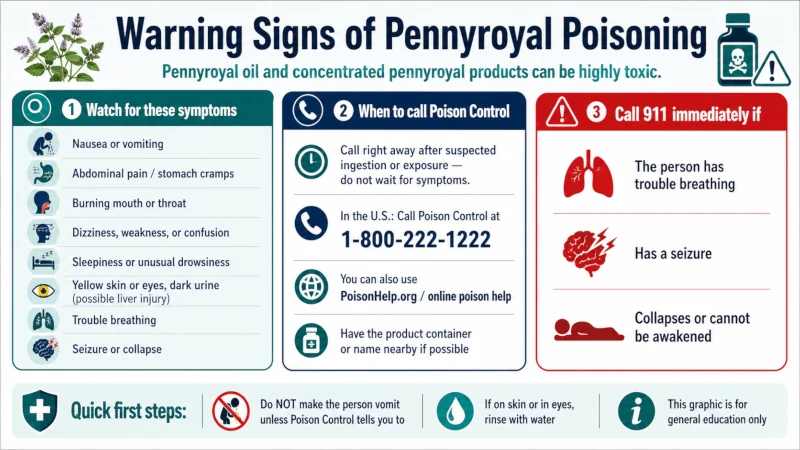
If someone has swallowed pennyroyal oil, or a large amount of strong pennyroyal tea, treat it as an emergency rather than waiting to “see how it goes.” Get urgent medical help for vomiting, severe abdominal pain, confusion or agitation, drowsiness, fainting, seizures, difficulty breathing, or any bleeding.
In the United States, you can reach Poison Control 24/7 at 1-800-222-1222, and call 911 for seizures, collapse, or trouble breathing. Bring the product or plant with you if you can. Early treatment matters here, because the antidote approach (N-acetylcysteine, the same drug used for Tylenol overdose) works best when started quickly [NIH LiverTox, 2020].
| Health Disclaimer This article is for general education and is not a substitute for professional medical advice, diagnosis, or treatment. Pennyroyal (mosquito plant) is a toxic herb that has caused serious harm and death, particularly when the oil is ingested or when it is used during pregnancy. Do not use pennyroyal internally, do not use it to try to affect a pregnancy or menstrual cycle, and do not apply it to pets. If you are pregnant or breastfeeding, take any medication, or have a health condition, talk with a qualified healthcare professional before using any herbal product. If you suspect pennyroyal poisoning, contact Poison Control (1-800-222-1222 in the US) or emergency services immediately. |
Frequently Asked Questions
Is the mosquito plant the same as pennyroyal?
Yes. “Mosquito plant” is a common name for pennyroyal, which exists as two related species — European (Mentha pulegium) and American (Hedeoma pulegioides) — with the same active chemistry [Memorial Sloan Kettering, 2022].
Can I drink pennyroyal tea for health benefits?
It’s not recommended. There’s no proven medicinal benefit, and there’s real risk: strong or repeated use pushes toward doses that have caused liver failure, and even tea has been implicated in serious poisonings, including in infants and in someone on interacting medications [Memorial Sloan Kettering, 2022]; [NIH LiverTox, 2020].
Does pennyroyal actually keep mosquitoes away?
Its scent does deter some insects, which is how it got the name, but a plant nearby won’t protect your skin, and the concentrated oil that repels insects is toxic. Proven, EPA-registered repellents are a far better bet — see our mosquito repellent guide.
Is pennyroyal safe during pregnancy?
No. It can cause miscarriage and toxic effects and should be avoided entirely in pregnancy and breastfeeding [Memorial Sloan Kettering, 2022].
Why do old herbal books recommend it if it’s this dangerous?
Long tradition isn’t the same as evidence of safety or benefit. Pennyroyal is a case where historical popularity and modern toxicology point in opposite directions, and the documented deaths are the reason the medical guidance is now so cautious [NIH LiverTox, 2020].
My flea product contains pennyroyal — should I worry?
Choose a different product. Pennyroyal oil is toxic to dogs and especially to cats, which ingest it while grooming [PetMD, 2012].
References
- National Institute of Diabetes and Digestive and Kidney Diseases. “Pennyroyal Oil.” LiverTox: Clinical and Research Information on Drug-Induced Liver Injury. Updated March 28, 2020. PMID 31643984. View source
- Memorial Sloan Kettering Cancer Center. “Pennyroyal.” Integrative Medicine — About Herbs. View source
- PetMD Editorial. “Pennyroyal Oil Poisoning in Dogs.” PetMD, November 19, 2012. View source
- U.S. Food and Drug Administration. “FDA Removes 7 Synthetic Flavoring Substances from Food Additives List.” 2018. View source
