Contents
- 1 Medical disclaimer
- 2 Quick answer
- 3 The oral nitrate pathway
- 4 Step 1: Nitrate comes from food
- 5 Step 2: Saliva delivers nitrate to the tongue
- 6 Step 3: Tongue bacteria convert nitrate → nitrite
- 7 Step 4: After swallowing, nitrite can support NO
- 8 Why this matters for blood pressure and circulation
- 9 Where mouthwash fits in
- 10 How to support the pathway safely
- 11 FAQ
- 12 Next reads
- 13 References
Medical disclaimer
This article about the oral nitrate pathway is for educational purposes only and is not medical advice. If you have high blood pressure, heart disease, kidney disease, are pregnant, or take prescription medications, talk with a qualified clinician and/or dentist before making major changes to diet, supplements, or daily oral‑care products.
Your mouth isn’t just for chewing and talking. It’s also part of how your body makes nitric oxide (NO)—a tiny signaling molecule that helps blood vessels relax and supports healthy circulation.[1][2]
Quick answer
A major “food‑based” NO route is the oral nitrate pathway (also called the enterosalivary nitrate → nitrite → NO pathway):
1) You eat nitrate‑rich vegetables
2) Your body concentrates nitrate into saliva
3) Helpful oral bacteria (mostly on the tongue) convert nitrate → nitrite
4) After you swallow, nitrite can contribute to nitric oxide in the stomach and in circulation—especially when oxygen is lower (like during exercise).[1][2]
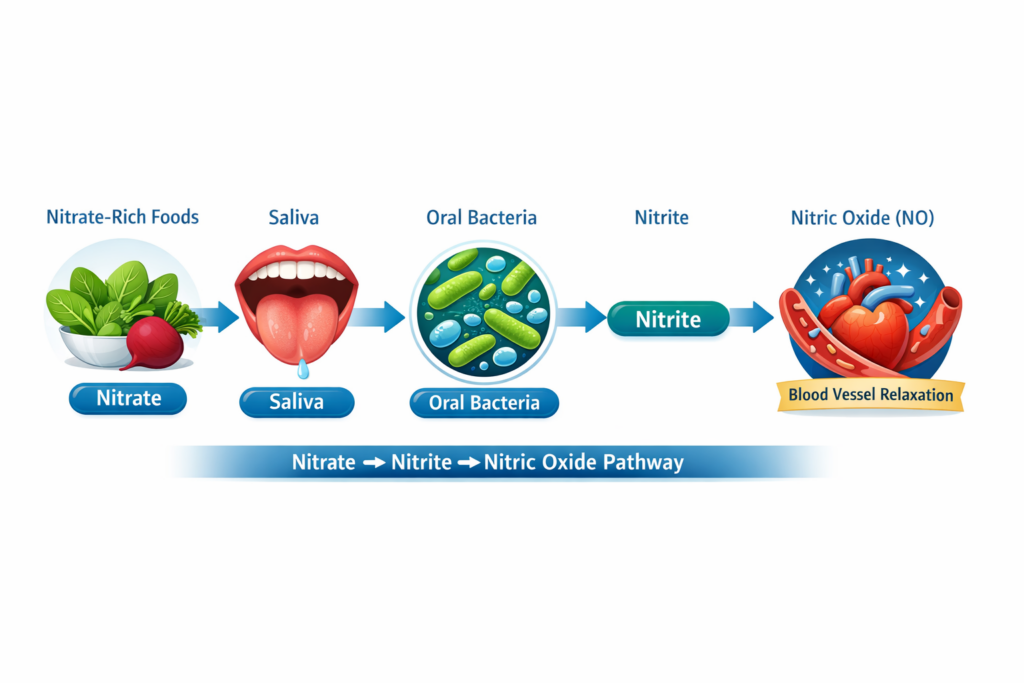
The oral nitrate pathway
Humans don’t do the nitrate → nitrite step efficiently without oral bacteria. That’s why the tongue microbiome matters.[1][2]
Nitrate → nitrite → nitric oxide pathway
| Step | What happens | Where it happens |
| 1) Eat nitrate‑rich foods | Nitrate enters the body | Gut → blood |
| 2) Nitrate concentrates in saliva | Salivary glands move nitrate into saliva | Mouth |
| 3) Bacteria convert nitrate → nitrite | Nitrate‑reducing bacteria create nitrite | Tongue/mouth |
| 4) Swallow nitrite | Nitrite reaches stomach and circulation | Stomach → blood |
| 5) Nitrite supports NO signaling | NO helps blood vessels relax | Blood vessels/tissues |
Step 1: Nitrate comes from food
Nitrate is naturally present in many vegetables (especially leafy greens and beets). After a nitrate‑rich meal, nitrate is absorbed into the bloodstream and later “recycled” into saliva.[1][8]
Step 2: Saliva delivers nitrate to the tongue
Saliva matters because it transports nitrate back into the mouth where bacteria can act on it. Low saliva flow (dry mouth, dehydration, mouth‑breathing, certain medications) can reduce how much nitrate reaches the tongue surface.[1][2]
Step 3: Tongue bacteria convert nitrate → nitrite
On the back of the tongue, specific bacteria use nitrate reductase enzymes to convert nitrate (NO₃⁻) into nitrite (NO₂⁻).[1][2] Oral health can influence this: gum disease and microbiome disruption are associated with lower nitrate‑reducing capacity in some studies.[2][9]
Step 4: After swallowing, nitrite can support NO
After you swallow, nitrite can form nitric oxide in the stomach and also circulate to tissues. This conversion can become more relevant when oxygen is lower (for example, during exercise).[1][7][8]
Why this matters for blood pressure and circulation
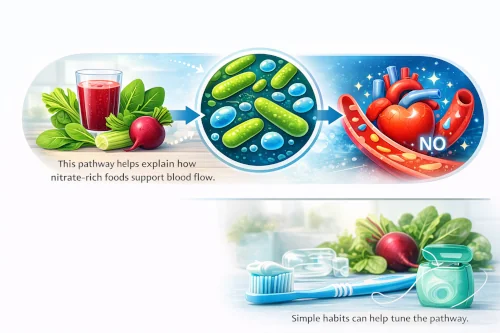
Nitric oxide is one of the body’s main “relax” signals for blood vessels. When vessels relax, blood flows with less resistance, which can support healthier blood pressure patterns over time.[1][8]
In humans, nitrate‑reducing oral bacteria patterns have been associated with vascular and cardiometabolic markers, including blood pressure—which supports that this pathway is meaningful in real life (not just in theory).[3]
Where mouthwash fits in
Strong antiseptic mouthwashes can reduce oral bacteria broadly, including nitrate‑reducing bacteria. Reviews and clinical studies suggest this can lower salivary nitrite and, in some people, may slightly raise blood pressure—especially with frequent use.[4][5][6]
Oral-care choices
| Oral-care choice | Likely effect on nitrate pathway | Practical guidance |
| Brush + floss/interdental cleaning | Neutral (doesn’t broadly wipe out bacteria) | Foundation habit for most people |
| Tongue cleaning (gentle) | May help reduce odor and improve hygiene without “sterilizing” the mouth | Avoid scraping hard enough to irritate tissue |
| Strong antiseptic rinse (e.g., chlorhexidine; some strong formulas) | More likely to disrupt nitrate → nitrite conversion[4][5] | Best short‑term when dentist‑directed |
| Occasional cosmetic rinse | Probably smaller effect than strong antiseptics (varies by ingredient)[4] | If used, keep habits consistent during a BP/NO test |
How to support the pathway safely
Start food-first. If you have BP concerns or take BP meds, go slow and track trends.
- Eat leafy greens most days (arugula, spinach, lettuce, beetroot, radishes, celery).
- Stay hydrated and support saliva flow (especially if you have dry mouth).
- Chew your food well (it boosts saliva and helps nitrate mix across the tongue).
- Keep mouthwash habits consistent while you test any nitrate strategy.
FAQ
- Is vegetable nitrate the same as “processed meat nitrites”? They’re different in food context. Vegetables come with vitamin C, polyphenols, potassium, and fiber, while processed meats come with different compounds and are generally recommended to limit for overall health. If you want to use nitrate for NO support, vegetables are the safer “food-first” approach.
- Should I stop mouthwash if I care about nitric oxide? Not automatically. Mouthwash can be important for specific dental needs. The practical point is to avoid long‑term antiseptic use by habit if you don’t need it—and to ask your dentist what fits your situation.[4]
- How long does the nitrate → nitrite effect last after a meal? Saliva nitrite often rises for hours after a nitrate‑rich meal and then gradually drops. Many people do best with consistent intake (daily greens) rather than chasing a one‑time “boost.”[1][8]
- Do NO supplements work the same way? It depends. Beet/nitrate products often rely on oral bacteria, while L‑citrulline and L‑arginine support a different NO pathway. If a product is nitrate‑based, your mouth bacteria still matter.[1][2]
- Who should be extra careful? People on blood pressure medications, nitrate drugs for chest pain, PDE‑5 inhibitors, people with kidney disease, or anyone with very low blood pressure should get clinician guidance before using nitrate or NO‑boosting supplements.
Next reads
- Nitric oxide for blood pressure
- Nitrate-rich vegetables list for nitric oxide
- Beetroot juice for blood pressure
- Does mouthwash reduce nitric oxide
References
- [1] Wootton-Beard PC, et al. Role of oral and gut microbiomes in enterosalivary nitrate metabolism (review). Frontiers in Cellular and Infection Microbiology. 2025. https://www.frontiersin.org/journals/cellular-and-infection-microbiology/articles/10.3389/fcimb.2025.1612223/full
- [2] Hyde ER, et al. Pathways linking oral bacteria and nitric oxide metabolism (review; open access). 2022. https://www.ncbi.nlm.nih.gov/pmc/articles/PMC9124908/
- [3] Burleigh MC, Liddle L, et al. Association between nitrate‑reducing oral bacteria and cardiometabolic/vascular markers. J Am Heart Assoc. 2019. https://www.ahajournals.org/doi/10.1161/JAHA.119.013324
- [4] Tribble GD, Angelov N, Weltman R, et al. Antiseptic mouthwash, the nitrate–nitrite–nitric oxide pathway, and blood pressure (review; open access). 2020. https://pmc.ncbi.nlm.nih.gov/articles/PMC7567004/
- [5] Bondonno CP, Liu AH, Croft KD, et al. Antibacterial mouthwash blunts oral nitrate reduction and increases blood pressure in treated hypertensive adults. 2015. https://pubmed.ncbi.nlm.nih.gov/25359409/
- [6] Joshipura KJ, et al. Over‑the‑counter mouthwash use, nitric oxide markers, and cardiovascular risk markers (open access). 2020. https://pmc.ncbi.nlm.nih.gov/articles/PMC7125030/
- [7] Bailey SJ, et al. Oral microbiome, nitric oxide, and exercise performance (review). 2022. https://www.sciencedirect.com/science/article/pii/S1089860322000544
- [8] Lundberg JO, Carlström M, et al. Nitrate–nitrite–nitric oxide physiology (background reviews). 2010–2018 (overview). https://pubmed.ncbi.nlm.nih.gov/?term=nitrate+nitrite+nitric+oxide+Lundberg+review
- [9] Hsu YH, et al. Periodontitis and impaired oral nitrate reduction (research). 2023. https://www.nature.com/articles/s41368-023-00266-9
Last updated: 2025-12-29