
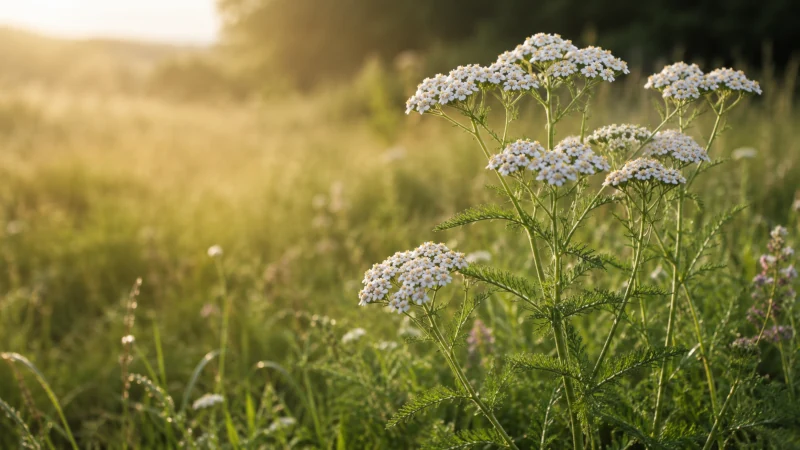
Milfoil is an old country name for yarrow (Achillea millefolium), the feathery, white-flowered herb soldiers once carried to dress wounds — not the aquatic weed that shares the name. If you’re weighing milfoil benefits for digestion, period cramps, a scraped knee, or your skin, here’s the honest version up front: yarrow has a genuine 2,000-year track record and some encouraging early science, but most of its reputation rests on tradition and lab or animal studies rather than solid human trials. The one benefit with a real (if small) clinical signal is easing menstrual cramp pain. Everything else is worth understanding for what it is — promising, traditional, or simply untested.
What is milfoil?
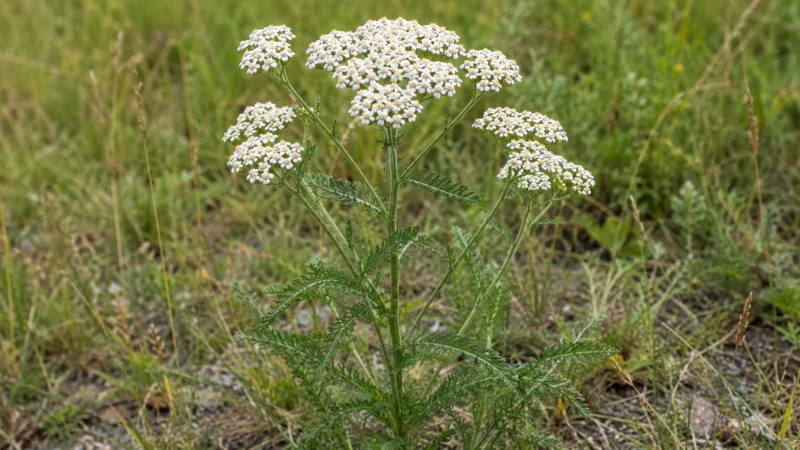
Yarrow goes by a small pile of names: milfoil, thousand-leaf, nosebleed plant, soldier’s woundwort, sanguinary, and milenrama in Spanish. It’s a member of the daisy family (Asteraceae, also called Compositae), which is the single most important fact about it for safety reasons we’ll get to. The flowering tops — the flat clusters of tiny white or pink blooms plus the upper leaves — are the parts used in herbal medicine [Drugs.com yarrow monograph, 2026].
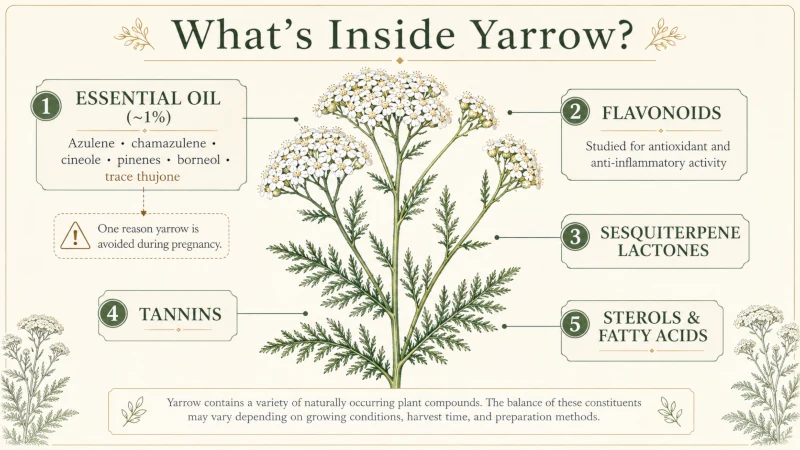
What’s actually in it: yarrow yields roughly 1% essential oil, rich in azulene and chamazulene (the same blue-tinted compound found in chamomile), along with pinenes, cineole, borneol, and trace amounts of thujone. Beyond the oil, the plant contains sesquiterpene lactones, flavonoids, tannins, sterols, and fatty acids [Drugs.com, 2026]. Those flavonoids and the essential-oil compounds are what most researchers credit for its anti-inflammatory and antioxidant activity [review of the genus Achillea, 2011].
The name itself is a clue to its oldest use. Achillea comes from the Greek hero Achilles, said to have carried the plant into battle to treat his soldiers’ wounds; the Romans knew it as herba militaris, the military herb [Drugs.com, 2026].
Milfoil (yarrow) benefits at a glance
| Use | What you can realistically expect | Evidence strength |
|---|---|---|
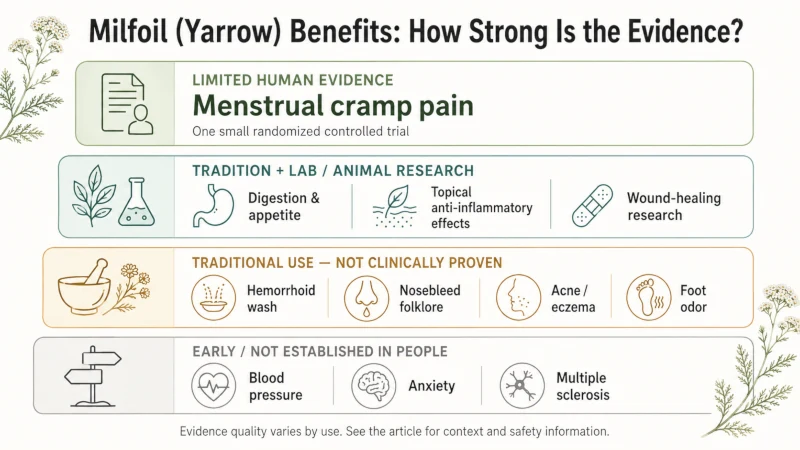
| Menstrual cramps | May ease period-pain severity. One small trial had women drink yarrow tea 3×/day for 3 days per cycle. | Limited human evidence — one small trial |
| Digestion & appetite | Traditional after-meal bitter for a heavy, gassy, “off appetite” feeling; may nudge digestive juices. | Traditional use + animal data; no solid human trials |
| Minor wound care | May soothe and support healing on small, clean scrapes as a wash or compress. Not for deep, large, or infected wounds. | Traditional use + lab/animal data; one mixed human trial |
| Skin irritation, acne, eczema | Traditionally used topically to calm irritated skin; results are inconsistent. Patch-test first. | Traditional use; thin human evidence |
| Hemorrhoids, nosebleeds, foot odor | Folk astringent uses — a soothing hemorrhoid wash or a footbath. Harmless, but unproven. | Traditional use only |
| Blood pressure, anxiety, other body-wide effects | Sometimes claimed, but studied mostly in animals or single small trials. Don’t count on it. | Early research — not established in people |
Digestion and appetite
This is yarrow’s best-documented traditional role. As a bitter herb, it’s long been used to stimulate the appetite and ease sluggish, uncomfortable digestion — the kind of heavy, gassy feeling after meals. Germany’s Commission E, an expert panel that reviewed herbal medicines, approved yarrow taken by mouth for loss of appetite and dyspeptic (indigestion-type) complaints, and as a sitz bath for cramping in the pelvic area [Alomair et al., Molecules, 2022]. The proposed mechanism is straightforward: bitters prompt the stomach and digestive glands to increase their secretions.
What’s missing is strong human proof. Yarrow has shown gastroprotective, anti-ulcer effects in rats, but those are animal results, and there are no quality clinical trials confirming a digestive benefit in people [Drugs.com, 2026]. So it’s reasonable to think of yarrow as a traditional after-meal bitter rather than a proven treatment. If your real problem is recurring gastritis-type discomfort or persistent gas and bloating, the underlying cause matters more than any tea — and that’s a conversation for your doctor.
Menstrual cramps — the strongest human signal
If any milfoil benefit has earned a real (if modest) evidence check mark, it’s this one. In a small double-blind randomized trial, students with primary dysmenorrhea drank yarrow tea — a teabag made with about 4 grams of yarrow powder in hot water — three times a day for three days across two menstrual cycles. The yarrow group reported significantly greater reductions in period-pain severity than the placebo group, with no side effects noted [Jenabi & Fereidoony, 2015].
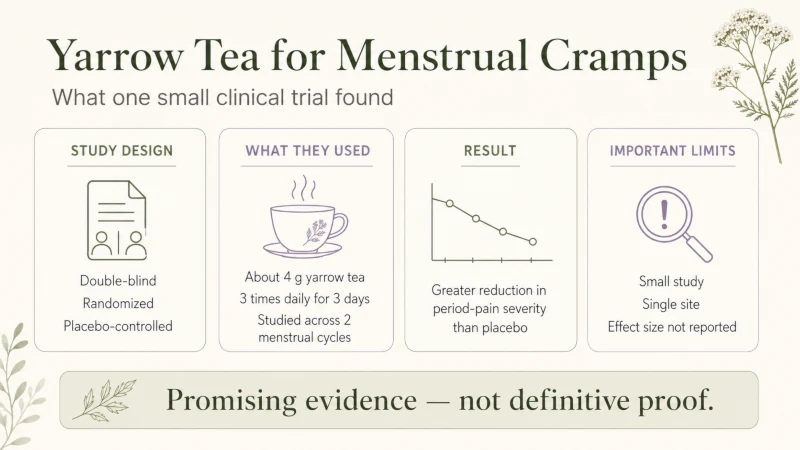
Keep the limitations in view: it was a single small study at one site, and the researchers reported statistical significance without an effect size, so the real-world size of the benefit is uncertain. It’s a promising result, not a settled one.
Worth separating from that: yarrow is a traditional emmenagogue (an herb thought to stimulate menstrual flow) and was historically used to “regulate” cycles and slow heavy bleeding. Those specific claims don’t have clinical backing, and the emmenagogue property is exactly why the plant is a problem in pregnancy — more on that below.
Wound care and skin
Yarrow’s woundwort reputation is ancient, and modern lab work offers a plausible reason for it: in laboratory studies, yarrow extracts applied to skin cells increase their growth and affect wound closure, and the plant has topical anti-inflammatory activity [Drugs.com, 2026]. Wound healing has mostly been studied in rodents. The closest human evidence comes from a trial of a yarrow ointment on episiotomy wounds, which found less pain, redness, and swelling but no measurable effect on other healing markers — a mixed result [Drugs.com, 2026].
The practical takeaway: as a traditional wash or compress for minor, clean scrapes, yarrow is a low-stakes folk remedy. It is not appropriate for large, deep, or infected wounds, which need proper medical care. For acne and eczema, yarrow shows up on traditional herbs-for-skin lists, but the human evidence is thin — treat it as soothing tradition, not treatment, and patch-test first because of the allergy risk covered below.
Nosebleeds, hemorrhoids, and other topical folk uses
The nickname “nosebleed plant” cuts both ways in folklore — the crushed leaf was used both to start and to stop nosebleeds. There’s no clinical evidence for either, and packing your nose with plant material isn’t something to try; standard first aid (lean forward, pinch the soft part of the nose for 10–15 minutes) is safer, and recurrent nosebleeds deserve a doctor’s look.
As an astringent, yarrow appears on traditional lists of herbs for hemorrhoids, where it’s used as a soothing wash for itchy, inflamed flare-ups. The support there is traditional rather than clinical, and fiber and the basics do far more for hemorrhoids than any herb. A yarrow footbath for sweaty, odor-prone feet is another harmless traditional use, if an unproven one.
Inflammation and early-stage research
Most of yarrow’s anti-inflammatory and antioxidant reputation comes from test-tube and animal studies, largely attributed to its flavonoid content [Drugs.com, 2026]. Researchers have also looked at yarrow (or closely related Achillea species) for blood-pressure lowering, diuretic, anxiety-reducing, and even multiple-sclerosis add-on effects — but these are mostly animal experiments or single small trials. This is genuinely early-stage science. It’s a reason for further study, not a reason to expect any of these effects yourself. In particular, older claims that yarrow “purifies the blood” or treats arteriosclerosis aren’t supported by human evidence.
How milfoil is used
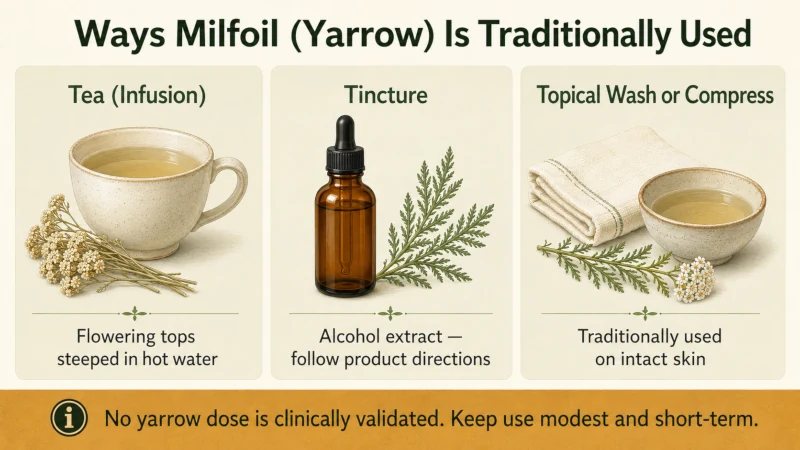
Traditionally, yarrow shows up in a few forms:
- Tea (infusion): the flowering tops steeped in hot water, taken as a digestive bitter or for cramps.
- Tincture: an alcohol extract, dosed by the dropperful per label directions.
- Topically: a cooled infusion used as a wash, compress, or sitz bath on intact skin.
On dosing, honesty matters more than a confident number. Yarrow herb has traditionally been used at about 4.5 grams a day, but there are no quality clinical studies validating that or any other dose [Drugs.com, 2026]. More is not better here: a case report documented anticholinergic effects (things like dry mouth, blurred vision, and a racing heart) in a person drinking roughly five cups of yarrow tea a day for a week [Drugs.com, 2026]. If you try yarrow, keep the amount modest and short-term, and choose products from reputable brands, since supplements aren’t tightly regulated for potency or purity.
Milfoil side effects and safety
Common side effects
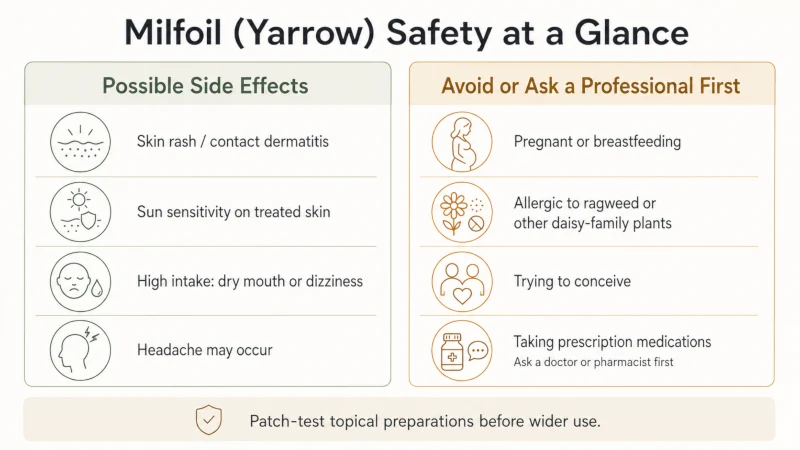
The most frequently reported reaction is contact dermatitis — an itchy, red rash where the plant touches skin [Drugs.com, 2026]. Yarrow can also cause photosensitivity, meaning treated skin may react to sunlight, so keep freshly applied areas covered and out of the sun. At high doses, the anticholinergic effects mentioned above, along with headaches or dizziness, become more likely.
The daisy-family allergy problem
This is the safety point most worth remembering. Yarrow belongs to the Asteraceae (daisy) family, alongside ragweed, chamomile, chrysanthemums, and marigolds. If you’re allergic to any of those — and ragweed allergy is very common — you’re more likely to react to yarrow, on the skin or taken internally [Drugs.com, 2026]. Its use is specifically contraindicated in people with a known allergy to Aster-family plants. Patch-test any topical preparation on a small area and wait a day before wider use.
Pregnancy and breastfeeding
Avoid yarrow if you’re pregnant or breastfeeding. Yarrow contains thujone, which acts as an abortifacient even in the small amounts present, and the plant’s traditional use to stimulate menstruation points the same direction [Drugs.com, 2026]. Standard herbal-safety guidance treats it as a plant to keep off the pregnancy menu entirely.
Medications and who should avoid milfoil
Formal drug interactions for yarrow are not well documented, though monographs flag a possible interaction with diuretic (“water pill”) medicines [Drugs.com, 2026]. Some pharmacology reviews raise theoretical concerns that yarrow could affect how the liver processes certain drugs, but this isn’t well established — the sources genuinely disagree on how much it matters. Given that uncertainty, the sensible move is simple: if you take any prescription medication, check with your doctor or pharmacist before adding yarrow. A pharmacist can screen your list in a minute or two.
Beyond pregnancy and daisy-family allergy, hold off and get personalized advice if you:
- take regular medications, especially blood-pressure, sedative, or diuretic drugs;
- have a diagnosed medical condition;
- are trying to conceive (an antispermatogenic effect has been reported in research, and safety data are limited) [Drugs.com, 2026];
- have surgery coming up; or
- are considering it for a child.
When to see a doctor
Herbal self-care has limits. See a doctor — or seek urgent care — if you notice:
- A nosebleed that won’t stop after 15–20 minutes of steady pressure, or nosebleeds that keep returning.
- Menstrual bleeding that’s unusually heavy or soaks through protection quickly, or new, severe period pain.
- A wound that’s deep, gaping, dirty, or shows signs of infection — spreading redness, warmth, pus, or fever.
- Digestive red flags: vomiting blood, black or tarry stools, unexplained weight loss, or pain that keeps worsening.
And call 911 for any sign of a serious allergic reaction — trouble breathing, swelling of the face or throat, or feeling faint.
| Health Disclaimer: This article is for general education and information only. It is not medical advice, and it is not a substitute for diagnosis or treatment from a qualified healthcare professional who knows your history. Herbal remedies like yarrow (milfoil) can cause side effects and may interact with medications. If you are pregnant or breastfeeding, take prescription drugs, have an ongoing health condition, or are treating a child, talk to your doctor or pharmacist before using yarrow or any herbal product. Seek medical care for the warning signs described above, and call 911 for any sign of a severe allergic reaction. |
Frequently Asked Questions
Is milfoil the same as yarrow?
Yes. “Milfoil” is a traditional common name for yarrow (Achillea millefolium), the medicinal daisy-family herb. Confusingly, the same word is also used for Eurasian watermilfoil, an unrelated invasive water plant that isn’t used medicinally. When people ask about milfoil benefits, they mean yarrow.
What is milfoil (yarrow) actually good for?
Traditionally, as a digestive bitter, for menstrual cramps, and as a topical wash for minor wounds and skin irritation. The strongest human evidence is a small trial showing yarrow tea reduced menstrual cramp pain [Jenabi & Fereidoony, 2015]. Most other uses rest on tradition or animal and lab studies rather than clinical trials.
Can you drink yarrow tea every day?
There’s no validated daily dose, and high intake isn’t harmless — anticholinergic effects were reported in someone drinking about five cups a day for a week [Drugs.com, 2026]. If you use it, keep the amount modest and short-term, and check with your doctor first if you take any medication or have a health condition.
Who should not use milfoil?
Anyone who is pregnant or breastfeeding, anyone allergic to ragweed or other daisy-family plants, and anyone trying to conceive should avoid it. People on prescription medications or with medical conditions should talk to a doctor or pharmacist first [Drugs.com, 2026].
Does yarrow really stop bleeding?
That’s its oldest reputation, tied to the Achilles legend, and yarrow does have astringent properties — but there’s no clinical evidence it reliably stops bleeding, and it should never be used on large, deep, or infected wounds. Persistent or heavy bleeding needs medical attention, not an herb.
Is milfoil safe to put on your skin?
For most people a topical wash on intact skin is low-risk, but yarrow can cause contact dermatitis and can make skin more sensitive to sunlight. Because it’s in the daisy family, patch-test a small area first, especially if you have hay fever or plant allergies.
References
- Drugs.com. Yarrow (Natural Products, professional monograph), medically reviewed, last updated July 10, 2026. → View source
- Jenabi E, Fereidoony B. Effect of Achillea millefolium on relief of primary dysmenorrhea: a double-blind randomized clinical trial. J Pediatr Adolesc Gynecol. 2015;28(5):402–404. DOI: 10.1016/j.jpag.2014.12.008. → View source
- Alomair MK, Alabduladheem LS, Almajed MA, et al. Achillea millefolium Essential Oil Mitigates Peptic Ulcer in Rats through Nrf2/HO-1 Pathway. Molecules. 2022;27(22):7908. DOI: 10.3390/molecules27227908. PMC9692697. → View source
- Saeidnia S, Gohari AR, Mokhber-Dezfuli N, Kiuchi F. A review on phytochemistry and medicinal properties of the genus Achillea. PMC3232110. → View source
