
Star fruit is good food: low in calories, high in vitamin C, crisp and faintly tart. It is also the one fruit in the produce aisle that kidney specialists tell certain patients to avoid outright.
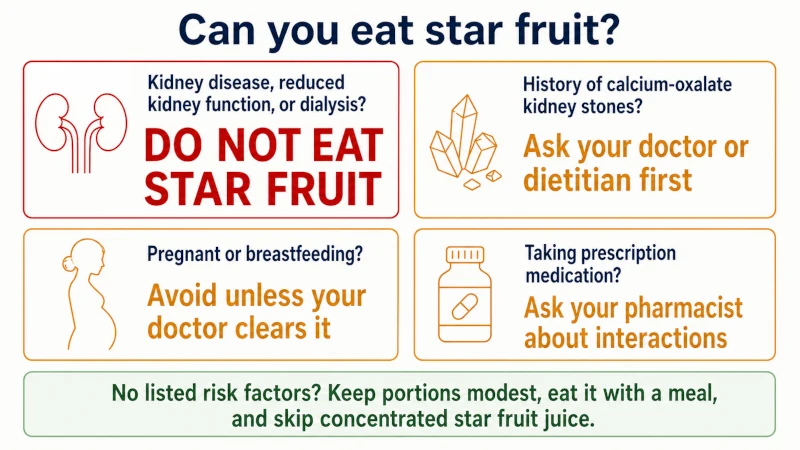
So before anything else — if you have chronic kidney disease, reduced kidney function, or you’re on dialysis, don’t eat star fruit or drink star fruit juice. Healthy kidneys clear the neurotoxin this fruit contains. Damaged kidneys don’t, and it accumulates (National Kidney Foundation guidance on starfruit, accessed 2026).
For everyone else, the carambola star fruit health benefits are real but modest, and the honest version of them is more useful than the marketing one. Below is what the evidence actually supports, what it doesn’t, and how much is too much even for people with normal kidneys.
What’s actually in carambola (Averrhoa carambola)
Star fruit is mostly water. A 100-gram serving carries about 31 calories, which is why it fills a bowl without filling you out.
| Per 100 g, raw | Amount |
| Calories | 31 kcal |
| Protein | 1.0 g |
| Fat | 0.33 g |
| Carbohydrate | 6.7 g |
| Dietary fiber | 2.8 g |
| Sugars | 3.9 g |
| Vitamin C | 34.4 mg |
| Vitamin A | 3 mcg RAE |
| Vitamin E | 0.15 mg |
| Potassium | 133 mg |
| Copper | 0.14 mg |
| Folate | 12 mcg |
| Magnesium | 10 mg |
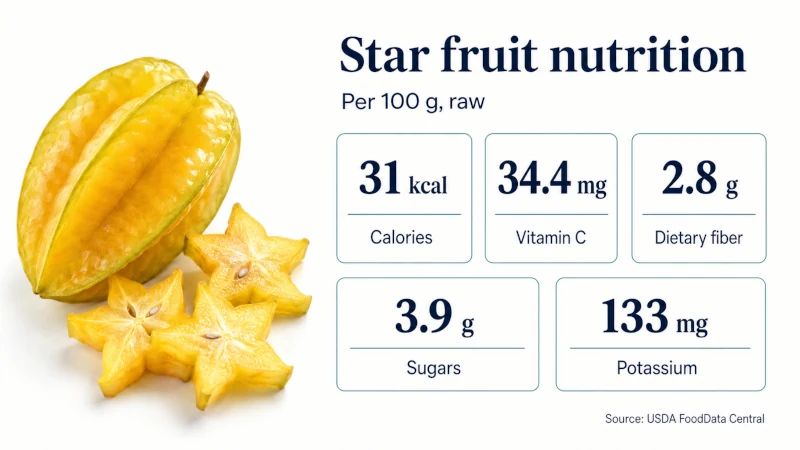
Source: USDA FoodData Central, SR Legacy entry for “Carambola, (starfruit), raw,” FDC ID 171715.
Two numbers here deserve attention and one deserves a correction.
The vitamin C is the headline. A cup of sliced star fruit — about 108 grams — delivers roughly 37 mg, close to half the daily requirement for adult women (75 mg) and about 41% for men (90 mg) (NIH Office of Dietary Supplements, 2025). That’s a solid contribution from a fruit most people treat as a garnish.
The fiber is respectable but not remarkable: 2.8 grams per 100 grams puts star fruit in the same neighborhood as an apple, not in league with beans or berries.
The correction: star fruit is often described as a good source of vitamin A. It isn’t. At 3 mcg RAE per 100 grams, it supplies a rounding error of the daily requirement. If you want vitamin A from produce, you want orange and dark-green vegetables.
Carambola star fruit health benefits, graded by evidence
Strong: it’s a meaningful vitamin C source
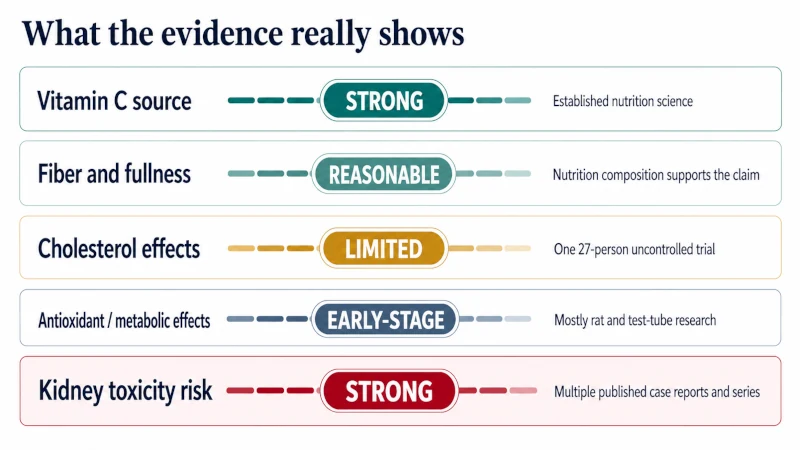
This one isn’t in dispute — it’s arithmetic plus established nutrition science. Vitamin C is required to build collagen, supports immune function, works as an antioxidant, and substantially improves absorption of the non-heme iron found in plant foods (NIH Office of Dietary Supplements, 2025). Eating star fruit alongside beans, lentils, or leafy greens helps you get more iron out of that meal.
What vitamin C does not do is prevent colds. Regular supplementation shortens a cold by about 8% in adults and 14% in children, and starting it after symptoms appear doesn’t help at all (NIH Office of Dietary Supplements, 2025). Useful, unglamorous, real.
If your goal is maximum vitamin C per bite, star fruit is not the best tropical option — guava beats it comfortably, and acerola cherry is in a different category entirely.
Reasonable: fiber and fullness
At 31 calories and 2.8 grams of fiber per 100 grams, star fruit does what most whole fruit does — adds bulk and chewing time for very little energy. It fits comfortably into a higher-fiber eating pattern.
That’s the accurate version. The stronger claim circulating online — that eating a few star fruits at breakfast reliably relieves constipation — has no clinical evidence behind it, and there’s a specific reason not to test it, covered in the kidney section below. If constipation is what you’re trying to fix, herbal and fiber-based options have far more behind them.
Limited and preliminary: cholesterol
One small trial in Thailand gave 27 older adults juice made from 100 grams of fresh star fruit twice daily for four weeks. LDL cholesterol fell and HDL rose, both statistically significant. Total cholesterol and triglycerides didn’t budge (Leelarungrayub et al., Clinical Interventions in Aging, 2016).
Read those results with the authors’ own caveats attached: 27 people, no control group, four weeks, and three participants developed diarrhea. The authors also note they didn’t measure oxalate intake — a notable gap given what follows. This is a signal worth studying, not a reason to treat star fruit as a cholesterol therapy. A commercial drug monograph reviewing the same literature concludes that clinical trial data are insufficient to recommend star fruit for any indication (Drugs.com star fruit monograph, 2025).
If you’re tracking your lipids, changes that size need a real lipid panel, not a fruit bowl.
Early-stage only: antioxidants and metabolic effects
Star fruit contains apigenin, epicatechin, proanthocyanidins, and carambolaflavone, and extracts show antioxidant and lipid-modifying activity in test tubes and in rats (Abduh et al., Frontiers in Pharmacology, 2023). Much of that work uses leaf extracts rather than the fruit, at doses no one gets from eating.
Interesting chemistry. Not yet a human health benefit.
Star fruit and your kidneys
Star fruit contains two problem compounds. The first is caramboxin, a neurotoxin that interferes with GABA and glutamate signaling in the brain — the systems that keep neural activity in check (de Oliveira & de Aguiar, Jornal Brasileiro de Nefrologia, 2015). The second is oxalate, which can crystallize in the kidney tubules and cause direct injury.
If you have any degree of kidney disease
Avoid it completely — fruit, juice, dried, and cooked. Healthy kidneys excrete caramboxin. Impaired kidneys let it build to concentrations that cause intractable hiccups, confusion, seizures, and, in reported cases, death (National Kidney Foundation, 2026). A literature review compiled by a drug information service counted 123 published nephrotoxicity cases, roughly 80% of them in people with chronic kidney disease, with 27 deaths (Drugs.com star fruit monograph, 2025).
The University of Florida’s horticultural extension service, which is in the business of encouraging Floridians to grow this tree, still states that people diagnosed with kidney disease should not eat carambola without their doctor’s approval (UF/IFAS Extension, HS12/MG269).
This is not a dose-related caution. It’s a “don’t.”
If your kidneys are healthy
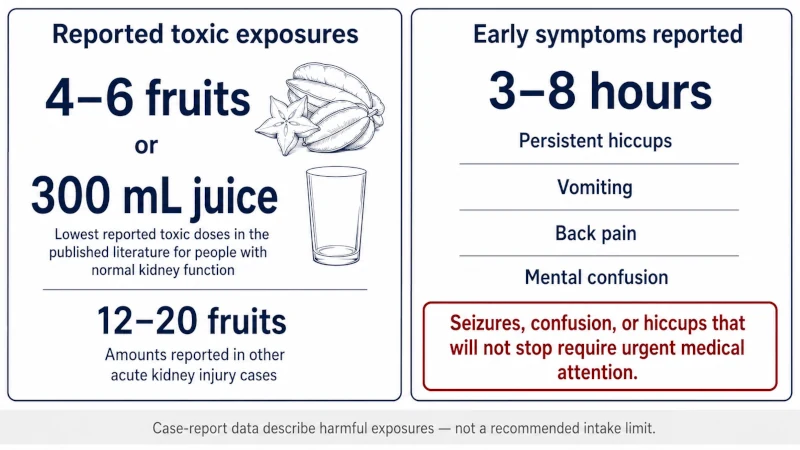
You still have a ceiling, and it’s lower than most people would guess.
Published case reports describe acute kidney injury in people with previously normal kidney function after concentrated exposures. Five patients in one Brazilian series had consumed 12 to 15 fruits, or 300 to 1,500 mL of juice, over a few hours. Symptoms started 3 to 8 hours later — persistent hiccups in every case, plus vomiting, back pain, and mental confusion. Four developed acute renal failure. All recovered (Neto et al., NDT Plus, 2009).
A review of the wider literature found the lowest reported toxic doses in people with normal kidney function were 4 to 6 star fruits, or 300 mL of juice (Wijayaratne et al., BMC Nephrology, 2018). A 2020 case report documented a previously healthy woman who drank juice made from about 20 fruits and needed dialysis; her kidney function returned to normal over 30 days (Maduro et al., BMJ Case Reports, 2020).
Two practical rules come out of this:
- Juice is the dangerous form. Juicing concentrates several fruits into one glass and strips the bulk that would otherwise stop you. Nearly every serious case involves juice or a large quantity eaten quickly.
- Don’t eat it on an empty stomach, and don’t eat it while dehydrated. One of the Brazilian patients became ill after just 300 mL of juice taken on an empty stomach.
A star fruit or two with a meal is a different thing entirely from a tall glass of star fruit juice before breakfast.
Kidney stones and oxalate
If you’ve had calcium-oxalate kidney stones, treat star fruit as a high-oxalate food and talk to your doctor or a registered dietitian before including it.
Here the sources disagree sharply, and you should know that. Analyses of soluble oxalate across cultivars have reported a range of 80 to 730 mg per 100 g (Neto et al., NDT Plus, 2009) — which would place star fruit among the highest-oxalate foods there is, comparable to spinach. A widely used drug monograph reports a far lower figure of 9.6 mg per 100 g, while noting that sour varieties run higher (Drugs.com star fruit monograph, 2025). That’s a seventy-fold spread.
The likeliest explanation is real variation between sweet and tart cultivars combined with different measurement methods, but no one has resolved it. Given the uncertainty and the documented harm, caution is the reasonable position for stone formers.
Medication interactions
Star fruit juice inhibits cytochrome P450 enzymes — the liver system that clears a large share of prescription drugs. In human liver microsomes, juice at 5% concentration inhibited every CYP isoform tested by more than 70%, though CYP3A4 was the least affected of the group (Zhang et al., Journal of Pharmacy & Pharmaceutical Sciences, 2007).
That work was done on liver tissue in a lab, not in people, so the size of the real-world effect in a person taking medication is not established. The mechanism is the same one behind the well-known grapefruit warnings, and drug information services take it seriously enough to flag specific combinations: star fruit is listed as one to avoid alongside bosutinib, panobinostat, and venetoclax (Drugs.com star fruit monograph, 2025).
If you take any prescription medication — especially statins, calcium channel blockers, immunosuppressants, or oral cancer drugs — ask your pharmacist before making star fruit a regular habit. Pharmacists are the right people for this question; it takes them about a minute.
Who should avoid star fruit
- Anyone with chronic kidney disease, reduced kidney function, or on dialysis. No amount.
- People with a history of calcium-oxalate kidney stones, unless their doctor or dietitian clears it.
- People who are pregnant or breastfeeding. Not because harm has been demonstrated, but because safety data in pregnancy and lactation are absent, and the fruit has a documented toxin. Drug information services advise avoiding it (Drugs.com star fruit monograph, 2025).
- Anyone taking medications metabolized by CYP enzymes, pending a conversation with their pharmacist.
- People who have reacted to it before. Allergy to star fruit is rare and poorly characterized — no star fruit allergens have been formally identified, and the evidence consists of isolated case reports of oral itching and, very rarely, anaphylaxis (Thermo Fisher Allergen Encyclopedia, f295 Carambola). Rare isn’t never.
Common side effects in people without these risk factors are mild and digestive. Loose stools were the most frequent complaint in the one small feeding study available, affecting 3 of 27 participants at roughly 200 g of juiced fruit per day (Leelarungrayub et al., 2016).
Choosing and eating it
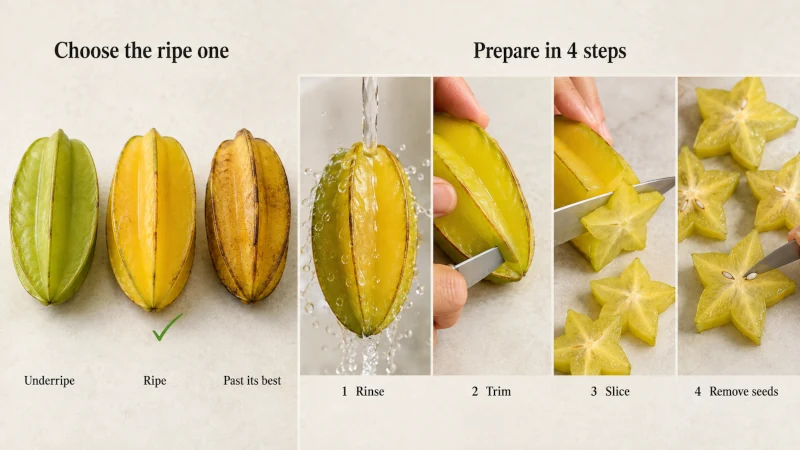
Pick fruit that is deep yellow with only light browning on the rib edges. Fully green fruit is underripe and sharply sour; heavy brown edges mean it’s going. Sweet cultivars are the ones sold for fresh eating; tart cultivars are grown mainly for juice and processing (UF/IFAS Extension, HS12/MG269).
You don’t peel it. Rinse, trim the brown edges off the ribs, slice crosswise into stars, and flick out any seeds. That’s the whole preparation.
Sliced raw, it works in salads, alongside sharp cheese, or over yogurt. It holds its shape when cooked, so it poaches and roasts well, and it makes good jam because it sets easily.
Worth clearing up one point of confusion: star fruit is a modest source of potassium at 133 mg per 100 g, well under a third of what you’d get from a banana. If you’re managing potassium for a heart or kidney condition, potassium is not the reason star fruit is restricted. The neurotoxin is.
One thing to skip: the juice. Concentrating the fruit is what turns a pleasant snack into the exposure that shows up in case reports.
Red flags: when to get help now
Call 911 or go to an emergency room if, after eating star fruit or drinking star fruit juice, you or someone else has:
- a seizure
- confusion, agitation, or unusual drowsiness
- hiccups that won’t stop — this is the hallmark early sign of star fruit toxicity and appeared in every patient in the Brazilian case series
- markedly reduced urination
- persistent vomiting with weakness or muscle twitching
Tell the medical team exactly what was eaten and how much. Star fruit poisoning is uncommon enough that they may not think of it, and it is treatable — patients in the published cases recovered with hydration and, when needed, dialysis.
For milder issues — nausea, loose stools, mild stomach upset that settles within a day — an urgent care visit or a call to your doctor’s office is enough.
| Health Disclaimer: This article is for general information and education. It is not medical advice, and it can’t account for your health history, medications, or lab results. Talk to your doctor before adding star fruit to your diet if you have any kidney condition, a history of kidney stones, or take prescription medication — and check with your pharmacist about interactions. If you are pregnant or breastfeeding, ask your doctor first. If you think you’re experiencing star fruit toxicity, seek emergency care rather than waiting it out. |
Frequently Asked Questions
How much star fruit is safe if my kidneys are healthy?
There’s no official limit, but the case literature suggests a practical ceiling. Harm in people with normal kidney function has been reported at doses as low as 4 to 6 fruits, or 300 mL of juice, taken in a short window (Wijayaratne et al., BMC Nephrology, 2018). One or two fruits with a meal, occasionally, sits well below anything in the reported cases. Juice is the form to avoid, not the fruit.
I’ve never had my kidneys checked. Should I worry?
Early kidney disease usually has no symptoms, which is the problem. Diabetes is the leading cause of kidney disease in the US, and about one in three adults with diabetes has it (NIDDK, 2025). Diabetes also showed up in roughly 42% of published star fruit toxicity cases (Wijayaratne et al., BMC Nephrology, 2018). If you have diabetes, high blood pressure, or a family history of kidney disease and you’ve never had your kidney function tested, ask your doctor — it’s a routine blood and urine test, and it settles the question.
Does cooking, drying, or juicing make star fruit safer?
No home preparation is known to remove caramboxin, and drying concentrates the fruit rather than diluting it. Juicing makes things worse, not better, because it packs several fruits into a single glass. The advice for people with kidney disease covers the fruit in every form (National Kidney Foundation, 2026).
Is star fruit safe during pregnancy or breastfeeding?
The data are absent rather than reassuring. No studies establish that it’s safe in pregnancy or lactation, and drug information services advise avoiding it on that basis (Drugs.com star fruit monograph, 2025). Given that the fruit carries a documented neurotoxin, that’s a reasonable default. Ask your doctor.
Is star fruit a good choice if I have diabetes?
The fruit is low in sugar — about 3.9 grams per 100 grams — and low in calories, which makes it a sensible fit in a diabetes-friendly eating pattern. No trials show it improves blood sugar control, so treat it as a good fruit choice rather than a treatment. The more important question is your kidney function: because diabetes is the leading cause of kidney disease (NIDDK, 2025), find out where yours stands before making star fruit a regular part of your diet.
References
- National Kidney Foundation. “Starfruit — Benefits, risks, poisoning.” Accessed August 2026. View source
- National Institutes of Health, Office of Dietary Supplements. “Vitamin C — Health Professional Fact Sheet.” 2025. View source
- U.S. Department of Agriculture, Agricultural Research Service. “Carambola, (starfruit), raw.” FoodData Central, SR Legacy, FDC ID 171715. View source
- Leelarungrayub J, Yankai A, Pinkaew D, Puntumetakul R, Laskin JJ, Bloomer RJ. “A preliminary study on the effects of star fruit consumption on antioxidant and lipid status in elderly Thai individuals.” Clinical Interventions in Aging. 2016;11:1183–1192. View source
- Drugs.com. “Star Fruit — Uses, Benefits & Dosage.” Natural Products Database. Revised September 22, 2025. View source
- Abduh MS, Saghir SAM, Al Hroob AM, et al. “Averrhoa carambola leaves prevent dyslipidemia and oxidative stress in a rat model of poloxamer-407-induced acute hyperlipidemia.” Frontiers in Pharmacology. 2023. View source
- de Oliveira ESM, de Aguiar AS. “Why eating star fruit is prohibited for patients with chronic kidney disease?” Jornal Brasileiro de Nefrologia. 2015;37(2). PMID 26154645. DOI 10.5935/0101-2800.20150037. View source
- Crane JH, Balerdi CF, Maguire I. “Carambola Growing in the Florida Home Landscape.” UF/IFAS Extension, HS12/MG269. View source
- Neto MM, Silva GEB, Costa RS, et al. “Star fruit: simultaneous neurotoxic and nephrotoxic effects in people with previously normal renal function.” NDT Plus. 2009;2(6):485–488. PMID 25949386. View source
- Wijayaratne DR, Bavanthan V, de Silva MVC, Nazar ALM, Wijewickrama ES. “Star fruit nephrotoxicity: a case series and literature review.” BMC Nephrology. 2018;19:288. View source
- Zhang JW, Liu Y, Cheng J, et al. “Inhibition of human liver cytochrome P450 by star fruit juice.” Journal of Pharmacy & Pharmaceutical Sciences. 2007;10(4):496–503. DOI 10.18433/J30593. View source
- Maduro IPNN, Brandão ARJ, Israel KCP. “Acute nephrotoxicity and neurotoxicity associated with concentrated star fruit juice consumption.” BMJ Case Reports. 2020. PMID 33310820. DOI 10.1136/bcr-2020-234460. View source
- Thermo Fisher Scientific. “f295 Carambola.” Allergen Encyclopedia. View source
- National Institute of Diabetes and Digestive and Kidney Diseases. “Diabetic Kidney Disease.” 2025. View source
