
You’ve probably seen “vitamin F” on a supplement label or an old health book and wondered why your doctor’s never mentioned it. Here’s the short answer: it isn’t a vitamin. “Vitamin F” is a nearly century-old nickname for two fats your body can’t make on its own — linoleic acid and alpha-linolenic acid — better known today as omega-6 and omega-3 fatty acids (Cleveland Clinic, 2022).
That mix-up happened for a reason. In the 1920s, researchers George and Mildred Burr fed animals a fat-free diet and watched them develop scaly skin and stalled growth — a deficiency pattern that looked exactly like a missing vitamin. Feeding the animals certain fats fixed it, so the fix got a vitamin letter. Within a decade, chemists figured out these “vitamin F” compounds were actually fats, not vitamins, and the more accurate label — essential fatty acids — took over in the scientific literature. The old name stuck around in supplement marketing anyway (Cleveland Clinic, 2022).
So when you see “vitamin F benefits” today, what you’re really reading about is omega-3 and omega-6 fat benefits. This guide covers what the evidence actually supports, where to get these fats from food, how much you need, and who should be careful with supplements.
What Is Vitamin F, Really?
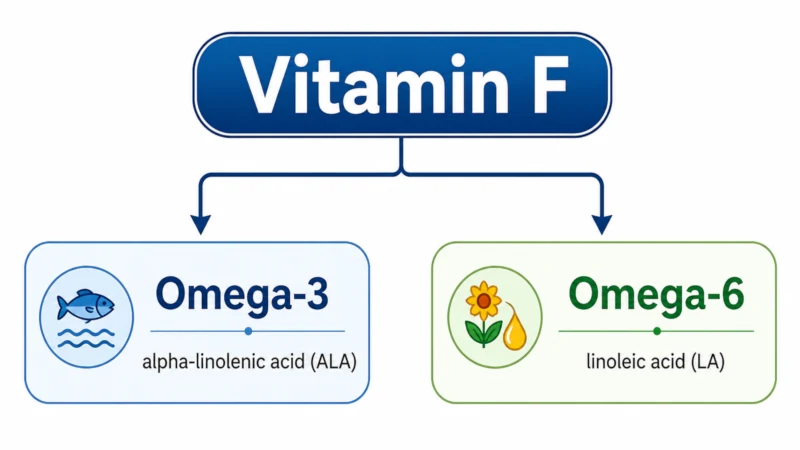
“Vitamin F” breaks down into two essential fatty acids:
- Linoleic acid (LA) — an omega-6 fat, the parent compound of the whole omega-6 family
- Alpha-linolenic acid (ALA) — an omega-3 fat, the parent compound of the omega-3 family
Both are called “essential” because your body genuinely cannot build them from scratch — you have to get them from food (Linus Pauling Institute, 2026). Once you eat them, your body can convert small amounts of ALA into the longer-chain omega-3s EPA and DHA (the ones most associated with heart and brain research), but that conversion is inefficient — often under 10% (NIH Office of Dietary Supplements, 2026). That’s the practical reason fish and fish oil get so much attention: they deliver EPA and DHA directly instead of relying on your body to make them.
How Vitamin F Works in Your Body
These fats aren’t just fuel. They’re built directly into the membrane of every cell in your body, where they affect how flexible and permeable those membranes are (Linus Pauling Institute, 2026). They’re also the raw material for prostaglandins and related signaling molecules — hormone-like compounds that help regulate inflammation, blood clotting, blood vessel width, and more (Cleveland Clinic, 2022). Broadly speaking, compounds made from omega-6s tend to promote inflammation and clotting more than compounds made from omega-3s — which is part of why the balance between the two matters, not just the total amount (NIH Office of Dietary Supplements, 2026.
DHA in particular concentrates heavily in the brain, retina, and sperm cells, which is why omega-3 research leans so hard on brain and eye outcomes (NIH Office of Dietary Supplements, 2026.
Vitamin F Benefits: What the Evidence Actually Supports
Evidence quality varies a lot by condition here — this is one of the most heavily studied nutrition topics, and also one where headlines often outrun the data. Here’s an honest breakdown.
Heart Health
This is where the evidence is strongest, with real nuance. Eating fatty fish regularly is consistently linked to a lower risk of coronary heart disease and heart failure, and omega-3s reliably lower triglycerides (NIH Office of Dietary Supplements, 2026). But large, more recent trials of omega-3 supplements in generally healthy people have had mixed results — some show a reduced risk of heart attack, others show no effect on major cardiovascular events overall. The clearest supplement benefit shows up in people who already have coronary heart disease. The American Heart Association recommends one to two servings of fatty fish a week for most people, and doesn’t recommend omega-3 supplements for people without elevated cardiovascular risk (NIH Office of Dietary Supplements, 2026.
Omega-6 fats matter here too, in a less publicized way: swapping saturated fat for omega-6-rich oils reliably lowers total cholesterol, though large trials haven’t found a clear reduction in heart attacks from that swap alone (Linus Pauling Institute, 2026.
Skin Health
Both fatty acid families show up in skin research, and the results are genuinely mixed rather than a clean win. A 2025 systematic review of omega-3 supplementation for skin conditions found that most trials of psoriasis showed clinical improvement, while most trials of atopic dermatitis (eczema) did not reach statistical significance — even though some individual studies looked promising (Journal of Integrative Dermatology, 2025). Cleveland Clinic frames it similarly: essential fatty acids may help maintain the skin barrier, which can be useful for dryness, acne, and conditions like psoriasis, but this is a supportive role, not a cure (Cleveland Clinic, 2022.
Joint Health
Fish oil is one of the better-studied supplements for rheumatoid arthritis, but “helps manage symptoms alongside medication” is a very different claim from “prevents arthritis.” Trials generally show omega-3 supplements can reduce how much anti-inflammatory medication people need, with less consistent effects on joint swelling or morning stiffness itself (NIH Office of Dietary Supplements, 2026). A separate meta-analysis found benefit for rheumatoid arthritis and other inflammatory arthritis types, but not for osteoarthritis (Linus Pauling Institute, 2026). There’s no good evidence that essential fatty acids prevent arthritis from developing in the first place.
Eyes and Brain
DHA is a structural component of the retina, and higher dietary DHA is associated with a lower risk of age-related macular degeneration in observational studies — but once someone already has the disease, omega-3 supplements haven’t been shown to slow it down in large trials (NIH Office of Dietary Supplements, 2026). Dry eye research is similarly split: some trials show symptom relief from omega-3 supplements, but a large one-year trial found fish oil no better than placebo (NIH Office of Dietary Supplements, 2026). For brain health, people who eat more fish tend to show slower cognitive decline in observational studies, but clinical trials of omega-3 supplements in healthy or already-declining older adults haven’t consistently replicated that benefit (Linus Pauling Institute, 2026.
Pregnancy and Infant Development
This is one of the stronger, more specific findings: a 2018 Cochrane review of nearly 20,000 pregnancies found that long-chain omega-3 supplementation reduced the risk of early preterm birth (before 34 weeks) by 42% and reduced low birthweight (NIH Office of Dietary Supplements, 2026). DHA also accumulates rapidly in the fetal brain and retina during the third trimester, which is why prenatal DHA intake gets so much attention (NIH Office of Dietary Supplements, 2026.
A note on claims that didn’t make the cut: you may see “vitamin F” credited with preventing arthritis outright, protecting against radiation, or treating candida overgrowth. None of those held up to a check against current evidence, so they’re left out here rather than repeated.
Vitamin F Food Sources
You don’t need a supplement to get either fatty acid family — most diets provide plenty of omega-6, and a normal mixed diet can cover omega-3 needs too, though many people fall short on the long-chain omega-3s (EPA and DHA) specifically.
| Fatty acid | Best food sources |
| ALA (omega-3) | Flaxseed and flaxseed oil, chia seeds, walnuts, canola and soybean oil, edamame |
| EPA and DHA (omega-3) | Salmon, mackerel, herring, sardines, trout — cold-water fatty fish generally |
| LA (omega-6) | Sunflower, safflower, corn, and soybean oils; walnuts; most nuts and seeds |
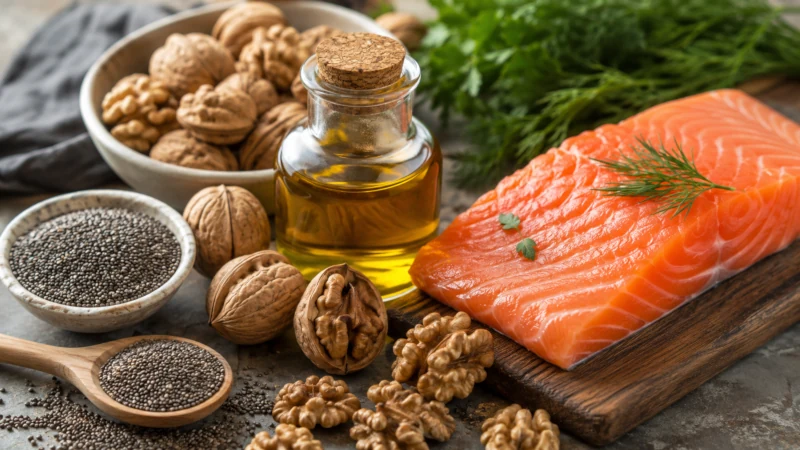
Flaxseed oil is a genuinely efficient source — one tablespoon provides roughly 7 grams of ALA, more than most other plant sources per serving (NIH Office of Dietary Supplements, 2026). But it’s worth using it the way it’s meant to be used: drizzled cold, on salads or after cooking, not as a frying oil. Polyunsaturated oils like flaxseed are more chemically unstable when heated, and repeated or high-heat exposure accelerates the formation of oxidation byproducts linked to cellular damage (Leong et al., 2015. If you cook with oil, save the more heat-stable options (olive, avocado) for the pan.
If eczema-friendly eating is what brought you here, our guide to foods for eczema covers this in more depth, including where fatty fish and seeds fit into that picture.
Vitamin F Deficiency: Signs and Who’s at Risk
A true deficiency of essential fatty acids is rare in people eating a typical varied diet in the United States (NIH Office of Dietary Supplements, 2026). When it does happen, the signature signs are rough, scaly skin and a red, itchy rash, along with — in more severe or prolonged cases — slowed growth in children, increased infection susceptibility, and poor wound healing (Linus Pauling Institute, 2026.
Deficiency mostly shows up in specific situations rather than from ordinary diet:
- People receiving intravenous (parenteral) nutrition that lacks fat
- Fat malabsorption conditions, including cystic fibrosis
- Very restrictive or fat-free diets sustained for a long period
If you’re not in one of these situations and you eat a reasonably varied diet, deficiency isn’t something to worry about day to day.
How Much Vitamin F Do You Need?
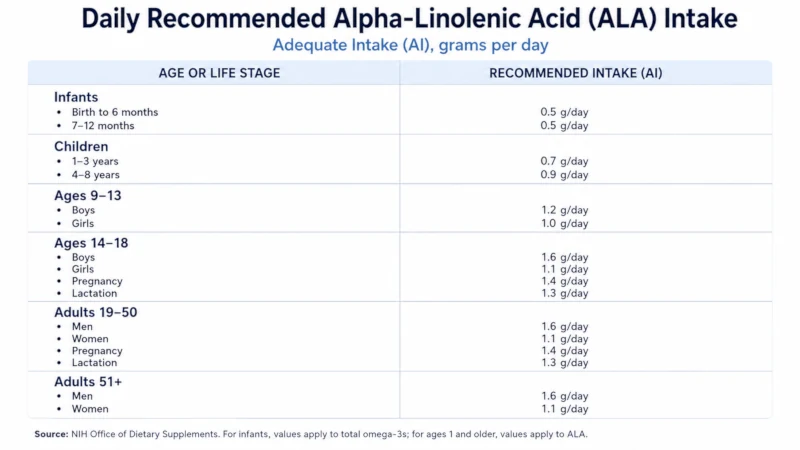
For alpha-linolenic acid (the omega-3), there are established Adequate Intake levels:
| Life stage | ALA (omega-3) per day |
| Adult men | 1.6 g |
| Adult women | 1.1 g |
| Pregnant | 1.4 g |
| Breastfeeding | 1.3 g |
For linoleic acid (the omega-6), the Institute of Medicine’s Adequate Intake is roughly 17 grams a day for men and 12 grams for women under 50, dropping slightly after 50 — equivalent to about 5–10% of daily calories (PeaceHealth Health Information Library, 2015). Most people eating a typical Western diet already meet or exceed this without trying, since vegetable oils are so widespread in packaged food.
There’s no similarly settled number for EPA and DHA specifically, but the American Heart Association’s practical guidance is one to two servings of fatty fish per week for general heart health, and about 1 gram per day of combined EPA and DHA (preferably from food) for people with existing heart disease, under medical guidance (NIH Office of Dietary Supplements, 2026.
Vitamin F Safety: Side Effects, Interactions, and Who Should Be Careful
Realistic expectations. Getting essential fatty acids from food carries essentially no risk for most people. Supplements are a different conversation, with real (if usually mild) downsides.
Common side effects of omega-3 supplements are usually mild: an unpleasant aftertaste, bad breath, heartburn, nausea, stomach discomfort, diarrhea, headache, and odorous sweat (NIH Office of Dietary Supplements, 2026). Flaxseed and flaxseed oil specifically can cause bloating and diarrhea, particularly at higher doses (NCCIH, 2025.
Medication interactions. High-dose omega-3 supplements — generally in the multi-gram range — can increase bleeding risk when combined with warfarin or other blood-thinning medications. Most research suggests typical fish oil doses (3–6 g/day) don’t meaningfully affect standard anticoagulant monitoring, but it’s still something your prescriber should know about (NIH Office of Dietary Supplements, 2026). There are also theoretical interaction concerns with flaxseed (NCCIH, 2025.
Pregnancy and breastfeeding. Fish and seafood in general — chosen from lower-mercury options like salmon, sardines, and trout — are considered beneficial during pregnancy, and DHA specifically supports fetal brain and eye development (NIH Office of Dietary Supplements, 2026). Flaxseed itself is a different story: some research suggests it’s possibly unsafe during pregnancy, and the evidence on flaxseed oil specifically during pregnancy or breastfeeding is too limited to call it safe (NCCIH, 2025). If you’re pregnant or breastfeeding, talk to your provider before adding any flaxseed supplement.
Who should be extra cautious or check with a provider first:
- Anyone on blood thinners or with a bleeding disorder
- Anyone with an upcoming surgery
- Pregnant or breastfeeding people considering flaxseed or flaxseed oil supplements specifically
- Anyone taking a new fatty acid supplement alongside other medications — interactions aren’t always well studied
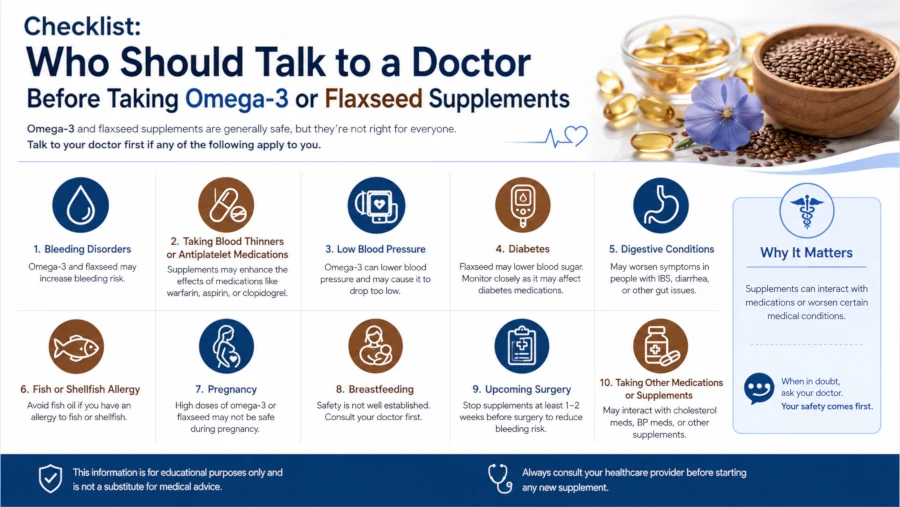
When to talk to a healthcare professional: before starting any fatty acid supplement if you’re on regular medication, pregnant, breastfeeding, or managing a chronic condition like heart disease, rheumatoid arthritis, or a clotting disorder. Food sources don’t carry these concerns.
| HEALTH DISCLAIMER: The information on this page is for educational purposes only and isn’t a substitute for professional medical advice, diagnosis, or treatment. Always talk with a qualified healthcare provider before starting a new supplement, especially if you’re pregnant, breastfeeding, managing a chronic condition, or taking medication. This content doesn’t establish, treat, cure, or prevent any disease. |
Frequently Asked Questions
Is vitamin F a real vitamin?
No. It’s a historical name from the 1920s for two essential fatty acids — linoleic acid (omega-6) and alpha-linolenic acid (omega-3) — that were later reclassified as fats, not vitamins (Cleveland Clinic, 2022.
What’s the difference between “vitamin F” and omega-3?
“Vitamin F” is really an umbrella term for both omega-3 (ALA) and omega-6 (LA) essential fatty acids. Omega-3 is just one half of that picture.
Can you get too much vitamin F?
From food, it’s very unlikely. From high-dose supplements, yes — doses in the multi-gram range can increase bleeding risk and cause GI side effects, and the FDA advises against exceeding 5 g/day of combined EPA and DHA from supplements (NIH Office of Dietary Supplements, 2026.
What are the best food sources of vitamin F?
Flaxseed and flaxseed oil, walnuts, chia seeds, and canola or soybean oil for omega-3 (ALA); fatty fish like salmon and sardines for the long-chain omega-3s EPA and DHA; and sunflower, corn, and soybean oil, plus most nuts and seeds, for omega-6.
Does vitamin F help with skin conditions like eczema and psoriasis?
The evidence is mixed and condition-specific. Trials on psoriasis more often show improvement than trials on eczema, but even the more promising results are modest, and neither condition should be managed with fatty acids alone (Journal of Integrative Dermatology, 2025.
Is it safe to take vitamin F supplements while pregnant?
Fish and dietary omega-3s are generally considered beneficial during pregnancy. Flaxseed and flaxseed oil supplements specifically are less well studied in pregnancy, with some evidence suggesting flaxseed itself may be unsafe — talk to your provider before using them (NCCIH, 2025.
References
- Cleveland Clinic. Vitamin F. Medically reviewed 05/24/2022. View source
- Cleveland Clinic. Prostaglandins: What It Is, Function & Side Effects. Medically reviewed 11/04/2022. View source
- National Institutes of Health, Office of Dietary Supplements. Omega-3 Fatty Acids — Fact Sheet for Consumers. View source
- National Institutes of Health, Office of Dietary Supplements. Omega-3 Fatty Acids — Fact Sheet for Health Professionals. Updated 2026. View source
- Linus Pauling Institute, Oregon State University. Essential Fatty Acids. Updated January 2026. View source
- National Center for Complementary and Integrative Health (NIH). Flaxseed and Flaxseed Oil: Usefulness and Safety. Last updated February 2025. View source
- PeaceHealth Health Information Library. Omega-6 Fatty Acids. Last reviewed 05/24/2015; citing Institute of Medicine, Dietary Reference Intakes for Energy, Carbohydrate, Fiber, Fat, Fatty Acids, Cholesterol, Protein and Amino Acids (National Academies Press, 2005). View source
- Leong XF, Ng CY, Jaarin K, Mustafa MR. Effects of Repeated Heating of Cooking Oils on Antioxidant Content and Endothelial Function. Austin J Pharmacol Ther. 2015;3(2):1068. View source
- Abdelnour A, El Jbeily R, Babi C, et al. Review of Omega-3 Fatty Acid Dietary Supplementation in Cutaneous Inflammatory Disorders. Journal of Integrative Dermatology. 2025. DOI: 10.64550/joid.dc39qy52. View source
