
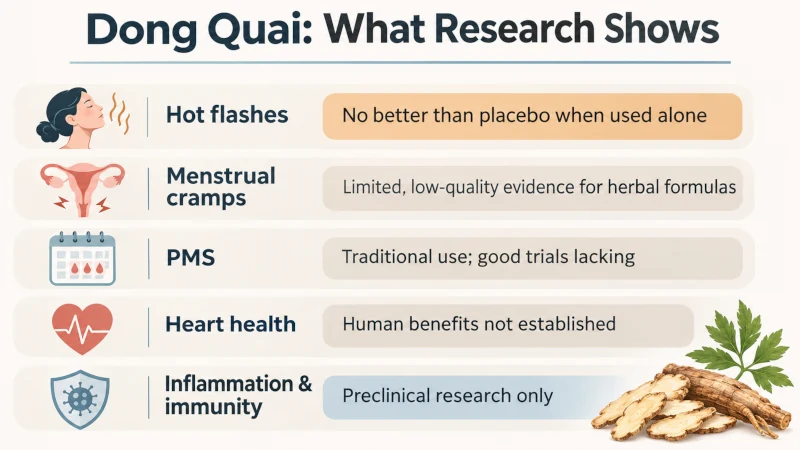
Dong quai is one of the best-known herbs in traditional Chinese medicine, used for centuries for period pain and menopause symptoms. The short answer on dong quai root: the most rigorous trial of the herb on its own found it worked no better than a placebo for hot flashes [Hirata et al., 1997], the support for menstrual cramps comes mainly from low-quality studies of multi-herb formulas [Zhu et al., 2008], and most other claimed benefits have only been seen in lab dishes and animals. It also comes with real cautions, especially if you take a blood thinner, are pregnant or breastfeeding, or have a hormone-sensitive cancer.
If you’re weighing it up, the safety sections below matter more than the benefits.
Dong quai root at a glance
| Also called | Angelica sinensis, Chinese angelica, dang gui, tang kuei, female ginseng [MSK, 2026] |
| Part used | Root |
| Traditional uses | Menstrual cramps, PMS, menopause symptoms [MSK, 2026] |
| Strongest human evidence | A 24-week randomized trial found it no better than placebo for hot flashes [Hirata et al., 1997] |
| Main cautions | Bleeding risk with blood thinners; pregnancy and breastfeeding; hormone-sensitive cancers; sun sensitivity [Drugs.com, 2025; LactMed, 2021; MSK, 2026] |
What is dong quai root?
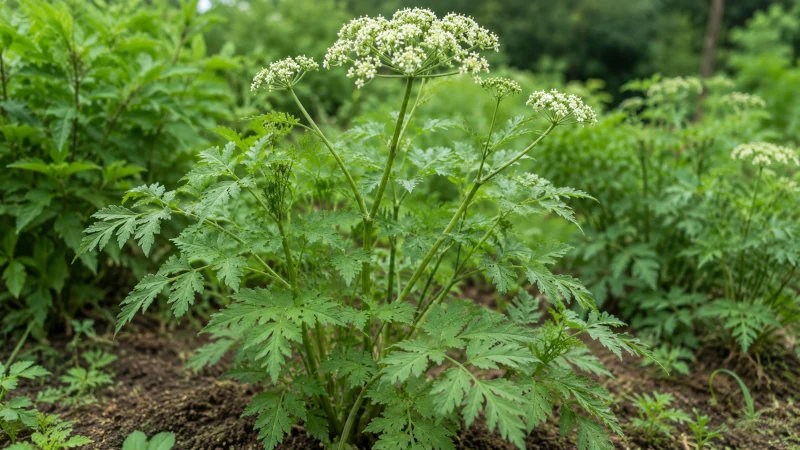
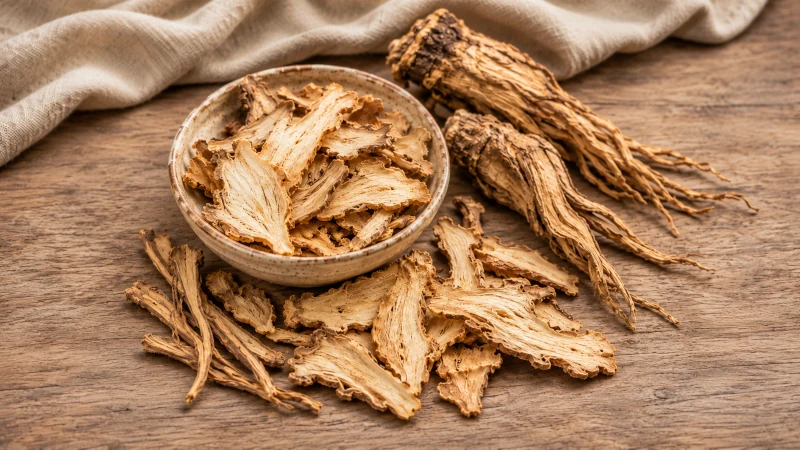
Dong quai (Angelica sinensis) is a perennial herb native to China, Japan, and Korea, and it is promoted in the West as a “woman’s herb” [Cassileth, 2011]. Its root has been used in Chinese medicine for more than 2,000 years [Miller, 1998]. Practitioners usually combine it with other herbs rather than prescribing it alone [MSK, 2026], which is worth remembering when you read about the research: many studies test formulas, not dong quai by itself.
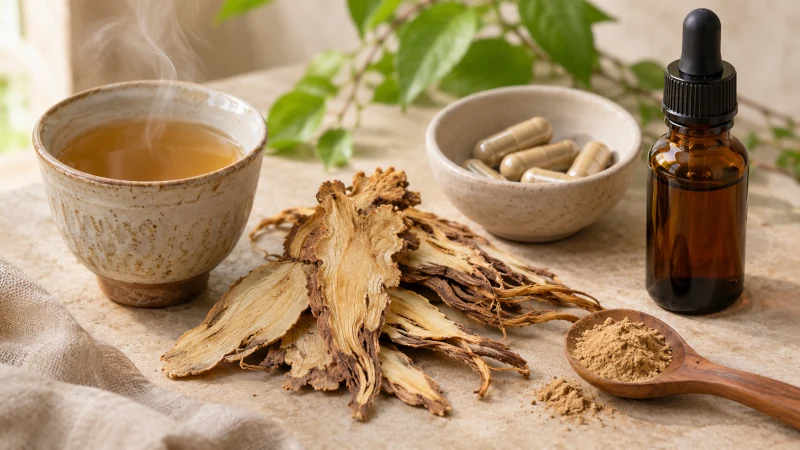
Scientists have identified more than 70 compounds in the root, including ferulic acid, Z-ligustilide, and a range of polysaccharides [Chao & Lin, 2011]. In the U.S. it is sold as a dietary supplement in capsules, liquid extracts, powders, and teas, and the FDA has not reviewed it for safety or effectiveness [WebMD, 2026]. Like other traditional “women’s herbs” such as blue cohosh and false unicorn root, it has a long history of use and very little clinical testing.
Dong quai root benefits: what the research shows
Most of the benefits you’ll see listed online come from tradition, test-tube experiments, or animal studies. Human trials are few, small, and mostly negative.
Menopause and hot flashes
This is dong quai’s best-known modern use, and the one that has been tested most directly. In a double-blind trial at a large California HMO, 71 postmenopausal women with hot flashes took either 4.5 g of dong quai root a day or a placebo for 24 weeks [Hirata et al., 1997]. Hot flashes and overall symptom scores fell by 25 to 30 percent in both groups, with no meaningful difference between them [Miller, 1998].
Expert bodies have landed in the same place. The North American Menopause Society describes dong quai as no more effective than placebo, and the Endocrine Society suggests clinicians tell patients the evidence for benefit is inconsistent [Drugs.com, 2025]. A small trial in men with hot flashes found no benefit either [MSK, 2026].
Blends are harder to judge. In a study of 55 women, a dong quai and chamomile mix reduced hot flashes, but there’s no way to know which herb was responsible. In a six-month study of 100 women, a placebo did better than a dong quai and huang qi mix [Breastcancer.org, 2026].
| VERDICT: Not supported for hot flashes when taken alone. If menopause symptoms are wrecking your sleep or work, treatments with much stronger evidence exist, both hormonal and non-hormonal, and are worth raising with a clinician. Black cohosh has more trial data than dong quai, though its results are still mixed; see our evidence review of black cohosh. |
Menstrual cramps and PMS
Painful periods are the use most tied to dong quai in Chinese medicine, but no strong trials have tested dong quai on its own for cramps or PMS. What exists is research on Chinese herbal formulas. A Cochrane review of 39 randomized trials involving 3,475 women found “promising evidence” for these formulas in primary dysmenorrhea, but the authors warned that the trials were of poor methodological quality [Zhu et al., 2008]. Reviews summarized in one professional monograph likewise describe the dong quai studies as short and low quality [Drugs.com, 2025].
Two narrower uses have early signals. One systematic review found it helpful for missed periods caused by antipsychotic medicines, and it may have a role in the long-term management of ovarian endometriosis cysts after surgery [MSK, 2026]. Both need more research, and both are situations that call for a doctor’s supervision rather than self-treatment.
| VERDICT: Limited, low-quality evidence, mostly for multi-herb formulas. If your cramps are severe, getting worse, or started later in life, rule out causes such as endometriosis or fibroids first. Our guide to painful periods and what helps covers the warning signs. |
Heart health, inflammation, and immunity
Claims that dong quai lowers blood pressure, calms inflammation, eases migraines or arthritis, or strengthens immunity all rest on laboratory and animal research. Compounds isolated from the root, including ferulic acid, Z-ligustilide, and n-butylidenephthalide, show anti-inflammatory and cardiovascular effects in cell and animal studies [Chao & Lin, 2011], and extracts have shown antitumor, nerve-protective, and blood-forming effects in the lab [MSK, 2026]. None of this has been shown to help people.
Some human data point the other way. Case reports have linked dong quai products to raised blood pressure [MSK, 2026], and the American Heart Association lists dong quai among supplements with anticoagulant effects that can add to bleeding risk [Drugs.com, 2025].
Evidence at a glance
| Use | What the research shows | Evidence grade |
| Hot flashes | No better than placebo in a 24-week trial of dong quai alone; blends mixed [Hirata et al., 1997; Breastcancer.org, 2026] | Tested; not supported |
| Menstrual cramps | Herbal formulas promising in poor-quality trials [Zhu et al., 2008] | Limited, low quality |
| PMS | Traditional use; no good trials of dong quai alone [MSK, 2026] | Traditional only |
| Fertility | Traditional claim; evidence limited [Medical News Today, 2023] | Insufficient |
| Blood pressure, heart health | Lab and animal findings; human case reports of raised blood pressure [Chao & Lin, 2011; MSK, 2026] | Insufficient |
| Inflammation, migraine, arthritis | Isolated compounds in cell and animal studies [Chao & Lin, 2011] | Preclinical only |
| Immunity | Lab studies only [Chao & Lin, 2011] | Preclinical only |
Does dong quai act like estrogen?
This is where the sources genuinely disagree, and it matters for safety. In the lab, dong quai shows estrogen-like activity and stimulates the growth of breast cancer cells. One extract boosted both estrogen receptor-positive and receptor-negative cells, and dong quai promoted the growth of estrogen receptor-positive breast tumors in mice [MSK, 2026].
In people, the picture is different. The 24-week trial found no estrogen-like changes in the uterine lining or vaginal cells, and no change in blood estrogen levels [Hirata et al., 1997; Miller, 1998]. Population studies are mixed: one cohort found no rise in breast cancer risk among users, though few participants took dong quai [Drugs.com, 2025], and a study of nearly 32,000 breast cancer survivors on tamoxifen linked dong quai use to a lower risk of endometrial cancer, an association that can’t prove cause and effect [Breastcancer.org, 2026].
With unproven benefits and worrying lab signals, cancer specialists lean cautious. Dong quai is not recommended for people with breast cancer [Breastcancer.org, 2026], and anyone with a hormone-sensitive cancer is advised to check with their care team, since it may worsen the condition [MSK, 2026].
Dong quai root side effects
Short-term use appears to be tolerated by most people, but long-term and high-dose use haven’t been studied [Breastcancer.org, 2026]. Reported side effects include:
- Nausea, upset stomach, bloating, loss of appetite, and diarrhea [WebMD, 2026; MSK, 2026]
- Sun sensitivity and skin reactions after sun exposure [MSK, 2026]
- Fever [MSK, 2026]
- Breast enlargement in men and raised blood pressure, from case reports [MSK, 2026]
- Rare but serious allergic reactions, including hives, swelling, and trouble breathing [WebMD, 2026]
Sources differ on how big the sun-sensitivity risk is. Several references list it as a side effect [MSK, 2026; LactMed, 2021], and chemical analyses have found phototoxic compounds in the root [Page & Lawrence, 1999]. One professional monograph, though, notes that documented skin reactions have come from a related species, Korean angelica, and judges the risk from Angelica sinensis to be limited [Drugs.com, 2025]. Sunscreen and covering up while you take it is a sensible middle path.

There’s also a question mark over long-term use. The same chemical analyses found constituents with carcinogenic effects [Page & Lawrence, 1999], and the North American Menopause Society has flagged possible carcinogenicity [Drugs.com, 2025]. That is a theoretical concern rather than a demonstrated harm in people, but it’s another reason not to take dong quai indefinitely.
Drug interactions
The interaction that matters most is with warfarin. In a published case, a 46-year-old woman whose atrial fibrillation was stable on warfarin saw her INR, a measure of how long blood takes to clot, more than double after four weeks of dong quai. It returned to normal a month after she stopped [Page & Lawrence, 1999].
Not every source rates this risk the same. Memorial Sloan Kettering notes that in a randomized, placebo-controlled study, the extra anti-clotting effect appeared limited [MSK, 2026], while a professional drug monograph still advises monitoring whenever the two are combined [Drugs.com, 2025]. Because the downside is bleeding, the cautious reading wins: don’t combine them without your prescriber knowing.
Check with a doctor or pharmacist before taking dong quai if you use:
- Warfarin, heparin, or other anticoagulants [Drugs.com, 2025]
- Antiplatelet medicines such as aspirin, clopidogrel (Plavix), ticagrelor (Brilinta), or cilostazol [WebMD, 2026]
- Supplements that may also affect bleeding, such as ginkgo, garlic, or ginger [Medical News Today, 2023]
- Medicines broken down by the liver enzyme CYP3A4. Long-term dong quai may speed up their breakdown, although how much this matters in practice is unknown [MSK, 2026]
- Clozapine. Two case reports suggest dong quai can speed its breakdown [MSK, 2026]
Who should avoid dong quai root
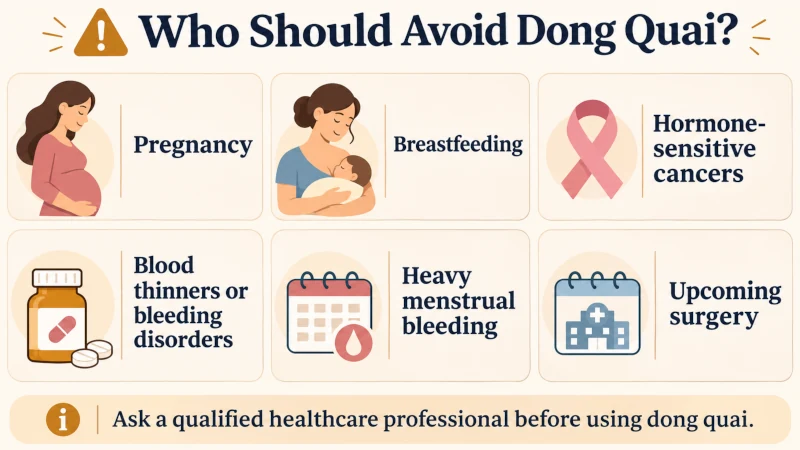
- Pregnant women. Dong quai may raise the risk of miscarriage [MSK, 2026] and has shown both stimulating and relaxing effects on the uterus [Drugs.com, 2025].
- Breastfeeding parents. There’s no data on how it affects babies, and it’s best avoided while nursing [LactMed, 2021].
- People with breast cancer or other hormone-sensitive cancers, unless their oncology team approves [Breastcancer.org, 2026; MSK, 2026].
- People with other hormone-sensitive conditions, such as endometriosis or fibroids, should get medical advice first [Medical News Today, 2023].
- Anyone with a bleeding disorder or very heavy periods, or who takes a blood thinner [Medical News Today, 2023; Drugs.com, 2025].
- Anyone scheduled for surgery. Stop about two weeks beforehand [Medical News Today, 2023].
How dong quai root is taken
Dong quai comes as capsules, liquid extracts, dried powder, and tea [WebMD, 2026]. There’s no established effective dose, because no dose has been shown to work for any condition. For context only: traditional decoctions use roughly 3 to 15 g of root a day, and the menopause trial used 4.5 g a day [Drugs.com, 2025].
Quality is another variable. Supplements don’t need FDA approval before they’re sold, and differences between labeled and actual ingredients are common [LactMed, 2021]. Questions have also been raised about what some dong quai products actually contain [Drugs.com, 2025]. If you do use it, choose a product checked by an independent testing organization, follow the label, and tell your clinician. Third-party testing confirms what’s in the bottle; it doesn’t prove the herb works [LactMed, 2021].
When to see a doctor
Stop taking dong quai and get urgent care if you notice signs of a serious allergic reaction, such as hives, swelling of the face or throat, trouble breathing, or fainting [WebMD, 2026]; unexplained bleeding or bruising, especially if you take a blood thinner; or severe sunburn or blistering after sun exposure [WebMD, 2026].
Book an appointment if:
- You have any vaginal bleeding after menopause. It needs checking whatever supplements you take, and current ACOG guidance calls for an ultrasound plus endometrial biopsy for most people being evaluated [Cleveland Clinic, 2026].
- Period pain is severe or has changed. Conditions such as endometriosis, fibroids, and ovarian cysts can cause it; our overview of common female reproductive disorders explains the signs.
- Hot flashes or night sweats are disrupting your sleep or daily life.
- You take prescription medicine, are pregnant or trying to conceive, or are being treated for cancer, before you start any herbal product.
| HEALTH DISCLAIMER: This article is for general education and is not a substitute for advice from a doctor, pharmacist, or other qualified healthcare professional. Dong quai can interact with medicines and is not safe for everyone. Talk to a professional who knows your health history before starting, stopping, or combining any herbal supplement, and do not use this information to delay getting care for symptoms that worry you. |
Frequently Asked Questions
Is dong quai the same as female ginseng?
“Female ginseng” is one of dong quai’s common names [MSK, 2026]. It’s a nickname reflecting its use as a women’s tonic, not a sign that the two plants are related: dong quai is Angelica sinensis, while Asian ginseng is a different plant.
Does dong quai work for hot flashes?
Not when taken on its own. In a 24-week randomized trial of 71 postmenopausal women, dong quai did no better than a placebo [Hirata et al., 1997], and the North American Menopause Society describes it as no more effective than placebo [Drugs.com, 2025].
Does dong quai raise estrogen levels?
In the main human trial it didn’t change blood estrogen levels, the uterine lining, or vaginal cells [Miller, 1998]. Lab studies do show estrogen-like activity, which is why people with hormone-sensitive cancers are advised to avoid it or check with their doctor [MSK, 2026].
Can I take dong quai with a blood thinner?
Not without your prescriber’s input. A published case showed a more-than-doubled INR in a woman on warfarin after four weeks of dong quai [Page & Lawrence, 1999], and drug references advise monitoring if the two are combined [Drugs.com, 2025].
How long before surgery should I stop dong quai?
About two weeks, because it may increase bleeding risk [Medical News Today, 2023]. Tell your surgeon and anesthesiologist about every supplement you take.
Is dong quai safe during pregnancy or breastfeeding?
No. It may increase miscarriage risk [MSK, 2026], and it’s best avoided while breastfeeding [LactMed, 2021].
References
- Santora T; reviewed by Dixon S. Is It OK to Use Dong Quai for Menopausal Symptoms? Breastcancer.org. View source
- Cassileth BR. Dong quai (Angelica sinensis). Oncology (Williston Park). View source
- Chao WW, Lin BF. Bioactivities of major constituents isolated from Angelica sinensis (Danggui). Chin Med. View source
- Cleveland Clinic Consult QD. New guidance supports dual assessment methods for postmenopausal bleeding. View source
- Drugs.com. Dong Quai (professional natural product monograph). View source
- Hirata JD, et al. Does dong quai have estrogenic effects in postmenopausal women? A double-blind, placebo-controlled trial. View source
- Drugs and Lactation Database (LactMed). Dong Quai. National Institute of Child Health and Human Development; View source
- Ames H; medically reviewed by Boyle K. Dong quai [article]. Medical News Today. View source
- Miller KE. Efficacy of dong quai for symptoms of menopause [Tips from Other Journals]. Am Fam Physician. View source
- Memorial Sloan Kettering Cancer Center. Dong Quai. About Herbs. View source
- Page RL 2nd, Lawrence JD. Potentiation of warfarin by dong quai. Pharmacotherapy. View source
- WebMD. Dong Quai (Vitamins & Supplements database). View source
- Zhu X, Proctor M, Bensoussan A, Wu E, Smith CA. Chinese herbal medicine for primary dysmenorrhoea. View source


