“Female disorders” is a broad search term, not a single diagnosis. It can refer to painful or irregular periods, heavy bleeding, difficulty becoming pregnant, menopause symptoms, or breast inflammation during breastfeeding. Some of these problems are common and manageable. Others need prompt evaluation because the same symptom can have several causes.
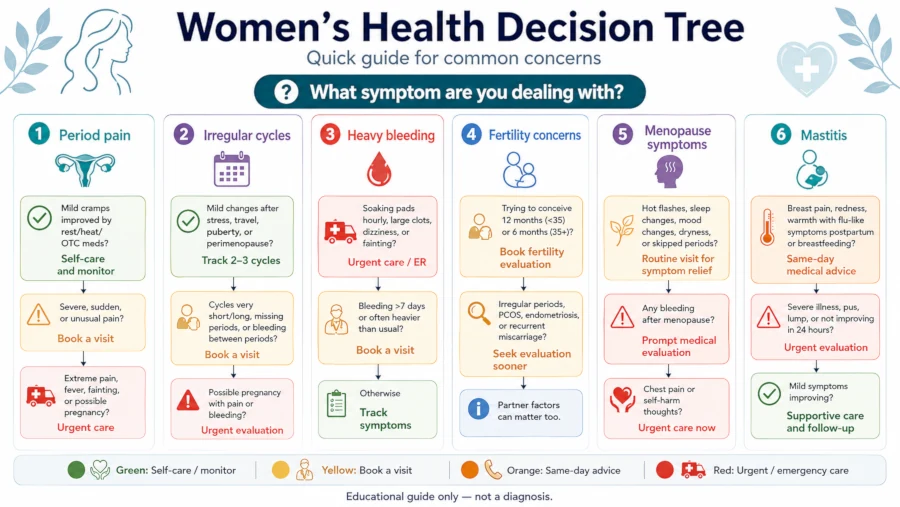
Natural measures may ease discomfort, but they cannot tell you whether pain comes from primary menstrual cramps, endometriosis, fibroids, an ovarian cyst, an infection, or another condition. Herbs also cannot reliably unblock fallopian tubes, restore ovarian function, stop dangerous bleeding, or replace antibiotics when mastitis becomes bacterial. The safest approach is to match the remedy to a clear goal—and to know when self-care is no longer enough.
| Start with the symptom, not the herb Track what is happening, how severe it is, and whether it is new. A symptom diary can help a clinician distinguish a common pattern from one that needs testing. Treatment is more useful when the cause is understood. |
Common Female Disorders and What Their Symptoms May Mean
| What you notice | What it may point to | A reasonable next step |
| Cramps that disrupt work, school, sleep, or normal activity | Primary dysmenorrhea; sometimes endometriosis, fibroids, ovarian cysts, or another pelvic condition | Track timing and severity. Seek evaluation if pain is severe, worsening, new, or occurs outside the period. |
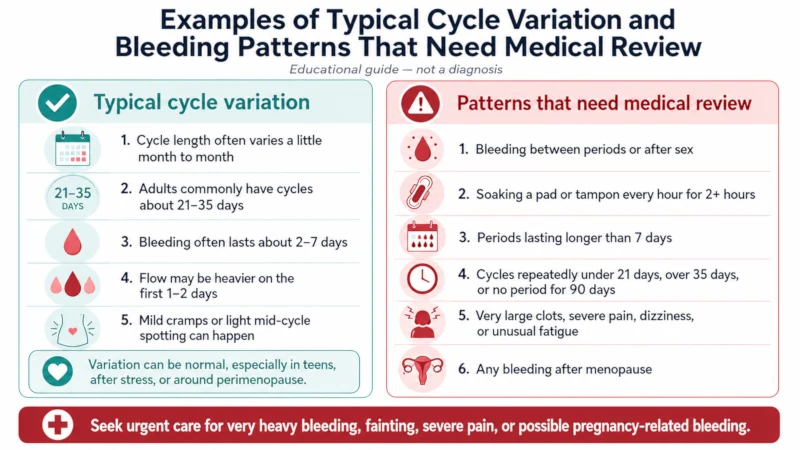
| Cycles shorter than 24 days, longer than 38 days, or highly variable | Pregnancy, stress, weight change, thyroid disease, PCOS, medications, perimenopause, or primary ovarian insufficiency | Take a pregnancy test when relevant and arrange evaluation if the pattern persists or changes suddenly. |
| Bleeding longer than 8 days, soaking protection every 1–2 hours, or large clots | Heavy menstrual bleeding, sometimes with anemia; possible fibroids, hormone-related causes, bleeding disorders, or pregnancy complications | Contact a clinician promptly. Urgent care is appropriate with faintness, chest pain, or shortness of breath. |
| No period for 3 months when not pregnant or breastfeeding | Amenorrhea from pregnancy, stress, weight change, endocrine conditions, medications, or reduced ovarian function | Do not try to “bring on” a period with herbs. Arrange a medical evaluation. |
| No pregnancy after 12 months of trying—or 6 months at age 35 or older | Infertility involving either partner or both; ovulation, sperm, tubal, uterine, age-related, or unexplained factors | Request a fertility evaluation; seek help sooner with irregular periods, severe pelvic pain, endometriosis, PID, or recurrent miscarriage. |
| A hot, swollen, painful breast with flu-like symptoms while breastfeeding | Mastitis, sometimes following milk stasis or nipple damage | Continue feeding or expressing as tolerated, use cold compresses, and seek care if not improving within 12–24 hours. |
| Any vaginal bleeding after menopause | Bleeding that requires investigation, even when light | Contact a clinician promptly rather than treating it as a return of normal periods. |
Painful periods (dysmenorrhea)
Primary dysmenorrhea means menstrual pain without another identified pelvic disease. Secondary dysmenorrhea is pain caused by a condition such as endometriosis, fibroids, or an ovarian cyst. The distinction matters: comfort measures may help both, but secondary pain usually needs condition-specific treatment.[Office on Women’s Health: Period Problems, 2025]
Heat on the lower abdomen, gentle activity, adequate sleep, and over-the-counter pain medicine can help some people. Nonsteroidal anti-inflammatory drugs such as ibuprofen are commonly used when medically appropriate, but they are not safe for everyone. Ask a clinician or pharmacist if you have kidney disease, ulcers, a bleeding disorder, take blood thinners, or may be pregnant. Make an appointment if pain stops you from normal activities, becomes progressively worse, begins later in life, or occurs between periods.
Irregular or missing periods
Cycles can be irregular during the first years after periods begin and during perimenopause. Persistent or sudden changes can also be associated with pregnancy, major stress, rapid weight change, intense exercise, thyroid disease, polycystic ovary syndrome (PCOS), high prolactin, some medicines, or primary ovarian insufficiency. A missed period is a reason to consider pregnancy before trying any herbal product.[Office on Women’s Health: Period Problems, 2025]
Avoid products marketed to “force” menstruation or “cleanse” the uterus. The label may hide multiple herbs, doses can vary, and an induced bleed does not correct the cause of absent or irregular periods. Evaluation is especially important after three months without a period when pregnancy and breastfeeding do not explain it.
Heavy or unusual bleeding
Heavy menstrual bleeding is more than an inconvenient period. Warning signs include bleeding for more than eight days, needing a new pad or tampon every one to two hours, clots larger than a quarter, or symptoms of blood loss such as dizziness, weakness, chest pain, or shortness of breath. Bleeding between periods, after sex, or after menopause also deserves medical attention.[Office on Women’s Health: Period Problems, 2025]
Do not rely on astringent, “hemostatic,” oxytocic, or emmenagogue herbs to stop heavy bleeding. They have not been shown to make an undiagnosed bleed safe, and some may increase medication, pregnancy, or clotting risks. If heavy periods are causing fatigue, ask about a blood count and iron testing. Iron-rich foods can support nutrition, but iron supplements should be matched to a confirmed need and an appropriate dose.
Difficulty becoming pregnant
Infertility is generally defined as not becoming pregnant after one year of regular unprotected sex, or after six months when the woman is age 35 or older. Fertility problems may involve the woman, the man, both partners, or no immediately identifiable cause. In women, common contributors include ovulation problems, PCOS, primary ovarian insufficiency, age-related changes, endometriosis, uterine conditions, or blocked fallopian tubes.[Office on Women’s Health: Infertility, 2026]
Herbal products are not a substitute for evaluating both partners. No herb has been shown to reopen blocked tubes or reliably “stimulate” ovaries in a way that replaces diagnosis and treatment. Seek help earlier than the usual timeline if periods are absent or very irregular, pelvic pain is severe, there is a history of endometriosis or pelvic inflammatory disease, or there have been repeated miscarriages.[Office on Women’s Health: Infertility, 2026]
Perimenopause and menopause
Menopause is a normal life stage, reached after 12 consecutive months without menstrual bleeding. The years leading up to it are called perimenopause. Periods may become less predictable, and symptoms can include hot flashes, night sweats, sleep disruption, vaginal dryness, urinary changes, mood changes, or discomfort during sex. Treatment is optional, but symptoms that affect daily life are worth discussing because both hormonal and nonhormonal options are available.[Office on Women’s Health: Menopause Basics, 2026]
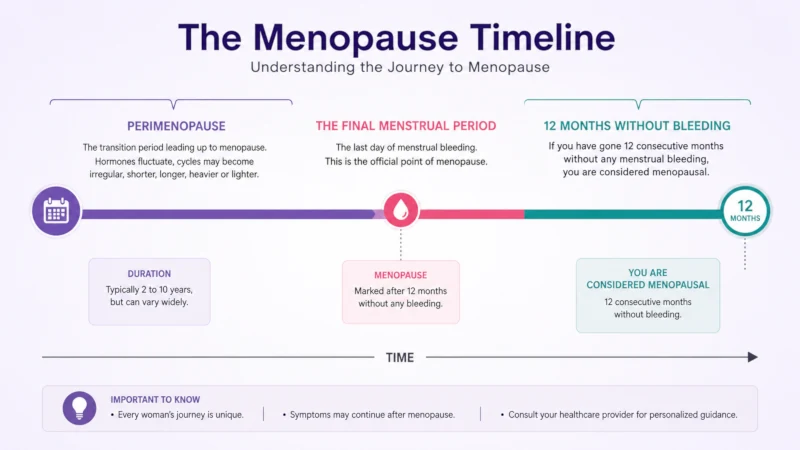
A new episode of bleeding after menopause should be checked promptly. Do not assume that a supplement has “restarted” a normal cycle.[Office on Women’s Health: Menopause Basics, 2026]
Nipple pain and mastitis during breastfeeding
Nipple cracks or soreness can make feeding difficult, but breast pain with a hot, swollen area, a lump, burning pain, discharge, fever, chills, or flu-like symptoms may be mastitis. Continue breastfeeding or express enough milk for comfort if you can; sudden weaning can worsen milk buildup. Cold compresses and usual pain medicine may help when safe for you. Avoid vigorous massage, essential oils, herbal poultices, or unprescribed creams on the breast.[NHS: Mastitis, reviewed 2023]
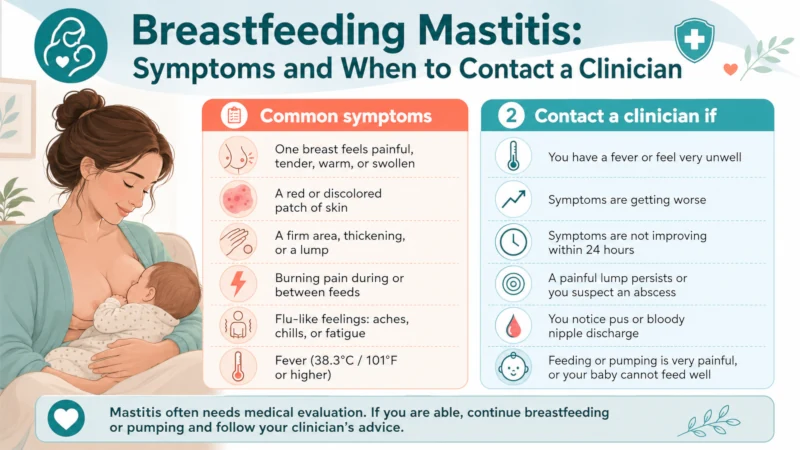
Contact a clinician if symptoms are not improving within 12 to 24 hours, or sooner if you feel very unwell. Antibiotics may be needed. A lactation consultant can also help with latch, positioning, and milk-removal problems, but a feeding assessment should not delay medical care when infection is suspected.[NHS: Mastitis, reviewed 2023]
What Natural Support Can—and Cannot—Do
Natural support is most useful for comfort, routine nutrition, sleep, stress management, and symptom tracking. It is least reliable when a product promises to correct hormones, restore fertility, induce a period, stop heavy bleeding, or treat infection. A safer starting point is to choose one low-risk measure for one clearly defined symptom.
Supportive steps with a reasonable safety profile
- Use a heating pad or warm bath for cramps, with care to avoid burns.
- Try gentle walking, stretching, or other movement that feels tolerable; stop if pain becomes sharper or you feel faint.
- Record cycle dates, bleeding volume, pain, medications, pregnancy possibility, and accompanying symptoms.
- Eat regularly and include iron-rich foods if periods are heavy. Ask about testing before starting high-dose iron.
- Protect sleep and reduce alcohol or late caffeine when hot flashes or insomnia are prominent.
- During pregnancy, favor a food-first approach and confirm supplement needs with prenatal care. The site’s pregnancy nutrition overview can offer meal ideas, but it should not replace individualized prenatal advice.
For readers interested in historical or traditional uses, the site’s overview of herbs for women can provide background. Traditional use is not the same as clinical evidence, and the safety of an herb depends on the product, dose, medical history, medications, and pregnancy or breastfeeding status.
Herbal products: evidence and safety
| Product | Evidence for common women’s-health uses | Important cautions | Evidence grade |
| Chamomile | Reliable clinical evidence is insufficient for treating menstrual or reproductive disorders. Tea may be soothing, but that is not proof of disease treatment. | May trigger allergy, especially with ragweed/daisy-family allergy. Possible interactions include warfarin and sedatives. Pregnancy and breastfeeding safety is not established. | Insufficient |
| Evening primrose oil | NCCIH reports insufficient evidence for any health condition, including PMS or menopause symptoms. It is not a proven labor-induction method. | Usually causes mild gastrointestinal effects when they occur; interactions are possible. Pregnancy and breastfeeding evidence is inconclusive. | Insufficient |
| Black cohosh | A 2023 review cited by NCCIH found potential benefit for overall menopause symptoms and hot flashes, but evidence does not establish broad hormonal or reproductive benefits. | Rare liver-injury reports; product contamination or mislabeling can occur. Avoid in pregnancy or breastfeeding; discuss hormone-sensitive conditions and medicines with a clinician. | Limited / mixed |
| “Hormone-balancing,” emmenagogue, or oxytocic blends | No reliable basis to assume that a mixed product corrects the cause of irregular cycles, infertility, or heavy bleeding. | Avoid during pregnancy unless specifically prescribed. Use extra caution with bleeding disorders, liver disease, surgery, or medications. | Insufficient / potentially risky |
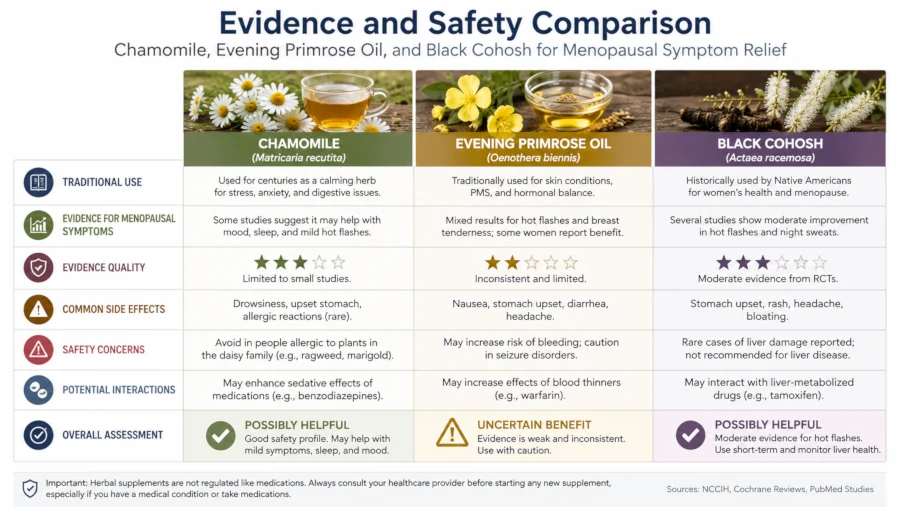
Chamomile: NCCIH’s chamomile review finds too little reliable evidence to rate its usefulness for most health conditions and notes allergy and interaction concerns. The site’s German chamomile profile is best treated as a traditional-use overview rather than a treatment recommendation.
Evening primrose oil: NCCIH reports that the evidence is insufficient for PMS, menopause symptoms, or other health conditions. Common adverse effects are usually mild gastrointestinal symptoms, but interactions remain possible, and pregnancy or breastfeeding safety is not settled. [NCCIH: Evening Primrose Oil, 2024]
Black cohosh: NCCIH notes potential benefit for some menopause symptoms, including hot flashes, but not for every symptom or every person. Rare liver-injury reports and uncertainty around hormone-sensitive conditions make clinician review sensible. Stop the product and seek care for dark urine, jaundice, marked fatigue, or upper abdominal pain. [NCCIH: Black Cohosh, 2024]
Many supplements have not been adequately tested during pregnancy or breastfeeding, and “natural” does not guarantee a consistent dose, a pure product, or freedom from drug interactions. [NCCIH: Using Dietary Supplements Wisely, 2019]
How to Use an Herb or Supplement More Safely
- Name the goal precisely: for example, “reduce mild cramps” rather than “balance hormones.”
- Rule out pregnancy before using products intended to affect menstruation or uterine activity.
- Ask a clinician or pharmacist to check medications, medical conditions, surgery plans, and breastfeeding status.
- Choose a single-ingredient product when possible, use the labeled dose, and avoid stacking products with overlapping ingredients.
- Look for independent quality testing, while remembering that quality certification does not prove effectiveness.
- Start one change at a time and record benefits or adverse effects. Stop for rash, breathing difficulty, unusual bleeding, severe digestive symptoms, jaundice, or worsening pain.
- Set a review point. If the symptom persists, recurs, or interferes with daily life, seek evaluation instead of increasing the dose or adding more herbs.
When to Seek Urgent or Prompt Medical Care
| Seek urgent care now Get urgent help for very heavy bleeding with fainting, chest pain, shortness of breath, severe weakness, or confusion; severe one-sided pelvic pain when pregnancy is possible; fever with rapidly worsening breast pain or feeling seriously ill; or signs of a severe allergic reaction such as facial swelling or trouble breathing. |
Arrange prompt evaluation
- Bleeding after menopause, between periods, or after sex.
- Period pain that prevents normal activities, worsens over time, begins later in life, or occurs outside menstruation.
- No period for three months when pregnancy or breastfeeding does not explain it.
- Cycles that remain shorter than 24 days, longer than 38 days, or change markedly from your usual pattern.
- Mastitis symptoms that are not improving within 12 to 24 hours.
- No pregnancy after 12 months of trying, or after 6 months at age 35 or older; sooner with irregular periods, severe pain, endometriosis, PID, or repeated miscarriage.
| Health Disclaimer: This article is for education and cannot diagnose or treat a medical condition. Symptoms discussed here can have many causes. Ask a qualified clinician or pharmacist before using herbs or supplements—especially during pregnancy or breastfeeding, with hormone-sensitive conditions, liver disease, bleeding disorders, upcoming surgery, or prescription medication use. Seek urgent care for emergency warning signs rather than relying on self-care. |
Frequently Asked Questions
What are the most common “female disorders”?
The phrase is broad rather than diagnostic. Common concerns include painful periods, irregular or missing periods, heavy or unusual bleeding, endometriosis, PCOS, fertility problems, perimenopause or menopause symptoms, and breast problems during breastfeeding. A symptom can fit more than one condition, so persistent, severe, or changing symptoms deserve evaluation.
Can herbs regulate an irregular menstrual cycle?
There is no reliable evidence that an over-the-counter herb can safely correct all causes of irregular periods. Pregnancy, thyroid disease, PCOS, stress, weight change, medicines, perimenopause, and reduced ovarian function require different responses. Identify the cause before using a product that claims to induce or regulate bleeding.
What can help period pain naturally?
Heat, gentle movement, sleep, and symptom tracking are reasonable low-risk measures. Some people also use over-the-counter anti-inflammatory medicine when medically appropriate. Severe, worsening, or activity-limiting pain should be assessed for endometriosis, fibroids, ovarian cysts, or another cause.
When is heavy menstrual bleeding an emergency?
Seek urgent care when heavy bleeding is accompanied by fainting, chest pain, shortness of breath, severe weakness, or confusion. Contact a clinician promptly for bleeding longer than eight days, soaking pads or tampons every one to two hours, large clots, or symptoms of anemia.
Are black cohosh and evening primrose oil safe?
Neither product is risk-free. Black cohosh may help some menopause symptoms, but evidence is limited and rare liver injury has been reported. Evening primrose oil has insufficient evidence for PMS or menopause. Both can interact with medicines, and pregnancy or breastfeeding use should be discussed with a clinician.
When should I seek a fertility evaluation?
A common threshold is after 12 months of trying to conceive, or 6 months if the woman is age 35 or older. Seek help sooner with absent or irregular periods, severe pelvic pain, endometriosis, pelvic inflammatory disease, or repeated miscarriages. Both partners should be evaluated when applicable.
References
- Office on Women’s Health. “Period Problems.” U.S. Department of Health and Human Services, updated September 26, 2025. View source
- Office on Women’s Health. “Infertility.” U.S. Department of Health and Human Services, updated June 4, 2026. View source
- Office on Women’s Health. “Menopause Basics.” U.S. Department of Health and Human Services, updated April 2, 2026. View source
- National Health Service. “Mastitis.” NHS, reviewed March 17, 2023. View source
- National Center for Complementary and Integrative Health. “Chamomile: Usefulness and Safety.” NIH, updated November 2024. View source
- National Center for Complementary and Integrative Health. “Evening Primrose Oil: Usefulness and Safety.” NIH, updated November 2024. View source
- National Center for Complementary and Integrative Health. “Black Cohosh: Usefulness and Safety.” NIH, updated November 2024. View source
- National Center for Complementary and Integrative Health. “Using Dietary Supplements Wisely.” NIH, updated January 2019. View source
