
Yes, you can smoke mugwort. The dried leaf burns easily, people have rolled it and packed it into pipes for generations, and one of its old English names is “sailor’s tobacco” [NCCIH, 2025]. The more useful question behind “can you smoke mugwort” is whether it’s worth doing, and the honest answer leans no. Nobody has run a controlled study on what smoking it does to dreams, sleep, or mood, so the benefits rest on folklore and personal reports. The downsides are better understood: burning any plant produces tar and carbon monoxide, mugwort is a well-documented allergen, and it is off-limits in pregnancy.
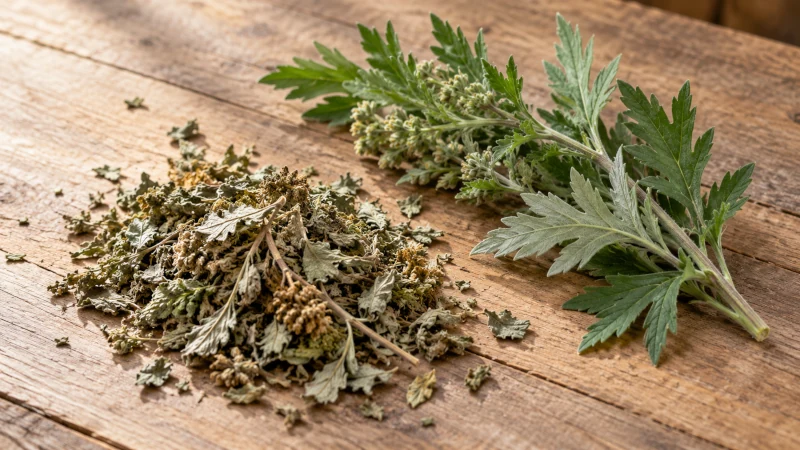
Why People Smoke Mugwort
Mugwort (Artemisia vulgaris) is a tall, silvery-leaved weed in the daisy family. It is native to Europe and parts of Asia and Africa and now grows across much of North America [NCCIH, 2025]. Most people who smoke it want one of three things.
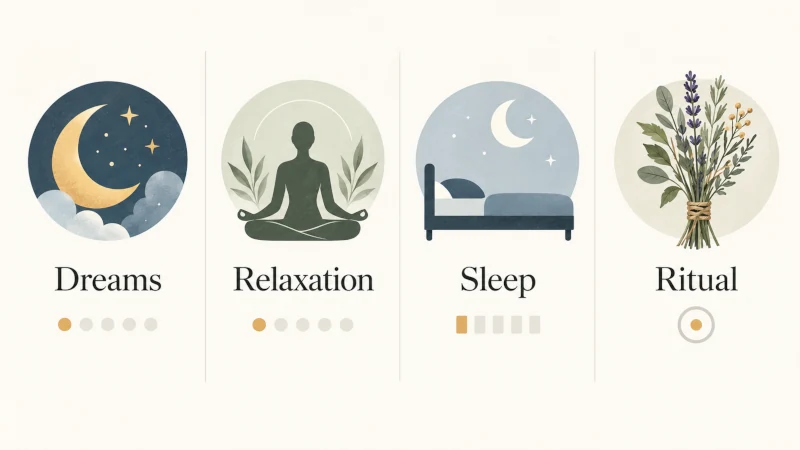
- Dreams. Its reputation as a dream herb drives most of its popularity. People smoke a little before bed hoping for vivid dreams, better recall, or lucid dreams.
- Relaxation. Some use it as a wind-down herb or as a tobacco-free base in herbal smoking blends.
- Ritual. Mugwort has a long place in spiritual and ceremonial practice, where it may be burned or smoked during meditation.
A 2020 review of the plant’s history says mugwort has been treated as a substitute for cannabis, with mild intoxicating and relaxing effects when smoked [Ekiert et al., 2020]. That description is secondhand. The review cites a regulatory compendium, not a study in people, and it is roughly as far as the scientific literature goes.
Does Smoking Mugwort Actually Do Anything?
The National Center for Complementary and Integrative Health puts it plainly: very little research has been done on mugwort in people, and there isn’t enough evidence to say whether it is safe or useful for any health condition [NCCIH, 2025]. That covers tea and capsules. Smoked mugwort has never been studied for benefits at all.
| What people claim | What the evidence is | Strength |
| Vivid or lucid dreams | Folklore and personal reports. No controlled human trials of smoked or brewed mugwort. | Anecdotal |
| Relaxation or a mild “high” | Described in reviews that trace back to secondary sources. No trials. | Anecdotal |
| Better sleep | No human trials of smoked mugwort. | Insufficient |
| Spiritual or ritual value | Long cultural history across many traditions. | Traditional (not a health claim) |
Dreams and lucid dreaming
Plenty of people say mugwort gives them strange, memorable dreams. The experience is real to them, but it has never been separated from expectation. If you go to bed planning to notice your dreams, you are more likely to remember them, herb or no herb.
Websites often credit thujone, a compound in mugwort’s essential oil, for the effect. No study shows that smoking mugwort delivers a meaningful dose of thujone, or that thujone changes dreams. What is known about thujone points the other way. It blocks one of the brain’s main calming signals, and the hallmark of thujone poisoning is seizures, not sleep [European Medicines Agency, 2012].
Relaxation and “getting high”
If smoking mugwort relaxes you, some of that may simply be the ritual: slowing down, breathing deliberately, taking ten minutes for yourself. Whether the herb adds anything hasn’t been tested. There’s no evidence it produces anything like a cannabis high, and it isn’t a treatment for anxiety or insomnia.
Is It Safe to Smoke Mugwort?
The smoke itself is the main problem

“Herbal” and “natural” don’t change what happens when plant material burns. When the Federal Trade Commission settled charges against makers of herbal cigarettes, it required their packs and ads to state that herbal cigarettes are dangerous to your health because they produce tar and carbon monoxide [Federal Trade Commission, 2000]. The American Lung Association makes the broader point: whether the material is wood, tobacco, or marijuana, combustion releases toxins and carcinogens [American Lung Association, 2025].
Mugwort has no nicotine, so it lacks tobacco’s addictive pull. That doesn’t make it safe for your lungs. Regular smoking of any plant raises concern for the chronic cough, phlegm, and bronchitis seen in cannabis smokers [American Lung Association, 2025], though no one has studied mugwort smokers specifically.
What burning mugwort releases
The closest data come from moxibustion, a traditional practice in which compressed mugwort is burned near the skin. These studies measure smoke drifting through a treatment room, not smoke pulled straight into the lungs, and they don’t agree with each other.
- A UK laboratory test of moxa sticks found that under normal treatment conditions, neither the volatile compounds nor the carbon monoxide in the smoke posed a safety hazard [Wheeler et al., 2009]. A later review of that work notes that a few aromatic amines did exceed limits once the results were extrapolated to long-term exposure [Ekiert et al., 2020].
- A 2020 chemical analysis of moxa smoke, made from a related mugwort species, identified 294 compounds, 112 of them flagged as potentially toxic. The authors recommended ventilation in treatment rooms [Xu et al., 2020].
- In rats exposed to moxa smoke for 20 minutes a day over 24 weeks, low concentrations didn’t change lung function. Medium and high concentrations reduced it [He et al., 2019].
Taken together, occasional exposure to diluted room smoke looks low-risk. Nobody has measured what happens when you inhale mugwort smoke directly from a joint or pipe, which is a far more direct exposure.
Allergy is the risk specific to mugwort
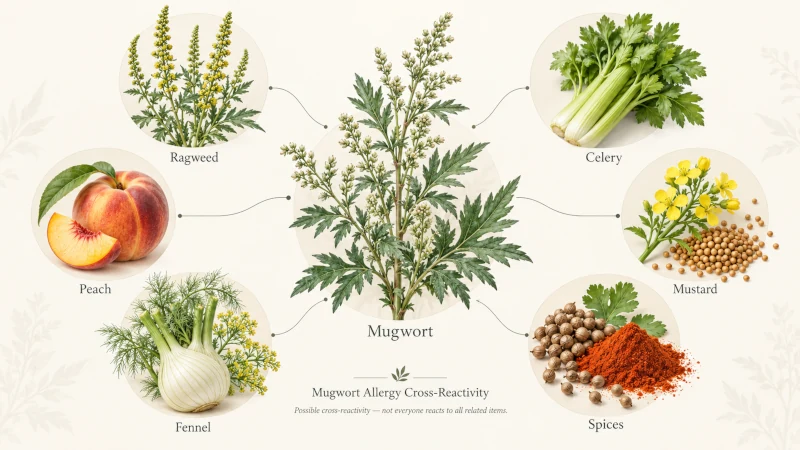
Mugwort pollen is a major late-summer and autumn allergen. In Europe, roughly 10 to 15 percent of people tested for suspected allergies are sensitized to it, and in China it is a leading cause of seasonal hay fever and asthma [Thermo Fisher Scientific, 2020]. It cross-reacts with ragweed and sits at the center of several pollen-food allergy patterns involving celery, peach, mustard, fennel, and spices. Reactions range from an itchy mouth to anaphylaxis [Thermo Fisher Scientific, 2020].
Dried mugwort is usually harvested as flowering tops [Ekiert et al., 2020], so a smoking blend can carry material from near the flowers. No study has tested allergic reactions to smoked mugwort specifically. Still, if ragweed season flattens you every September, inhaling mugwort is a reasonable thing to skip.
Thujone: a smaller, less certain concern
Mugwort’s essential oil contains alpha- and beta-thujone, in amounts that vary widely from plant to plant [Ekiert et al., 2020]. Thujone acts on the GABA-A receptor in a way that can trigger convulsions at high doses, and severe human poisonings have followed the use of thujone-rich essential oils. European regulators concluded that 3 to 7 mg a day from herbal medicines doesn’t raise special concern [European Medicines Agency, 2012].
How much thujone survives burning and reaches your bloodstream from a few puffs is unknown. For a healthy adult who smokes occasionally, it is probably minor next to the smoke itself. For anyone with a seizure disorder, it’s reason enough to stay away.
Who Should Not Smoke Mugwort
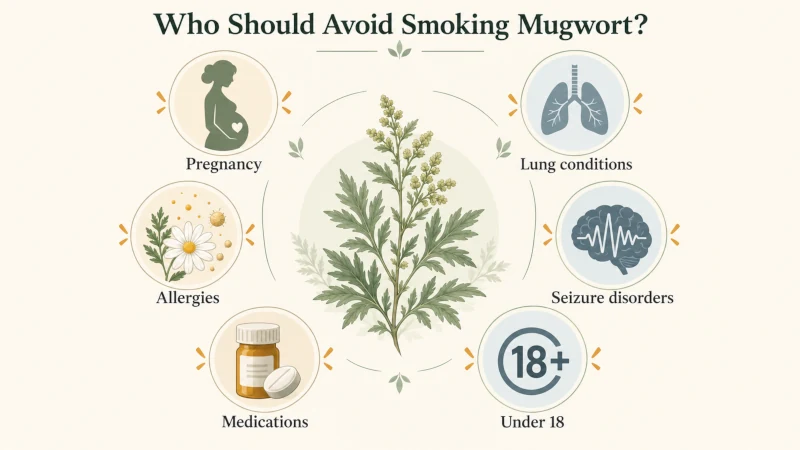
- Anyone pregnant, trying to conceive, or breastfeeding. NCCIH says mugwort should not be used during pregnancy, and little is known about its safety while breastfeeding [NCCIH, 2025]. Large doses have been linked to miscarriage [Ekiert et al., 2020], and the carbon monoxide in any smoke is a separate concern [Federal Trade Commission, 2000].
- People with asthma, COPD, or another lung condition. Smoke from burning plant material irritates the airways [American Lung Association, 2025].
- People allergic to ragweed, chrysanthemum, marigold, daisies, or other plants in the daisy family, and anyone with celery, carrot, fennel, mustard, peach, or spice allergies [Thermo Fisher Scientific, 2020; Ekiert et al., 2020].
- People with epilepsy or another seizure disorder, or anyone taking anticonvulsants or sedatives. This is a theoretical concern based on how thujone acts in the brain, not a documented interaction [European Medicines Agency, 2012].
- People with diabetes, until they’ve checked with a clinician. One review flags caution because mugwort may raise blood glucose, though that evidence is thin [Ekiert et al., 2020].
- Anyone under 18.
- Anyone taking prescription medication. Reliable interaction data for mugwort don’t exist. European regulators judged drug-metabolism interactions with thujone unlikely but called the data inadequate [European Medicines Agency, 2012]. NCCIH’s general advice applies: talk with your healthcare provider before using an herbal product, because some herbs and medicines interact in harmful ways [NCCIH, 2025]. A pharmacist is often the quickest person to ask.
If You Decide to Try It Anyway
This page doesn’t recommend smoking mugwort. If you’re an adult with none of the conditions above and you’ve decided to try it, these steps keep the risk lower.
- Know what you’re buying. Several different plants are sold as mugwort, and their chemistry differs. Look for a label that names Artemisia vulgaris; our guide to what mugwort is and what the evidence supports explains how the species differ. Herbal products sold as supplements are not approved by the FDA before they reach the shelf [NCCIH, 2025].
- Start very small, once, on a night with nothing important the next morning. Don’t drive afterward.
- Don’t mix it with tobacco or cannabis. You add nicotine or THC and their risks, and you won’t know which plant is doing what.
- Keep it occasional. There is no safety data on regular or daily use.
- Smoke outdoors, away from children and anyone who is pregnant.
- Never add essential oil to a blend, pipe, or vaporizer.
- Stop at the first warning sign: wheezing, chest tightness, a cough that won’t settle, hives, or an itchy mouth or throat.
Gentler Ways to Get What You’re After
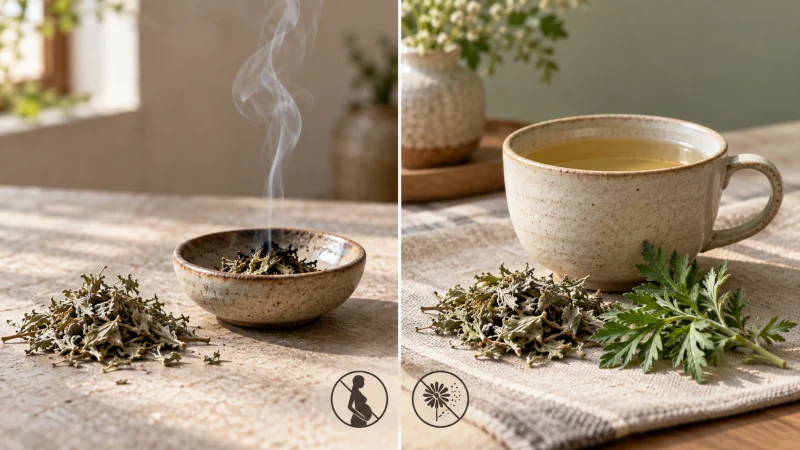
If dreams are the draw, a cup of mugwort tea skips the smoke. The pregnancy and allergy cautions still apply and the dream evidence is just as anecdotal, but your lungs stay out of it. Our guide to the benefits of mugwort tea covers brewing and what to realistically expect.
For winding down, a nervine tea of chamomile, lemon balm, passionflower, and linden makes a smoke-free evening ritual from herbs with at least some human data. If stress is the real problem, our evidence-graded look at supplements to reduce anxiety and stress and our roundup of foods that reduce stress are better starting points than any smoking herb. And if you mainly want to remember your dreams, a notebook by the bed costs nothing.
When to Get Medical Help
- Call 911 for swelling of the lips, tongue, or throat, trouble breathing, widespread hives, or feeling faint after smoking or handling mugwort. These are signs of anaphylaxis.
- Get emergency care for a seizure, new confusion, or repeated vomiting. Poison Control (1-800-222-1222) can advise while you arrange help.
- See a doctor if wheezing, chest tightness, or a cough lasts more than a few days.
- Tell your doctor or midwife if you are pregnant or breastfeeding and have already smoked mugwort.
- Talk to a clinician if you’re using any herb to manage ongoing insomnia, anxiety, or low mood. Those deserve a proper assessment. If you’re in crisis, call or text 988.
| Health Disclaimer: This article is for general education and is not medical advice, diagnosis, or treatment. Smoking any plant material carries health risks, and mugwort has not been shown to treat, cure, or prevent any condition. Talk with a doctor or pharmacist before using mugwort in any form, especially if you are pregnant, breastfeeding, or trying to conceive; have a lung condition, allergies, or a seizure disorder; or take prescription medication. If you have signs of a serious allergic reaction, stop and call 911. |
Frequently Asked Questions
Does smoking mugwort get you high?
There’s no good evidence it does. A 2020 review describes mild intoxicating and relaxing effects when mugwort is smoked, but that description traces back to a secondary source, not a study in people [Ekiert et al., 2020]. Most reports describe mild relaxation at most, and without a controlled trial there’s no way to separate that from expectation.
Is mugwort safer to smoke than tobacco?
It has no nicotine, so it lacks tobacco’s addictive pull. It has not been shown to be safer for your lungs. U.S. regulators have required herbal cigarettes to warn that they produce tar and carbon monoxide [Federal Trade Commission, 2000], and no study has compared lung health in mugwort smokers with tobacco smokers.
Can I smoke mugwort every day?
There’s no safety data on daily use, and regular smoking of any plant exposes your airways to combustion products [American Lung Association, 2025]. If you smoke it at all, keep it occasional.
Is mugwort the same as wormwood?
No. Mugwort is Artemisia vulgaris. Wormwood is Artemisia absinthium, the plant behind absinthe and a major source of thujone [European Medicines Agency, 2012]. They’re relatives, not substitutes.
Can I smoke mugwort while pregnant or breastfeeding?
No. NCCIH advises against mugwort during pregnancy and notes that little is known about its safety while breastfeeding [NCCIH, 2025], and smoke adds carbon monoxide on top [Federal Trade Commission, 2000]. If you already have, tell your doctor or midwife.
References
- National Center for Complementary and Integrative Health. Mugwort: Usefulness and Safety. National Institutes of Health. View source
- Ekiert H, Pajor J, Klin P, Rzepiela A, Ślesak H, Szopa A. Significance of Artemisia vulgaris L. (Common Mugwort) in the History of Medicine and Its Possible Contemporary Applications Substantiated by Phytochemical and Pharmacological Studies. Molecules. 2020;25(19):4415. doi:10.3390/molecules25194415. PMID: 32992959. View source
- European Medicines Agency, Committee on Herbal Medicinal Products. Public statement on the use of herbal medicinal products containing thujone. View source
- Thermo Fisher Scientific. w6 Mugwort. ImmunoCAP Allergen Encyclopedia. View source
- Federal Trade Commission. FTC Accepts Settlements of Charges that “Alternative” Cigarette Ads Are Deceptive. View source
- American Lung Association. Marijuana and Lung Health. View source
- Wheeler J, Coppock B, Chen C. Does the burning of moxa (Artemisia vulgaris) in traditional Chinese medicine constitute a health hazard? Acupuncture in Medicine. View source
- Xu X, Shan S, Wang W, Liu H. Analysis of the Components in Moxa Smoke by GC-MS and Preliminary Discussion on Its Toxicity and Side Effects. Evidence-Based Complementary and Alternative Medicine. View source
- He R, Han L, Liu P, et al. Lung Function Decline after 24 Weeks of Moxa Smoke Exposure in Rats. Evidence-Based Complementary and Alternative Medicine. View source


