
Jojoba oil for hair works best as a light conditioner. A few drops can make dry ends feel softer and easier to manage, and the oil is generally gentle on skin. It will not regrow hair. No human trial has tested jojoba oil on its own for hair growth, and in the one animal study that compared it with other treatments, jojoba was a comparison group while peppermint oil produced the most growth [1].
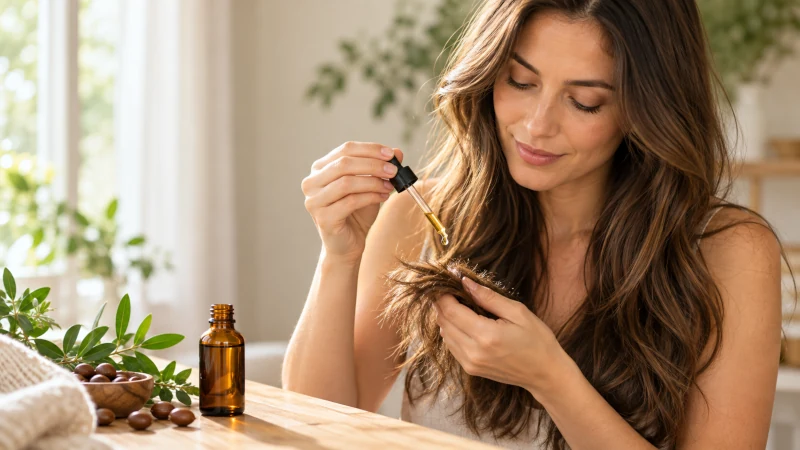
Most of the research on jojoba and hair comes from lab tests on hair samples, not from people using the oil at home. That limits what anyone can honestly promise about it.
| The short version: Jojoba oil is a liquid wax that closely resembles the oil your skin makes [2].In a lab study on bleached and dyed hair, a jojoba conditioner smoothed the cuticle and a panel liked how the hair felt, but it did not make hair easier to comb or shinier [3].There is no human evidence that jojoba oil grows hair, treats dandruff, or treats scalp psoriasis.Test any new oil on your inner arm twice a day for 7 to 10 days before using it on your scalp [4].Keep it on the outside. Jojoba oil is not meant to be swallowed [5]. |
What jojoba oil actually is
Jojoba (Simmondsia chinensis) is a desert shrub native to Arizona, California, and northern Mexico [5]. The “oil” pressed from its seeds is technically a liquid wax: about 98% of it is wax esters, with small amounts of sterols and vitamin E compounds called tocopherols [2].
That wax structure is close to sebum, the oil your scalp produces. It is one reason jojoba spreads easily and feels less greasy than heavier products such as lanolin or petroleum jelly [2].
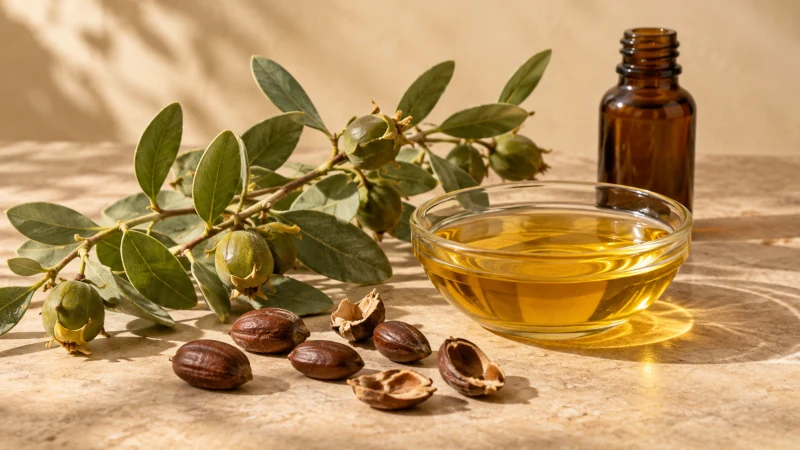
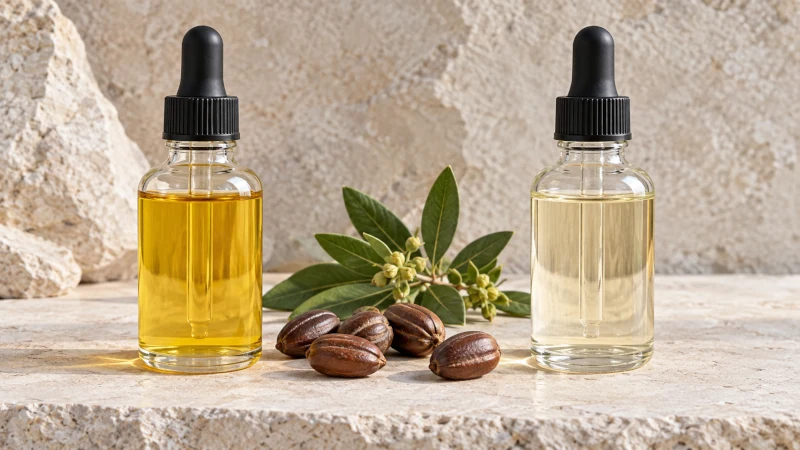
Unrefined jojoba is golden. Refined jojoba is nearly colorless, and because refining removes some of the natural antioxidants, it can be less stable on the shelf [2].
You may see claims that jojoba is rich in zinc, copper, or other minerals that “feed” hair. A comprehensive chemistry review describes its wax esters, sterols, and vitamin E compounds but does not list zinc or copper among its notable components [2]. Its value for hair is as a lubricant and softener, not as a nutrient.
Jojoba oil for hair: what the evidence shows
Softer, more manageable hair
The most direct test comes from a 2026 laboratory study. Researchers bleached and dyed hair samples, which made them harder to comb, then treated them with conditioners containing jojoba oil or coconut oil [3]. Under the microscope, the oil conditioners left the cuticle smoother and the strands more water-repellent, and a sensory panel preferred how the oil-treated hair felt [3].
Older lab work points the same way. When jojoba was added to a chemical hair-straightening product, hair from people of African descent lost less protein and resisted breakage better [2].
Both are lab studies on hair samples. They suggest jojoba is a reasonable conditioning ingredient. They do not show that it repairs damaged hair.
Frizz, tangles, and shine
Here the results are mixed. In the same 2026 study, conditioners generally made damaged hair easier to comb, but the jojoba formula did not significantly reduce combing resistance, and none of the products changed shine [3].
A drop of oil can still smooth flyaways and make hair feel softer to the touch. Just don’t expect it to detangle like a conditioner or add measurable gloss.
Dry, itchy, or flaky scalp
Jojoba is an emollient, which means it softens dry skin. It reduced inflammation in rats [2], and a dermatology review describes anti-inflammatory activity [6]. No trial has tested it on itchy or flaky human scalps.
Flakes aren’t always dry skin. They can come from dandruff, seborrheic dermatitis, psoriasis, a fungal infection, or eczema. For dandruff, the American Academy of Dermatology (AAD) recommends shampoos containing zinc pyrithione, salicylic acid, sulfur, selenium sulfide, ketoconazole, or coal tar, and a dermatologist visit if they don’t help [7]. If you’re unsure what you’re dealing with, our guide to scalp psoriasis vs. dandruff walks through the differences.
People with dry or textured hair are a different case. The AAD notes that flaking in these hair types can come from not using the right conditioner, oil, or scalp moisturizer [8]. There, a light oil like jojoba is a reasonable thing to try.
Hair growth and hair loss
Despite frequent claims, no human study has shown that jojoba oil grows hair. The studies that do exist point elsewhere:
- Mouse study: In a 2014 study, mice received saline, jojoba oil, 3% minoxidil, or 3% peppermint oil. Peppermint oil produced the most prominent hair growth [1]. Jojoba served as a comparison treatment.
- Alopecia areata trial: In a 1998 trial of 86 people, 44% of those who massaged a blend of thyme, lavender, rosemary, and cedarwood essential oils into the scalp improved, compared with 15% of those who used only the carrier oils, jojoba and grapeseed [9]. Jojoba was part of the inactive comparison.
- Review of hair oiling: A 2024 conference abstract in the British Journal of Dermatology found support for only a few oils, such as coconut oil as a protective pre-wash and rosemary oil for pattern hair loss, rather than for oils in general [10].
If you’re losing hair, see a dermatologist sooner rather than later. The AAD notes that treatment started early is more likely to help, and that proven options such as minoxidil take 6 to 12 months to show results [11]. For plant-based options with some research behind them, see our guide to herbs for hair loss.
Evidence at a glance
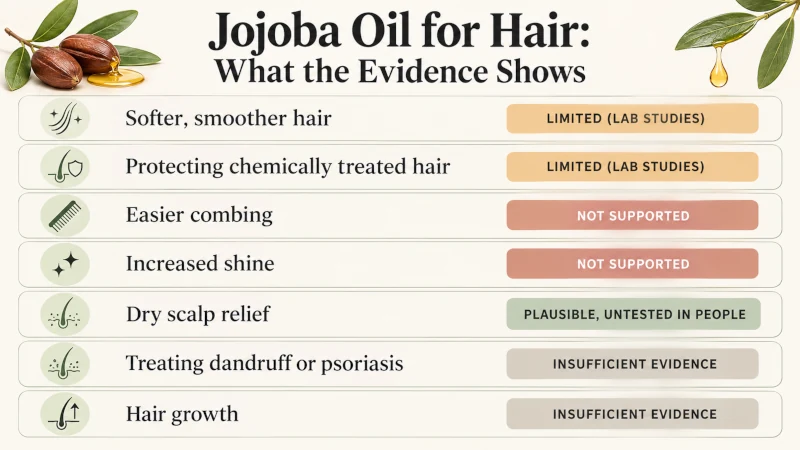
| Use | What the research shows | Evidence |
| Softer, smoother hair | Lab study on damaged hair samples: smoother cuticle, panel preferred the feel [3] | Limited (lab only) |
| Protecting chemically treated hair | Added to a straightening product, reduced protein loss and breakage [2] | Limited (lab only) |
| Easier combing | Jojoba conditioner did not significantly reduce combing resistance [3] | Not supported |
| Shine | No change in shine in lab testing [3] | Not supported |
| Dry scalp | Emollient; anti-inflammatory in animals [2] | Plausible, untested in people |
| Dandruff or psoriasis | No human studies | Insufficient |
| Hair growth | No human studies; comparison group in animal and human trials [1] [9] | Insufficient |
How to use jojoba oil on your hair
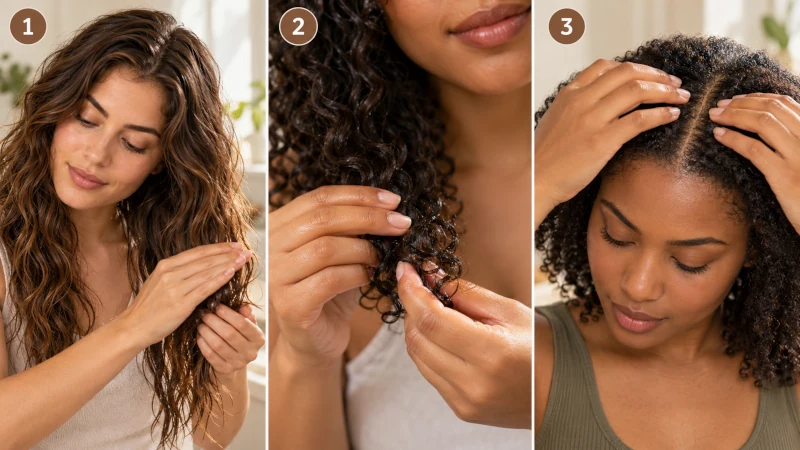
No study has set an ideal amount or timing, so treat these as practical starting points rather than tested protocols. Patch test first (see the safety section below).
As a pre-wash treatment
Work a small amount through dry lengths and ends, leave it on briefly, then shampoo as usual. Coconut oil has more research behind it as a protective pre-wash [10]; jojoba is a lighter alternative if coconut feels heavy on your hair.
As a finishing oil for ends
Rub one or two drops between your palms and smooth them over the ends of damp or dry hair. Fine or straight hair needs less. This mirrors the AAD’s advice for conditioner: ends only for fine hair, the full length for dry or curly hair [8].
On the scalp
If your scalp feels dry and tight, massage in a few drops and wash it out. If you have dandruff, start with a dandruff shampoo instead, since that is what the AAD recommends [7]. If your scalp is already oily, adding more oil is unlikely to help.
As a carrier for essential oils
Essential oils should never go on the scalp undiluted. In the alopecia areata trial, the blend used about 10 drops of essential oil in roughly 23 mL of carrier oil (3 mL jojoba plus 20 mL grapeseed), or about 1½ tablespoons [9]. The study authors noted that essential oils can cause contact dermatitis [9], so patch test the finished blend as well as the jojoba on its own.
Choosing a jojoba oil
- Check the ingredient list. Look for a single ingredient: Simmondsia chinensis (jojoba) seed oil.
- Golden or clear. Golden oil is unrefined; clear oil is refined and loses some natural antioxidants in processing [2]. Either works on hair.
- Be cautious with blends. Products marketed as botanical or even “unscented” can still contain fragrance-related ingredients that irritate sensitive skin [4].
- Store it well. Keep the bottle closed and away from heat and direct light.
Safety and side effects
Jojoba oil is generally well tolerated on skin. In human patch tests, it caused no allergic reactions except in people who were already highly allergic [2]. Allergic contact dermatitis has still been reported in individual cases and confirmed by patch testing [5].
Patch test first
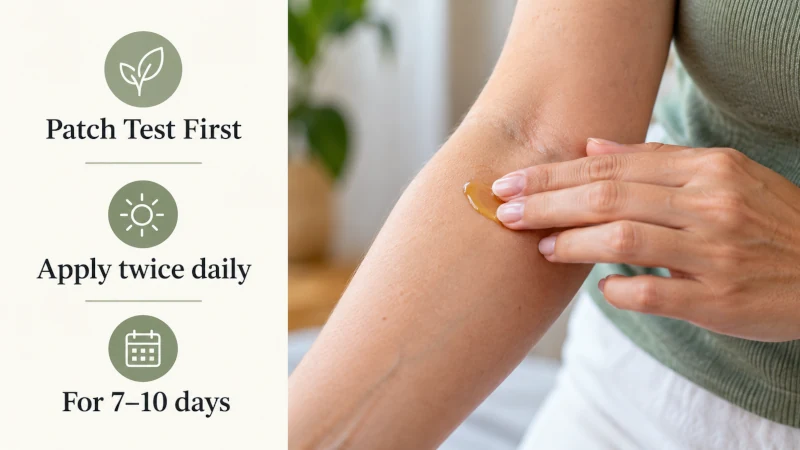
The AAD suggests applying a quarter-sized amount to the inside of your elbow or inner arm twice a day for 7 to 10 days. If you notice a reaction, wash the product off and stop using it [4]. Our guide to patch testing explains what to watch for.
Nut and seed allergies
Jojoba comes from a seed and is sometimes called “coffee nut” or “goatnut” [2]. There is no reliable data on whether it cross-reacts with nut allergies. If you have severe food or nut allergies, ask your allergist before using it.
Don’t swallow it
Jojoba oil is not meant to be eaten. Drugs.com advises against ingesting it, noting that it contains about 14% erucic acid and that jojoba seed meal contains simmondsin, a compound linked to toxicity [5]. Acute toxicity was low in mice [2], so sources differ on how dangerous a small amount would be, but there is no reason to take it by mouth. Store it out of children’s reach.
Keep it out of your eyes
In rabbits, jojoba caused mild eye irritation that cleared within 24 hours [2]. If oil gets in your eyes, rinse with water.
Pregnancy and breastfeeding
There is no reliable safety information for jojoba during pregnancy or breastfeeding, and the animal studies that raised concerns involved jojoba seed meal rather than the oil [5]. The alopecia areata trial excluded pregnant participants [9], so avoid essential-oil blends during pregnancy unless your clinician says otherwise.
Medications
No drug interactions with jojoba are well documented [5]. However, a dermatology review notes that jojoba may increase skin absorption of topical drugs [6]. If you use a prescription or medicated scalp product, such as minoxidil or a steroid solution, ask your dermatologist before layering jojoba with it.
Who should skip it or ask first
- Anyone who had redness, itching, or a rash during a patch test
- People with a known jojoba allergy or a history of reactions to cosmetic oils
- People with severe nut or seed allergies, until they have spoken with an allergist
- Anyone using prescription scalp treatments
- Pregnant or breastfeeding people considering essential-oil blends
When to see a dermatologist
Jojoba is a grooming product, not a treatment. The AAD lists signs that hair loss or scalp symptoms need a dermatologist [12]:
- A bald patch that appears suddenly, within a day or two
- Hair coming out in clumps
- Burning, stinging, intense itching, or tenderness on the scalp, which can signal an infection
- Scaly patches on the scalp, especially with pus
- Dandruff that doesn’t improve with dandruff shampoo [7]
Round, smooth bald patches can be a sign of alopecia areata, an autoimmune condition that needs a proper diagnosis. Get emergency care if you develop swelling of your face, lips, or throat, or trouble breathing after using any product.
| HEALTH DISCLAIMER: This article is for general information and is not a substitute for medical advice, diagnosis, or treatment. Talk with a board-certified dermatologist or another qualified clinician about hair loss or scalp symptoms, and before using a new product if you are pregnant, breastfeeding, have allergies, or have a skin condition. |
Frequently Asked Questions
Does jojoba oil help hair grow?
There is no human evidence that it does. In a mouse study, peppermint oil produced the most growth and jojoba was a comparison treatment [1], and in a human alopecia areata trial, jojoba was part of the carrier-only group [9]. For hair loss, see a dermatologist; proven treatments such as minoxidil take 6 to 12 months to work [11].
Can I leave jojoba oil in my hair overnight?
No study has tested overnight use. A small amount on the ends is unlikely to cause problems for most people who have passed a patch test [4]. Wash it out in the morning, and stop if you notice irritation or breakouts along your hairline.
Is jojoba oil or coconut oil better for hair?
Is jojoba oil good for an oily scalp?
Claims that jojoba “balances” or reduces oil production have not been shown in studies. If your scalp is oily, keep jojoba on the ends of your hair and leave the scalp out.
Can jojoba oil treat dandruff?
No study shows that it does. The AAD recommends dandruff shampoos with ingredients such as zinc pyrithione, salicylic acid, selenium sulfide, ketoconazole, or coal tar, and a dermatologist visit if flakes persist [7].
How often should I use jojoba oil on my hair?
There is no research-based schedule. Many people use a drop or two on the ends as needed, or a pre-wash treatment once or twice a week. If your hair starts to feel heavy or limp, use less.
References
- Oh JY, Park MA, Kim YC. Peppermint oil promotes hair growth without toxic signs. View source
- Gad HA, Roberts A, Hamzi SH, Gad HA, Touiss I, Altyar AE, Kensara OA, Ashour ML. Jojoba oil: an updated comprehensive review on chemistry, pharmaceutical uses, and toxicity. View source
- Silva AS, da Silva CR, Pinto CASO, Dario MF, Andreo-Filho N, Lopes PS, Velasco MVR, Leite-Silva VR. Evaluation of hair fiber and sensory properties following the application of conditioners containing jojoba and coconut oils. View source
- American Academy of Dermatology. How to test skin care products. View source
- Drugs.com. Jojoba (Natural Products, professional monograph). Medically reviewed; View source
- Pazyar N, Yaghoobi R, Ghassemi MR, Kazerouni A, Rafeie E, Jamshydian N. Jojoba in dermatology: a succinct review. View source
- American Academy of Dermatology. How to treat dandruff. View source
- American Academy of Dermatology. Tips for healthy hair. View source
- Hay IC, Jamieson M, Ormerod AD. Randomized trial of aromatherapy: successful treatment for alopecia areata. Arch Dermatol. View source
- Hussain F, Dubash F. Hair oiling: a paradigm shift in the deep-rooted ritual from East to West [conference abstract BC07]. View source
- American Academy of Dermatology. Hair loss: diagnosis and treatment. View source
- American Academy of Dermatology. Hair loss: signs and symptoms. View source


