
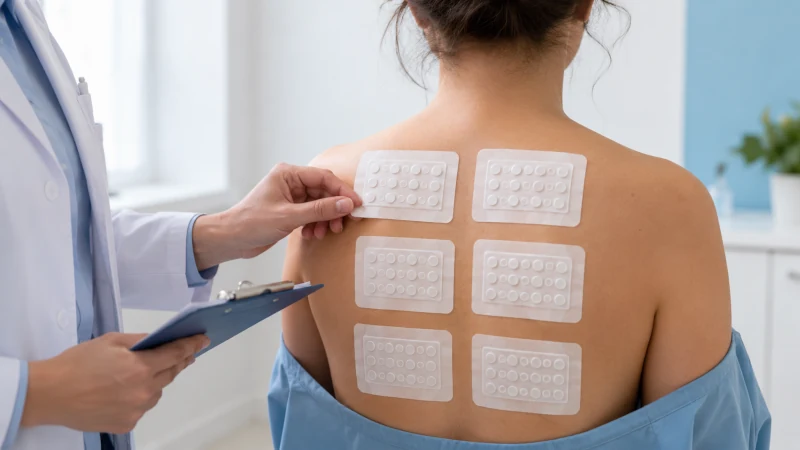
If a rash keeps coming back and you can’t pin down what’s setting it off, patch testing is how dermatologists find the answer. It’s a diagnostic skin test that identifies the specific substances your immune system reacts to — the nickel in a bracelet, a preservative in your moisturizer, a fragrance in your shampoo — so you can stop guessing and start avoiding the actual cause. Patch testing is the long-standing standard for diagnosing allergic contact dermatitis, the itchy, slow-building rash that appears where something touched your skin [American Academy of Dermatology, 2021] [American Family Physician, 2010].
Below is what the test does, what happens during it, how to read your results, and how it’s different from the quick “try it on your arm first” trick you may already use before slathering on a new product.
What patch testing actually is
Allergic contact dermatitis works on a delay. Your immune system usually doesn’t react the first time it meets an allergen — it quietly becomes sensitized, and a later exposure is what triggers the rash, often a day or two after contact rather than within minutes [Yale Medicine, 2022]. That delay is the entire reason this test exists. Rather than looking for an instant response, patch testing holds small amounts of common allergens against your skin for two days and watches for a reaction that builds slowly.
It’s also why patch testing isn’t the same as a skin prick test or an allergy blood test. Those look for immediate, type I allergies — pollen, food, latex — where symptoms show up fast [American Academy of Dermatology, 2021]. For a contact rash, they’re the wrong tool and won’t reveal what your skin is reacting to on contact [American Family Physician, 2010].
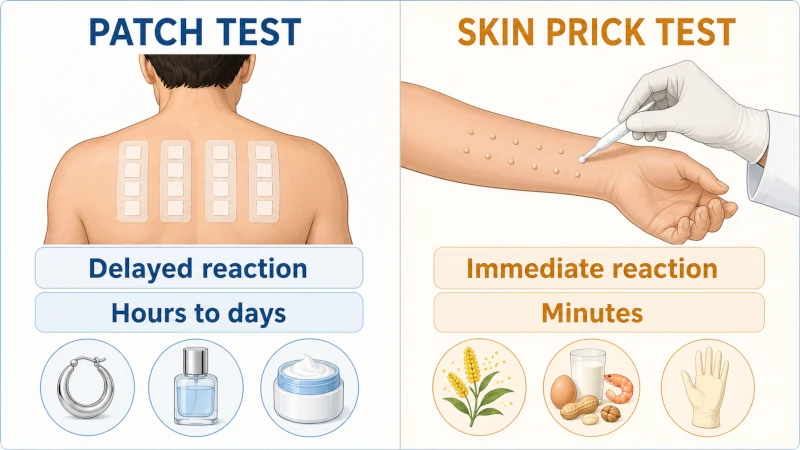
One more thing worth knowing up front: once you’re allergic to something like nickel, that sensitivity is generally lifelong [Yale Medicine, 2022]. That sounds discouraging, but it’s the opposite — it means a confirmed result turns into a permanent, workable avoidance plan instead of an endless cycle of trial and error. And there’s a lot to sort through. More than 15,000 substances can cause an allergic skin reaction [American Academy of Dermatology, 2021].
When patch testing is worth considering
Patch testing is most useful when a rash is persistent or keeps returning, looks eczema-like, and hasn’t cleared even after you’ve tried avoiding the obvious culprits or using over-the-counter treatments [American Family Physician, 2010]. It’s also worth raising with your doctor if the rash follows a pattern that points to something you touch — your hands, face, eyelids, or the spots where jewelry, waistbands, or a phone rest against your skin.
Many people develop reactions to substances they handle at work, which is common enough that specialized panels exist for specific trades such as florists and dental technicians [American Academy of Dermatology, 2021]. If your skin flares at work and calms down on vacation, that’s a clue worth mentioning.
What happens during the test
The process runs across about a week and usually involves three visits.
At the first visit, your dermatologist applies small amounts of allergens in tiny chambers fixed to adhesive panels, placed on your upper back [DermNet, 2023]. Each chamber is labeled so every reaction can be traced back to a specific substance.
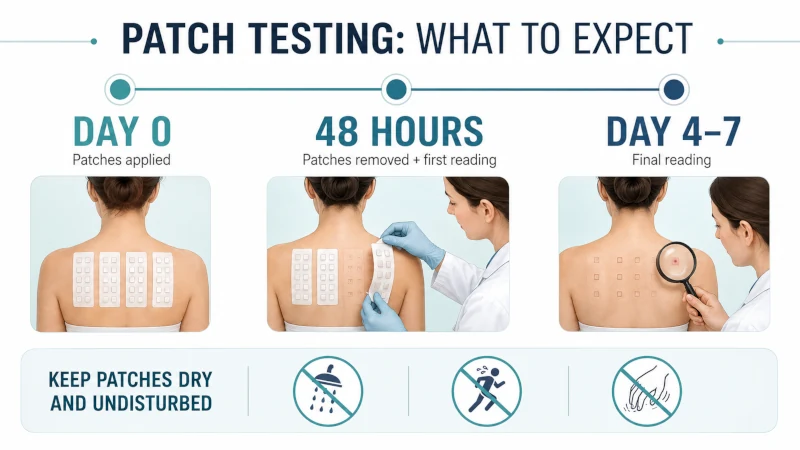
Then the waiting begins. You leave the patches in place for 48 hours [American Academy of Dermatology, 2021]. During this window, keeping the patches dry and undisturbed is what makes the results trustworthy — that means no showering, no heavy sweating or workouts, and no scratching at the site. If the patches get wet, loosen, or come off, the test can miss something [American Academy of Dermatology, 2021]. Because you can’t shower normally, many people plan the test around a low-key couple of days [American Family Physician, 2010].
At the second visit, around 48 hours in, the patches come off and your dermatologist reads your skin [American Academy of Dermatology, 2021]. But that’s not the final word. You’ll return for a third visit a few days later — typically between day 4 and day 7 — because contact allergies are delayed, and some reactions only appear at that later reading [American Academy of Dermatology, 2021] [DermNet, 2023]. Skipping that last appointment is one of the easiest ways to get an incomplete answer.
The allergens on the panel
Most testing starts with a standardized baseline set of the most common troublemakers, which catches over 70% of relevant allergens [DermNet, 2023]. In the U.S., one widely used ready-to-use option is the T.R.U.E. Test, an FDA-approved system of pre-loaded panels covering roughly three dozen allergens; it’s also FDA-approved for children aged 6 to 17 [DermNet, 2023].
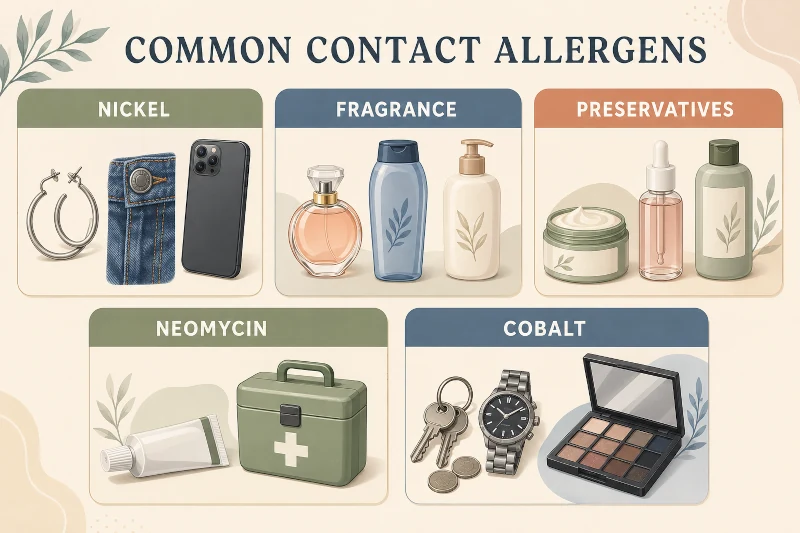
Frequent offenders include nickel, fragrance mixes, formaldehyde and formaldehyde-releasing preservatives, neomycin (a topical antibiotic), balsam of Peru, and cobalt [Yale Medicine, 2022] [DermNet, 2023]. Nickel alone accounts for a large share of positive results — roughly one in seven patients in one analysis [American Family Physician, 2010]. If your suspected trigger isn’t in the standard set, expanded or customized testing can add more substances; expanded testing finds about 80% of allergens [American Academy of Dermatology, 2021].
Making sense of your results
A positive reaction usually looks like a small itchy, red bump at the spot where that particular allergen sat [American Academy of Dermatology, 2021]. But a positive result isn’t automatically the answer to your rash. Your dermatologist has to connect each reaction to your actual life — the products you use, your job, your hobbies — to decide which positives are genuinely relevant, which is why your history matters as much as the test itself [American Family Physician, 2010].
It also helps to keep expectations realistic. No skin test is perfect: patch testing has been reported to have a sensitivity and specificity in the range of 70 to 80% [American Family Physician, 2010]. The allergen concentrations are carefully calibrated, but if a test substance is a little too weak it can miss a true allergy (a false negative), and if it’s too strong it can provoke a reaction in someone who isn’t truly allergic (a false positive) [DermNet, 2023]. The first round doesn’t always find the culprit, and your dermatologist may suggest testing additional substances [American Academy of Dermatology, 2021]. Even among people who react, about 15% are reacting to something outside the standard baseline series [DermNet, 2023].
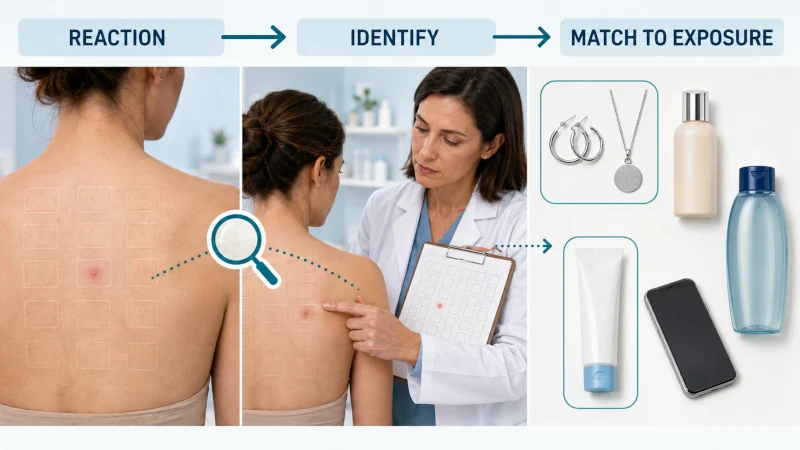
So patch testing is a powerful clue-finder, not a cure. What makes it valuable is what you do with the result.
Side effects and safety
Most side effects are minor. The patches irritate some people’s skin, and that irritation usually settles on its own within a few days [American Academy of Dermatology, 2021]. If you have a darker skin tone, you may notice temporarily lighter or darker patches where the tests sat, and that discoloration also fades over time [American Academy of Dermatology, 2021]. If you have psoriasis, be aware the patches can trigger a flare [American Academy of Dermatology, 2021].
Serious reactions are rare. A small number of people develop an infection or a life-threatening allergic reaction, and when a severe reaction happens, it tends to occur within 30 minutes of the patches going on [American Academy of Dermatology, 2021].
Get emergency care right away — call 911 — if you notice swelling, nausea, vomiting, or difficulty breathing after the patches are applied. These can be signs of a life-threatening allergic reaction [American Academy of Dermatology, 2021].
If you’re pregnant or breastfeeding, or taking oral steroids or other medications that calm the immune system, mention it before scheduling — those factors, along with recent strong sun exposure on your back, can affect timing or dampen the skin’s response, and your dermatologist will factor them in.
After your results: putting them to use
The real payoff is a plan you can actually follow. The single most effective treatment for allergic contact dermatitis is identifying and then avoiding your trigger [Yale Medicine, 2022]. Once you know it, everyday choices get easier: reaching for fragrance-free products if fragrance is your issue, choosing nickel-free jewelry, or covering the metal stud on jeans with an iron-on patch or a coat of clear nail polish if nickel is the problem [American Family Physician, 2010] [American Academy of Dermatology, 2021].
For the rash itself while it heals, a dermatologist may recommend a topical steroid and sometimes an antihistamine for itch, with the skin typically settling over one to two weeks once you’re avoiding the trigger [Yale Medicine, 2022]. If you’re managing an ongoing condition, it helps to fold your results into your broader routine — our guides on how to treat dermatitis and building a gentle eczema skincare routine walk through day-to-day care, and if you also live with psoriasis, knowing your triggers pairs well with the lifestyle and dietary adjustments some people find helpful for psoriasis.
How to patch test a new skincare product at home
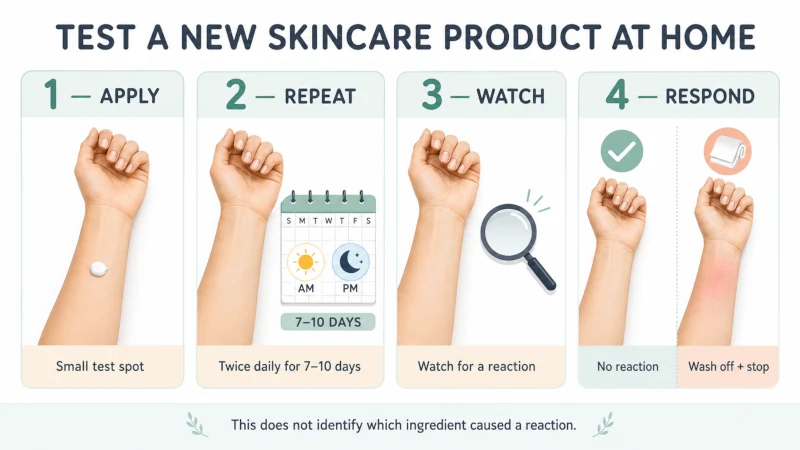
This is the version most people mean when they say “patch test” — and it’s different from the clinical test above. At-home testing can tell you whether a specific product bothers your skin, but it can’t identify which ingredient is responsible; for that, you’d need medical patch testing [American Academy of Dermatology, 2021].
Dermatologists recommend a simple routine before you commit a new product to your face [American Academy of Dermatology, 2021]:
- Apply the product to a quarter-sized test spot where it won’t get rubbed off or washed away, such as the inner forearm or the bend of your elbow.
- Use it there twice a day for 7 to 10 days, in the same amount and thickness you’d normally use.
- For a rinse-off product like a cleanser, leave it on for about 5 minutes (or as the label directs) before washing.
- If your skin stays clear after 7 to 10 days, the product is likely fine to use.
- If you get redness, itching, or swelling, gently wash the product off, stop using it, and soothe the spot with a cool compress or a little petroleum jelly.
A caveat: some active ingredients, such as retinol and glycolic acid, can cause mild irritation that’s normal and temporary, especially on sensitive skin [American Academy of Dermatology, 2021]. And “hypoallergenic,” “natural,” or “clean” on a label doesn’t guarantee your skin won’t react, which is exactly why testing first is worth the few minutes [American Academy of Dermatology, 2021].
When to talk to a doctor
See a board-certified dermatologist if a rash keeps coming back, spreads, won’t clear with avoidance and basic care, or you simply can’t figure out the cause [American Academy of Dermatology, 2021]. If an at-home product reaction is severe or doesn’t ease with a cool compress or petroleum jelly, that’s also a reason to get seen [American Academy of Dermatology, 2021]. And if you ever notice swelling, trouble breathing, nausea, or vomiting after a product or a patch test, treat it as an emergency and call 911.
Health Disclaimer: This article is for general education and is not a substitute for professional medical advice, diagnosis, or treatment. Patch testing is a medical procedure that should be performed and interpreted by a qualified dermatologist. Always talk with your doctor or a board-certified dermatologist about your specific symptoms, any medications you take, and whether testing is right for you — especially if you are pregnant or breastfeeding. If you think you’re having a severe allergic reaction, call 911.
Frequently Asked Questions
Does patch testing hurt?
Not usually. The patches themselves are painless, though if you’re allergic to one of the substances, that spot can feel itchy or sore as a reaction develops. Any irritation typically clears within a few days [American Academy of Dermatology, 2021].
How is patch testing different from a skin prick or allergy blood test?
Skin prick and blood (RAST) tests detect immediate, type I allergies like pollen, food, and latex. Patch testing is built for the delayed, type IV reactions behind contact rashes — a different kind of allergy that a prick or blood test won’t catch [American Academy of Dermatology, 2021] [American Family Physician, 2010].
Can I shower with the patches on?
No. The patches need to stay dry and undisturbed for the full 48 hours, so no showering, heavy sweating, or scratching at the site. Getting them wet can produce inaccurate results [American Academy of Dermatology, 2021].
What if the test doesn’t find my trigger?
It happens. The first round can miss the culprit, and your dermatologist may test additional substances — expanded testing finds about 80% of allergens, and roughly 15% of people who react are reacting to something outside the standard baseline set [American Academy of Dermatology, 2021] [DermNet, 2023].
Is the at-home product test the same thing?
No. Testing a new product on your arm tells you whether that product irritates you, but not which ingredient is to blame. Only medical patch testing can identify the specific allergen [American Academy of Dermatology, 2021].
How long does it take to get results?
Plan for about a week. Patches go on at the first visit, come off and get read at about 48 hours, and you return for a final reading around day 4 to 7 because some reactions are delayed [American Academy of Dermatology, 2021] [DermNet, 2023].
References
- American Academy of Dermatology. “Patch testing can find what’s causing your rash.” Reviewed by board-certified dermatologists; updated March 15, 2021. View source
- American Academy of Dermatology. “How to test skin care products.” Updated August 10, 2021. View source
- Yale Medicine. “Allergic Contact Dermatitis.” Fact sheet; medical expert Keith Choate, MD, PhD; 2022. View source
- DermNet (New Zealand). “Baseline series of patch test allergens.” Last reviewed October 2023. Non-U.S. source — used for allergen and procedure facts, not U.S. care instructions. View source
- Usatine RP, Riojas M. “Diagnosis and Management of Contact Dermatitis.” American Family Physician. 2010;82(3):249-255. PMID 20672788. View source
