
If your scalp itches and flakes keep landing on your shoulders, dandruff is the obvious suspect. Sometimes the cause is scalp psoriasis instead, and the two respond to different treatment. Here is how scalp psoriasis vs. dandruff usually compares, and when to let a dermatologist look.
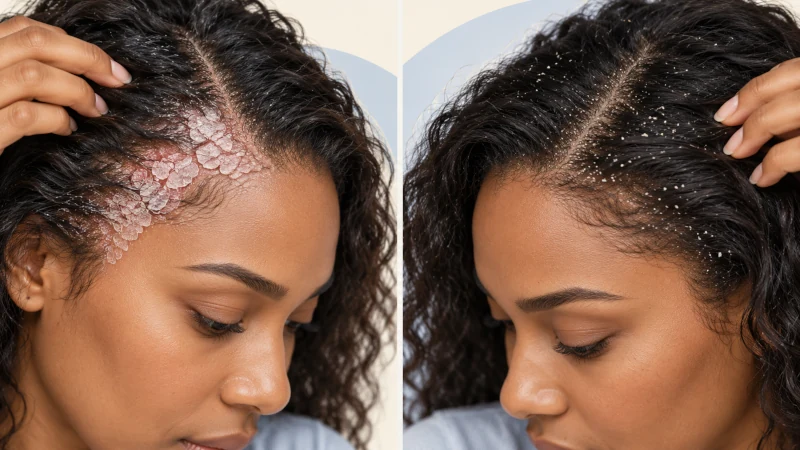
| The short answer: Scalp psoriasis tends to cause thicker, well-defined patches with dry, silvery-looking scale that can spread past the hairline onto the forehead, the back of the neck, or the skin around the ears. Dandruff usually causes smaller, looser white or yellowish flakes, sometimes on an oily scalp. Both can itch, and mild cases can look alike, so persistent symptoms deserve a dermatologist’s look. [AAD, Scalp psoriasis: Symptoms] [National Psoriasis Foundation, Scalp Psoriasis, 2026] |
Appearance alone can’t settle every case. Seborrheic dermatitis, the condition dandruff belongs to, can resemble psoriasis, and some people have both [AAD, Seborrheic dermatitis overview, 2022]. Use the clues below to choose a next step, not to diagnose yourself.
Scalp Psoriasis vs. Dandruff at a Glance
Read each row as a tendency, not a rule. Many people have a mix of features from both columns.
| Feature | Scalp psoriasis | Dandruff / seborrheic dermatitis |
| Type of flakes or scale | Often dry, with a silvery or powdery sheen; ranges from fine, dandruff-like scaling to thick, crusted plaques | White to yellowish flakes that may be dry or greasy |
| Thickness | Patches range from barely noticeable to thick and raised | Dandruff flakes are usually small; untreated seborrheic dermatitis scale can thicken |
| Borders | More often sharply defined | Usually poorly defined, fading into surrounding skin |
| Inflammation and color | Red or pink on lighter skin; may look purple, gray, or brown on darker skin | Dandruff alone isn’t inflamed. Seborrheic dermatitis tends to look red on lighter skin and pink, slightly purple, or lighter than the skin on darker skin |
| Oiliness | Scale more often looks dry | Often linked to oily areas; scale may look greasy but can be dry |
| Itching | Common; can be intense | Common |
| Burning or soreness | Can occur | Burning is often reported with seborrheic dermatitis |
| Cracking or bleeding | Scalp may crack and bleed, especially with scratching | Scratching can break the skin and lead to infection |
| Beyond the hairline | Commonly reaches the hairline, forehead, and back of the neck | Dandruff stays on the scalp; seborrheic dermatitis can involve the face |
| Behind the ears | Common site | Also common with seborrheic dermatitis |
| Other body areas | Elbows, knees, trunk, limbs | Eyebrows, sides of the nose, ears, beard area, chest |
| Nail changes | Pits, discoloration, crumbling, lifting, buildup can occur | Not a typical feature |
| Hair loss | Sometimes, usually temporary; often from scratching or forceful scale removal | Not a defining feature |
| Typical severity | One mild patch to the whole scalp | Dandruff is mild; seborrheic dermatitis ranges from mild to stubborn |
| Underlying cause | Immune-mediated disease; genes plus environment | Not fully understood; normal skin yeast (Malassezia), skin oils, barrier changes, individual susceptibility |
| Contagious? | No | No |
| Common treatments | OTC salicylic acid and tar; prescription corticosteroids, vitamin D analogs; light therapy; pills or injections for some | OTC zinc pyrithione, selenium sulfide, ketoconazole, salicylic acid, sulfur, coal tar; prescription options if stubborn |
| Need for medical diagnosis | Recommended if suspected; usually diagnosed by exam, biopsy occasionally | Mild dandruff can be self-treated; see a clinician if it persists or is severe |
Sources for the table: [AAD, Scalp psoriasis: Symptoms], [National Psoriasis Foundation, Scalp Psoriasis, 2026], [National Psoriasis Foundation, About Psoriasis, 2026], [AAD, Seborrheic dermatitis overview, 2022], [MedlinePlus, Seborrheic dermatitis, 2025], [StatPearls, Seborrheic Dermatitis, 2024], [AAD, Nail psoriasis, 2023], [AAD, Scalp psoriasis treatments], [AAD, How to treat dandruff, 2023].
Two Different Conditions Behind the Same Flakes
Scalp psoriasis: an immune-driven disease that shows up on the scalp
Psoriasis is a chronic, immune-mediated disease. An overactive immune system sends signals that make skin cells multiply too quickly, and the result is inflamed, scaly patches [NIAMS, Psoriasis]. Genes and environmental factors both contribute, and the exact trigger for that immune activity isn’t fully understood [National Psoriasis Foundation, About Psoriasis, 2026].
The scalp is one of its most common sites: the National Psoriasis Foundation estimates that 52 to 80 percent of people with psoriasis have experienced scalp psoriasis [National Psoriasis Foundation, Scalp Psoriasis, 2026]. It can be one small patch hidden under the hair or cover the whole scalp [AAD, Scalp psoriasis: Symptoms]. Psoriasis is not contagious [National Psoriasis Foundation, About Psoriasis, 2026], and it isn’t purely cosmetic. Scalp involvement is considered a “high-impact” site because of its effect on quality of life, and people with scalp psoriasis have a higher risk of psoriatic arthritis [National Psoriasis Foundation, Scalp Psoriasis, 2026].
Dandruff and seborrheic dermatitis: one spectrum, two names
The American Academy of Dermatology (AAD) describes dandruff as possibly the mildest form of seborrheic dermatitis. Both produce white-to-yellowish scale that can be dry or greasy, and both can itch. The difference is that seborrheic dermatitis causes visible inflammation and can spread beyond the scalp to the ears, eyebrows, beard, the skin beside the nostrils, and sometimes the chest; dandruff does not [AAD, Seborrheic dermatitis overview, 2022].
Dandruff is far more common than psoriasis. One clinical review estimates that dandruff probably affects close to half of people, compared with roughly 5 percent for seborrheic dermatitis [StatPearls, Seborrheic Dermatitis, 2024]. It is not a sign of a dirty scalp; dermatologists call that a common misconception [AAD news release, 2023]. It is not contagious either [AAD, Seborrheic dermatitis overview, 2022].
The cause isn’t fully known. Oil-gland activity, yeasts called Malassezia that normally live on everyone’s skin, changes in the skin barrier, and genes all appear to contribute [MedlinePlus, Seborrheic dermatitis, 2025]. Researchers see it as an interplay between that normal yeast, the oils on the skin surface, and individual susceptibility, not an infection you catch from someone else [StatPearls, Seborrheic Dermatitis, 2024].
What the Flakes and Patches Look Like
Psoriasis flakes vs. dandruff flakes
Psoriasis scale is usually dry and has a silvery or powdery sheen [AAD, Scalp psoriasis: Symptoms] [National Psoriasis Foundation, Scalp Psoriasis, 2026]. It ranges from fine scaling that looks a lot like dandruff to thick, crusted plaques [National Psoriasis Foundation, Scalp Psoriasis, 2026]. The scale sits on a raised patch; forcing it off can loosen hair and make the scalp bleed [AAD, Scalp psoriasis: Symptoms].
Dandruff flakes are small pieces of skin that come loose from the scalp. They show up in dark hair or on dark clothing [AAD, How to treat dandruff, 2023]. Seborrheic dermatitis scale is white to yellowish and can be greasy and sticky or dry and flaking [MedlinePlus, Seborrheic dermatitis, 2025].
Flakes by themselves are an unreliable guide. Fine, white psoriasis scale can pass for dandruff, and dry-looking flakes don’t rule out seborrheic dermatitis. Yellow, greasy scale points toward seborrheic dermatitis but doesn’t prove it.
The patch underneath the flakes
What sits under the flakes is often more telling. Psoriasis tends to form raised patches with a sharp, clearly defined edge. Seborrheic dermatitis patches usually have poorly defined margins that fade into the surrounding skin [StatPearls, Seborrheic Dermatitis, 2024]. Plain dandruff often has no visible patch at all.
Why redness is a poor clue on darker skin
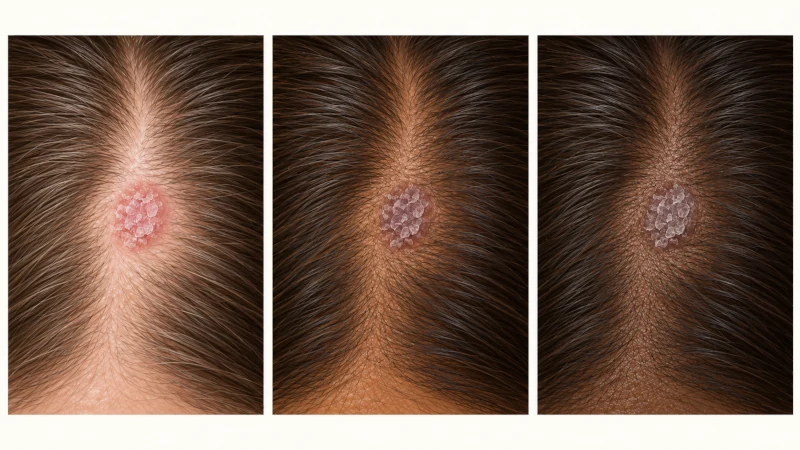
Many descriptions say psoriasis is “red,” but that’s only reliable on lighter skin. Scalp psoriasis plaques may look red, purple, or brown depending on skin color [National Psoriasis Foundation, Scalp Psoriasis, 2026]. On skin of color, plaques can look darker and thicker, with a purple, grayish, or dark brown tone [National Psoriasis Foundation, About Psoriasis, 2026]. Seborrheic dermatitis also shifts: on darker skin it often looks pink, slightly purple, or lighter than the surrounding skin, while lighter skin tends to show a red, raised rash [AAD, Seborrheic dermatitis overview, 2022]. Reviews of psoriasis in skin of color also note differences in how it presents [Kaufman & Alexis, Am J Clin Dermatol, 2018].
If you have medium or dark skin, put more weight on texture, thickness, sharp borders, and where the patches appear than on color.
Does It Extend Beyond the Hairline?
Scalp psoriasis often refuses to stay inside the hair. It can involve the hairline, forehead, back of the neck, and the skin around and behind the ears [National Psoriasis Foundation, Scalp Psoriasis, 2026] [AAD, Scalp psoriasis: Symptoms]. A thick, clearly bordered band of scale crossing onto the forehead raises suspicion for psoriasis.
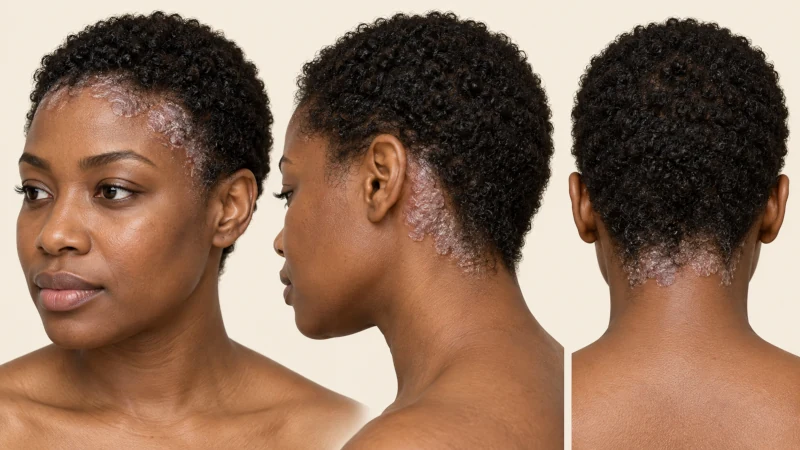
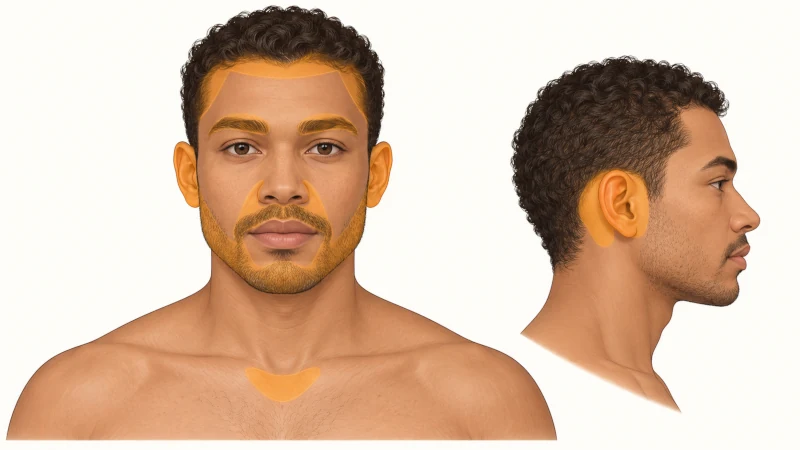
It isn’t proof. Seborrheic dermatitis also commonly affects the skin behind the ears, the outer ear, the eyebrows, and the creases of the nose [MedlinePlus, Seborrheic dermatitis, 2025]. So “behind the ears” fits both conditions. What helps is the combination: sharp edges and thick dry scale lean toward psoriasis, while greasy, ill-defined scaling around oily areas of the face leans toward seborrheic dermatitis.
Clues Outside Your Scalp That May Point Toward Psoriasis
A quick check of the rest of your body can be informative:
- Elbows, knees, and trunk. Psoriasis most often appears on the scalp, elbows, and knees, and plaques also commonly form on the trunk and limbs [NIAMS, Psoriasis].
- Nails. Tiny dents (pits), white, yellow or brown discoloration, crumbling, a nail lifting from the finger, buildup under the nail, or blood under the nail can be signs of nail psoriasis [AAD, Nail psoriasis, 2023]. No single nail change proves psoriasis; nail infections can also change nails, which is why dermatologists check for infection [AAD, Nail psoriasis, 2023].
- Joints. Stiff, swollen, or painful joints, or heel pain, can signal psoriatic arthritis and deserve prompt medical attention [NIAMS, Psoriasis].
- Face, eyebrows, and beard. Greasy scale in the eyebrows, beside the nostrils, or in facial hair fits the usual seborrheic dermatitis pattern instead [AAD, Seborrheic dermatitis overview, 2022].
Finding nothing elsewhere doesn’t rule psoriasis out. A dermatologist can diagnose scalp psoriasis by examining the scalp itself [AAD, Scalp psoriasis: Diagnosis and treatment].
Itching, Burning, Cracking, and Bleeding
Both conditions itch, so itch alone won’t separate them. With scalp psoriasis, itching is one of the most common symptoms and can be intense enough to disrupt sleep. The scalp may also burn or feel sore, and it can become so dry that it cracks and bleeds [AAD, Scalp psoriasis: Symptoms]. Seborrheic dermatitis itches too, especially on the scalp, and people often report burning [StatPearls, Seborrheic Dermatitis, 2024].
Scratching makes either problem worse. In psoriasis it can enlarge and thicken patches and cause bleeding [AAD, Scalp psoriasis: Symptoms]; scratching or otherwise injuring the skin can worsen psoriasis, a reaction called the Koebner phenomenon [National Psoriasis Foundation, Scalp Psoriasis, 2026]. In seborrheic dermatitis, scratching the itchy rash can lead to infection [AAD, Seborrheic dermatitis overview, 2022].
Can Scalp Psoriasis or Dandruff Cause Hair Loss?
Scalp psoriasis can lead to hair loss, but it’s usually temporary. Scratching or forcefully removing scale is a common cause, and hair usually regrows after the psoriasis clears [AAD, Scalp psoriasis: Symptoms] [AAD, Scalp psoriasis and hair loss]. The National Psoriasis Foundation describes noticeable temporary hair loss from severe scalp psoriasis as rare [National Psoriasis Foundation, Scalp Psoriasis, 2026]. Hair loss is not a defining feature of dandruff.
Persistent or patchy hair loss can have causes other than either condition, and a dermatologist can look for them [AAD, Scalp psoriasis and hair loss]. Smooth, round bald patches without scale, for example, suggest a different problem; our guide to [alopecia areata and patchy hair loss] explains that pattern.
Scalp Psoriasis vs. Seborrheic Dermatitis (and “Dry Scalp”)
Why doctors compare these two
For a dermatologist, the real question often isn’t “dandruff or psoriasis” but “seborrheic dermatitis or psoriasis.” Psoriasis classically shows sharply defined plaques with loose, silvery scale and may come with nail changes; seborrheic dermatitis shows greasy, yellowish scale-crust with poorly defined edges in oil-rich areas [StatPearls, Seborrheic Dermatitis, 2024]. Scalp psoriasis can also be mistaken for eczema [National Psoriasis Foundation, Scalp Psoriasis, 2026].
Can you have both?
Yes. People with psoriasis are more likely to develop seborrheic dermatitis, and when both are present the overlap is sometimes called sebopsoriasis [AAD, Seborrheic dermatitis overview, 2022]. Some experts question whether sebopsoriasis is a distinct condition at all [StatPearls, Seborrheic Dermatitis, 2024]. Either way, it isn’t something you can sort out in the mirror, and it is one reason “dandruff” that doesn’t behave as expected is worth a dermatologist visit.
What about “dry scalp”?
“Dry scalp” describes how your scalp feels, not a specific diagnosis. Flaking can come from dandruff, seborrheic dermatitis, psoriasis, a fungal infection of the scalp, or eczema [AAD, How to treat dandruff, 2023]. Hair dye, straightening products, and hairsprays can also irritate the scalp [AAD, Scalp psoriasis and hair loss]. A dry-feeling scalp doesn’t rule out seborrheic dermatitis, since its scale can be dry as well as greasy [AAD, Seborrheic dermatitis overview, 2022].
What Causes Each Condition, and What Sets Off Flares
| Scalp psoriasis | Dandruff / seborrheic dermatitis | |
| What drives it | Overactive immune system; genetics and environment; not fully understood | Interplay of normal skin yeast, skin-surface oils, barrier changes, genes, and individual susceptibility |
| Commonly reported flare triggers | Stress, infections, skin injury, certain medications, smoking, alcohol, weather changes (including cold, dry air) | Stress or fatigue, weather extremes, winter and early spring, heavy alcohol use |
Sources: [NIAMS, Psoriasis], [National Psoriasis Foundation, About Psoriasis, 2026], [National Psoriasis Foundation, Scalp Psoriasis, 2026], [AAD, Scalp psoriasis: Symptoms], [MedlinePlus, Seborrheic dermatitis, 2025], [StatPearls, Seborrheic Dermatitis, 2024], [AAD, Seborrheic dermatitis overview, 2022].
Diet appears on the National Psoriasis Foundation’s list of possible triggers, which vary from person to person [National Psoriasis Foundation, Scalp Psoriasis, 2026]. No diet cures psoriasis [National Psoriasis Foundation, About Psoriasis, 2026]. If you suspect a food connection, talk with your doctor or a registered dietitian before cutting out whole food groups.
How Doctors Tell the Difference
Diagnosis is usually made by looking. A dermatologist examines the scalp, hairline, and ears, checks the skin elsewhere and your nails, and asks about itch, family history, and joint symptoms [AAD, Scalp psoriasis: Diagnosis and treatment] [National Psoriasis Foundation, About Psoriasis, 2026]. Seborrheic dermatitis is likewise diagnosed from its appearance and location [MedlinePlus, Seborrheic dermatitis, 2025].
Most people don’t need tests. If the picture isn’t clear, a dermatologist may remove a small sample of skin (a biopsy) to look at under a microscope [AAD, Scalp psoriasis: Diagnosis and treatment] [National Psoriasis Foundation, Scalp Psoriasis, 2026]; for seborrheic dermatitis, a biopsy is rarely needed [MedlinePlus, Seborrheic dermatitis, 2025].
How Treatment Differs
Treating dandruff and seborrheic dermatitis
Mild dandruff often improves with regular hair washing. If it doesn’t, the AAD suggests an over-the-counter (OTC) dandruff shampoo containing one of these: zinc pyrithione, salicylic acid, sulfur, selenium sulfide, ketoconazole, or coal tar. If one doesn’t help, alternating shampoos with different active ingredients is reasonable [AAD, How to treat dandruff, 2023].
- Follow the label. Some medicated shampoos need to stay on the scalp for about 5 to 10 minutes before rinsing [AAD, How to treat dandruff, 2023].
- Match frequency to your hair. People with fine or straight hair or an oily scalp may wash daily and use the dandruff shampoo about twice a week; people with coarse, curly, or coily hair may use it about once a week, applied to the scalp rather than the lengths, because it can dry hair [AAD, How to treat dandruff, 2023].
- Coal tar shampoos can make the scalp more sensitive to sun, so protect your scalp outdoors [AAD, How to treat dandruff, 2023].
For stubborn or severe seborrheic dermatitis, a clinician may prescribe stronger ketoconazole, ciclopirox, sodium sulfacetamide, a topical corticosteroid, or tacrolimus or pimecrolimus [MedlinePlus, Seborrheic dermatitis, 2025].
Treating scalp psoriasis
Over the counter: the two active ingredients to look for are salicylic acid, which softens and lifts scale, and tar (coal or pine), which can slow skin-cell growth and ease itching and scaling [National Psoriasis Foundation, Scalp Psoriasis, 2026]. Some people get enough relief from an OTC medicated shampoo or solution [AAD, Scalp psoriasis treatments].
By prescription: topical corticosteroids are the most commonly prescribed treatment for scalp psoriasis, including a corticosteroid (clobetasol propionate) shampoo for stubborn cases. Other options include calcipotriene, a vitamin D analog, alone or combined with a strong corticosteroid, and tazarotene. Because long-term corticosteroid use can cause side effects, dermatologists often pair it with another treatment [AAD, Scalp psoriasis treatments].
In the office or clinic: corticosteroid injections into thick patches and targeted light treatment such as the excimer laser [AAD, Scalp psoriasis treatments].
Whole-body medicines: if psoriasis is extensive or hasn’t responded to topical care, a dermatologist may consider apremilast, an oral retinoid, methotrexate, cyclosporine, or a biologic [AAD, Scalp psoriasis treatments]. Because the scalp is a high-impact site, these can be considered when scalp psoriasis hasn’t responded to other treatment [National Psoriasis Foundation, Scalp Psoriasis, 2026]. For most people, medicine applied to the scalp is the starting point; it’s the most commonly prescribed treatment [AAD, Scalp psoriasis treatments].
Can you use dandruff shampoo for scalp psoriasis?
Partly. Some ingredients overlap: salicylic acid and coal tar appear in both dandruff and psoriasis products [AAD, How to treat dandruff, 2023] [National Psoriasis Foundation, Scalp Psoriasis, 2026]. Zinc pyrithione and ketoconazole shampoos reduce a normal skin yeast linked to flaking and dandruff [National Psoriasis Foundation, Scalp Psoriasis, 2026], which helps if seborrheic dermatitis is also present. They don’t address the immune process that drives psoriasis; stronger psoriasis medicines work on the immune system itself [AAD, Scalp psoriasis treatments]. The right choice depends on the diagnosis and how severe it is.
What happens if you treat psoriasis like dandruff?
Mild scale may improve for a while with a scale-softening shampoo. Scalp psoriasis can be stubborn, though, and many people need a dermatologist’s help to control it [AAD, Scalp psoriasis: Diagnosis and treatment]. If it remains after OTC treatment, a dermatologist can tailor a plan [AAD, Scalp psoriasis treatments]. Cycling through shampoos while patches thicken, crack, or bleed mostly delays treatment that works.
The reverse is also true: a shampoo that doesn’t work doesn’t prove psoriasis. Persistent flaking can also come from seborrheic dermatitis that needs prescription treatment, a fungal scalp infection, or eczema [AAD, How to treat dandruff, 2023].
Gentle Scalp Care That Helps Either Way
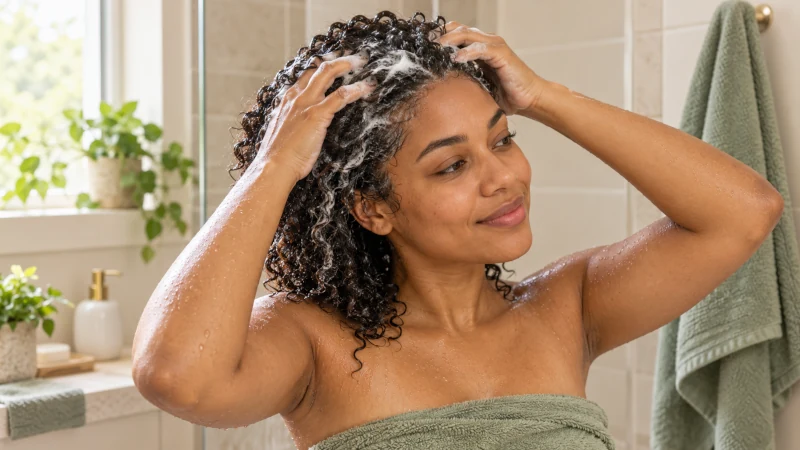
- Shampoo gently. Rubbing, scrubbing, and scratching tend to worsen scalp psoriasis [AAD, Scalp psoriasis: Tips for managing].
- Loosen scale; don’t pick it. Picking can make psoriasis flare and cause hair loss. Soften thick scale (salicylic acid products help), then gently comb or brush it away [AAD, Scalp psoriasis: Tips for managing] [AAD, Scalp psoriasis and hair loss].
- Keep nails short and smooth so scratching does less damage [AAD, Scalp psoriasis and hair loss].
- Put medicated products on the scalp, not just the hair, and follow the label [AAD, Scalp psoriasis and hair loss] [AAD, How to treat dandruff, 2023].
- Ease dryness. Alternating a medicated shampoo with a gentle one, conditioning after each wash, and letting hair air-dry can help a dry scalp [AAD, Scalp psoriasis and hair loss].
- Test hair products. Dab a little on your scalp first; if it irritates within a few hours, choose something gentler [AAD, Scalp psoriasis and hair loss].
- Manage stress where you can. Stress can worsen psoriasis, and many people with seborrheic dermatitis notice flares when stressed [AAD, Scalp psoriasis: Tips for managing] [AAD, Seborrheic dermatitis overview, 2022].
If you prefer natural approaches, keep expectations realistic. Dermatologist guidance for both conditions centers on medicated shampoos and prescription treatment, not essential oils, vinegar rinses, or baking soda. Our evidence review of [herbs for skin issues] separates the few botanicals with small studies behind them from the ones that are mostly tradition. Use any of them alongside, not instead of, treatment that works.
If you’re pregnant, breastfeeding, or treating a child, check with a clinician or pharmacist before starting a medicated shampoo.
Which Sounds More Like Your Scalp?
| Clues that lean toward scalp psoriasis | Clues that lean toward dandruff / seborrheic dermatitis |
| Thick, clearly bordered plaques | Loose, fine white or yellowish flakes |
| Scale that clings to a raised patch | Oily or greasy-looking scalp areas |
| Patches crossing the hairline onto the forehead or neck | Flaking spread diffusely across the scalp |
| Similar patches on elbows, knees, or trunk | Greasy scale in eyebrows, beside the nose, or in a beard |
| Nail pits or other nail changes | Clear improvement with an anti-dandruff shampoo |
| Cracking or bleeding |
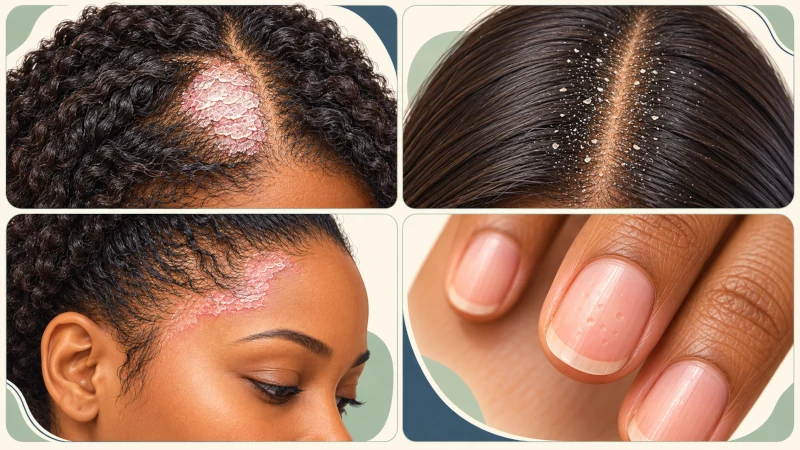
These clues can help you decide on a next step, but they can’t replace a diagnosis, especially because the two conditions can overlap or occur together.
When to See a Dermatologist
For most people, dandruff doesn’t need medical attention, and flaking that clears with an OTC dandruff shampoo can be managed at home [AAD, How to treat dandruff, 2023]. Make an appointment with a dermatologist, or start with your primary care clinician, if you have:
- Thick, persistent, or clearly bordered patches
- Cracking, bleeding, or substantial inflammation
- Severe itch, burning, or soreness, or symptoms that disturb your sleep or daily life
- Patches spreading past the hairline or appearing elsewhere on your body
- Nail changes or joint pain or stiffness
- Persistent or patchy hair loss
- No improvement after following OTC dandruff treatment, or flaking that worsens despite it [AAD, How to treat dandruff, 2023]
- Uncertainty about what you’re dealing with
Get prompt care, the same day if possible (urgent care is reasonable if your clinician can’t see you), if patches drain fluid or pus, crust over, or become very red or painful [MedlinePlus, Seborrheic dermatitis, 2025]. A sudden, severe flare of seborrheic-dermatitis-like rash also deserves prompt evaluation, because it can occasionally signal a problem with the immune system [StatPearls, Seborrheic Dermatitis, 2024]. Red, scaly skin covering most of the body is a rare, serious form of psoriasis that needs urgent medical care [NIAMS, Psoriasis].
With a dermatologist’s treatment plan, it’s uncommon to struggle with scalp psoriasis for long [AAD, Scalp psoriasis: Diagnosis and treatment].
Scalp Psoriasis and Dandruff Myths
| Myth | What the evidence shows | Source |
| Dandruff means your scalp is dirty. | Not supported. Dermatologists call this a common misconception. | [AAD news release, 2023] |
| Psoriasis is contagious. | Not supported. You can’t catch psoriasis from another person. | [National Psoriasis Foundation, About Psoriasis, 2026] |
| All white flakes are dandruff. | Not supported. Scalp psoriasis can produce fine, dandruff-like scaling. | [National Psoriasis Foundation, Scalp Psoriasis, 2026] |
| If dandruff shampoo doesn’t work, it must be psoriasis. | Not supported. Seborrheic dermatitis, fungal infection, and eczema can also persist. | [AAD, How to treat dandruff, 2023] |
| Scalp psoriasis always causes hair loss. | Not supported. When it happens, it’s usually temporary. | [AAD, Scalp psoriasis: Symptoms] |
Putting the Clues Together
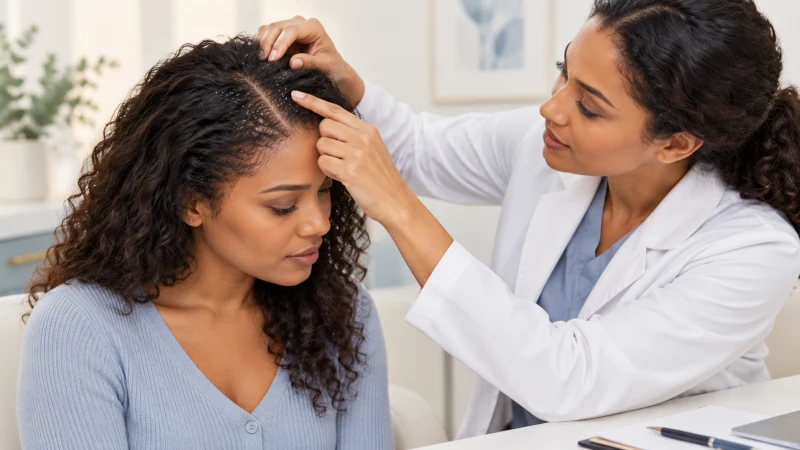
No single clue decides it; the pattern does. Loose flakes that settle with an anti-dandruff shampoo fit dandruff. Sharp-edged plaques crossing the hairline, matching patches on elbows or knees, or pitted nails make psoriasis more likely. When the clues are mixed or treatment stalls, a dermatologist can tell you which you have, or whether you have both.
| HEALTH DISCLAIMER: This article is for general education. It is not medical advice and does not replace diagnosis or treatment from a qualified healthcare professional. Scalp psoriasis, seborrheic dermatitis, fungal infections, eczema, and contact irritation can look alike, and some people have more than one. See a dermatologist or primary care clinician for persistent, severe, or uncertain symptoms. Do not start, stop, or change prescription treatment without your clinician’s guidance. Check with a clinician or pharmacist before using medicated or herbal products if you are pregnant, breastfeeding, treating a child, taking other medicines, or managing another health condition. Seek prompt care for scalp patches that drain pus, crust, or become very red or painful. For a medical emergency, call 911. |
Frequently Asked Questions
Is scalp psoriasis dry or oily?
Psoriasis scale usually looks dry, with a silvery or powdery sheen [National Psoriasis Foundation, Scalp Psoriasis, 2026]. Greasy, yellowish scale is more typical of seborrheic dermatitis, but the overlap is real, so texture alone can’t settle it.
Can dandruff turn into psoriasis?
They are separate conditions with different drivers, so dandruff doesn’t become psoriasis. Scalp psoriasis can produce fine scaling that looks like dandruff [National Psoriasis Foundation, Scalp Psoriasis, 2026], and people with psoriasis are more likely to develop seborrheic dermatitis too [AAD, Seborrheic dermatitis overview, 2022].
Why isn’t my dandruff shampoo working?
Make sure you’re leaving it on the scalp as long as the label says and using it often enough, and try a shampoo with a different active ingredient. If flaking persists or worsens, see a dermatologist; it may be seborrheic dermatitis needing prescription care, psoriasis, a fungal infection, or eczema [AAD, How to treat dandruff, 2023].
Will scalp psoriasis go away on its own?
Psoriasis is lifelong, and symptoms tend to come and go [National Psoriasis Foundation, Scalp Psoriasis, 2026]. Treatment can control it well, and with a dermatologist’s plan it’s uncommon to struggle with scalp psoriasis for long [AAD, Scalp psoriasis: Diagnosis and treatment].
Should I see primary care or a dermatologist first?
Either is reasonable. A primary care clinician can assess mild symptoms and refer you; going straight to a dermatologist makes sense if you have thick plaques, nail changes, hair loss, or flaking that hasn’t responded to OTC treatment.
References
- American Academy of Dermatology. Scalp psoriasis: Symptoms. aad.org. View source
- American Academy of Dermatology. Scalp psoriasis: Diagnosis and treatment. aad.org. View source
- American Academy of Dermatology. Scalp psoriasis: Shampoos, scale softeners, and other treatments. aad.org. View source
- American Academy of Dermatology. Scalp psoriasis: Tips for managing. aad.org. View source
- American Academy of Dermatology. Scalp psoriasis: 10 ways to reduce hair loss. aad.org. View source
- Ludmann P (writer); Spearman DD, Kaye ET, Peebles JK (reviewers). Seborrheic dermatitis: Overview. American Academy of Dermatology. View source
- Schleehauf B (writer). How to treat dandruff. American Academy of Dermatology. View source
- American Academy of Dermatology. How to treat dandruff: Board-certified dermatologist’s tips (news release). View source
- Ludmann P (writer). What is nail psoriasis, and how can I treat it? American Academy of Dermatology. View source
- National Psoriasis Foundation. Scalp Psoriasis. psoriasis.org. View source
- National Psoriasis Foundation. About Psoriasis. psoriasis.org. View source
- National Institute of Arthritis and Musculoskeletal and Skin Diseases. Psoriasis. niams.nih.gov. View source
- MedlinePlus Medical Encyclopedia (A.D.A.M.). Seborrheic dermatitis. U.S. National Library of Medicine. View source
- Tucker D, Syed HA, Masood S. Seborrheic Dermatitis. In: StatPearls. View source
- Kaufman BP, Alexis AF. Psoriasis in Skin of Color: Insights into the Epidemiology, Clinical Presentation, Genetics, Quality-of-Life Impact, and Treatment of Psoriasis in Non-White Racial/Ethnic Groups. Am J Clin Dermatol. View source


