
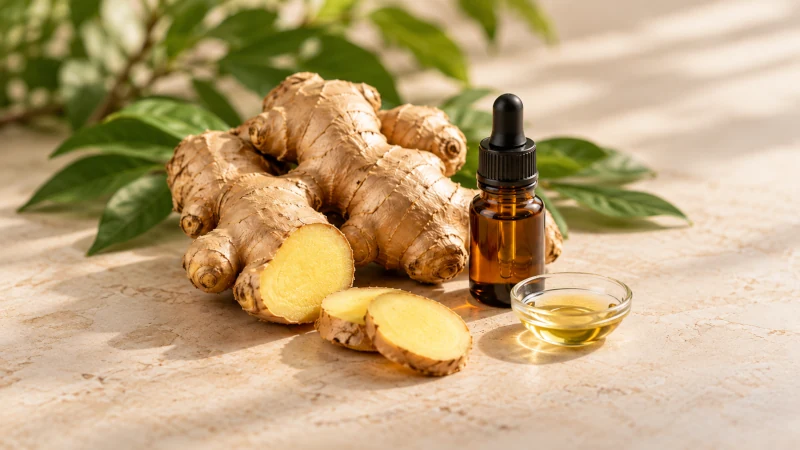
Ginger oil is a concentrated essential oil distilled from the ginger rhizome, and most of what it’s sold for — detox, immunity, glowing skin, heart health — has never been tested in people. Where it has been tested, the findings are narrower. Inhaling ginger essential oil may ease nausea for some people after surgery or chemotherapy, and one small trial found that a ginger-and-orange massage oil relieved knee pain for about a week. That’s a modest track record, but a real one.
Below, we sort what ginger oil can reasonably do from what it can’t, show you how to dilute it so it doesn’t irritate your skin, and flag the people who should skip it or check with a clinician first.
What ginger oil is, and why it isn’t the same as eating ginger
Ginger (Zingiber officinale) is a knobby underground stem, or rhizome, that has been used in food and folk medicine since ancient times [NCCIH, 2025]. Ginger essential oil is distilled from that rhizome into a highly concentrated liquid with a warm, spicy smell [Healthline, 2024]. It’s one of the oils commonly used in aromatherapy, either inhaled or diluted and applied to the skin [NCCIH, 2020].
That concentration is why the oil and the spice aren’t interchangeable. Most clinical studies of ginger — for pregnancy nausea, menstrual cramps and knee arthritis — tested ginger supplements, not essential oil [NCCIH, 2025]. You can’t borrow those results for a bottle of oil, and you shouldn’t try to close the gap by swallowing it. If oral ginger is what you’re curious about, our guide shows how ginger root has been studied for migraines, including the doses used in trials.
Ginger oil benefits: what the research shows
Ginger oil research is small, short and hard to blind. A strong smell is difficult to hide from participants or from the staff measuring results, which can tilt findings [Hines et al., 2018]. Read the results below with that in mind.
Nausea after surgery: promising, not settled
This is ginger oil’s best-studied use. In a South Korean study of 60 adults recovering from abdominal surgery, the 30 who inhaled ginger essential oil reported lower nausea and vomiting scores than the 30 who inhaled saline, with the biggest drop in the first six hours [Lee & Shin, 2017]. Patients weren’t randomly assigned to groups, though, which weakens the result.
The wider evidence is less tidy. A Cochrane review of 16 studies with 1,036 people — testing ginger, peppermint, oil blends and rubbing-alcohol vapor — found that aromatherapy overall did no better than placebo at reducing how severe nausea felt. People who used it may have needed fewer rescue anti-nausea drugs, but the reviewers rated the evidence low to very low quality and called the findings very uncertain [Hines et al., 2018].
In practice: if you’re facing surgery and want to try ginger aromatherapy, ask your care team first. Treat it as an add-on to anti-nausea medication, not a replacement.
Nausea during chemotherapy: a small, short-lived effect
In a crossover trial of women with breast cancer, participants wore a necklace scented with either ginger essential oil or a ginger fragrance placebo for five days after chemotherapy. Ginger oil lowered nausea scores in the acute phase, but the benefit didn’t hold across the full treatment period. Some quality-of-life measures, including appetite loss, did improve [Lua et al., 2015]. The National Cancer Institute sums it up as a modest drop in acute nausea, with no effect on vomiting or on longer-lasting nausea [NCI, 2023].
If you’re in cancer treatment, check with your oncology team before adding any essential oil. They can weigh it against your anti-nausea plan.
Knee and muscle pain: short-term relief in one small trial

In Hong Kong, 59 older adults with moderate-to-severe knee pain were split into three groups. One received six massages over three weeks with an oil containing 1% ginger and 0.5% orange essential oil; one received the same massages with plain olive oil; one got no massage. A week after treatment ended, the aromatic-oil group had better pain and function scores than both other groups. By four weeks, the advantage was gone [Yip & Tam, 2008].
That’s one small study of a blend, and it isn’t the whole picture: NCCIH notes that ginger applied to the skin hasn’t been shown to help knee osteoarthritis symptoms [NCCIH, 2025]. A ginger oil massage may feel good on a sore knee or tight shoulders, and the warmth and the massage itself probably do some of the work. Don’t expect it to change the course of arthritis.
Motion sickness and morning sickness: don’t swap in the oil
Ginger has a reputation for both, but that reputation comes from ginger taken by mouth, and the evidence is uneven. Oral ginger may help nausea in pregnancy, while most studies for motion sickness haven’t found a benefit [NCCIH, 2025]. We found no trials testing ginger essential oil for either. If you’re pregnant and nauseated, ask your obstetric provider about ginger tea or supplements rather than reaching for the oil.
Claims that don’t hold up yet
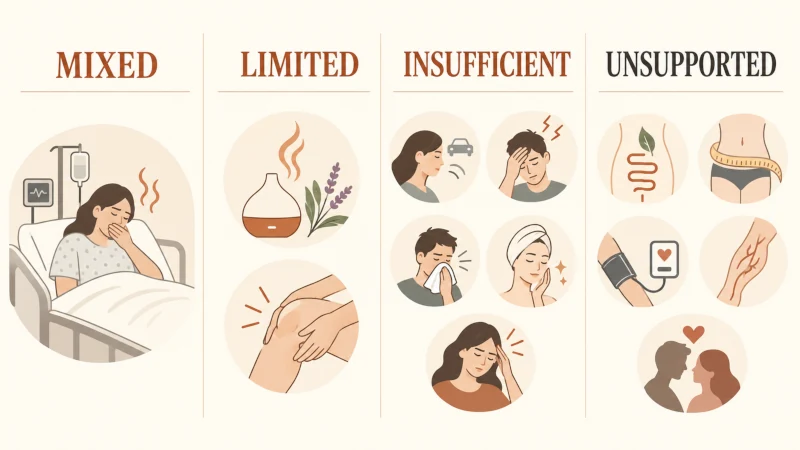
Most of the remaining claims on product pages — anti-inflammatory, antioxidant, immune-boosting — trace back to test-tube and animal research [Healthline, 2024]. Lab activity is a reason to keep studying ginger oil. It isn’t evidence that diffusing it or rubbing it on your skin does the same thing in your body.
| Claim | What the human evidence shows | Verdict |
| Nausea after surgery | One non-randomized study positive; Cochrane review of aromatherapy overall found no clear effect on severity, possibly fewer rescue drugs (low-quality evidence) | Mixed |
| Chemotherapy nausea | One crossover trial: acute nausea improved, not sustained; no effect on vomiting | Limited |
| Knee pain (massage) | One small trial of a ginger-orange blend: better at 1 week, not at 4 weeks; NCCIH says topical ginger hasn’t been shown to help knee OA | Limited, short-term |
| Motion sickness | Not tested with the oil; oral ginger mostly unhelpful | Insufficient |
| Stress, anxiety, low mood | No human trials of ginger oil identified | Insufficient |
| Colds, flu, “immunity” | Lab and animal studies only | Insufficient |
| Skin, wrinkles, acne | No human trials identified | Insufficient |
| Detox, liver, weight loss | No human trials identified | Unsupported |
| Blood pressure, circulation, clots | No human trials of the oil; oral ginger’s effect on platelets is a caution, not a benefit | Unsupported |
| Migraine | Small trials used oral ginger powder or extract, not essential oil | Insufficient for the oil |
| Aphrodisiac | No human trials identified | Unsupported |
If stress relief is what drew you to ginger oil, lavender has considerably more research behind it. And for colds, sleep, fluids, vaccination and a few well-chosen foods have better support than any diffuser; see our guide to the best foods for cold and flu.
How to use ginger oil safely
Any essential oil can irritate skin or trigger an allergy, and the risk rises with concentration [Tisserand, 2024]. Three habits cover most of the risk: dilute it, keep it out of your mouth, and keep the bottle away from children and pets.
Inhaling it

Inhalation is how ginger oil was used in the nausea studies. Put a drop or two on a tissue or cotton ball and breathe in the scent, or use a room diffuser [NCI, 2023]. If you use a diffuser, follow the manufacturer’s directions for how much oil to add.
Diluting it for skin and massage
Don’t put ginger oil straight on your skin. Blend it into a carrier oil such as sweet almond, jojoba or fractionated coconut oil first. Robert Tisserand, co-author of the reference text Essential Oil Safety, recommends these general ranges [Tisserand, 2024]:
| Use | Recommended concentration | Roughly, in 10 mL (2 tsp) of carrier* |
| Sensitive or damaged skin | 0.2–1% | Up to 2 drops |
| Face | 0.5–1.2% | 1–2 drops |
| Body oil or massage | 1–3% | 2–6 drops |
| Bath and wash-off products | 2–4% | 4–8 drops |
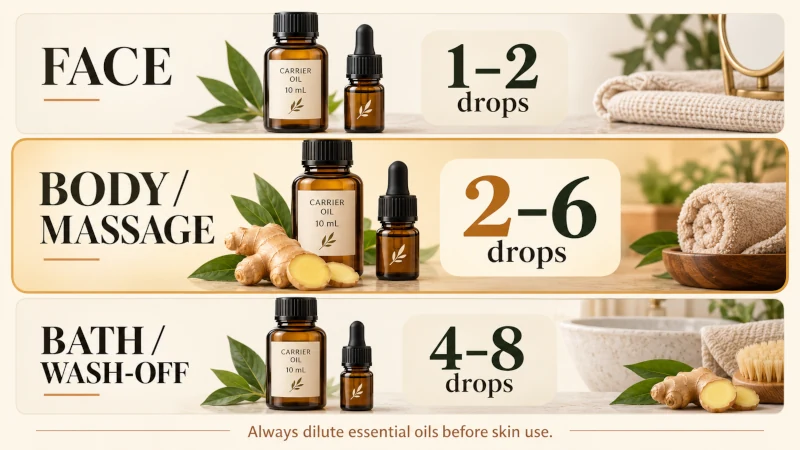
*Drop sizes vary between bottles, so drop counts are always approximate [Tisserand, 2024]. These figures assume about 20 drops per milliliter.
The 2 to 3 drops per 10 mL often suggested for ginger oil lands near 1%, a sensible starting point for body use and close to the 1% ginger concentration used in the knee-pain trial [Yip & Tam, 2008]. Tisserand allows stronger blends (3–10%) for short-term use on a small painful area, but there’s little reason to start there.
Before using a new blend over a larger area, try it on a small patch of skin and watch for redness, itching or swelling. Our guide explains how to patch test a new product at home.
Adding it to a bath
Essential oils don’t mix with water. They float on the surface, where they can reach your skin undiluted. If you want a ginger-scented bath, blend a few drops into a tablespoon of carrier oil or unscented body wash first; Tisserand’s range for bath products is 2–4% [Tisserand, 2024]. Skip it if your skin is sensitive, broken or freshly shaved.
Why you shouldn’t swallow it
Some websites suggest taking ginger oil by the drop in water or honey. We don’t recommend it. Swallowing essential oils can cause poisoning, and choking on one can pull oil into the lungs and cause pneumonia [Poison Control, n.d.]. The National Cancer Institute also advises against swallowing large amounts [NCI, 2023].
You may read that ginger oil is “generally recognized as safe” by the FDA [Healthline, 2024]. That status covers ginger oil as a flavoring ingredient in commercially made food, not drops taken from an aromatherapy bottle. If someone swallows ginger oil, contact Poison Control at 1-800-222-1222 or use the webPOISONCONTROL online tool [Poison Control, n.d.].
Buying and storing ginger oil
Aromatherapy products don’t need FDA approval before they’re sold [NCI, 2023], and it can be hard to know exactly what’s in a bottle [Poison Control, n.d.]. Labels like “therapeutic grade” aren’t backed by any official standard. Look for the botanical name (Zingiber officinale) and the extraction method on the label, and favor sellers that publish batch test results.
Essential oils change chemically as they age, and their aroma fades once they’re exposed to air [NCI, 2023]. Keep the cap tight, store the bottle away from heat and light, and lock it up if you have young children [Poison Control, n.d.].
Ginger oil side effects, interactions, and who should avoid it
Skin reactions
The most common problems are skin irritation and allergic reactions, which become more likely when oil stays on the skin for long periods [NCI, 2023]. Allergic reactions are the most frequent type of skin reaction to essential oils, and once you’re sensitized, you may react every time you use that oil [Tisserand, 2024]. If a rash appears, wash the area with soap and water and stop using the oil. Treat any trouble breathing as an emergency [Poison Control, n.d.].
Medication interactions
Here the sources don’t line up neatly. Ginger taken by mouth can make blood platelets less sticky. Memorial Sloan Kettering advises people taking warfarin or other blood thinners, NSAIDs such as ibuprofen, diabetes medicines or tacrolimus to avoid ginger supplements, and to stop them two weeks before surgery. The same source notes that a systematic review found the bleeding evidence inconclusive [MSKCC, 2022]. NCCIH’s advice is simpler: if you take any medicine, talk with your health care provider before using ginger [NCCIH, 2025].
All of that research involves swallowed ginger. How much ginger oil reaches your bloodstream from a diffuser or a 1% massage blend hasn’t been well studied. If you take a blood thinner, have a bleeding disorder or have surgery coming up, check with your pharmacist before using ginger oil regularly.
Pregnancy, breastfeeding, and children
Sources disagree on ginger in pregnancy. NCCIH says ginger supplements may be safe during pregnancy and that little is known about breastfeeding [NCCIH, 2025], while Memorial Sloan Kettering advises avoiding ginger supplements in both [MSKCC, 2022]. There’s no good safety data on ginger essential oil in pregnancy either way, so talk with your obstetric provider before using it.
Children have thinner skin and immature livers, which may make them more vulnerable to essential oils [Poison Control, n.d.]. Keep bottles out of reach, and ask your pediatrician before using any essential oil on a child.
Who should skip it or ask first
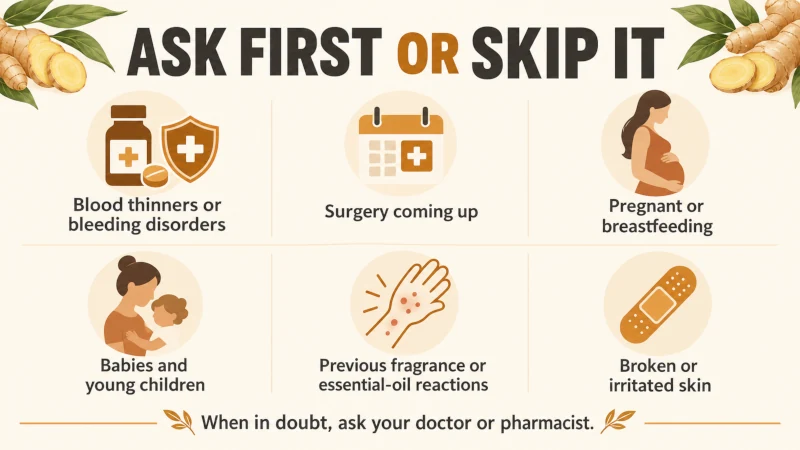
- Anyone allergic to ginger, or who has reacted to fragrances or essential oils before
- Anyone with broken, burned or inflamed skin in the area (don’t apply it there)
- People taking blood thinners, regular NSAIDs, diabetes medicines or tacrolimus, or with a bleeding disorder (ask first)
- Anyone with surgery in the next two weeks (tell your surgical team)
- People who are pregnant or breastfeeding (ask first)
- Infants and young children (ask your pediatrician)
When to stop and get medical help
Call 911 or get emergency care if:
- You have trouble breathing after using any essential oil [Poison Control, n.d.]
- Vomiting may be from poisoning, or vomit contains blood or dark material that looks like coffee grounds [MedlinePlus, 2025]
Contact Poison Control (1-800-222-1222) right away if anyone swallows an essential oil, especially a child [Poison Control, n.d.].
See a health care provider promptly if:
- Vomiting lasts longer than 24 hours, you can’t keep fluids down for 12 hours, you haven’t urinated in 8 hours, you’ve vomited three or more times in a day, or you have severe belly pain, a headache or a stiff neck [MedlinePlus, 2025]
- Knee pain comes with fever, redness, warmth or a lot of swelling; you can’t bear weight; the knee locks or buckles; or pain lasts more than three days despite home care [MedlinePlus, 2024]
- A skin reaction spreads, blisters or doesn’t settle after you wash the oil off and stop using it
HEALTH DISCLAIMER: This article is for general education only and isn’t a substitute for advice, diagnosis or treatment from a qualified health care provider. Ginger oil is not proven to treat, cure or prevent any disease. Talk with a doctor, pharmacist or obstetric provider before using ginger oil if you are pregnant or breastfeeding, take prescription medicine (especially blood thinners or diabetes medicines), have a bleeding disorder or upcoming surgery, or want to use it on a child. Don’t swallow essential oils. If someone has trouble breathing after exposure, call 911. If someone swallows an essential oil, call Poison Control at 1-800-222-1222.
Frequently Asked Questions
Does ginger oil help with nausea?
It may help a little, for some people. Inhaled ginger oil lowered nausea after abdominal surgery in one non-randomized study [Lee & Shin, 2017] and eased early chemotherapy nausea in one small trial [Lua et al., 2015], but a Cochrane review of aromatherapy overall found no clear effect on how severe nausea felt [Hines et al., 2018]. Use it alongside, not instead of, the medicine your care team recommends.
Can I put ginger oil directly on my skin?
No. Dilute it in a carrier oil first — around 1% for body use, roughly 2 drops in 2 teaspoons of carrier oil — and test it on a small patch of skin before wider use [Tisserand, 2024].
Is it safe to swallow ginger oil?
We don’t recommend it. Swallowing essential oils can cause poisoning, and accidentally inhaling oil into the lungs can cause pneumonia [Poison Control, n.d.]. If you want ginger by mouth, food, tea or supplements are what research has actually studied [NCCIH, 2025].
Is ginger oil good for hair growth?
Product pages often say so, but we found no human trials of ginger essential oil for hair growth. If you’re losing hair, a dermatologist can look for causes that have effective treatments.
How long does ginger oil last?
Many essential oils don’t carry an expiration date, but their chemistry changes as they age and the scent fades after exposure to air [NCI, 2023]. Keep the bottle tightly closed, cool and dark, and replace it if the smell has changed noticeably.
References
- National Center for Complementary and Integrative Health. Ginger: Usefulness and Safety. View source
- National Center for Complementary and Integrative Health. Aromatherapy. View source
- PDQ Integrative, Alternative, and Complementary Therapies Editorial Board. Aromatherapy With Essential Oils (PDQ)–Patient Version. National Cancer Institute. View source
- Hines S, Steels E, Chang A, Gibbons K. Aromatherapy for treatment of postoperative nausea and vomiting. Cochrane Database of Systematic Reviews. View source
- Lee YR, Shin HS. Effectiveness of ginger essential oil on postoperative nausea and vomiting in abdominal surgery patients. Journal of Alternative and Complementary Medicine. View source
- Lua PL, Salihah N, Mazlan N. Effects of inhaled ginger aromatherapy on chemotherapy-induced nausea and vomiting and health-related quality of life in women with breast cancer. Complementary Therapies in Medicine. View source
- Yip YB, Tam ACY. An experimental study on the effectiveness of massage with aromatic ginger and orange essential oil for moderate-to-severe knee pain among the elderly in Hong Kong. Complementary Therapies in Medicine. View source
- Memorial Sloan Kettering Cancer Center. About Herbs: Ginger. View source
- Soloway RA, Troutman WG. Essential oils: Poisonous when misused. Poison Control, National Capital Poison Center. View source
- Tisserand R. Dilution for essential oils. Tisserand Institute. View source
- Healthline Editorial Team; medically reviewed by Varma A, MD. Everything You Should Know About Health Benefits of Ginger Oil. View source
- MedlinePlus Medical Encyclopedia. Nausea and vomiting – adults. View source
- MedlinePlus Medical Encyclopedia. Knee pain. View source


