
If you’ve heard about ginger root for migraines and that it can work about as well as a popular drug, you heard right — up to a point. A 2014 clinical trial found that 250 milligrams of powdered ginger relieved migraine pain about as effectively as sumatriptan, a standard prescription triptan, with fewer side effects (Maghbooli et al., Phytotherapy Research, 2014). That’s a real, peer-reviewed finding, not folklore. It’s also one small trial, and it doesn’t mean ginger can replace your medication.
This article walks through what the actual research says, how people use ginger in practice, and where the evidence runs out.
What Migraine Actually Is
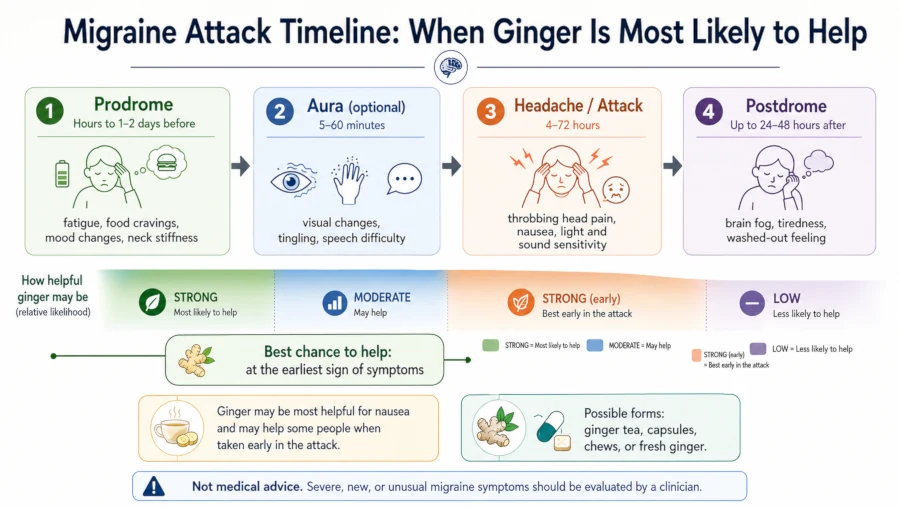
Migraine is a neurological disorder, not just a severe headache. The pain is usually one-sided, throbbing, and gets worse with routine physical activity, typically lasting anywhere from four hours to three days (American Migraine Foundation, Signs & Symptoms). It’s also one of the most disability-causing neurological conditions worldwide — the World Health Organization ranks migraine third among all neurological disorders for the disability it causes, behind only stroke and neonatal encephalopathy (WHO, Migraine and Other Headache Disorders, 2025).
Attacks often follow a pattern. A prodrome phase — mood changes, yawning, food cravings, neck stiffness — can start hours or even days before the pain begins. About 1 in 5 people with migraine also experience aura: visual disturbances, tingling, or brief speech trouble, usually in the 5 to 60 minutes right before the headache hits. Nausea, vomiting, and sensitivity to light and sound commonly ride along with the headache phase itself.
The mechanism involves the trigeminal nerve system and shifting serotonin signaling. Inflammatory molecules called prostaglandins sensitize the pain fibers around blood vessels in the brain — and that’s the exact pathway where ginger’s chemistry becomes relevant.
Common Migraine Triggers
Triggers vary from person to person, but the usual suspects are:
- Stress and anxiety
- Disrupted or insufficient sleep
- Hormonal shifts, particularly around menstruation
- Aged cheeses, red wine, cured meats, and caffeine excess or withdrawal
- Skipped meals or dehydration
- Bright or flickering light, strong smells
- Weather and barometric pressure changes
Keeping a headache diary to spot your own patterns is one of the more effective non-drug strategies for cutting down attack frequency.
How Ginger May Help With Migraine Pain and Nausea
Ginger (Zingiber officinale) contains dozens of active compounds. The two most studied for pain and inflammation are gingerols — concentrated in fresh ginger — and shogaols, more prominent in dried or heat-processed ginger. Both act on mechanisms that connect directly to migraine biology.
Anti-Inflammatory Action: Blocking COX and Leukotrienes
Gingerols and shogaols inhibit cyclooxygenase enzymes (COX-1 and COX-2) — the same enzymes ibuprofen and other NSAIDs target. COX-2 drives prostaglandin production, the inflammatory signal that sensitizes trigeminal pain fibers during a migraine. A widely cited 2005 review found that ginger suppresses prostaglandin synthesis through COX inhibition and also blocks leukotriene production via 5-lipoxygenase — a dual action NSAIDs don’t share (Grzanna, Lindmark & Frondoza, Journal of Medicinal Food, 2005).
In practical terms: ginger may dampen the inflammatory cascade behind migraine pain by hitting some of the same molecular targets as over-the-counter pain relievers, without the stomach lining risk that comes with regular NSAID use.
Antiemetic Action: Blocking Serotonin Signals
Nausea affects most people during a migraine attack, and for many it’s as disabling as the head pain. Ginger’s antiemetic effect is well documented, mostly from research on pregnancy-related and chemotherapy-related nausea. A 2013 pharmacology study found that [6]-gingerol, [6]-shogaol, and zingerone — three of ginger’s pungent compounds — act as non-competitive antagonists at serotonin 5-HT3 receptors, blocking serotonin-triggered signals in the same type of nerve cells (visceral afferent neurons) that prescription antiemetics like ondansetron target, in a dose-dependent way (Kim et al., Neurogastroenterology & Motility, 2013).
If ginger dulls the nausea component of an attack, that alone can make an attack more livable, even on days it doesn’t touch the headache itself.
What the Clinical Evidence Actually Shows
Here’s the honest picture: there’s no large, multi-center, placebo-controlled trial of ginger for migraine. What exists is a handful of small controlled trials plus a larger body of lab and mechanistic research. A 2021 review in the Journal of Clinical Psychiatry put it plainly — the evidence base is “clearly too small for formal recommendations to be possible” (Andrade, Journal of Clinical Psychiatry, 2021). That context matters for everything below.
Ginger vs. Sumatriptan
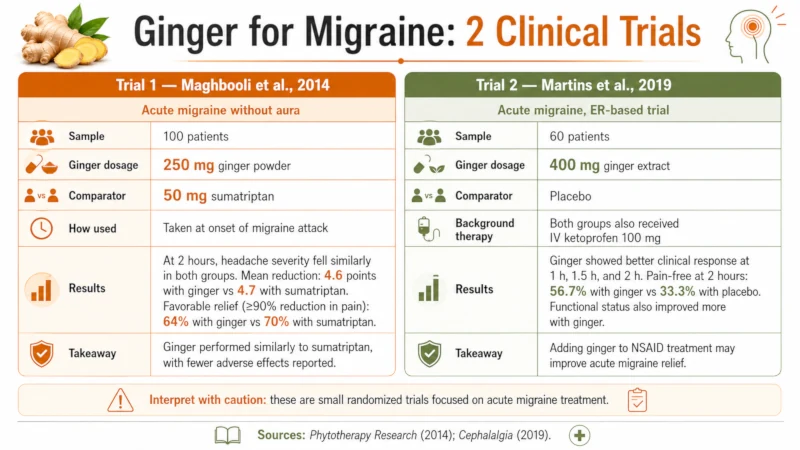
The most-cited trial enrolled 100 adults with migraine without aura in a double-blind randomized design. Participants received either 250 mg of ginger powder or 50 mg of sumatriptan at the onset of an attack, tracked across five subsequent attacks. Both groups saw a significant, statistically similar drop in headache severity within two hours. Ginger produced fewer reported side effects, and satisfaction with treatment didn’t differ between groups.
The caveat matters: this was a single-center trial with no placebo arm — ginger was compared against an active drug, not against nothing. It can’t tell us whether ginger beats doing nothing at all, or whether the result holds across every migraine type.
Ginger Added to a Standard Painkiller
A 2019 double-blind, placebo-controlled trial recruited 60 adults in a hospital emergency room. Everyone received 100 mg of IV ketoprofen (an NSAID); on top of that, they were randomized to 400 mg of ginger extract or placebo. At one hour, 1.5 hours, and two hours, the ginger group reported significantly better pain relief and functional improvement than the ketoprofen-plus-placebo group (Martins et al., Cephalalgia, 2019). This design was stronger than the sumatriptan comparison — it had an actual placebo arm — but the sample was still small.
Where the Evidence Runs Thin
Two findings temper the picture. First, the same research group ran a separate three-month trial testing whether daily ginger could prevent migraines, rather than treat them once they start. In 107 patients given 200 mg of ginger extract three times daily versus placebo, ginger provided no greater benefit than placebo for reducing migraine frequency (Martins et al., Cephalalgia, 2020). If you’re hoping daily ginger will mean fewer migraines overall, the one trial that tested exactly that found no advantage.
Second, when the 2021 review pooled the acute-treatment data across two RCTs (227 patients combined), ginger was associated with roughly 1.8 times the odds of being pain-free at two hours compared to placebo, and roughly halved the risk of migraine-related nausea and vomiting, with no increase in side effects. That’s a real signal — but it’s built on just two small trials, not the dozens that back most standard migraine treatments.
Ginger for Nausea: A Separate, Stronger Evidence Base
Ginger’s case for nausea specifically — separate from migraine — rests on a bigger body of research. A 2014 meta-analysis of 12 trials in 1,278 pregnant women found ginger significantly reduced nausea compared to placebo, though it did not significantly reduce the number of vomiting episodes (Viljoen et al., Nutrition Journal, 2014). For postoperative nausea, the picture is murkier: a 2018 meta-analysis examined ginger’s effect after surgery, and the National Institutes of Health’s own complementary-health center describes that evidence as “uncertain” (Tóth et al., Phytomedicine, 2018; NCCIH, Ginger: Usefulness and Safety, 2025). Since nausea is a core migraine symptom, the pregnancy data is the most directly relevant — and it points to real, if partial, benefit.
Put together: ginger’s anti-inflammatory and antiemetic mechanisms are well established at the molecular level. Small trials suggest it can meaningfully ease pain and nausea during an active migraine attack. What’s missing is evidence that it prevents attacks, and evidence at the scale needed for a formal recommendation. Ginger fits as an adjunct or complementary option — not a first-line replacement for prescribed migraine therapy.
How to Use Ginger Root for Migraines
The clinical trials used standardized powdered ginger or extract capsules. In practice, people use several forms, and the right one depends on how severe the attack is, whether nausea is your main complaint, and plain convenience.
Ginger Capsules or Powder
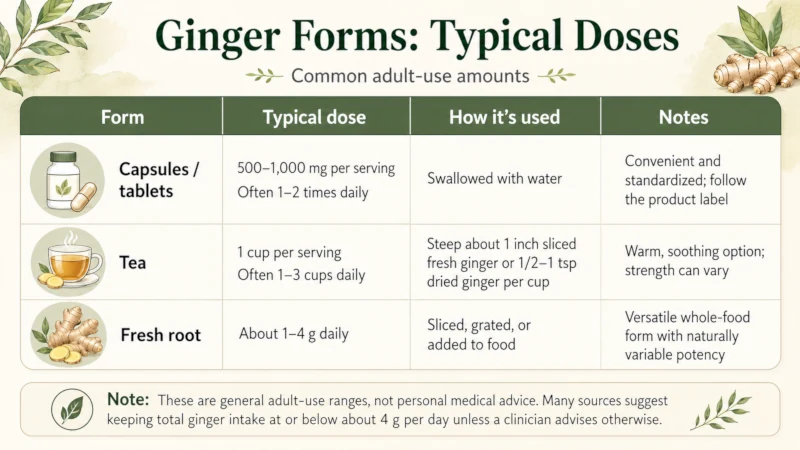
The Maghbooli trial used 250 mg of powdered ginger at the first sign of an attack; the Martins trial used 400 mg of a standardized extract (5% active gingerol content). Both fall within ranges considered safe for short-term adult use. For acute relief, 250–500 mg of standardized ginger extract or powdered root at the onset of a migraine is the most evidence-aligned starting point. Look for products that list gingerol content per serving.
If capsules are hard to keep down during an attack, ginger tea or fresh ginger tends to be more tolerable.
Ginger Tea
Steep a 1-inch piece of peeled fresh ginger (roughly 10–15 g) in 8 oz of hot water for 8–10 minutes, then strain. A little honey can cut the bitterness if needed. Drink it at the first sign of prodrome or head pain. This form delivers gingerols gently and adds hydration, which matters since dehydration is itself a trigger for some people.
Fresh Ginger
Finely grating or mincing fresh ginger into yogurt, warm water with lemon, or a smoothie works well for people who’d rather eat whole food than take a capsule. Fresh ginger carries the most gingerols; dried ginger carries more shogaols.
For ongoing, lower-level anti-inflammatory support, regular dietary ginger — in stir-fries, soups, or tea — is well tolerated for most people, though the evidence for this specific preventive use in migraine is anecdotal rather than clinical (and the one trial that tested daily ginger for prevention found no benefit over placebo, as noted above).
Ginger Forms at a Glance
| Form | Practical Use | Gingerol Level | Notes |
| Capsule / Powder | 250–500 mg at onset; easy to dose | Standardized (varies) | Most studied form in trials |
| Ginger Tea | Steep 10–15 g fresh ginger 8–10 min | Moderate | Easier to keep down if nauseated |
| Fresh Root | Grate or mince; mix with food/water | Highest gingerol content | Lower shogaol than dried |
| Dried / Ground | Add to food or warm water | Lower gingerol, higher shogaol | Shogaols also anti-inflammatory |
The recommended daily serving of ginger powder generally ranges from about 170 mg to 1 g, and the FDA recognizes up to 4 g per day as a safe upper limit for most adults; gastrointestinal side effects become more likely above roughly 6 g per day (StatPearls, Ginger Root, 2024).
Safety, Side Effects, and Who Should Be Cautious
Ginger is generally recognized as safe in food amounts and short-term supplement use (NCCIH, 2025; StatPearls, 2024).
Common Side Effects
- Heartburn or acid reflux, especially with GERD
- Mild stomach upset, bloating, or diarrhea at higher doses
- Mouth or throat irritation from raw fresh ginger
Medication Interactions
The most clinically significant interaction is with anticoagulants. Ginger can inhibit platelet aggregation and may increase the anticoagulant effect of warfarin, raising bleeding risk; case reports have documented elevated INR in people combining warfarin with substantial ginger intake. Some studies in healthy volunteers found no effect on warfarin pharmacokinetics, so the evidence here is mixed rather than settled — but the risk is real enough to warrant caution.
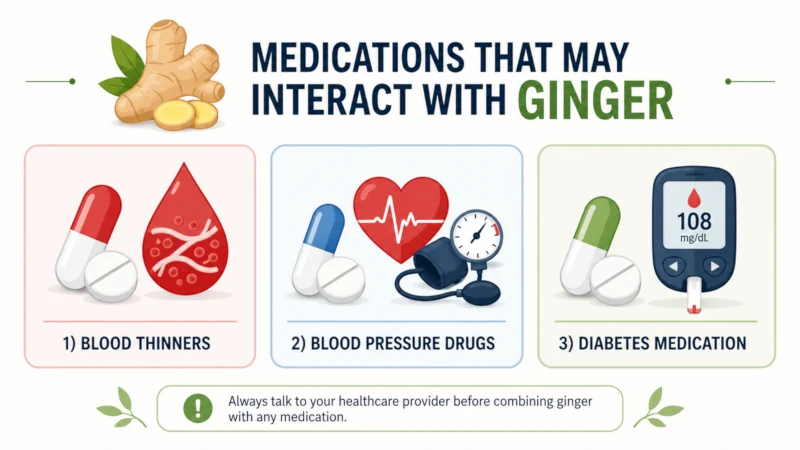
Other interactions worth knowing about:
- Blood pressure medications: ginger may lower blood pressure on its own; combining it with antihypertensives could have an additive effect.
- Diabetes medications: ginger may lower blood glucose, so monitor levels if you’re on insulin or oral hypoglycemic agents.
- Antiplatelet drugs (aspirin, clopidogrel): additive bleeding risk.
Who Should Talk to a Doctor First
Check in with a doctor or pharmacist before using ginger supplements if you:
- Take warfarin, heparin, or other anticoagulants
- Take antiplatelet medications regularly
- Have gallstones or a history of gallbladder disease (ginger increases bile secretion)
- Have significant GERD or peptic ulcer disease
- Have upcoming surgery — ask your surgical team when to stop taking ginger beforehand, since its antiplatelet effect can affect bleeding risk
Pregnancy and Breastfeeding
At normal culinary amounts, ginger is generally considered safe in pregnancy and is well studied for nausea: the same 2014 meta-analysis covering 12 trials in pregnant women found it significantly more effective than placebo for nausea, with no increase in adverse outcomes at the doses studied. High-dose supplementation hasn’t been fully evaluated for pregnancy safety, though, and there’s no firmly established maximum safe dose. Ask your obstetrician or midwife before using ginger supplements while pregnant. Evidence on ginger and breastfeeding is limited and inconclusive, so check with a healthcare provider there too (StatPearls, Ginger Root, 2024).
What to Realistically Expect
Ginger is unlikely to fully stop a severe migraine in its tracks. The evidence suggests it may ease pain intensity, take the edge off nausea, and shorten an attack — most plausibly at mild-to-moderate severity, and when taken early. If you notice prodrome symptoms before the pain peaks, that’s likely your best window: ginger tea or a capsule at that early stage is more likely to help than ginger taken once an attack is already severe.
Think of it as one tool in a broader plan, alongside prescribed medication where appropriate, trigger tracking, consistent sleep and hydration, and ongoing conversation with a doctor or headache specialist. Ginger is a relative of turmeric, another botanical studied for anti-inflammatory effects through some of the same pathways — though the evidence specifically linking turmeric to headache relief is thinner than what exists for ginger.
When Ginger Isn’t Enough — Red-Flag Symptoms
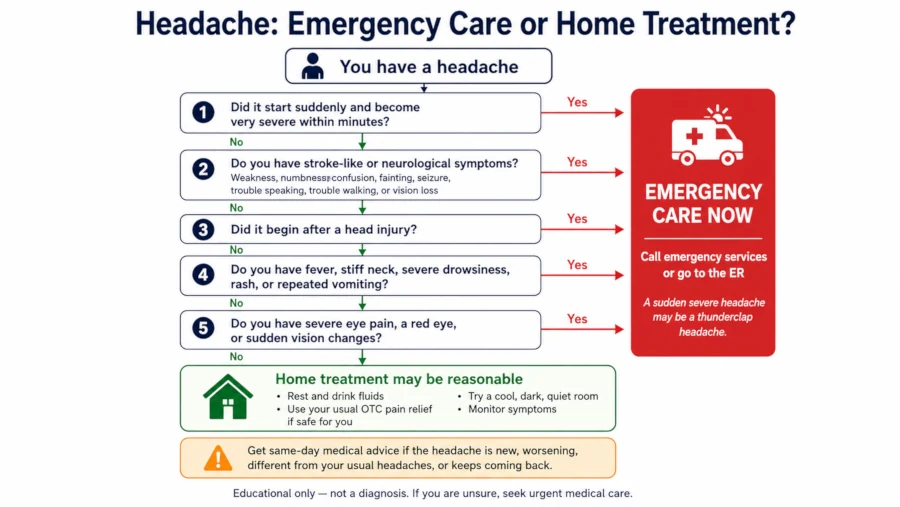
Get emergency care right away if a headache:
- Is the worst of your life, especially if it came on suddenly (“thunderclap” headache)
- Comes with fever, stiff neck, confusion, or light sensitivity you haven’t had before
- Follows a head injury
- Comes with weakness, slurred speech, or vision loss
- Keeps getting worse over days or weeks
These are signs of a possible serious underlying condition — not something to manage with a home remedy.
See a doctor or headache specialist if you have headaches 15 or more days a month, your migraines are becoming longer or more frequent, over-the-counter pain relievers have stopped working, or migraine is interfering with work, school, or caregiving.
| Health Disclaimer: The information on this page is for educational purposes only and isn’t a substitute for professional medical advice, diagnosis, or treatment. Talk with a qualified healthcare provider before starting any supplement, changing your medication routine, or if you have concerns about a medical condition. Don’t delay seeking professional care because of something you’ve read here. Use of this information is at your own risk. |
Frequently Asked Questions
Can ginger replace sumatriptan or other prescription migraine medication?
No. One small trial found ginger produced comparable relief to sumatriptan, but it hasn’t been tested at the scale needed to recommend it as a substitute. If you have a diagnosis and a prescribed treatment plan, don’t stop it without talking to your doctor first.
Does daily ginger prevent migraines?
The one trial that tested this directly — 107 people taking ginger extract three times a day for three months — found no benefit over placebo for reducing migraine frequency. Ginger’s stronger evidence is for treating an attack once it starts, not preventing attacks from happening.
How much ginger should I take for a migraine?
The clinical trials used 250–500 mg of powdered ginger or standardized extract at the first sign of an attack. For tea, a 1-inch piece of fresh ginger (roughly 10–15 g) steeped in hot water is in a similar range. Earlier is better — ideally during prodrome or right as the headache starts.
This is probably ginger’s best-supported benefit, though most of the direct evidence comes from pregnancy-related and chemotherapy-related nausea rather than migraine nausea itself. The mechanism — blocking serotonin receptors involved in nausea — is well characterized and there’s no clear reason it wouldn’t apply during a migraine.
Is it safe to combine ginger with ibuprofen or acetaminophen?
Dietary amounts of ginger are generally fine alongside both. Ginger supplements plus ibuprofen are probably fine for most people, but both have some antiplatelet activity, so at higher doses or with regular combined use, check with a pharmacist. Ginger with acetaminophen is considered lower risk.
References
- Maghbooli M, Golipour F, Moghimi Esfandabadi A, Yousefi M. Comparison Between the Efficacy of Ginger and Sumatriptan in the Ablative Treatment of the Common Migraine. Phytotherapy Research. 2014;28(3):412–415. View source
- Martins LB, Rodrigues AMDS, Rodrigues DF, et al. Double-Blind Placebo-Controlled Randomized Clinical Trial of Ginger Addition in Migraine Acute Treatment. Cephalalgia. 2019;39(1):68–76. View source
- Martins LB, Rodrigues AMDS, Monteze NM, et al. Double-Blind Placebo-Controlled Randomized Clinical Trial of Ginger in the Prophylactic Treatment of Migraine. Cephalalgia. 2020;40(1):88–95. View source
- Andrade C. Ginger for Migraine. Journal of Clinical Psychiatry. 2021;82(6):21f14325. View source
- Grzanna R, Lindmark L, Frondoza CG. Ginger — An Herbal Medicinal Product With Broad Anti-Inflammatory Actions. Journal of Medicinal Food. 2005;8(2):125–132. View source
- Kim SO, et al. Ginger and Its Pungent Constituents Non-Competitively Inhibit Serotonin Currents on Visceral Afferent Neurons. Neurogastroenterology & Motility. 2013;25:439–447. View source
- Viljoen E, Visser J, Koen N, Musekiwa A. A Systematic Review and Meta-Analysis of the Effect and Safety of Ginger in the Treatment of Pregnancy-Associated Nausea and Vomiting. Nutrition Journal. 2014;13:20. View source
- Tóth B, Lantos T, Hegyi P, et al. Ginger (Zingiber officinale): An Alternative for the Prevention of Postoperative Nausea and Vomiting. A Meta-Analysis. Phytomedicine. 2018;50:8–18. View source
- National Center for Complementary and Integrative Health (NCCIH). Ginger: Usefulness and Safety. Updated February 2025. View source
- Modi M, Modi K. Ginger Root. StatPearls. Updated August 2024. View source
- World Health Organization. Migraine and Other Headache Disorders. Updated 24 October 2025. View source
- American Migraine Foundation. Signs & Symptoms. View source
