
Contents
You check your blood pressure at home. It’s higher than you expected. So you make a deal with yourself: “I’ll start exercising.” Two weeks later, you’re either doing nothing… or you’re doing too much, getting sore, and wondering why the numbers don’t look magically different.
Medical note: This information about exercise for blood pressure is for education only and doesn’t replace personalized medical care. If you take blood pressure medication, have cardiovascular/kidney disease, are pregnant, or get symptoms (chest pain, fainting, severe headache, shortness of breath), get medical guidance before changing your exercise routine.
Exercise is one of the most reliable, drug‑free tools for improving blood pressure trends—but only when you treat it like a plan, not a burst of motivation. For most beginners, the best mix is aerobic movement and strength, with optional isometrics as a time‑efficient add‑on.[1][2][3]
A quick example (clearly just an example):
“Mark,” 56, already on BP medication, tried to fix everything at once—hard workouts, cutting salt aggressively, and adding a beet supplement. He got dizzy, stopped, and decided exercise “didn’t work.”
When he switched to a calmer plan—20 minutes of brisk walking after dinner most days plus two short strength sessions per week—his weekly averages became easier to interpret. No drama. Just progress.
What most people get wrong about exercise for blood pressure
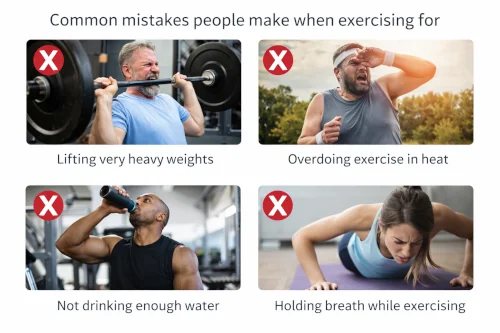
- They go from zero to intense (then quit).
- They do only cardio or only weights, even though both help in different ways.[1][2][3]
- They hold their breath while lifting and spike pressure unnecessarily.
- They measure BP right after workouts and panic (post‑exercise readings aren’t your resting baseline).
- They stack too many changes at once (new workouts + new supplements and big diet changes), so they can’t tell what’s helping.
The evidence
Exercise training lowers resting blood pressure on average, and the effect tends to be larger when baseline BP is higher. A classic systematic review and meta‑analysis found endurance (aerobic) training reduced BP on average, with larger reductions in hypertensive groups.[3] That doesn’t mean you need marathon training. It means consistent moderate activity adds up.
Isometrics (static holds) are interesting because several analyses show meaningful average BP reductions, but there are fewer studies than for aerobic training. An individual participant data meta‑analysis reported average reductions around −6 mmHg systolic and −3 mmHg diastolic across included trials, often over 3–12 weeks.[4] Promising. But not a magic trick.[3][4]
Three “it depends” moments
- It depends on medication. If you’re on BP meds, adding exercise can lower readings further—great, but it changes your safety margin. Track weekly averages and discuss symptoms with your clinician.[2]
- It depends on joints and pain. If walking hurts, cycling or swimming can build the same aerobic base with less impact.
- It depends on time. A perfect 45‑minute routine you never do is worse than three 10‑minute sessions you actually do. Mayo Clinic notes you can split activity into shorter sessions and still benefit.[2]
Exercise types that help BP
| Type | What it looks like | Beginner dose | Tradeoffs / edge cases |
| Aerobic (walking/zone 2) | Brisk walk, cycling, swimming; you can talk in short sentences | 10–20 min most days → build toward 150 min/week[1][2] | Too easy may not progress; too hard may reduce adherence |
| Strength (dynamic) | Squats to a chair, rows, presses, bands/machines | 2 days/week, full‑body, 20–30 min[1][3] | Avoid breath‑holding; start lighter than you think |
| Isometrics | Wall sit, handgrip holds | 3 days/week, protocol-style holds[4] | BP rises during holds; not for everyone |
| Movement snacks | 5–10 min breaks from sitting | 2–4 mini bouts/day | Small dose, big consistency win |
How to do it step-by-step
This plan is intentionally boring. That’s the point. Run it for 4 weeks, then reassess.
Step 1 — Pick your aerobic anchor
Choose one repeatable time. After dinner works well for many people. Start with 10 minutes of brisk walking 4–5 days/week.
Step 2 — Add 2 short strength sessions
Two days/week, 20–30 minutes. Focus on big patterns (sit‑to‑stand, hip hinge, push, pull). Breathe continuously—no breath holding.
Step 3 — Optional: add isometrics (for time efficiency)
If you tolerate exercise well and want a short add‑on, consider isometrics 3 days/week using a protocol (example: repeated 2‑minute holds with rest).[4] If you get chest pain, severe dizziness, or have uncontrolled hypertension, get clinician clearance first.[2][4]
Step 4 — Track trends, not drama
Use home BP monitoring and compare weekly averages. One spiky day isn’t the story. The story is the 2–4 week trend.
A realistic 4‑week beginner plan
| Week | Aerobic | Strength | Optional isometrics | What to track |
| 1 | 10 min, 4–5 days | 1 session (easy) | None | Weekly BP average and minutes |
| 2 | 12–15 min, 4–5 days | 2 sessions | 1 session | Symptoms, sleep, soreness |
| 3 | 15–20 min, 5 days | 2 sessions | 2 sessions | Weekly BP average and adherence |
| 4 | 20 min, 5 days (or build toward 150 min/week)[1][2] | 2 sessions | 3 sessions | Compare Week 1 vs Week 4 averages |
Quick checklist
- Start with 10 minutes. Build from there.
- Consistency first; intensity second.[1][2]
- Breathe during strength work—no breath holding.
- Don’t judge BP right after workouts; use resting averages.
- Add strength 2×/week even if walking is your main habit.[1][3]
- If you add isometrics, follow a protocol (not random max holds).[4]
- If you feel dizzy or faint, stop and reassess—especially if on BP meds.[2]
Frequently Asked Questions
- How soon can exercise lower blood pressure? Many studies run for weeks. The cleanest approach is comparing weekly averages across 2–4 weeks rather than expecting day‑to‑day changes.[3][4]
- Is strength training safe for high blood pressure? Often yes when loads are appropriate and you avoid breath holding. If you have symptoms with exertion, get clinician guidance.[2][3]
- Do I need 150 minutes per week right away? No. That’s a target. Start with what you can repeat and build. AHA recommends 150 min/week moderate activity plus strength 2 days/week.[1]
- Are isometrics better than cardio? They may help BP in studies, but there are fewer studies and BP rises during holds. Consider them an add‑on, not a replacement.[3][4]
- What if my BP spikes during exercise? BP rises during exertion. What matters is your resting trend and how you feel. Stop and seek medical advice for chest pain, severe shortness of breath, or faintness.[2]
Don’t look for the perfect workout. Look for the repeatable one. Aerobic movement plus strength is a strong foundation, and isometrics can be a useful add‑on for some people.[1][3][4]
One practical next step: choose one anchor walk (10 minutes after one meal) and do it 4 times this week. Then compare your weekly BP average next week.
Recommended
References
- [1] American Heart Association. Recommendations for Physical Activity in Adults. https://www.heart.org/en/healthy-living/fitness/fitness-basics/aha-recs-for-physical-activity-in-adults
- [2] Mayo Clinic. Exercise: A drug-free approach to lowering high blood pressure. https://www.mayoclinic.org/diseases-conditions/high-blood-pressure/in-depth/high-blood-pressure/art-20045206
- [3] Cornelissen VA, Smart NA. Exercise training for blood pressure: a systematic review and meta-analysis. J Am Heart Assoc. 2013. (PMC) https://pmc.ncbi.nlm.nih.gov/articles/PMC3603230/
- [4] Smart NA, et al. Effects of isometric resistance training on resting blood pressure: individual participant data meta-analysis. J Hypertens. 2019. (PMC) https://pmc.ncbi.nlm.nih.gov/articles/PMC6727950/
- [5] O’Driscoll JM, et al. Exercise training and resting blood pressure: network meta-analysis (abstract). Br J Sports Med. 2023. https://pubmed.ncbi.nlm.nih.gov/37491419/
Last updated: 2026-01-08