
The sanicle plant (Sanicula europaea) is a shade-loving woodland herb from the carrot family that has been used in European folk medicine for centuries — most often as a gentle astringent for minor wounds, mouth irritation, and mild throat or chest complaints.
Its Latin name comes from sanare, meaning “to heal,” and old herbals describe it as a kind of all-purpose “self-heal.” Modern evidence, however, is far more modest: there are no large human clinical trials, and regulators treat it as a traditional herb rather than a proven medicine [WebMD, 2024].
This guide explains what sanicle actually is, what it has traditionally been used for, what the research does and does not show, and who should avoid it.
Sanicle at a Glance
Before we get into traditional uses, here are the key botanical and herbal facts about the sanicle plant.
| Feature | Details |
| Botanical name | Sanicula europaea L. |
| Family | Apiaceae (formerly Umbelliferae) |
| Common names | Sanicle, European sanicle, wood sanicle, self-heal (historical) |
| Parts used | Leaves and aerial parts (dried) |
| Native range | Central and southern Europe; also parts of Asia and North Africa |
| Typical habitat | Shaded deciduous woodland, especially under oak and beech |
| Key constituents | Triterpene saponins, tannins, allantoin, phenolic acids, small amount of essential oil |
| Traditional actions | Astringent, mild expectorant, vulnerary (wound-supporting) |
| Evidence level | Traditional / historical use; no strong modern clinical trials |
What Is the Sanicle Plant?
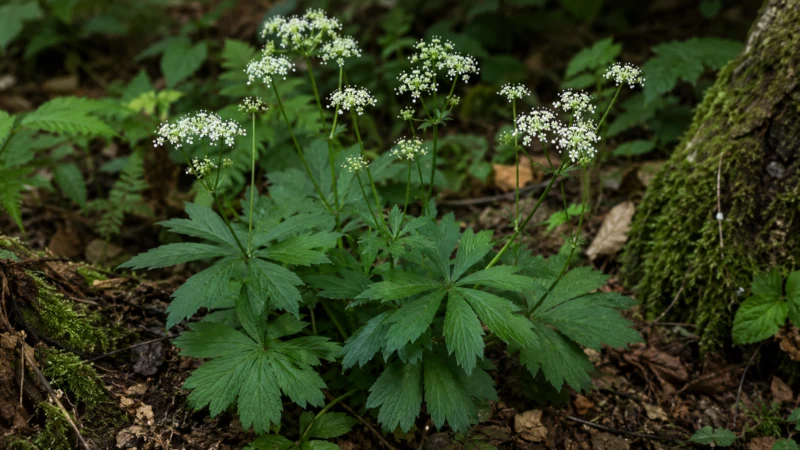
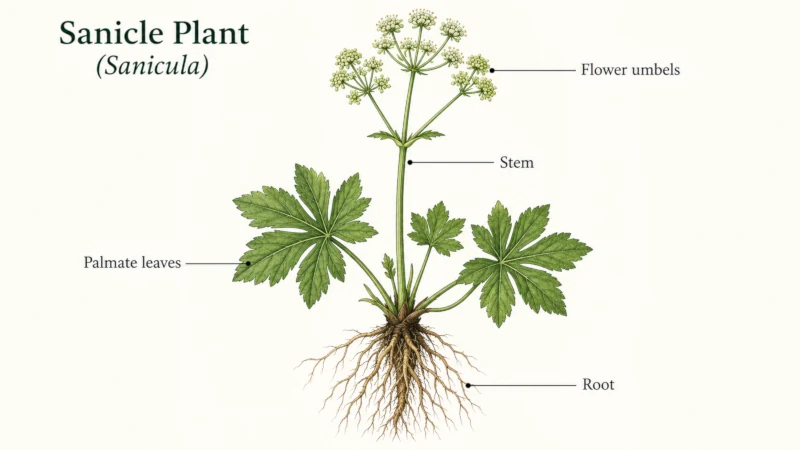
Sanicle is a perennial herb that grows 20–50 cm tall in the damp, shaded floor of European deciduous forests, especially under oak and beech. Its basal leaves are deeply palmate with five toothed lobes, and small pinkish-white flowers sit in tight umbels above the foliage from late spring to early summer. It belongs to the Apiaceae family, which also includes carrot, parsley, and fennel [Kew POWO, 2024].
The dried leaves and aerial parts are the parts used in traditional herbal preparations. Chemical analyses have identified triterpene saponins (the group thought to give the plant its mild expectorant action), tannins (responsible for its astringent, tissue-tightening effect), allantoin, phenolic acids, and a trace of essential oil [RxList, 2023].
A note on American sanicle
A related North American species, Sanicula marylandica (black snakeroot or American sanicle), is sometimes sold under the same common name. Its traditional uses overlap with European sanicle, but the two are not interchangeable in research literature, and most of the scant evidence base refers specifically to S. europaea.
Traditional Uses of the Sanicle Plant
European herbalists from the 15th century onwards recommended sanicle chiefly for its astringent and wound-supporting actions. It is important to stress upfront that these are traditional uses — they reflect historical practice, not proven modern treatments. Most consumer herbal databases list sanicle as having insufficient evidence for every indication [WebMD, 2024].
1. Minor cuts, grazes, and bruises (external use)
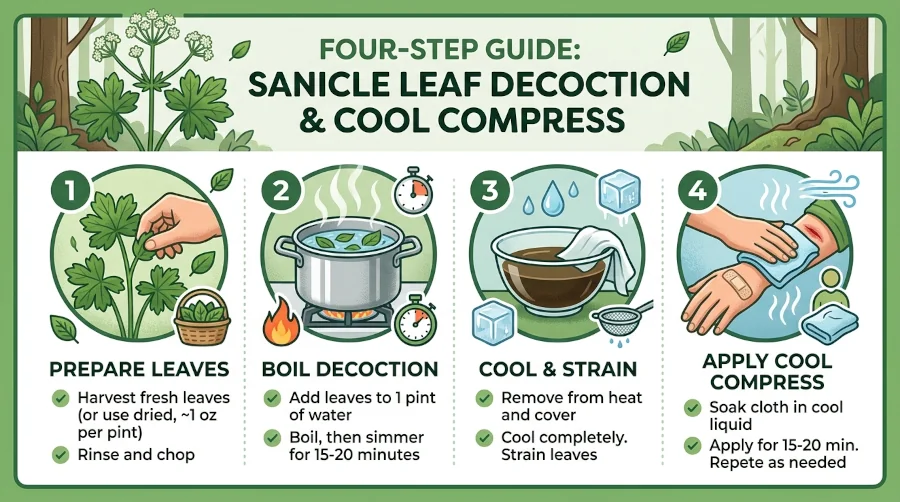
The classical application is a cooled decoction or poultice of the leaves, applied as a compress to clean, minor wounds and bruises. The astringent tannins can temporarily tighten surface tissue, while allantoin — a compound also found in comfrey and well studied on its own — is associated with skin cell turnover [PubMed, allantoin reviews]. For a broader overview of plants used on the skin, see our guide on herbs for skin health.
2. Mouth, gum, and throat irritation
A cooled sanicle decoction has traditionally been used as a mouth rinse or gargle for mild gum inflammation, mouth ulcers, and sore throats. The mechanism is the same: tannins briefly firm up inflamed mucous membranes. If you are exploring gentle options for a scratchy throat, our article on natural sore throat remedies covers the better-studied alternatives.
3. Coughs and mild chest congestion
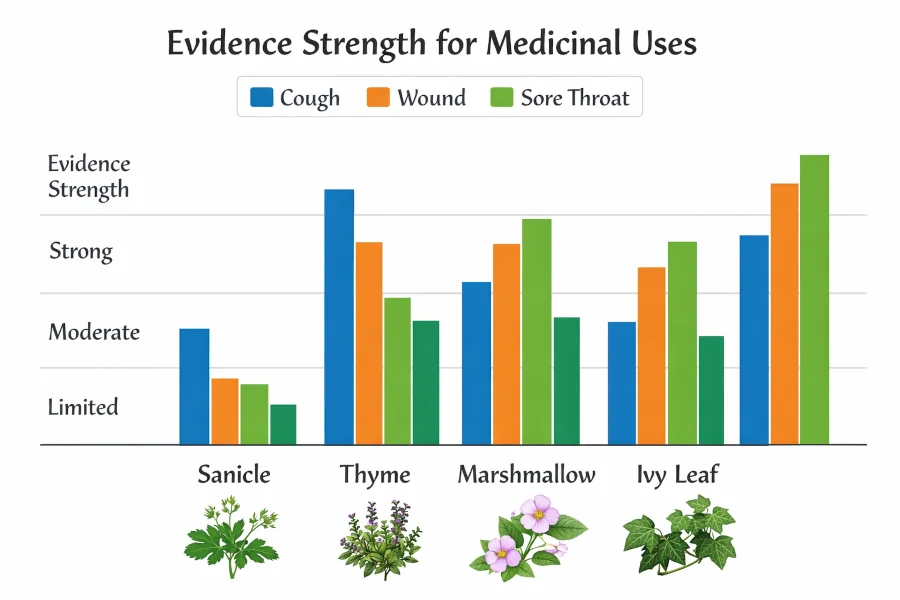
Saponins in sanicle are thought to act as mild expectorants, loosening bronchial secretions. This is why old herbals include it in cough teas. The effect is considered gentle rather than strong, and modern respiratory herbs like thyme and ivy leaf have far better clinical support. For everyday respiratory care, our round-up of foods and remedies for colds and flu is a more practical starting point.
4. Varicose and leg ulcers
Older herbals describe compresses of sanicle for slow-healing leg ulcers associated with poor venous circulation. This use is largely historical and should not replace medical care — chronic leg ulcers and varicose veins need proper clinical assessment, and infected wounds require evidence-based treatment.
What Does the Evidence Actually Say?
Honestly: very little. A search of major databases turns up only a handful of laboratory and animal studies on Sanicula europaea, mostly characterising its saponin content and looking at antimicrobial or antioxidant activity in test tubes [PubMed search]. Key points for readers:
- There are no large randomised human trials of sanicle for any condition.
- Consumer drug databases list it as having insufficient evidence for coughs, bronchitis, wounds, mouth sores, or any other use [WebMD, 2024].
- It is not included in the European Medicines Agency’s list of herbs with a formal traditional-use monograph, unlike better-studied plants such as thyme or marshmallow [EMA HMPC].
- Its active compound classes (tannins, saponins, allantoin) are plausible but are shared with many other plants that have stronger evidence.
The fair summary is that sanicle is a traditional European herb with biologically plausible but largely unproven uses. It should not be positioned as a treatment for any specific disease.
How Sanicle Is Traditionally Prepared
These are historical preparation methods, included for context. They are not dosing recommendations.
- Infusion (tea): about 1–2 teaspoons (roughly 2–3 g) of dried leaves steeped in a cup of just-boiled water for 10 minutes, strained, and sipped — traditionally up to three cups a day, short term.
- Decoction for external use: around 50 g of dried leaves simmered in 1 L of water for 10 minutes, cooled, and used as a compress, wash, or gargle.
- Poultice: fresh mashed leaves wrapped in gauze and applied to bruises or closed minor injuries.
- Mouth rinse / gargle: the cooled decoction swished or gargled and then spat out — not swallowed in large quantities.
If you are new to herbal self-care, our introduction to safe use of herbal remedies explains how to think about dosage, quality, and sourcing.
Safety, Side Effects, and Interactions
Because sanicle has not been studied in modern clinical trials, its full safety profile is simply not known [RxList, 2023]. What we can say comes from traditional use and from what we know about its main compound classes.
Possible side effects
- Stomach upset, nausea, or diarrhoea, especially from strong or prolonged oral use (tannins and saponins can both irritate the gut).
- Contact irritation or allergic skin reaction in people sensitive to other plants in the Apiaceae family (carrot, celery, parsley, fennel).
- Mouth dryness from repeated gargling, due to the astringent effect.
Possible interactions
- Tannin-rich herbs can reduce absorption of iron supplements and some oral medications if taken at the same time — space them apart by at least 2 hours.
- Theoretical additive effect with other astringent or “drying” herbs.
- Anyone on prescription medication should check with a pharmacist or doctor before adding any new herb [NCCIH].
Who should avoid the sanicle plant
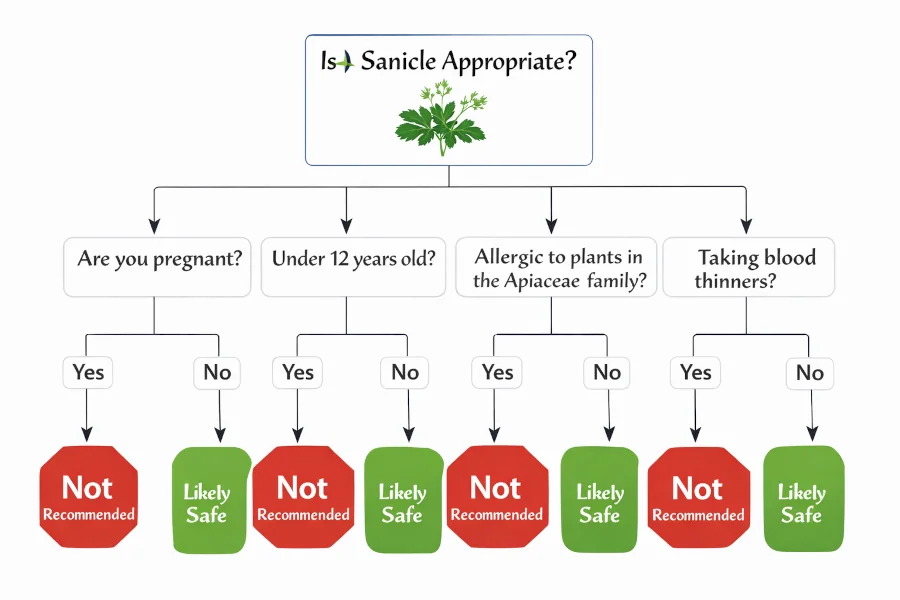
- Pregnant or breastfeeding people — safety has not been established [WebMD, 2024].
- Infants and young children.
- People with known allergy to Apiaceae plants.
- Anyone with chronic gastrointestinal conditions (IBD, ulcers) unless advised by a clinician.
- People with serious wounds, infected wounds, or chronic leg ulcers — these need medical care, not a home herbal compress. See our guide to safe natural wound care.
When to see a healthcare professional
Stop any home use of sanicle and seek medical advice promptly if you notice:
- A wound that is red, hot, swollen, draining pus, or not improving after 48 hours.
- A cough lasting more than 2–3 weeks, coughing up blood, or a high fever.
- A sore throat with difficulty breathing or swallowing, drooling, or a stiff neck.
- Any rash, hives, facial swelling, or breathing difficulty after taking the herb.
Realistic Expectations
It is easy to read romantic claims about sanicle online — that it “heals anything,” or that one old proverb (“he who keeps sanicle has no business with a doctor”) proves its power. A people-first view is more sober. The sanicle plant is a mild, traditional supportive herb. In a healthy adult, a cooled gargle for a scratchy throat or a cool compress on a small bruise is unlikely to do harm and may provide mild relief, but it will not replace proper medical care, and it has no proven role in treating disease.
| Health Disclaimer: This article is provided for educational and informational purposes only and is not a substitute for professional medical advice, diagnosis, or treatment. Sanicle (Sanicula europaea) has a long history of traditional use, but modern clinical evidence is very limited. Always speak with a qualified healthcare professional before using any herbal preparation — especially if you are pregnant, breastfeeding, taking prescription medication, managing a chronic condition, or giving herbs to children. Stop use and seek medical attention if you experience an allergic reaction, worsening symptoms, or any unexpected side effect. |
Frequently Asked Questions
Is the sanicle plant safe to drink as a tea?
In small amounts and for short periods, traditional sanicle tea has been used without major reported problems, but its safety has not been formally studied. Pregnant or breastfeeding people, children, and anyone on medication should avoid it unless a qualified practitioner advises otherwise [WebMD, 2024].
Does sanicle really heal wounds?
It contains allantoin and tannins, which are associated with skin repair and astringent effects, but there are no modern clinical trials showing that sanicle itself speeds wound healing. Deep, dirty, or infected wounds should always be evaluated by a healthcare professional.
Is sanicle the same as “self-heal”?
“Self-heal” is an old English name applied to several plants, most often Prunella vulgaris, which is a different species in a different family. European sanicle (Sanicula europaea) is sometimes also called self-heal in old herbals, which is a common source of confusion.
Can I pick sanicle in the woods and use it myself?
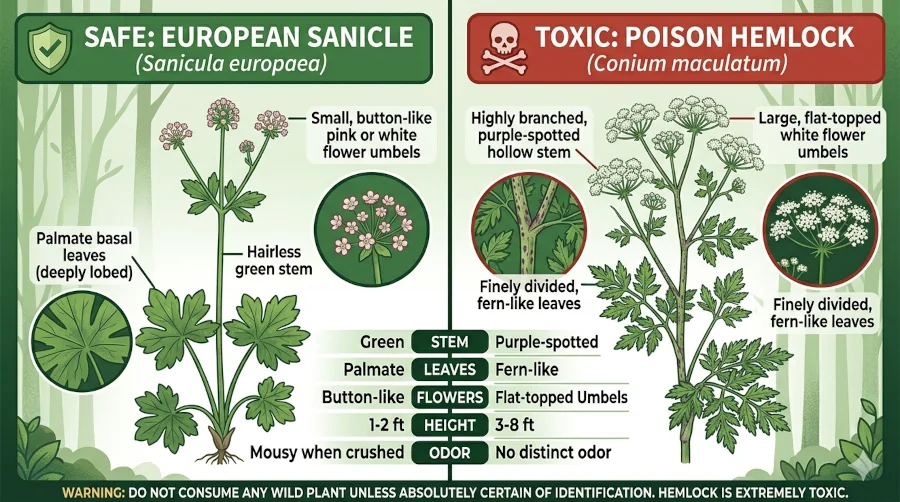
Foraging from the Apiaceae family is risky because it also contains highly toxic look-alikes such as hemlock. Unless you are trained in botanical identification, it is safer to buy dried sanicle from a reputable herbal supplier.
Does sanicle interact with blood thinners or other medication?
There are no well-documented drug interactions, but the evidence base is essentially empty, so absence of reports is not proof of safety. Always check with a pharmacist before combining any herb with prescription drugs [NCCIH].
References
- WebMD. Sanicle: Uses, Side Effects, and More. Consumer monograph, accessed 2024. → View source
- RxList. Sanicle supplement overview. Consumer monograph, accessed 2023. → View source
- Royal Botanic Gardens, Kew. Plants of the World Online: Sanicula europaea L. Taxonomy and distribution. → View source
- European Medicines Agency, Committee on Herbal Medicinal Products (HMPC). Herbal medicinal products overview. → View source
- National Center for Complementary and Integrative Health (NCCIH). Herbs at a Glance consumer series. → View source
- PubMed. Triterpene saponins, Sanicula europaea — literature search. → View source
- PubMed. Allantoin and wound healing — literature search. → View source
- Memorial Sloan Kettering Cancer Center. About Herbs database (general herbal safety reference). → View source
- Pamplona-Roger GD. Encyclopedia of Medicinal Plants, Vol. 2. Editorial Safeliz, 2000; p. 725 (traditional European uses). → View source
