
Here’s the whole method in two sentences: sit quietly for five minutes, feet flat and arm supported at heart level, then take two readings a minute apart and average them. Do that consistently, with a cuff that fits, and the numbers on your monitor will finally mean something.
Most people who bring home a monitor get shaky, all-over-the-place readings for weeks — not because the device is broken, but because of small setup habits that can swing a result by 10 or 20 points. Learning how to take blood pressure at home is mostly about removing those errors, one at a time. None of them is hard. You just have to know they exist.
The core method, in one paragraph
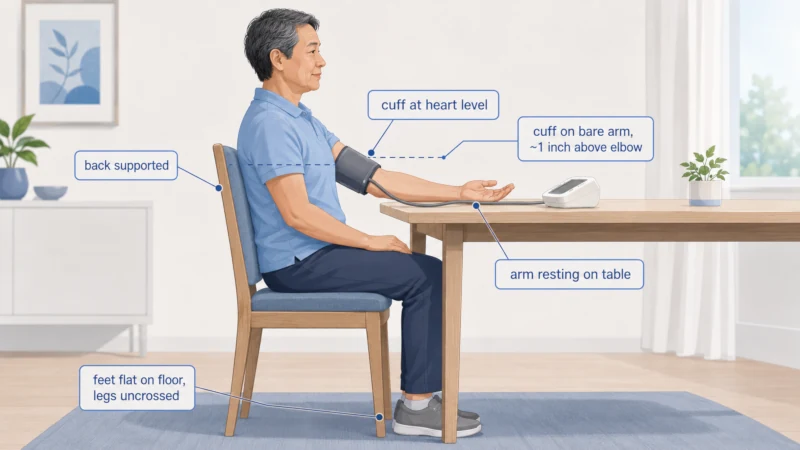
Rest, position, two readings. The American Heart Association’s home-monitoring guidance comes down to sitting still for at least five minutes, supporting your arm so the cuff sits at heart level, and taking two readings about a minute apart, then recording both [American Heart Association, 2025]. The average of those two is your number for that session. One reading is a snapshot and snapshots lie; the pattern over days is what you and your doctor actually use.
Set yourself up before you press start
A few things in the 30 minutes beforehand quietly push readings up. The AHA recommends avoiding caffeine, cigarettes, and exercise for 30 minutes before measuring, and emptying your bladder first [American Heart Association, 2025]. Then:
- Sit in a real chair with your back supported and both feet flat on the floor — not perched on a stool, not legs crossed.
- Put the cuff on a bare arm. A sleeve pushed up into a tight roll counts as clothing.
- Don’t talk and don’t scroll your phone during the reading.
- Measure at roughly the same time each day so you’re comparing like with like.
Small stuff, big payoff. A reading taken over clothing alone can be off by anywhere from 5 to 50 mmHg [Million Hearts (HHS), 2016].
Get the cuff size right (it changes the number more than you’d think)
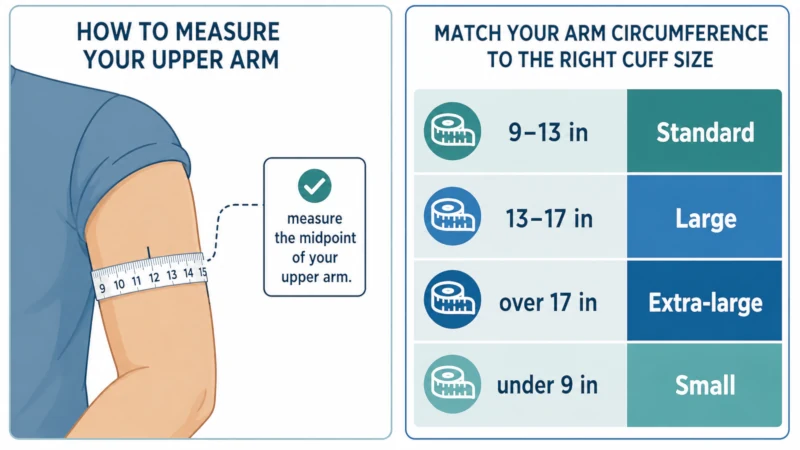
This is the error people never suspect. A cuff that’s too small reads falsely high; a cuff that’s too large reads falsely low [AHA scientific statement on BP measurement, 2019]. Most monitors ship with a “standard” cuff that simply doesn’t fit larger arms — and then the monitor takes the blame for numbers that are really a sizing problem.
Picture it: your upper arm measures about 15 inches around, but the cuff on the box tops out at 13. Every reading comes back high, you panic, and the fix was never medication — it was a bigger cuff. Swapping to the correct size can pull home numbers back in line with what your doctor measures.
How to measure your arm
Use a soft tape measure. Wrap it around the midpoint of your upper arm — halfway between shoulder and elbow — with your arm relaxed at your side. Then match that number to the range printed on your cuff or its box. Ranges differ by brand, so trust the label on your specific device rather than a generic chart.
| Upper-arm circumference | Cuff size to look for |
| Roughly 9–13 in (22–32 cm) | Standard adult |
| Roughly 13–17 in (32–42 cm) | Large adult |
| Above ~17 in (42 cm) | Extra-large |
| Below ~9 in (22 cm) | Small adult |
If your arm falls outside your cuff’s printed range, buy the correct size — it’s usually inexpensive and it’s the single highest-value fix on this page.
How to take blood pressure at home, step by step
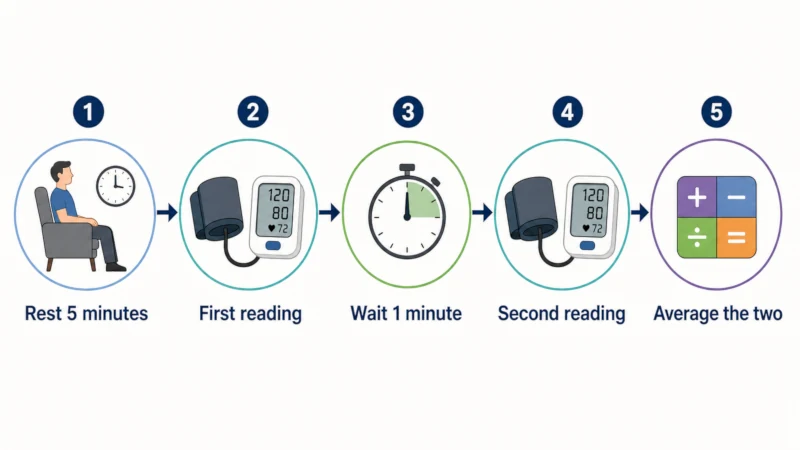
| Step | What to do | Why it matters |
| 1. Rest 5 minutes | Sit quietly — no phone, no talking, no TV. Feet flat. | Blood pressure settles during quiet rest; a rushed reading runs high. |
| 2. Position your arm | Rest it on a table so the cuff is at heart level, palm up. | An unsupported arm or one below heart level can add about 10 mmHg [Million Hearts (HHS), 2016] [Netea et al., 2003]. |
| 3. Apply the cuff | Snug on a bare upper arm, bottom edge about an inch above the elbow crease. | Loose cuffs and clothing under the cuff both distort the result. |
| 4. First reading | Press start. Stay still, stay silent, breathe normally. | Talking or moving can add roughly 10 mmHg [Million Hearts (HHS), 2016]. |
| 5. Wait 1 minute | Leave the cuff on or take it off — just wait. | Back-to-back readings without a pause are unreliable. |
| 6. Second reading | Same position, same stillness. | Averaging two readings smooths out normal beat-to-beat variation. |
| 7. Log both | Write down both numbers, the time, and anything notable (“after coffee,” “felt rushed”). | Patterns over days matter far more than any single number. |
The two-reading rule isn’t fussiness. Blood pressure changes beat to beat, and the first reading is often the highest of the session [AHA scientific statement on BP measurement, 2019]. Two readings, averaged, turn noise into signal. If your two readings are more than about 10 points apart, wait another minute and take a third, then average.
The small mistakes that quietly inflate your numbers
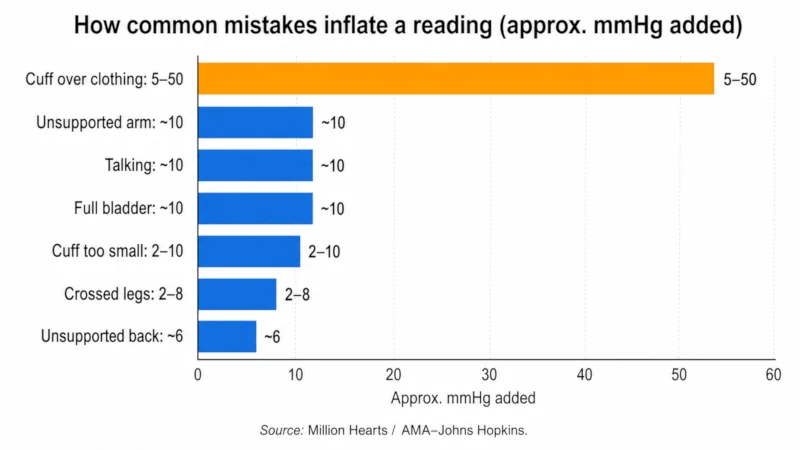
Here’s what throws readings off, and roughly how much. These estimates come from the AMA/Johns Hopkins “7 Simple Tips,” published by the CDC’s Million Hearts program [Million Hearts (HHS), 2016].
| Mistake | Roughly how much it adds | Fix |
| Talking or actively listening | ~10 mmHg | Stay silent until the reading finishes |
| Arm unsupported or below heart level | ~10 mmHg | Rest the arm on a table at heart level |
| Cuff over clothing | 5–50 mmHg | Bare arm, every time |
| Cuff too small for your arm | 2–10 mmHg | Measure your arm; match the printed range |
| Full bladder | ~10 mmHg | Use the bathroom first |
| Crossed legs | 2–8 mmHg | Feet flat, legs uncrossed |
| Unsupported back | ~6 mmHg | Sit back fully against the chair |
Notice how these stack. Do three or four at once and you can manufacture a “high” reading out of thin air — then chase it with anxious repeat measurements that climb higher because you’re now nervous about the number. Rest, position, and silence break that loop.
Upper-arm vs. wrist monitors
For home use, an automatic upper-arm cuff is the standard, and it’s what the American Heart Association recommends. The AHA is direct that wrist and finger monitors are not recommended because they give less reliable readings [American Heart Association, 2025].
There’s a narrow exception. If no upper-arm cuff — even an extra-large one — fits, or a physical limitation makes an arm cuff impossible to position, a validated wrist device is better than not monitoring at all. If you go that route, keep the wrist exactly at heart level (rest your forearm on a table and bring the wrist to mid-chest), and have your doctor confirm your wrist readings against the office equipment before you rely on them.
Whichever type you buy, choose one that’s been independently validated for accuracy. The AMA keeps a free, searchable list at validatebp.org — a more reliable guide than brand reputation, and worth checking before you buy.
Reading your numbers without spiraling
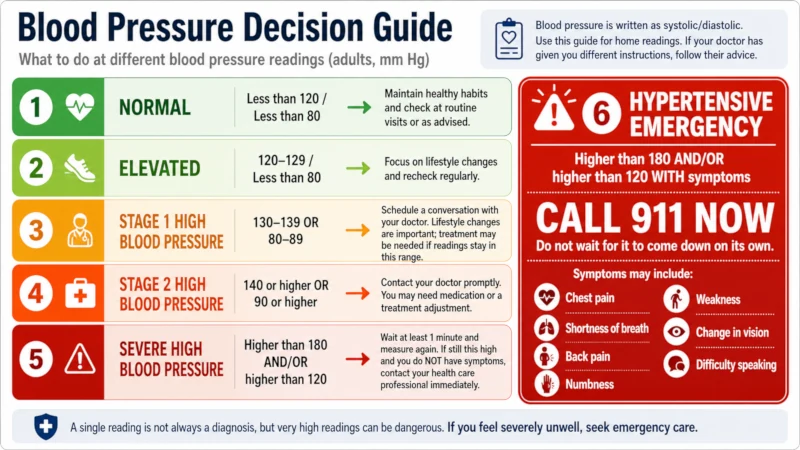
You’re not grading each reading. You’re watching an average settle over days. Once you have a week of readings, average them and compare against the standard categories: normal is under 120/80; elevated is 120–129 systolic with diastolic under 80; stage 1 is 130–139 or 80–89; stage 2 is 140-or-higher or 90-or-higher [American Heart Association, 2025].
Two patterns are worth naming. White-coat hypertension is when readings run high at the office but normal at home — the office setting itself nudges the number up. Its mirror image, masked hypertension, is when home readings run high while office readings look fine, and it carries real cardiovascular risk, so it shouldn’t be dismissed [AHA scientific statement on BP measurement, 2019]. Either way, the fix is the same: bring your log to your doctor rather than trying to settle it alone.
When your monitor and the office disagree
The first time you monitor, check both arms; from then on, use the arm that reads higher. A persistent difference of about 10 mmHg or more between arms is common but worth mentioning, because a large, consistent gap can occasionally point to a circulation problem [AHA scientific statement on BP measurement, 2019]. If your monitor and the office differ, bring your device to your next appointment and take a reading right after the staff does. If it’s off by more than about 5 mmHg, ask your doctor or pharmacist whether it needs recalibration or replacement — automatic monitors can drift over time.
Red flags: when a reading needs a doctor — or 911
Most home readings are for tracking, not emergencies. But some numbers need action.
- A single high reading is usually not a crisis. If one comes in higher than expected, rest and take it again before you worry [American Heart Association, 2025].
- Readings above 180/120 mmHg without symptoms: wait a minute and re-measure. If it’s still that high, contact your doctor promptly [American Heart Association, 2025].
- Above 180/120 with symptoms — chest pain, shortness of breath, back pain, numbness, weakness, vision changes, or trouble speaking — is a hypertensive emergency. Call 911. Don’t wait to see if it drops [American Heart Association, 2025].
And talk to your doctor if your home averages stay above 140/90 across several days, if you see a sudden sustained jump, or if readings are far more erratic than usual without an obvious explanation.
| Health Disclaimer: This article is for general education and is not medical advice. It can’t diagnose you or replace a conversation with a professional who knows your history. If you have high blood pressure, heart disease, kidney disease, diabetes, are pregnant, or take prescription medications, talk with your doctor before making decisions based on home readings — and before changing your treatment, diet, exercise, or supplements. Never stop or adjust blood pressure medication on your own; only your prescriber should do that. If you ever have a reading above 180/120 mmHg along with chest pain, shortness of breath, vision changes, weakness, or difficulty speaking, call 911. |
Frequently Asked Questions
How often should I measure?
If you’re newly diagnosed or your medication is being adjusted, a common approach is twice a day — morning and evening — for about a week, then sharing the log with your doctor. Once you’re stable, a couple of times a week is usually plenty. Over-measuring tends to breed anxiety, which nudges readings up. For more on timing, see our guide to the best time to check blood pressure.
What if my two readings are very different?
A gap of 5–10 points is normal. If it’s larger than about 10, wait another minute, take a third, and average. If big gaps keep happening, look at your technique first — are you moving or talking between readings? — and then consider whether the monitor needs checking.
Should I measure both arms?
The first few sessions, yes. If one arm consistently reads about 10 mmHg or more higher, mention it to your doctor. Then use the higher-reading arm for all future measurements so your data stays consistent.
My monitor reads differently than my doctor’s. Which is right?
Often the office device, but not always — timing, rest, and white-coat effect all play in. Bring your monitor to your appointment and compare readings back-to-back. If yours is off by more than about 5 mmHg, ask about calibration or replacement.
Can I trust an inexpensive monitor?
Price matters less than validation. Check whether your model appears on the AMA’s Validated Device Listing at validatebp.org before trusting its numbers, and re-check accuracy against the office once a year.
Does anxiety really change the number?
Yes. Nervousness and even talking can push a reading up meaningfully, which is exactly why the five-minute rest exists — and why you shouldn’t re-measure three times in a row chasing a number you didn’t like. Build the routine, record the result, and let the weekly average tell the story. A calm home monitoring routine beats obsessive checking, and lifestyle steps like regular exercise move the number more than the monitor ever will.
References
- American Heart Association. Monitoring Your Blood Pressure at Home. Last reviewed Aug 14, 2025. View source
- Million Hearts (HHS), adapted from AMA & Johns Hopkins University. 7 Simple Tips To Get an Accurate Blood Pressure Reading. 2016. View source
- Muntner P, Shimbo D, Carey RM, et al. Measurement of Blood Pressure in Humans: A Scientific Statement From the American Heart Association. Hypertension. 2019;73(5):e35–e66. PMID 30827125. View source
- Netea RT, Lenders JWM, Smits P, Thien T. Influence of body and arm position on blood pressure readings: an overview. J Hypertens. 2003;21(2):237–241. PMID 12569245. View source
- American Medical Association. US Blood Pressure Validated Device Listing (VDL). View source
